The Struggle for Poland
Vladimir Putin is by no means the first Russian leader to threaten his neighbours with force and annexations. Two centuries ago European statesmen faced a similar predicament. Only then it was Poland at stake, not Ukraine.
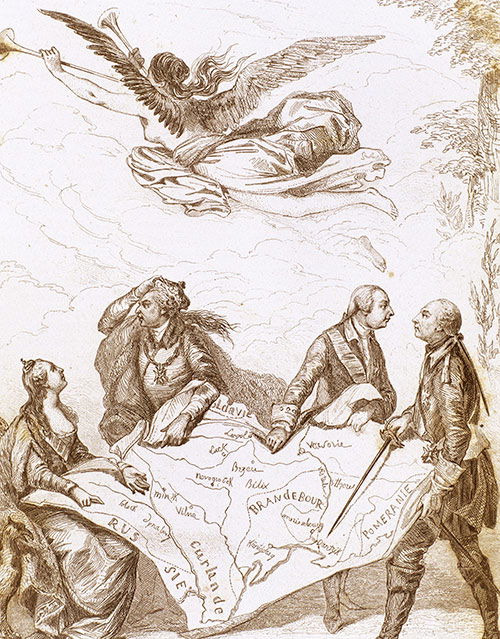
Since the 16th century Poland had been an elective monarchy. Its nobility enjoyed great license – their ‘golden freedoms’ – but Poland’s elected monarchs failed to establish the golden pillars of ancien régime monarchy: a centralised bureaucracy, a standing army and increased taxes. Foreign powers even put forward their own candidates in Polish royal elections. In the election contest of 1764 Catherine the Great of Russia sponsored her former lover, Stanislaus Poniatowski. Russian troops, invited by the wealthy Czartoryski family, kept in the distance but close enough to influence Polish electors. After his elevation to the Crown, Poniatowski refused to perform the Tsarina’s bidding. At the same time he proved unable to push much needed reforms through the Polish parliament, the Sejm. A group of dissatisfied nobles rebelled and even attempted to kidnap the king to remove him from Russian influence. Russian forces then intervened. In 1771 Catherine reached an agreement with Frederick the Great of Prussia and Maria Theresa of Austria: each would take a slice of Poland, thereby preserving the ‘balance of power’ between themselves.
When Russia became involved in a war with Ottoman Turkey, the Polish king took the opportunity to introduce the acclaimed Constitution of May 3rd, 1791: to this day a Polish national holiday. But Russia soon defeated the Turks and conservative nobles backed by Catherine the Great rebelled against the new constitution and invited Russian intervention. After initial resistance, the Polish monarch reluctantly deserted the reformers to avoid the destruction of his country. The outcome was the further loss of territories to Russia and Prussia in a second partition. Polish reformers were shocked and immediately began preparing for a new confrontation. Tadeusz Kościuszko raised the banner of insurrection in 1794 but, after an initial victory, Polish forces were crushed. What was left of Poland disappeared in the third and final partition of 1795. What was in 1770 the second largest country in Europe had been erased from the map.
Only 12 years later Napoleon vanquished Prussia at the Battle of Jena and created the Duchy of Warsaw out of the Prussian slice of Poland. In 1809 the Austrians challenged Napoleon and were similarly defeated. Napoleon took most of the Austrian slice of Poland, including Krakow, and added it to the Duchy of Warsaw. Most Poles consequently favoured an alliance with Napoleonic France against the three partitioning powers, although Prince Adam Jerzy Czartoryski placed his faith in his friend, Tsar Alexander I, who promised to restore Polish independence.
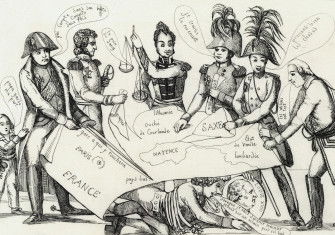
These events set the stage for the major confrontation at the Vienna Congress. The Congress was publicly announced in Article 32 of the First Peace of Paris, concluded between France and the allied powers in May 1814 after the collapse of the Napoleonic Empire. In this treaty the new boundaries of France were set; the purpose of the forthcoming Congress was therefore to deal with territories beyond French borders. The plan of the great powers in summoning the Congress was transparent to all: to settle first all outstanding issues on their own and then to procure the assent of the rest of Europe to lend legitimacy to their decisions. But their plan foundered when they failed to reach agreement during their negotiations in Paris and London before the Congress assembled. The chief stumbling block was the future of Poland.
The sudden collapse of the French imperium had placed the fate of the infant Duchy of Warsaw in doubt. The Tsar made known his general intention to restore Poland, although he kept the precise details of his plan shrouded in mystery. On the way to Vienna he even met with leading Polish nobles at Czartoryski’s estate at Puławy in eastern Poland. At the same time, to win the adherence of Prussia to the new coalition against France, the Tsar had promised to restore Prussia to its former dimensions. But, if Russia were not to return part of Poland to Prussia, where was the Tsar going to find sufficient territory to return Prussia to its former size? The answer was in Saxony, an independent kingdom across Prussia’s south-western border. Since the Saxon king had remained loyal to France long after other German princes had deserted, the Tsar argued that he had forfeited all rights to his throne.
Saxony would therefore be awarded to Prussia in compensation for the latter’s loss of its former Polish territories. Those lands would in turn form the kernel of a resurrected Kingdom of Poland, to be ruled over directly by the Tsar, but with its own constitution, national legislature, laws and army, separate from Russia. Curiously, the Russian slice of Poland was not to be immediately joined to the new Polish Kingdom (made up of the former Prussian and Austrian shares), although there were plans to do so at a later date.
The other allied statesmen were far from pleased with the Tsar’s agenda. Prince Klemens von Metternich, the Austrian foreign minister, was utterly opposed to Alexander’s acquisition of Poland, which would have given Russia control of the heights above the main invasion route to Vienna, incited unrest among those Poles still under Austrian rule and turned Prussia into a Russian vassal state. The interests of Britain were less directly affected. Nonetheless, Lord Castlereagh, the British foreign secretary, also feared the growth of Russian power and the potential discord that the Tsar’s scheme might cause between Austria and Prussia. The Polish-Saxon question bedevilled the talks in Paris and London throughout the long, hot summer of 1814. In early September the allied monarchs and statesmen began arriving in Vienna, yet the problem of how to reconstruct Central Europe remained unresolved.
 From September to November Castlereagh and Metternich worked closely with the Prussian minister, Prince Karl August von Hardenberg, to limit Russian gains in Poland. Why was Hardenberg willing to cooperate with Austria and Britain when the Tsar had already promised all of Saxony to Prussia? The answer seems to be that Hardenberg wanted Metternich’s support on German questions, especially the creation of a new confederation uniting all the German states for purposes of defence. Cooperation with Austria and Britain also seemed to offer the pleasing prospect of gains in both Saxony and Poland.
From a balance-of-power perspective, Austria, Britain and Prussia banded together because they believed that Russia had become too strong. Castlereagh served as their main spokesman in a series of private audiences with Alexander I in September and October. The British foreign secretary argued that Russian acquisition of Poland would deprive Prussia of a defensible frontier, violate the sanctity of existing treaties and stir discontent among the Poles. The Tsar insisted, however, that he had a genuine moral obligation to the Polish nation. Prince Adam Czartoryski, who accompanied the Tsar to the Congress, and even the aging Kościuszko, both saw the Tsar as Poland’s last, best hope. The other powers offered them only an assurance of dismemberment.
The Harvard political scientist Joseph Nye defines ‘hard power’ as the use of ‘force or payment’ to affect others to achieve desired outcomes – in other words, power resting on either military or economic resources – and he defines ‘soft power’ as ‘the ability to get what you want by the co-optive means of framing the agenda, persuading and eliciting positive attraction’. In a graphic illustration of Nye’s concept of ‘hard power’ – the application of military or economic force – the Tsar taunted Castlereagh with the fact that Russian troops were already in occupation of Polish territories (as Stalin was to do in 1945). ‘The Emperor’, Castlereagh reported back to London, ‘insinuated that this question could only end in one way as he was in possession.’ Castlereagh disclaimed all intention of dislodging the Russians by force, but told the Tsar that he believed his aim was not to possess Poland as a conqueror but to govern the Poles as a legitimate sovereign with the sanction of Europe. Clearly Castlereagh was skilfully attempting to deploy the instruments of ‘soft power’ – attractiveness and persuasion, with the ‘sanction of Europe’ – to counter the Tsar’s ‘hard power’ of military force.
Metternich, Castlereagh and Hardenberg met at Castlereagh’s apartments on the Minoritenplatz on October 23rd. Metternich had only just consented to the Prussian annexation of all of Saxony. The three statesmen agreed to offer the Tsar an independent Poland, knowing full well he would refuse. Then they planned to propose that the Tsar should be given Polish territory up to the River Vistula, including Warsaw, but no further; about half the territory he claimed. Metternich acted as their representative the next day, when he informed Alexander that Austria mightalso create its own Polish kingdom in the south. The Tsar reacted with indignation.
The collaboration of Metternich and Castlereagh with Hardenberg ultimately failed because the Prussian ruler, King Frederick William II, still felt beholden to the Tsar for the liberation of his territories from Napoleon. On November 5th the king summoned Hardenberg and ordered him to cease all resistance to the Tsar. Five days later the Russians turned the military occupation of Saxony over to the Prussians. The united front of Prussia, Austria and Britain collapsed like a house of cards.
On the surface, allied strategy in these three months appears to have been a classic exercise in the balance of power. Even though the Tsar had already offered Prussia all of Saxony and even though Britain had no direct interest in the dispute, Hardenberg and Castlereagh had joined forces with Metternich because they feared the growing power of Russia. But, despite appearances, it seems obvious that there was really no chance at all that these powers would ever use military force to expel Russia from Poland. So the contest really devolved into one of ‘soft’ versus ‘hard’ power.
In the next phase of the negotiation the ministers shifted their focus to Saxony. Neither Castlereagh nor Metternich was now willing to hand over all of the Saxon kingdom to Prussia and in early December both rescinded their earlier offers to Hardenberg. Austria and Prussia also began quietly preparing for the almost unthinkable possibility of war. Castlereagh explained the Austrian viewpoint to the British Cabinet: ‘It is the deliberate opinion of many of their officers, and … ministers, that, rather than have the Russians at Craco[w] and the Prussians at Dresde[n], they had better risk a war with what they can get.’
On December 5th Hardenberg sent a message to the military reformer General Gneisenau, himself of Saxon origin, that ‘it would be better to have a new war than that Prussia, after such glorious deeds and so many sacrifices, should come out of the affair badly’. Castlereagh addressed the British Cabinet the same day, weighing the prospects for maintaining peace: ‘My opinion is, that … as Europe is more extensively armed than at any former period, [this disagreement] may suddenly end in war.’ Three weeks later he again explained that the Prussians were ‘organising their army for the field … This may be all menace to sustain their negotiation, but they may also meditate some sudden effort, in conjunction with Russia, to coerce Austria and place themselves in a situation to dictate their own terms on all other points’. Meanwhile the Grand Duke Constantine, the younger brother of the Tsar, issued a stirring proclamation to the Polish army ‘to take up arms in the defence of your country and the preservation of your political existence’.
Were all of these steps mere sabre-rattling? Were military leaders just taking reasonable precautions, or was there a genuine risk of conflict? Most historians concur that, despite the display, war was unlikely.
 By mid-December Russia, Britain and Austria were all making overtures to the French delegation. Since the goal of Talleyrand, the French foreign minister, had always been to maintain the King of Saxony on his throne, he gravitated to the side of Austria and Britain. Prussian and Russian ministers introduced the idea of moving the King of Saxony to a principality on the Rhine so that he might keep a kingdom, while Saxony was transferred to Prussia. This Rhineland proposal was submitted to Castlereagh on December 20th. On the same day, the allies agreed to establish a ‘Statistical Committee’ to resolve their deepening disagreements over population sizes.
Formal conferences of the four allied powers to determine the fates of Saxony and Poland opened at Metternich’s offices on the Ballhausplatz on December 29th. Castlereagh and Metternich pushed for the immediate entry of France into the deliberations. At the session of the 30th Metternich suggested that the permission of the King of Saxony would be needed before dividing up his kingdom. This was all too much for Hardenberg to bear. Only three weeks earlier, Metternich himself had been offering all of Saxony to Prussia. Hardenberg angrily announced that any refusal to recognise Prussian acquisition of Saxony would be tantamount to an act of war. It was, in Castlereagh’s words, ‘a most alarming and unheard-of menace’.
The result of Hardenberg’s angry outburst was the secret treaty of January 3rd, 1815: a defensive alliance between Britain, Austria and France. It is certainly remarkable that, after 20 years of war, both Britain and Austria were now willing to unite with their former adversary. Castlereagh himself drew up the treaty on New Year’s Eve. Some historians argue that news of this treaty forced the Russians and Prussians to back down in a classic case of coercive diplomacy. Castlereagh himself lent credence to this interpretation of events in a later letter to the Cabinet. But the reality was different. The conclusion of this treaty – an ostensible exercise of ‘hard power’ – simply cannot account for the resolution of the crisis. The new alliance was purely defensive in nature: in the event that any of its signatories were attacked in completing or enforcing the Peace of Paris, the other parties were obliged to come to its aid. There is no evidence, however, that either Russia or Prussia ever planned to move beyond the borders of Poland and Saxony to attack the signatories of the Triple Alliance. The treaty was thus a dead letter from the start. Meanwhile, Hardenberg had already come to terms with the sacrifice of much of Saxony a fortnight earlier. In his diary on December 21st the Prussian chancellor had scribbled: ‘We are ready to cede a great part of Saxony.’ Finally, the treaty remained secret. Rumours of its existence abounded but were never officially confirmed. All this runs against the essence of coercive diplomacy, a form of ‘hard power’ requiring a credible threat to be conveyed to an adversary to influence its behaviour. British Cabinet minister Lord Mulgrave expressed it best: ‘I know not why it should have been made, or kept secret … if it were meant as a check to their pretensions, it seems to me that it ought to have been avowed; kept secret it leads to nothing but action which we want to avoid.’
Although the secret alliance of January 3rd, 1815 did not lead to the resolution of the Polish-Saxon question, it coincided with other factors that did. What finally resolved it was not the threat of ‘hard power’ embodied in the secret treaty, but the impact of several ‘soft power’ influences on the Tsar, who now made fresh concessions. First, the Tsar clearly did not wish to antagonise his former allies for the sake of Prussia. ‘Russia’, Castlereagh wrote to London, ‘will not encourage Prussia to resist now that she has secured her own arrangement in Poland.’ Second, the Tsar wanted to court the friendship of the German middle states; third, the Tsar looked to Britain to pay the Russian debt to Dutch bankers. Overshadowing all considerations was the Tsar’s increasing religiosity. Alexander now pictured himself as the saviour of all humanity. On December 31st, while Castlereagh was drafting the secret alliance, the Tsar was writing an appeal to other European sovereigns, which would lead to the Holy Alliance. The Russian Emperor was hoping to unite all sovereigns and their peoples in a spirit of Christian brotherhood. Against these lofty concerns the future boundaries of Prussia paled into insignificance.
One might say that Prussia lacked the ‘hard power’ resources of Russia and was therefore forced to succumb to allied demands. At the same time, the ‘soft power’ attractions of legitimacy and the sanction of Europe did have an impact, especially on the Tsar’s impressionable mind.
This brings us to the third and oft-neglected final phase of the negotiation. Although war between the allies had been avoided, the Prussians had backed down and the Tsar had made concessions, the Congress still required another month of hard bargaining. The statesmen were trying to strike the best balance they could in terms of the ‘hard power’ resource of population, which they saw as the key to future military strength.
As early as January 5th, Castlereagh had drawn up an entirely new plan for the reconstruction of Prussia, restoring it to its former size while awarding it only a part of Saxony. Castlereagh revealed his skill as a negotiator by opposing extremes on all sides. His efforts provide a remarkable picture of ‘balance-of-power’ diplomacy in action. Still believing in the need to strengthen Prussia in northern Germany, the foreign secretary insisted that the Prussians should be awarded two fifths of Saxony as well as territories along the Elbe and on the Rhine. Castlereagh even insisted, over Austrian objections, that the fortresses of Erfurt and Torgau be handed over to Prussia.
The Prussians obstinately maintained their Rhineland proposal, to no avail. The Austrians offered to return part of their Polish territory to Russia so that the latter might, in turn, give more of Poland to Prussia, instead of Saxony. The British and French members of the Statistical Committee recommended a different approach: Prussia would be given, as Castlereagh had suggested, the fortresses of Torgau and Erfurt, and another 900,000 inhabitants. The Prussians were willing to surrender the Saxon capital of Dresden, but they were determined to make a last stand to acquire Leipzig, scene of the decisive victory over Napoleon the year before. This final dispute was only resolved when the Tsar, still in a conciliatory mood, consented, at Castlereagh’s urging, to make further concessions in Poland. Hanover and the Netherlands, under British pressure, also turned over additional slices of territory to Prussia. ‘A fund was created’, wrote Castlereagh, to ‘operate a salutary reduction in favour of Saxony.’ The labours of the Statistical Committee greatly assisted in the final push. Populations of districts were added and subtracted in mechanical fashion to attain the desired results and a final agreement on the reconstruction of Central Europe was at long last achieved in early February, just before Castlereagh’s departure for London.
Although the Prussians did not receive all of Saxony and their territories remained dispersed, they gained a large arc stretching across northern Germany. Their position in the Rhineland made them part of the new barrier of states around France, much as Pitt and Castlereagh had intended, and actually thrust Prussia westward, setting the stage for later German unification under Prussian leadership. Meanwhile, Russia annexed most of the Duchy of Warsaw but made several other last-minute concessions, giving up not only Posen and Thorn but also the ancient royal capital of Krakow, which became a free city.
What do these negotiations reveal about the workings of ‘hard’ and ‘soft’ power? At Vienna, much as today, the possession of substantial ‘hard power’ resources furnished the credentials for membership in the exclusive club of great powers. The negotiations at Vienna highlighted the determination of those powers to reach major decisions by themselves without consulting the lesser states and with little concern for the wishes of the subject populations actually involved.
At the same time, ‘hard power’ resources alone were not decisive. Certainly, Russia set the agenda and dictated the outcome in Poland. This was truly an exercise of ‘hard power’. With fewer ‘hard power’ resources, Prussia met with less success. But the fact is that Russia made some concessions in Poland, while Prussia still took a large slice of Saxony and obtained further compensation elsewhere. In the end, ‘soft power’ considerations reduced the impact of ‘hard power’ and opened the door to a compromise solution.
By the beginning of February 1815 the interplay of ‘soft’ and ‘hard power’, expertly applied by the statesmen at Vienna, had performed its work. The allies were once again united and ready to meet a new challenge when Napoleon escaped from Elba and returned to the Tuileries Palace in Paris in early March.
Does this episode offer any lessons for dealing with the likes of President Putin today? As in both 1814 and 1945, the western powers may not be in a position to apply their own military force effectively to the region between Russia and the rest of Europe. The main instruments of foreign policy at their disposal appear to be the ‘hard power’ measures of offering arms to Ukraine and applying economic sanctions against Russia, combined with the ‘soft power’ tools of diplomacy, publicity and persuasion. It remains to be seen whether, given time and perseverance, Putin can be persuaded to make concessions as Alexander once was. The current Russian leader seems to lack the same devotion to European ideals as the former Tsar. But, as at the Vienna Congress, it may be in the exercise of ‘soft power’ that the best hope of restraining Russia still lies.
Mark Jarrett is the author of The Congress of Vienna and its Legacy: War and Great Power Diplomacy after Napoleon (I.B. Tauris, 2013).