

Stalin and Mao: Parallel Rise?
Russel Tarr compares and contrasts the rise to power of two Communist leaders.
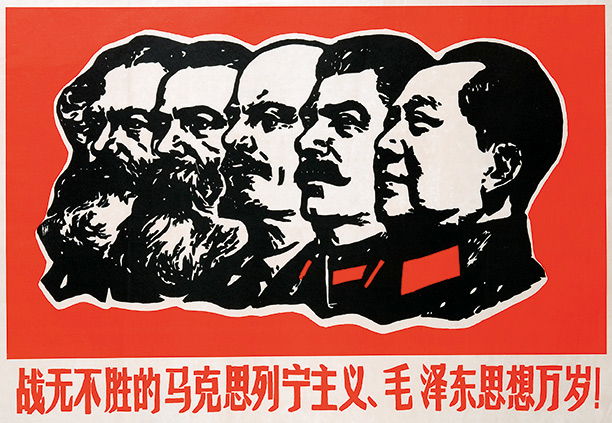 At first glance, the rise to power of Stalin and Mao appear easily comparable: both were members of deeply divided communist parties and both operated within societies that suffered from civil war and the ever-present threat of foreign attack. Moreover, both the USSR and China were mainly populated by a disaffected peasantry – despite the fact that Karl Marx, the founding father of communism, had developed his theories around the principle that the first successful revolutions would take place in countries with an educated, industrialised proletariat.
Nevertheless, there are challenges for the historian adopting a comparative approach. For example, Stalin rose to power within a party which was already in government. By the time Lenin died in 1924 and Stalin began his bid for power in earnest, the Bolshevik regime was already more than six years old. In marked contrast, at exactly the same time Mao was fighting not just to gain leadership of the Chinese Communist Party (CCP), but also to bring it to power in the country as a whole – a battle which would take a further 25 years of instability, setbacks and civil war against his nationalist rivals, the Kuomintang (KMT), led by Chiang Kai-shek.
Moreover, as communists both men were ideologically expected to believe in collective government, not personal dictatorship, so it is difficult to pinpoint exactly when each became the undisputed leader of his party. For the sake of simplicity, this article will regard Stalin’s announcement of the first Five Year Plan (1928) as signalling his emergence as de facto leader of the Bolshevik Party, whilst Mao’s defining moment is his formal appointment as Chairman of the victorious Communist Party at the end of the Chinese Civil War (1949).
Popular Support
Although Stalin was already a member of a party in power by the time of Lenin’s death, the regime was by no means secure within the country as a whole. Like Mao, Stalin therefore placed great emphasis on the relationship of the regime with the peasantry, who formed the backbone of both countries. Nevertheless, although they shared this same concern, they addressed it in completely different ways.
Stalin’s attitude towards the peasantry and national minorities was almost unremittingly hostile. This is superficially surprising since he was not only from Georgia (a region with a long tradition of national identity) but also came from peasant stock: his father was a ‘violent, drunken, semi-itinerant cobbler’ (Montefiore) who would ‘savagely beat’ both Stalin and his mother, who was a washerwoman. The young Stalin was very much from the wrong side of the tracks: although highly intelligent and self-educated, he was also disfigured by smallpox, his left arm was permanently damaged after an unknown accident, and he grew from being a street urchin to a violent gang-leader.
Nevertheless, despite (or perhaps because of) this background, Stalin was instinctively hostile to the idea of mass movements in general and those relying upon peasant support in particular, which meant that he found a natural home in Lenin’s Bolshevik party. Stalin’s own personal hostility towards the peasantry, which was a defining feature of his ‘party platform’ during his rise to power and beyond, can be illustrated by two examples. First, in 1921 he persuaded the Politburo to send Red Army troops into his homeland of Georgia and used intimidation and physical violence against local Menshevik officials – a gangsterism which alarmed even Lenin, whose ‘Final Testament’ therefore called for Stalin’s influence within the party to be drastically curtailed. Secondly, after a period of tactically supporting a more moderate line against the peasants, in 1928 Stalin announced his first Five Year Plan in terms of a war on the peasantry, a ‘Revolution from above’ characterised by rapid industrialisation financed by the compulsory requisitioning of grain. Peasant resistance to this ultimately resulted in an even more confrontational policy of forced collectivisation and the declaration that his objective was to deal the peasantry ‘such a blow that it will no longer rise to its feet’.
In marked contrast to Stalin, and in exactly the same year that the Five Year Plans were announced, Mao defined himself as the ally rather than as the enemy of the peasantry. Like Stalin, Mao came from a peasant family, being born in the agricultural Hunan province of China in 1893, and was a highly intelligent autodidact. However, unlike Stalin, Mao had grown up in a family which was both stable and comparatively prosperous. Moreover, as a young revolutionary he completely disagreed with the Bolshevik view that the proletariat was the key to communist revolution, arguing that ‘The peasants are the sea. We are the fish. The sea is our habitat’. Mao put his beliefs into practice following the attack on the communists by Nationalist forces in the ‘White Terror’ of 1927. Fleeing to the agricultural province of Jiangxi, he proceeded to forge strong links with its 3 million peasants, who, in the words of the Red Army General Peng Dehuai, ‘dug up from the ground the grain which they had hidden from the KMT troops and gave it to us’. The peasants welcomed Mao’s focused, peasant-based revolutionary programme during this period and responded enthusiastically to the declaration of the short-lived ‘Socialist Republic’ in 1931.
Surrounded by hostile forces, the communists were ultimately forced to abandon Jiangxi with the famous Long March to Yenan (1934-1935), but Mao used this experience to ‘sow seeds’ among the peasant communities he encountered during the 6000 mile trek (‘Learn from the masses, and then teach them’). After establishing the ‘Yenan Soviet’, the CCP continued to gain the support of the local populations by treating them with consideration. His soldiers were educated to use persuasion, not force, to win the hearts and minds of the peasantry. The Eight Rules of the Red Army meant that Mao’s communists respected women, paid for crops, and ran literacy classes. The American journalist Edgar Snow, who visited Mao during this period, observed that ‘All forms of taxation were abolished … to give the farmers a breathing- space. Second, the Reds gave land to the land-hungry peasants ... However, both the landlord and the rich peasant were allowed as much land as they could till with their own labour’. The contrast with Stalin could not be more glaring.
Ideological Divisions
The fact that Mao and Stalin were able to adopt such widely different attitudes and policies towards the peasantry, and yet still call themselves Marxists, clearly indicates how Marx himself was notoriously unclear about certain practical issues relating to the organisation and policy of a socialist state. Karl Marx preferred to take a broad-brush approach to history and political philosophy and left many practical issues about the organisation and policies of the socialist state comparatively vague.
The Bolshevik Party in the USSR was deeply divided by the time of Lenin’s death over policy towards the peasantry, and throughout this period Stalin refrained from making public statements on the issue in order to maximise his freedom of manoeuvre. In 1921 Lenin had decided to abandon the policy of War Communism, now characterised as a ‘temporary measure’ to which he had been ‘forced to resort by extreme want, ruin and war’. In place of compulsory requisitioning came a proportional tax to provide peasants with more incentive to produce grain. The partial revival of capitalism in this New Economic Policy (NEP) was highly controversial. The right wing of the party, led by Bukharin, vigorously defended gradual, peasant-based socialism and encouraged the peasants to ‘enrich yourselves through the NEP’. The Left Communists, however, felt that more emphasis needed to be placed on a programme of massive and rapid industrialisation if the regime was to survive. Represented most powerfully by Trotsky and his ‘platform of 46’, they described the NEP as ‘the first sign of the degeneration of Bolshevism’.
The Chinese Communist Party was equally divided about the role of the peasantry. However, in contrast to Stalin, Mao’s strategy was not to adopt a canny ‘wait and see’ approach, but to take a very bold and active part in these debates, leading a wing of the party which campaigned tirelessly for a peasant-based revolution. The success of his peasant- based social programmes in Jiangxi – which he pursued without waiting for official sanction from party headquarters in Shanghai – allowed Mao to rapidly rise to a position of political pre-eminence within the CCP. This process was considerably aided when, in 1930, the party adopted the ‘Li Lisan Line’, named after its new party chairman. This promoted the idea of a Bolshevik-style revolution in China spearheaded by the industrial proletariat and led by a centralised party elite. However, the incipient uprisings were crushed by the Nationalist forces of Chiang Kai-shek, and Li Lisan was deposed the following year on the orders of the ‘28 Bolsheviks’, a group of young Chinese Communists trained by, and acting on the orders of, the Soviet Union. Mao had firmly opposed the ‘Li Lisan Line’, arguing that ‘If we allot ten points to the revolution … seven points must go to the peasants’, and thereby his reputation within the party was considerably enhanced.
Military Divisions
The party divisions shared by Mao and Stalin were compounded by sharply contrasting military conditions. In military terms, Stalin’s position was superficially weak, whereas his main rival in the party, Leon Trotsky, enjoyed an impressive reputation. After successfully masterminding the strategy for the seizure of power in October 1917, Trotsky had been appointed Commissar for War, a role in which he built up the Red Army into a formidable fighting force that ensured Bolshevik victory in the Civil War (1918-1920). In contrast, Stalin’s own war record was unimpressive. During the Civil War, whilst serving as Commissar to Tsaritsyn, Stalin had obstructed Trotsky’s ‘military experts’ and even imprisoned them on a barge which then mysteriously sank. Stalin brushed aside Trotsky’s objections by calling him an ‘operetta commander, a chatterbox’, but although Lenin initially approved of this ‘ruthless’ approach he soon became alarmed at his protégé’s lack of judgement. In particular, Stalin disobeyed a direct order to support Tukhachevsky’s push on Warsaw with a detachment of cavalry. Combined with his heavy-handed approach to the Georgian question outlined earlier, this contributed to Lenin’s final recommendation that he be removed from office altogether.
Compared to Stalin, Mao’s military position was much stronger, since his rivals in the party suffered defeats in battle that tarnished their reputations. In 1934, with Jiangxi under heavy siege by nationalist forces, the party leaders embarked on a complete evacuation of the province: the famous Long March. However, by marching in a straight line, and lumbering themselves with massive amounts of inessential heavy equipment (such as typewriters), they became sitting ducks. In the Battle of Xiang, the KMT rounded on the communists and the Red Army lost 45,000 men – over 50 per cent of their fighting force. In contrast, Mao himself had a highly developed sense of military strategy. He crushed an incipient rebellion in his ranks by massacring 3,000 opponents in the Futien Incident of 1930, and continually stressed the importance of guerrilla warfare during the Jiangxi siege (‘The guerrilla must move amongst the people as a fish swims in the sea’). This strategy was formally adopted by the CCP after the disaster at Xiang: the CCP forces broke into four armies, each of which adopted a twisting path that made predicting their location extremely difficult. During the Second Civil War (1946-49) Mao successfully appointed Lin Biao as his military commander, which contributed to the final triumph over the KMT in the Three Great Campaigns.
Political Results
Although their reaction to these situations was very different, both Stalin and Mao proved remarkably adept at turning them to fullest advantage. Stalin astutely realised that Trotsky’s very success was a source of great unease within the party. Stressing Lenin’s expressed desire for a ‘collective leadership’ after his death and playing on his own reputation as an unthreatening ‘grey blur’ (Sukhanov), Stalin initially capitalised on divisions in the left wing of the party. Kamenev and Zinoviev were persuaded to ally with Stalin against Trotsky, who they feared was showing dictatorial (‘Bonapartist’) tendencies as Red Army chief. Once Trotsky had been expelled from the Politburo, Stalin cynically allied himself with Bukharin and other right-wingers to expel Kamenev and Zinoviev. In late 1927, Stalin then turned against Bukharin and rejected the NEP in favour of agricultural collectivisation and massive industrialisation. Bukharin secretly attempted to form an alliance with Kamenev and Zinoviev, arguing that unless he was ousted Stalin would eventually destroy the communist revolution (‘[Stalin is] an unprincipled intriguer who subordinates everything to his appetite for power’). Nevertheless, by this time Stalin had appointed so many supporters to senior positions in the party that his position was unassailable. In 1929 Bukharin was deprived of the chairmanship of the Comintern and expelled from the Politburo.
Mao too deftly turned the ideological and military divisions within his party to full advantage with a series of well-timed manoeuvres, although characteristically he did this through the force of his personality and achievements rather than by manipulating factions and working in the shadows. For example, during the Long March in 1935, Mao spoke out boldly at the Tsunyi Conference, blaming the party’s recent misfortunes on some of those out-of-touch ‘28 Bolsheviks’. The vote which followed saw the triumvirate of Bo Gu, Otto Braun and Zhou Enlai demoted to different degrees. Braun later reflected that this represented a total victory for Mao, ‘thereby subordinating the party itself to his will’. However, Mao himself wisely refrained from making a bid for complete power at this point, later recalling that at the Tsunyi conference ‘some people would have had me as the core, but I would have nothing of the kind’. Only slowly did a cult of personality develop around Mao (‘The Great Helmsman’), although by 1945 a Central Committee Resolution claimed that ‘The Tsunyi Meeting ... inaugurated a new central leadership, headed by Comrade Mao – a historic change of paramount importance in the Chinese Communist Party’.
The International Dimension
Although domestic factors played a central role, there was also an international dimension to the rise to power of both dictators. Both Mao and Stalin benefited from a sense of affronted nationalism and fear of foreign influence that allowed these communists perversely to present themselves as patriotic defenders of their homelands. However, whereas the danger to Soviet Russia was largely theoretical by the time that Stalin came to power, China had suffered from decades of direct and devastating foreign intervention by the time Mao took control. As a result, Stalin had actively to stoke the flames of nationalist fervour in a way that Mao never found necessary.
Western colonialism had led to China’s major trade and ports being under foreign control by the turn of the 20th century. Despite fighting on the side of the Allies during World War One, China’s claims for self-determination had been ignored at Versailles by the Big Three, who instead gave Germany’s base in China (Shandong) to Japan. The immediate beneficiary of this tide of offended nationalism – as was to be expected – was the Nationalist KMT party, who, with the support of the CCP, launched the Northern March against the Warlords and their imperialist backers in 1923. However, when Chiang Kai-shek became leader of the party he squandered this support by rounding upon his former allies in the CCP and becoming obsessed with their destruction even after the Japanese invaded Manchuria in 1931. Chiang Kai-shek’s insistence on attacking, rather than uniting with, the CCP against the Japanese was highly unpopular, and his increasing reliance upon American aid tainted the KMT with the reputation of being in the pocket of foreign colonialists. By 1945 the KMT armies had lost their most experienced officers, the political leadership was divided and the economy was suffering from rampant hyperinflation. It was in these circumstances that Mao was able to advance on Beijing and declare the Communist Republic of China on October 1st 1949.
Stalin made a deliberate point of capitalising upon his people’s fears of foreign exploitation and invasion. These anxieties were by no means unfounded, because Soviet Russia had become a pariah nation after World War One. Its decision to pull out of the war, renounce Tsarist war debts and campaign for a world revolution precipitated foreign intervention in the ensuing civil war. Britain, France, Japan and the United States all invaded the Soviet Union in the belief that communism should, in the words of Winston Churchill, be ‘strangled in its cradle’. Denied entry to the League of Nations (which Trotsky denounced in any case as ‘an organisation for the bloody suppression of the toilers’), the Soviet Union had signed the Rapallo Treaty with her fellow international outcast, Germany, in 1922. Nevertheless, Germany was rapidly re-integrated into the international community through the Dawes Plan (1924) and the Locarno Treaties (1925). In 1926 Germany joined the League, the former white general Pilsudski had seized control in Poland, and the USSR’s sense of isolation and vulnerability was complete.
However, whilst these anxieties were real, the threat of an actual foreign invasion by the late 1920s was minimal. Stalin therefore went to great lengths to generate a ‘war scare’ through which he could finally step out of the shadows with his own radicalised brand of Marxism. He ‘fostered and exploited fear of foreign attack’ (Sontag), giving mass publicity to the 1928 Shakhty trial, when 55 engineers in Donbass were found guilty of industrial espionage for the West on trumped-up charges (five were duly executed). He cleverly appealed to a sense of outraged nationalism by discarding Trotsky’s pursuit of World Revolution in favour of Socialism in One Country and depicting his new Five Year Plans for industry and agriculture as acts of patriotic necessity: ‘We are 50 or 100 years behind the advanced countries. We must make good this lag in ten years. Either we do it, or they crush us.’ With this speech Stalin finally emerged as a theorist in his own right and the undisputed leader of the Soviet Union.
Conclusion
In conclusion, it is clear that the conditions faced by Stalin and Mao were broadly similar, but that the policies they adopted could not have been more different. Stalin viciously attacked the peasantry whereas Mao enthusiastically embraced them. Stalin exploited fears about the military ambitions of his rivals, whereas Mao instead capitalised upon his own abilities in the arts of war. Stalin owed his initial rise within the party to his apparent lack of ideological conviction, whereas Mao owed his ascendancy to bold and uncompromising ideological pronouncements. In their manipulation of the international situation, Stalin spoke with strident passion, whereas Mao adopted an altogether more passive approach. Of all these contrasts, the most significant is surely the fact that Mao saw the mass of the people he sought to rule as allies rather than enemies: a fact which helps to explain why the USSR ultimately imploded, whereas China remains not merely in the hands of a communist government, but appears destined to become one of the superpowers of the 21st century.
Issues to Debate
- Why did Stalin and Mao adopt such radically different policies towards the peasantry?
- To what extent did Mao and Stalin rise to power as a result of their own efforts?
- Was fear or popular appeal more important in helping Stalin and Mao rise to power?
Further reading
- Robert Service, Stalin: A Biography (Pan, 2010)
- Simon Sebag Montefiore, Young Stalin (Vintage, 2008)
- Philip Short, Mao (Hodder & Stoughton, 1999)
- Jung Chang, Jon Halliday, Mao: The Unknown Story (Vintage, 2006)

