

Spreading the Word
Many of the world’s languages derive from a single source. Harry Ritchie tells the story of Proto-Indo-European.
 In English, the word for a male parent is father. In Dutch it is vader, in German vater and in the Scandinavian languages far. Father is also related to French père and padre in Spanish and Italian, which all derive from Latin's pater, to Classical Greek's pateras and even to peeta in Bengali or, indeed, pacer in Tocharian, an extinct language believed to have been last spoken about a thousand years ago on the north-western border of China.
Almost all the languages spoken in Europe, northern India, Iran and Afghanistan are related to one another. But this language family tree is an inverted form of the typical family tree. Almost all the European and north Indian languages are twigs and branches that grow thicker and fewer as they recede into the past and, like a real tree, they turn out to have grown from one seed. One language, spoken by one group 5,000 years ago, is the ancestor of almost every language now spoken from the Hebrides to the Himalayas, by nearly three billion people.
This is not a new discovery: the uncanny similarities between India's Sanskrit and Ancient Greek were first noticed a couple of centuries ago and the ancestor language was first painstakingly reconstructed by linguists in the 19th century. They traced the connections and ancestries of words and structures, beyond the invention of writing, far into the distant past.
Yet most people remain unaware of the extraordinary legacy of that one Bronze Age language. And it is extraordinary. The linguistic evidence is vast and undeniable. Around 5,000 years ago, one tribe, known by the unwieldy name of Proto-Indo-Europeans, achieved the complete linguistic takeover of Europe and northern India, yet there is nothing in the actual, archaeological record to suggest anything like an ancient empire stretching from Portugal to Orkney to Nepal. In fact, there is nothing in the archaeological record to suggest that this tribe existed at all: no monuments, no settlements, no buildings, not even any distinctive ornaments or pots. The only traces they left behind were the words they used, which have survived in their various forms in our modern languages and which can be reconstructed following logical rules of language change.
So what happened? Who were these linguistic overlords of an entire continent and half of another? Where did they come from and how did they do it?
This tribe may remain invisible to archaeology but, because so much of their language has been successfully reconstructed, we know a lot about them from their vocabulary. We know, for example, their number system – we can count to ten: oynos, duwo, treyes, kwetwores, penkwe, sweks, septm, oktu, newn, dekm. We know that theirs was a patriarchal society based on clans and three social classes (priests, warriors and farmers/herdsmen). The tribe was led by one man, possibly a warrior/priest, called the regs (giving Latin's rex). We know about the animals they reared and the food they ate (lots of meat and dairy, from their herds), washed down by mead (medhu). We know about the gods they worshipped, headed by a Sky Father (Dyeupihter); the feasts they used to hold; the taboo words they would never use while hunting. Language reconstruction offers the kind of insight conventional archaeology cannot. We even know that they distinguished two different sorts of fart. This is the reverse of conventional archaeology. With these language conquerors, we know their word for a soft fart (pezd, with disarming onomatopoeia), but we cannot tell who they were nor how they managed to impose their language on such an enormous area of the Earth's inhabitable land mass.
Scholars have been trying to find answers to these questions for nearly 200 years, puzzling over their vocabulary for clues. We know that they did not come from the Mediterranean, as no words for olive or cypress survive, for example. The absence of any terms for banana, monkey or elephant suggests that they were not from Africa. They did have words for things like wolf, beaver and oak, which points to a homeland with forests and rivers, and they had a word for bee (bhei), which means they lived west of the steppes (where there are no bees), and beech, which places them west of the 'beechline' that runs south from what is now the city of Kaliningrad to Crimea.
One theory is that they were the people who introduced farming to Europe and India, but unfortunately the dates are wrong. Farming had spread west into Europe by 6500 BC but, according to linguists' estimates, this language could only have been around by 4000 BC at the earliest.
Recent research has, however, made significant progress and has, for the first time, pinpointed the tribe to a particular place and time, to a homeland just south of Volgograd in southern Russia and to a date of 3500 BC.
It now seems that these Proto-Indo-Europeans spread out from their homeland on the border of the Russian steppes in a series of separate migrations. The first of these is the most astonishing. In 3500 BC a small group of them trekked across the grass desert of the steppes to a lushly fertile and uninhabited area at the foot of the Altai mountains, on the north-western border of China.
The next large migration was in 3000 BC, along the Danube. Thereafter, there were separate waves, west into Europe and south to Iran, Afghanistan and north India. Wherever they went, they left nothing behind – no towns, no forts or stockades, no temples, no signs of even a single house – apart from their language, which somehow replaced every local tongue.
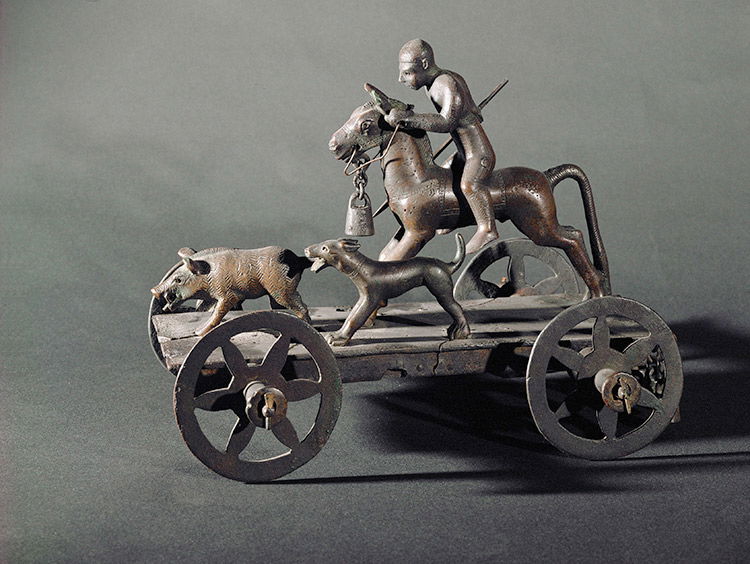
Although this new interpretation suggests they did not advance through military means, they did have two evolutionary technological innovations: the wheel and the horse. The Proto-Indo-Europeans certainly had a warrior caste and they seem to have set great store by manly prowess in battle. In his The Mighty Dead: Why Homer Matters (2014) the historian Adam Nicolson has argued persuasively that Homer's Iliad evokes a previous era of Proto-Indo-European warriors descending from the north to ransack the palaces and cities of the Mediterranean. But, mighty though their warriors were, the Proto-Indo-Europeans could not have conquered by military power alone. There were too few of them and cavalry charges and chariots were both inventions far in the future.
These people were nomads, who rode horses to control their vast herds and who put their wheels to use by making the wagons and carts that were their mobile homes. Hence their invisibility to the archeologists – they had neither permanent settlements nor buildings, but moved from one area to the next, through Europe and Iran and India in search of pasture for their herds. Theirs was a new form of nomadic farming and it was very successful at a time when settled farmers were struggling with the increasingly dry conditions of Bronze Age climate change.
Wealthy, well-fed, with wheels, the Proto-Indo-Europeans were like postwar Americans and the language they spoke was like English now, the prestige language of a successful and powerful people, isolating and killing off local languages, just as the majority of the 7,000 languages currently spoken in the world are fated to extinction and to be replaced, possibly by Spanish or Mandarin, but usually by English.
These Bronze Age people were inadvertent globalisers, transforming their known world, giving that world their voice and, in doing so, remaking that world in their own image. It was not just their language they bequeathed to the length and breadth of Europe and beyond but their culture and their mindset, too. Their influence can be seen in many areas, from their decimal numbers to their religious beliefs (those sky gods, ruled by Dyeu-pihter), to entertainment, the descendants of their epic poems including Homer, the Vedic epics of Sanskrit and even our films and novels.
Britons, Swedes, Russians, Indians, Iranians, Afghanis, everyone from Reykjavik to Nepal: they are all children of the Proto-Indo-Europeans.
Harry Ritchie is the author of English for the Natives: Discover the Grammar You Don't Know You Know (John Murray, 2014).


