

Sermons in the Sky: Apparitions in Early Modern Europe
Alexandra Walsham looks for the meaning of unusual phenomena widely reported across early modern Europe.
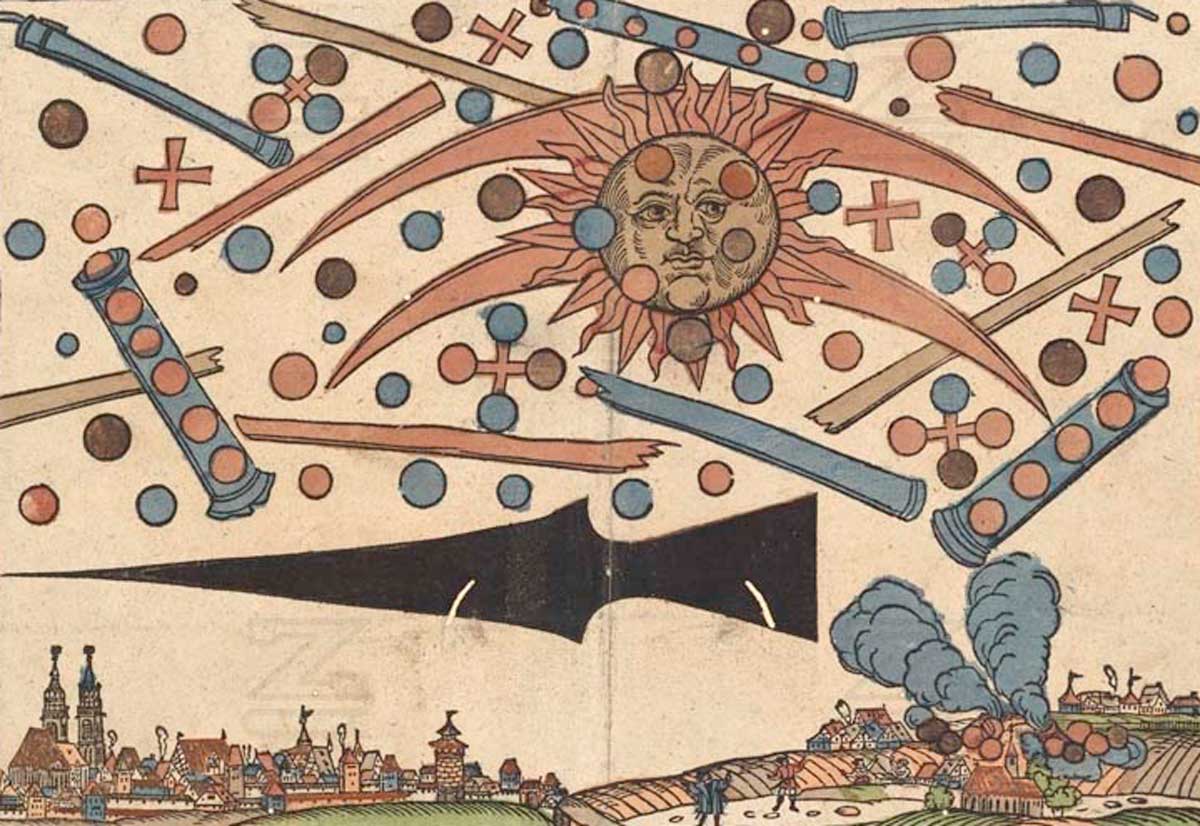
One September night in 1583 inhabitants of the city of London were greatly puzzled and troubled by a series of ‘wonderfull straunge sightes’ in the sky. Between eight o’clock and midnight the heavens were lit up with fiery constellations, ‘watery elements’ the colour of brimstone and blood, and shafts of light resembling arrows and spears. Fifteen years later frightened residents of the Cumbrian town of Cockermouth watched a fierce battle between regiments of soldiers take place in the elements above them. A similar vision of a spectral army seen over Berkshire one spring evening in 1628 was accompanied by the sound of heavy artillery and the semblance of a man steadily beating a drum. Many of those who witnessed this ‘miraculous’ apparition apparently ‘fell on their knees, and not only thought, but said, that verily the day of Judgement was come’. Triple suns and inverted rainbows perturbed observers in Sussex the following decade, and when a flaming sword appeared over several parts of Devon in 1638 an Axminster Justice of the Peace solemnly recorded it in his diary as a sinister portent of impending calamity.
Mysterious celestial sights of this kind were extremely common in sixteenth- and seventeenth-century England. The stuff of rumour and gossip and the subject of dozens of pamphlets and broadside ballads reporting strange and sensational news, they also filled the pages of chronicles, technical treatises, and popular anthologies of prodigies and wonders. Fascination with such phenomena was not confined to the credulous poor. Attested to by ‘worthy magistrates’, distinguished divines and respected men of letters, interest in heavenly spectacles transcended the barriers erected by wealth, education and social rank.
Nor was it limited to the British Isles. Early modern Europe was awash with accounts of bizarre and eerie apparitions. Phantom armies appeared high above hundreds of continental cities in the course of the period. Charging cavalry were discerned in the firmament near Nuremberg in 1554 and over Croatia in 1605, while a vision above Poland in January 1581 incorporated an ominous funeral procession of hooded black figures. Wittenberg was the scene of an apparition of a bloody sword and a cannon mounted on wheels in 1547; fourteen years later people at Eisleben saw an enormous crucifix, a rod and two fiery pillars. The ‘likeness’ of Atlas bearing the world on his shoulders and crying ‘Vigilate & Orate, (Watch and Pray)’ was perceived in the sky over Montpellier in 1573. Angels brandishing dangerous weapons proclaimed ‘woe, woe’ above Normandy and Picardy on several occasions in the late 1590s and the ghastly image of a wild man threatening vengeance terrified members of a community near Frankfurt around 1600. Visions of bears, lions and serpents fighting in the sky were also widespread: an account of two dragons which clashed over Ghent in 1579 was one of the many foreign news pamphlets London publishers had translated for the edification of their readers.
From a modern perspective, reports of such apparitions may seem like an acute form of collective delusion. There is a temptation to explain them away ‘scientifically’, as peculiar cloud formations, manifestations of the aurora borealis, or other meteorological anomalies. And yet to dismiss them as symptoms of ‘superstitious’ ignorance and quaint relics of a primitive mentality is to risk overlooking their historical and cultural significance. Like more recent sightings of flying saucers and extraterrestrial objects, the astonishing images early modern men and women saw projected in the air provide us with a unique glimpse of their deepest fears and anxieties. Close scrutiny of how contemporaries interpreted these intriguing visions reveals much about the underlying assumptions and pre-occupations of post-Reformation English and European society.
According to lay and clerical commentators alike, apparitions were sermons inscribed by the finger of God in the sky. They were ‘heralds’ and ‘trumpeters’ of His wrath and indignation, alarm bells alerting mankind to the punishments which the Almighty would shortly be inflicting upon it, ‘most apparent prints’ and ‘visible footsteps’ of His growing impatience with sin. Since the exhortations of godly ministers were scorned and ignored, the Lord had ordained ‘the Pulpit of the Heavens to be a Preacher of Repentance’ to His people on earth. Constant reiteration of this commonplace may help to explain why parishioners of the German village of Holzhausen were convinced that they had seen an image of Martin Luther hovering above them in June 1548! Along with monstrous babies, sixteen-headed cabbages, deformed animals and downpours of wheat, such prodigies warned of terrible plagues and proclaimed that the end of the world was imminent. Preaching before the House of Commons in 1628, Jeremiah Dyke, vicar of Epping, described them as ‘John Baptists of Judgement’. Like the handwriting which had appeared on the wall during King Belshazzar’s feast, they too prophesied doom and destruction.
These beliefs had ancient Christian and classical roots. The Old and New Testaments supplied ample proof that God used the natural world as a medium for communicating with and admonishing humanity: from the amazing signs shown to the Israelites in the wilderness, to the wonders listed in the Gospels as forerunners of Christ’s Second Coming. The books of Daniel and Revelation encouraged the idea that occult phenomena would prefigure the overthrow of the Antichrist and the advent of the millennium, while the Jewish historian Josephus’s famous account of the blazing comet, bright lights, and aerial battles which preceded the siege of Jerusalem in AD 70 further cemented the link between celestial marvels and future catastrophes. The same premise underpinned the many astrological prognostications which circulated in the late Middle Ages, in which peculiar sights in the heavens, along with unusual conjunctions of the planets and stars, were likewise interpreted as harbingers of political and social upheaval, auguries of the death of princes and the collapse of kingdoms. Revived during the Renaissance, the writings of Greek and Roman historians and natural philosophers, such as Livy and Pliny, also contained many remarkable omens and portents. All of these sources of influence converged to make speculation about the significance of prodigies a central component of late medieval popular culture.
The Reformation has often been represented as a movement which comprehensively rejected and violently disrupted the settled patterns of traditional piety. However, although Protestantism initiated a break with many aspects of the Roman Catholic past, it did nothing to arrest the tendency to read divine meaning into strange aberrations of nature or to undermine the notion that the universe was a sensitive gauge of human misconduct and moral disorder. Indeed, if anything, it seems to have reinforced it. Protestant theology placed renewed emphasis on the sovereignty and majesty of God and his constant providential intervention in temporal affairs. It also heightened apocalyptic expectancy, fostering the belief that contemporaries were living in the Last Days, when the cosmic battle between good and evil would reach a dramatic and cataclysmic conclusion. As historians have recently stressed, these observations cast doubt on Max Weber’s claim that the Reformation was a major watershed in the process of secularisation which he called ‘the disenchantment of the world’.
For Martin Luther and his successor Philip Melanchthon scrutiny of ‘visual impressions’, together with other signs and wonders, was a form of pious contemplation, a legitimate method of investigating the arcane purposes of the Almighty. John Calvin (1509-64) was more cautious, insisting that the Lord’s ways were beyond human comprehension and that it was presumptuous for mere human beings to ‘peep into the Ark of divine secrets’ and to seek to unravel the riddles of His Creation. Although they gave lip-service to this caveat, in practice Calvinists were no less inclined than Lutherans to regard nature as ‘God’s great book in folio’ and to analyse its irregularities as meticulously as they might do difficult passages in the Bible.
All over Europe ministers and pastors were at the forefront of efforts to record and interpret apparitions and other inexplicable phenomena. The second half of the sixteenth century saw the publication of many extensive collections of wonders such as Job Fincelius’s Wunderzeichen (1556), Conrad Lycosthenes’s Prodigiorum ac ostentorum chronicon (1557), and The Doome Warning all Men to the Judgemente (1581) compiled by Stephen Batman, chaplain to Archbishop Matthew Parker of Canterbury. The cumulative effect of these encyclopedias of the preternatural was to intensify fear that God would soon send His vengeance and to enhance anticipation that the Apocalypse was nigh.
Like other prodigies, celestial visions were a problematic category in Protestant thought. Their status was fraught with ambiguity. Reformation theologians insisted that miracles had ceased and that God no longer chose to override or operate in defiance of nature. But they still had to account for the many events which appeared ‘miraculous’ in the eyes of the average layman. There were several ways of tackling this challenge. One was to acknowledge that apparitions might be optical illusions created by elaborate tricks with mirrors or other ‘cunning devices’. A second was to suggest that spectral sights were sometimes the by-product of psychological disturbance or of a physical illness which interfered with and distorted the senses. Thirdly, they could be identified as diabolical in origin: false wonders wrought by that master magician, Lucifer, ‘stratagems of Satan’ designed to lead the innocent astray. This was a favourite way of discrediting prodigious visions exploited by the papists as propaganda for their cause – idolatrous visions of the Virgin Mary and the saints like those reported regularly in sixteenth-century Spain.
But the fourth explanation was the one most frequently invoked. All too often, it was argued, people without a detailed understanding of the normal workings of nature were simply unable to discern the hidden secondary causes of strange phenomena. Drawing on the theories of Aristotle and Pliny, scholars demonstrated that apparitions were the consequence of vapours and exhalations rapidly inflaming and cooling in the upper regions of the air. In his Certaine Secrete Wonders of Nature (1569), the Frenchman Pierre Boaistuau explained that mock suns were merely reflections projected onto clouds heavily laden with droplets of rain, while the Cambridge divine William Fulke devoted a section of his treatise on meteors, A Goodly Gallery with a most Pleasaunt Prospect, into the Garden of Naturall Contemplation (1563), to proving that a vision of a draco volans or fire-breathing dragon seen over the Thames on May Day 1547 was ‘nothing else’ but a curious configuration of ‘clouds and smoke’. As for menacing luminous impressions of aerial battles, these too were simply the unusual side effects of particular atmospheric conditions.
And yet none of these writers regarded enquiry into the natural causes of apparitions as incompatible with the notion that they were ambassadors sent by the Lord ‘to declare his power and move us to amendment of life’. They sharply criticised those of ‘Gallileo’s temper’ who sought to push the deity out of the picture completely. After all, it was axiomatic that ‘not so much as one Sparrow falleth to the ground, without God’s providence’. He simply used the elements as the couriers and executioners of His just punishments. In this sense, religious speculation stimulated rather than restrained scientific investigation – and vice versa. In striving to understand the natural world, Protestants like William Fulke and Philip Melanchthon were glorifying the Almighty. And in their attempts to decipher the cryptic messages enshrined in Creation they were also contributing to the expansion of botanical, zoological, astronomical and meteorological knowledge.
This, then, was the intellectual framework within which contemporaries interpreted celestial spectacles. It is now time to analyse the contents of these visions in a little more detail. Apparitions of angels wielding sabres and devils with forked tails and cloven feet tell us of a culture in which good and evil spirits were believed to be ever present, while the naked but hairy figure of the wildman which haunted German villagers around 1600 alerts us to the mythology surrounding creatures which hovered on the boundary between human and beast.
And just as reports of UFOs highlight late twentieth-century fears of invasion by aliens from other galaxies, so too do the sinister visions of violence and bloodshed seen in early modern England and Europe give graphic expression to the events that filled contemporaries with greatest horror and dread. As one writer explained, ‘Battles in the Air were most lively pictures of the same to be seen on earth’. They were premonitions of the tragedy about to engulf those who were witnesses to them.
Not surprisingly, such apparitions proliferated significantly in contexts of political and religious instability. On the fringes of Eastern Europe communities often saw the characteristically crescent-shaped blades used by the Ottoman Turks – ominous symbols of the threat Islam presented on the frontiers of Christendom. In the period between the invasion by the French king Charles VIII and the sack of Rome by the troops of the Holy Roman Emperor Charles V in 1527, Italians observed many visions of hideous confrontation in the air. So too did the French amid the turmoil, hatred and destruction generated by the protracted Wars of Religion between the Catholics and Huguenots in the seond half of the sixteenth century. They were likewise a common sight in the young and still vulnerable Dutch Republic. The conflicts which had racked the Holy Roman Empire in the 1540s and 50s were also accompanied by many extraordinary apparitions: a few days before one crucial battle between Maurice, Duke of Saxony, and Albert, Marquis of Brandenburg, for instance, the image of a huge man dripping blood and emanating sparks of fire appeared in the heavens. Such visions multiplied during the Thirty Years’ War between 1618 and 1648, when confessional tension and discord culminated once more in prolonged military confrontation.
Continental prodigies of this period were widely publicised in England in translations of foreign newsbooks and compilations like Captain L. Brinkmair’s The Warnings of Germany (1638). Fascinated and appalled by the similarity between these portents and strange phenomena seen on their own side of the Channel, many observers became increasingly convinced that God was sending advance notice that the English, too, would soon taste the cup of affliction. John Everard, an outspoken lecturer at St Martin in the Fields, for example, saw a disturbing connection between the appearance of three suns above the Cornish market town of Tregony in December 1621 and comparable signs observed prior to the Catholic massacre of Swiss Protestants at Valletelline in July 1620. Surely, thundered dozens of preachers, this sinful nation could not hope to be spared the horrors which had been endured by countries abroad for a whole generation? The Angel of the Lord had ‘poured out his viall of red wine’ on Germany and France, proclaimed Daniel Featley in the late 1620s, ‘our sins as it were holier to him to stretch his hand over the narrow sea, and cast the dregs of it on us, who have been long settled upon our lees: and undoubtedly this will be our potion to drink’.
Predictably, in the decade preceding the breakdown of relations between Charles I and Parliament in 1642, reports of spectral armies clashing in the firmament sprang up in large numbers. Just as visions of huge navies of ships had indexed expectations of the ‘invincible’ Spanish Armada in the mid- and late- 1580s, so the Civil War was clearly no surprise when it came: it had already been the theme of scores of God’s sermons in the sky. We may even wonder if the anxieties which they enshrined played a part in helping to bring it about.
Once the fighting broke out, there were many sightings in the vicinity of key battlefields such as Edgehill in Northamptonshire. At Aldeborough in Suffolk in August of 1642 muskets and ordnance were heard discharging in the air for over an hour, at the end of which appeared a group of angels with stringed and wind instruments playing melodious music. According to the puritan schoolmaster John Vicars, who described this ‘Masterpiece of Wonderment’ in his Prodigies and Apparitions or Englands Warning Pieces (1642-43), it signalled that ‘the terrible storm of wars and woes’ stirred up by ‘Papists, Atheists, and Profane Malignants’ would eventually make way for ‘a glorious peace and perfect reformation and for the setting up of Christ’s throne’.
Vicars’s millenarian reading of this vision reflects the fact that by the mid-seventeenth century the interpretation of prodigies had become dangerously politicised. Indeed his entire tract was designed to demonstrate divine displeasure at the policies pursued by Archbishop William Laud in the 1630s. But those who supported the Stuart king proved equally adept at harnessing aerial spectacles as evidence that God was on their side. A striking case in point is the report that the headless body of the royal martyr Charles had been seen hovering over the place of his execution in Whitehall in 1649. Blatantly exploited as propaganda by Royalists and Parliamentarians throughout that decade, prodigies were also utilised as powerful weapons of faction in the early Restoration. In a series of three tracts with the title Mirabilis Annus published in 1661 and 1662, the beleaguered Nonconformists assembled a collection of signs and wonders in support of their cause. In one of the many celestial apparitions they cited, armed men had been seen thrusting preachers from their pulpits above East Sussex – an obvious manifestation of the Lord’s displeasure at the ejection of so many Dissenting ministers from their church livings. It was significant that the editors of the treatise felt it necessary to ward off suggestions that some of the examples they included were merely ‘feigned’ and fabricated for the occasion. In the long run the appropriation, embellishment and perhaps even the invention of such spectacles for sectarian ends probably contributed to discrediting them and to fostering scepticism towards manifestations of the supernatural. After 1700 many learned lay and clerical observers began to condemn belief in omens and portents as a form of ‘vulgar superstition’ and irrational ‘enthusiasm’.
But in the preceding period this development, though important, was still embryonic. Throughout the century between the Reformation and the Civil War the consensus of opinion endorsed the traditional interpretation of visions and other prodigious phenomena as providential messengers which had been central to medieval cosmology. Powerfully reinforcing the idea of a moralised universe, Protestantism served to encourage the predisposition of contemporaries to invest celestial sights with eschatological significance. Notwithstanding growing awareness that such spectacles could be explained in terms of ‘natural causes’, in England, as in Europe as a whole, both the elite and the lower orders continued to see them as perturbing signs of divine indignation. We may see them as symptoms of profound political, ecclesiastical and social disequilibrium.
- Alexandra Walsham is Senior Lecturer in History, University of Exeter.

