

Sappho and her Brothers
The survival of a recently discovered song by the early Greek poet is little short of a miracle, says David Gribble. How was it discovered and what does it add to our picture of a complex and elusive figure?
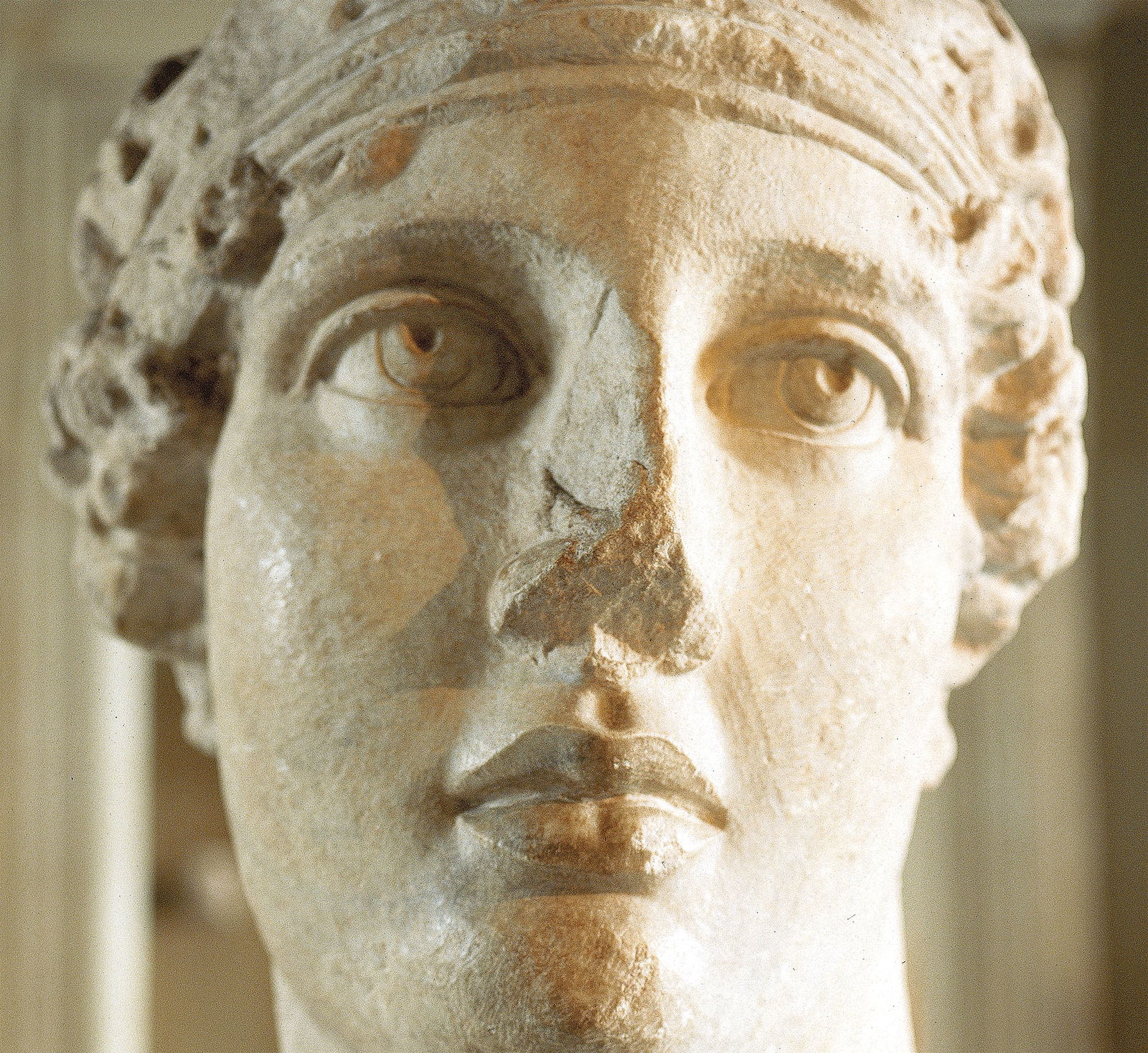
This story starts with a prayer and a song, sung around 600 BC on the Greek island of Lesbos by a woman seeking the safe return of her brother from a voyage. The woman was Sappho, one of the first poets of western literature, labelled the ‘tenth Muse’ by her admiring readers in the ancient world and one of the few female voices we have from antiquity.
The brother was Charaxus, who, Herodotus tells us, travelled to Naucratis in Egypt, where he fell in love with the courtesan Rhodopis, and that Sappho afterwards rebuked him in a song.
By a miracle of survival, we can once again, for the first time in more than a millennium, read Sappho’s prayer, hear the singer’s voice, experience her hopes for her brother’s return and her trust in the gods. Recovered from the sands of Egypt, and latterly from the storage rooms of a university library, it has recently been published by the Oxford papyrologist, Dirk Obbink.
Sappho’s poetry and the mystery of her biography have impressed and excited readers since the ancient world. But the story of the survival of her works is just as exciting and astonishing and the transmission of this new ‘brothers’ song (the other brother being Larichus) is no less so.
Sappho was a ‘lyric’ poet, her works accompanied by an instrument (usually a lyre, hence the word ‘lyric’) and in some cases by dancing, too. She must have been primarily an oral poet, as writing was secondary to the spoken word. To imagine Sappho composing, we should think along the lines of a singer-songwriter, blending words with music to the accompaniment of a guitar, rather than a Byron or a Shelley at their desk.
We no longer have the music to her songs, but the metre of the verse reveals the rhythm at least. Sappho’s songs, like other Greek lyric, were composed in patterns of long and short syllables, patterns which we know, through comparison with ancient Sanskrit verse, go back to Indo-European prototypes.
Where the song was performed and for what audience, we do not know. What is clear is that song played a central role in Sappho’s society. Performed at festivals, sacrifices, symposia and feasts, songs composed and performed by experts like Sappho helped archaic (800-480 BC) Greeks express and understand their relationship to one another and to their gods and provided a feeling of community and elevation above the everyday.
Although it is possible that the song was committed to writing for its premier performance, it is more likely that it was transmitted orally like the Homeric poems. Sappho’s songs became ‘hits’, memorised and recited at symposia and other events. It was probably only later, in a more literate age, that they were written down. By the time of Pericles in the late fifth century BC Sappho’s songs were circulating in written form. This preserved them, but came with the unfortunate effect of the loss of the music.
By the early third century BC, the library of the Ptolemies in the Egyptian city of Alexandria was able to collect nine ‘books’ of songs attributed to Sappho, organised according to the metre in which they were written. The Alexandrian librarians can be seen as the West’s first professional scholars, buying manuscripts in bulk from across the Greek world and editing, collecting and systematising to produce canonical editions, which preserved Sappho and other poets and authors for posterity. The Alexandrians were also poets themselves, inspired not just to collect and preserve the poetry of the golden age of Greece, but to add to it.
Sappho’s song about her brothers was in Book One of the Alexandrian collection, which contained works in the ‘Sapphic’ metre, including many of her most celebrated songs about love and her family. ‘Book’ in this case means a length of papyrus a few metres long, wound around sticks at each end. The scroll was read by holding the roll in each hand and rolling the papyrus from one hand to the other, to reveal the next ‘page’ of script.
Despite the difficulties an Alexandrian Greek must have had in reading Sappho by the time of the Roman Empire, editions of her poetry continued to circulate among the Greek elite who ruled Egypt. Sappho was a canonised classic and to read her works was a sign of the reader’s culture and Hellenism. And, as we know from ancient reactions (such as Longinus’ work, On the Sublime), Sappho’s startling musical and erotic poetry delighted ancient readers as much as it does modern. Copies of lyric poets’ work were kept and read even in a provincial town such as Oxyrynchus, where most of the papyri recovered from Egypt have been found.
It is to these late Greek Egyptian readers that we owe the survival of the brothers song. Egypt – the source of the papyrus paper that allowed its propagation, and the home of the scholars who had carefully collected it – was also to be the place responsible for its preservation. Some time in the third century ad, which we can tell from the handwriting, a copy of Sappho Book One was made and bought by an educated Greek. The scroll was used and loved – at one point it was accidentally ripped and the tear repaired – before it became too damaged for repair and was discarded. A portion of one of the papyrus pages, containing the last five stanzas of the brother’s song and fragments of the first two stanzas of a further song addressed to Aphrodite, survived intact.
***
One use the Egyptians found for waste papyri was to make ‘cartonnage’, a kind of papier-mâché. It was the practice in Egypt to protect mummies not only by wrapping them in linen, but also by applying panels made of this cartonnage material, typically coated in stucco and painted with a standardised image of the deceased. Many papyri have been preserved in this way.
Cartonnage was used for other purposes, too: for book bindings, for example. This was probably the fate of the discarded papyrus piece with the brothers song on it. Folded and pasted together with other torn papyri, it may have served for a time to protect another unknown text before finding its way once again to one of Egypt’s papyrus graveyards, where it would continue to lie for the next one and a half millennia – a literary time capsule.
Meanwhile, the preservation of Sappho and the other Greek lyric poets was under threat. Papyrus is a fragile medium and the survival of literary works in the ancient world was dependent on their copying and recopying by skilled scribes. Not long after the Sapphic manuscript was consigned to the scrapheap, the appetite and ability to re-transcribe literary works went into sharp decline. The weakening of the Roman and Byzantine empires reduced the literary class to a tiny group; and in a Christian culture there was little demand for a pagan female poet known for her homosexual erotic poetry. By the 12th century, the Byzantine scholar Tzetzes wrote that the works of Sappho had been entirely lost to time. As Byron wrote:
The isles of Greece! the isles of Greece
Where burning Sappho loved and sung,
Where grew the arts of war and peace,
Where Delos rose, and Phœbus sprung.
When Byron wrote these lines Sappho was little more than a legend, her works surviving in fragmentary lines and words (and, in one case, a whole song) quoted by other authors whose works had survived.
At the turn of the 20th century, all that was to change. European collectors and archaeologists descended on Egypt in search of antiquities and quickly discovered the literary treasures which, because of the dryness of the soil, could survive, given the right conditions, for centuries, without much deterioration of the papyrus. Huge volumes of papyri were discovered, mostly as scraps in the rubbish tips of provincial towns, such as those at Oxyrynchus, but rarely as whole books accidentally preserved. By the early 20th century, scholars had also realised that the casings of mummies (in a few cases, the mummies of crocodiles) could also harbour lost papyri. A new discipline was born – papyrology – the preservation, restoration and interpretation of the new discoveries.
***
Most of the recovered papyri were administrative documents, letters, accounts and so on. But literary works were also preserved and by the early 20th century papyrologists were publishing substantial new fragments and, in some cases, whole works, which had been thought lost forever, including hundreds of lines (or fragments of lines) from Sappho.
The recovery of papyri from Egypt became a mad scramble between European excavators, their Egyptian workmen, collectors and pillagers. So it was not surprising that a great number of papyri ended up in private hands. It was this route which led to a private collector making a call to Dirk Obbink with a request to examine and identify a papyrus he had recently acquired. The piece of papyrus cartonnage had been bequeathed by a private collector to the University of Mississippi, where it had lain, unrecognised, in its store rooms for years, before being auctioned at Christie’s in 2011 as part of a much larger group of Egyptian papyrus fragments. Only later did the new owner dissolve the layers of compacted papyri to release the Sapphic manuscript.
Obbink’s analysis soon showed that the text must be a song of Sappho. It was written in the poet’s Aeolic dialect and Sapphic metre and mentioned two of her brothers, whose names we knew from other sources. Moreover, the text overlaps in places with other, previously published, Sapphic fragments. Its authenticity was finally confirmed by carbon-dating, which dated the papyrus to around 200 AD.
The discovery of papyri from excavations in Egypt has all but dried up. It may be that the discovery of new Sappho songs will rely not on excavation from the sands of Egypt, but on fragments of her poems lying, unpublished or unrecognised, in libraries and private collections.
The discovery of Egyptian papyri has returned Sappho to us in a way that Byron could never possibly have imagined. Nevertheless, we can still only read about one per cent of the nine books of Sappho collected in Alexandria. What is more, many papyri are exceedingly fragmentary, recording only line ends or beginnings, or in some cases, mere scraps. The new brothers song is unusual in this respect: almost the whole poem (apart from the first stanza) is preserved.
Many readers have found an enticing, mysterious, or ‘pure’ quality in the fragmentary nature of Sappho’s songs, a ‘pleasure in ruins’. Ezra Pound’s four-word poem ‘Papyrus’, a made-up Sappho-style fragment from his 1916 collection, Lustra, celebrates this allusive and elusive quality of the new fragments, which were then just starting to be published:
Spring …
Too long …
Gongyla …
Many of Sappho’s fragments look just like this, marked out with an apparatus of dots for letters where the reading is not clear and square brackets around words or lines that the editor has filled out with suggested completions. Sappho’s fragments become a sheet for us to write our interpretation, make our own Sappho to suit our desires. So, for example, we could restore Pound’s imaginary fragment:
Spring [sends forth the flowers, but for me]
too long [have I suffered with desire for the lovely]
Gongyla, [who has departed]
As well as restoration of text, scholars have tried to recreate the social context which gave rise to the songs, from the poems themselves and from ancient accounts. But reliable information about Sappho and her society is hard to come by. Many myths and stories about Sappho circulated in the ancient world, based on false inferences from her songs, fabulous oral traditions and pure invention. Because of the love of women professed in her works, she gave us the common meaning of the word ‘lesbian’. Attempts of modern scholars to explain the context in which Sappho’s songs were performed, though, have sometimes been motivated by a misguided attempt to free her from the taint of homosexuality. They imagined her as a kind of Victorian schoolmistress, educating young girls in music and culture.
Many believe that the only reliable information about Sappho comes from what we can piece together from the fragments themselves. Reading Sappho (and trying to interpret the myths, glosses and explanations of later antiquity) is inevitably a process of filling in the square brackets, with the risk of introducing our own prejudices and preconceptions.
There are some things, however, which we can reliably say about Sappho’s songs and the context in which they were performed.
First, it is generally agreed that Sappho’s works were composed for a performance of some kind. These are songs to be enjoyed live. The musicality of Sappho’s verse, the way the vowels and consonants are put together (even without the benefit of musical accompaniment) impressed ancient readers.
Second, many of the songs are erotic, infused with a rich sexual vocabulary and imagery akin to that used by other (male) lyric poets. In Sappho, however, the objects of desire, the causes of unbearable eros, which in her songs paralyses the body, stills the tongue and brings the singer close to death, are young women. The word pais (‘child’, ‘girl’) is sometimes used, though whether a relationship between a mature woman and an adolescent is intended, such as those characteristic of Greek male homoerotic relationships, is not clear.
There is evidence from archaic Sparta of female groups, agelai, composed of girls before marriage, bound by erotic ties. Papyrus fragments of the (male) Spartan poet Alcman preserve marriage songs to be sung by girls dancing in chorus engaging in stylised erotic banter. Some scholars have even imagined Sappho as the trainer of some kind of ‘initiatory’ group like this, of girls on the cusp of marriage, in which the cultivation of beauty went closely together with expressions of homoerotic feeling. There is no clear evidence for this in the songs. We can safely say, however, that the homoeroticism in Sappho’s songs is rooted in a social context. We should not imagine her as some kind of sexual revolutionary; it is more likely that homoeroticism was an accepted part of the socialisation of her society and circle, like the male homoeroticism we are familiar with from Plato.
Most of Sappho’s compositions have a religious dimension: some are ‘hymns’, i.e., songs addressed to a god, calling on their presence or their assistance. They are infused by a sense of the numinous power of gods to inspire, to destroy, to help and to harm. Pre-eminent among Sappho’s gods is Aphrodite, who in the songs inspires eros and the blossoming fecundity of nature and is the cause of ruinous infatuation. Indeed, some have seen Sappho as having some cultic role in the worship of this delightful yet baneful goddess.
Finally, many songs have a deeply personal element. Some of them include Sappho’s own name in the text (for example, she imagines Aphrodite addressing her by name) and the names of other individuals, such as Gongyla. The following song preserved on papyrus is a good example. In it the singer consoles one Atthis, whose female friend/lover has gone to the nearby kingdom of Lydia in Asia Minor, perhaps to marry into a Lydian family:
… often, turning her mind in this direction,
…. she [honours?] you like a goddess [?]. She delighted particularly in your song.
But now she stands out among the Lydian women,
As sometimes, when the sun
Has set, the rosy-fingered moon
Surpasses all the stars; its light
Reaches equally over the salt sea and the flower-filled fields;
And the beautiful dew is spread out,
And the roses and tender chervil and fragrant clover are in bloom.
And often as she goes about, she remembers
Gentle Atthis with longing,
And [her] tender heart is consumed …
(Sappho fragment 96, lines 2-17)
The songs typically involve or suggest a social setting of some sort, a group (whose members are sometimes named) against which personal relations are played out. Sappho’s contemporary Alcaeus, who lived on Lesbos at about the same time, composed works performed for and in his hetairia, a male social, political and drinking group. Did the women in Sappho’s songs form part of a female hetairia, bound together by the cultivation of elegance and eros, just as Alcaeus’ was by war and wine?
***
It is important to recognise the limits of our conjectures. Sappho’s songs were probably performed at a wide variety of occasions, which we can only guess at: there is no one simple answer to the question of the context of their composition.
So what does the new discovery add to our understanding of this complex and alluring figure and the society that gave rise to her songs?
The new song is not about ‘typical’ Sapphic themes like eros, marriage, Aphrodite or the cultivation of luxury. Instead it is about an absent brother. (In fact, we do already have one Sapphic song fragment, number five, addressed to an [unnamed] brother. It was the first papyrus fragment of Sappho to be discovered in Egypt: ‘Lady Nereids’, the singer prays, ‘grant that my brother may return here unharmed to me’.)
The first four-line stanza of the new song is missing. When the text starts, we find the singer addressing another woman, whose name, if she was named, has been lost. Some have suggested it could be the singer’s mother but it could be another woman from Sappho’s group; at any rate, it is someone just as closely interested in the fate of the absent man as the singer. The singer is talking about two men, Charaxus and Larichus, both of them identified since ancient times as Sappho’s brothers.
The song is an ardent prayer for Charaxus’ return from a voyage and there is no suggestion of criticism of him, so we have to imagine a different voyage from the one in Herodotus that took Charaxus to Naucratis and into the arms of the courtesan Rhodopis and led to Sappho’s ridicule of him (if, indeed, that story is true).
The singer must have started by saying something like ‘How often have I told you that worrying about an absent friend will not bring him back any sooner’. And she goes on:
… And yet you are always chattering away:
‘May Charaxus come’, you say,
‘With a full ship’. That, I think, Zeus
Knows, and all the other gods. It’s not something
You should be thinking about.
But rather send me and bid me
Make many prayers to Queen Hera
That Charaxus may arrive, steering
His ship safe back here,
And find us safe and sound. Let us
Entrust all other things to the gods.
Great storms turn quickly
Into fair weather.
And when the king of Olympus wants
To send a divine helper to help someone in
Their troubles, that person grows fortunate
And richly blessed.
As for us, if Larichus ever lifts up his head,
and becomes a man,
How quickly would we be freed
from our great despondency.
The new song may not be as sexy, or display such verbal fireworks, as others of Sappho’s songs, but it is a subtle work of restrained emotion, which tells us a lot about Sappho and her society. Though the subject matter may be untypical, the themes and form are vintage Sappho: the consolation of a female addressee, the intimate style of address, the dialogue between women, the theme of departure and loss. These are all familiar themes, seen, for example, in the ‘Atthis’ song.
The new song shows us, for the first time in such sustained fashion, Sappho addressing a male world. We know that the Lesbos of Sappho’s day was riven by political conflict between competing families and groups, struggles which dominate the songs of Sappho’s contemporary, Alcaeus. These conflicts, the rise and fall of the fortunes of leaders and followers, their absence away from home, whether for political or peaceful reasons, must have dominated the lives of the women of Lesbos, too, though there is little direct evidence of it in the surviving fragments. The new song presents a scene that must have been played out frequently in the Lesbos of Sappho’s day: women praying for the return (like Charaxus), or the right moral attitude (Larichus), of the men they depend on.
***
The song is not really a prayer at all, but rather a preparation for a prayer, a dialogue about the way one should pray and about the proper attitude for women to adopt towards each other, towards men and towards the gods. Getting these things right – the right words to choose, the right moral attitude in adversity (resilience, trusting in the divine, not worrying or ‘chattering’) – obviously matters deeply and the song shows women engaged in rehearsing the words, formulating the attitudes. We have other similar examples in Greek literature of women formulating prayers for missing men-folk: Penelope praying for the return of her husband Odysseus and son Telemachus in theOdyssey, or Electra in Aeschylus’ Choephori, praying for the return of her brother Orestes. But this new song offers a rare glimpse of the construction and presentation of a female value system by women.
Both singer and addressee are female – and the original audience of this song was probably all-female, too. Yet the song also reaches out to the male world. The admonition to Larichus to ‘become a man’ seems intended for the ears of Larichus. Eventually the song must have reached the male world in order for it to be transmitted to us. Perhaps, then, the song was also destined for a further audience of men, who receive the message by hearing what women say about them ‘behind closed doors’. If this is right, the song is not just a drama about the lot of the women who wait at home, but an indirect communication to men.
The new song, preserved by Alexandrian scholars, Greek-Egyptian readers and literary papyri, gives us not just the experience of a woman 2,600 years ago longing for the return of a missing brother, but an archaic Greek drama crafted by women for women, with a distinctively female morality and a concept of the role of women in the world.
David Gribble is the author of Alcibiades and Athens: A Study in Literary Presentation (Oxford Classical Monographs, 1999).

