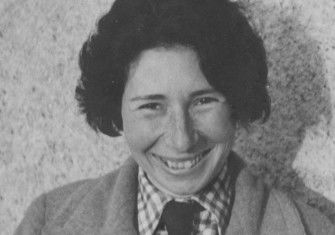
When Ethel Rosenberg was awaiting trial at the Women’s House of Detention in 1951, she would often, after lights were out, belt out songs in her high soprano voice. Miriam Moskowitz, a fellow prisoner, recalled that Ethel was treated ‘like a lady’ and well liked, even by the guards. Her renditions of ‘Goodnight Irene’ and Brahms’ ‘Lullaby’ won her such respect that her fellow prisoners crocheted her a hat which she wore to court to stand trial for espionage.
Such humanising details about Rosenberg’s character emerge from Anne Sebba’s compelling new biography. Rosenberg, who was executed as a spy on 19 June 1953 with her husband Julius, is revealed as a loving mother, a committed communist and a talented performer. While the contemporary American media demonised Ethel as the driving force behind Julius’ involvement with Soviet intelligence, Sebba documents how the prosecution manipulated the evidence against her and how she refused to testify against her husband to spare her own life.
Julius had indeed recruited agents for the Soviets and passed on information about the development of nuclear weapons from David Greenglass, Ethel’s brother, who worked at Los Alamos. Ethel Rosenberg was very politically active and committed to the communist cause but was never a spy. Instead, in Sebba’s telling, she came from a modest, Jewish immigrant family and harboured ambitions as a performer, even winning a place with a prestigious amateur chorus based at Carnegie Hall. She left school at 16 to support her family during the Great Depression and confined her singing to leftist fundraisers around New York.
Rosenberg had a fraught relationship with her mother, Tessie, who openly favoured David and disapproved of her eldest daughter’s ambitions. Rosenberg felt so insecure about her ability to mother her sons Michael and Robby, after years of Tessie’s cruel criticism, that she entered therapy. This profoundly important, but overlooked, aspect of Rosenberg’s life is explored through interviews with her therapist, Elizabeth Phillips, who believes that, despite the public vilification and execution of their parents, the Rosenberg boys thrived because of the good mothering they received in their early years.
So why did Ethel sacrifice her life rather than incriminate Julius? Sebba suggests it was a moral choice. Her brother had no such qualms. David and his wife Ruth testified that Ethel had typed up the notes about nuclear weapons that Julius passed to the Soviets. These false statements sealed her conviction. David would later confess to lying in court about this detail.
Rosenberg’s character was, of course, scrutinised during her trial for feminine flaws. Since she was three years older than Julius, the media portrayed her as a manipulative ‘mature woman’, who drove her feeble husband to commit treason. Even President Eisenhower, writing about his distaste for sentencing a woman to death, described her as ‘the leader in everything they did in the spy ring’. If Rosenberg’s sentence were to be commuted, he feared ‘the Soviets would simply recruit their spies from among women’.
Eisenhower’s suggestion that Ethel Rosenberg’s execution might deter the Soviets from using female agents was ironic since many were already operating, without detection. Tragically, it was Rosenberg, ‘a profoundly moral woman,’ according to Sebba, who paid the price when she was ‘executed in the most brutally incompetent manner’.
Ethel Rosenberg: A Cold War Tragedy
Anne Sebba
Weidenfeld & Nicolson 288pp £20.00
Buy from bookshop.org (affiliate link)
Julie Wheelwright is the author of Sisters in Arms: Female Warriors from Antiquity to the New Millennium (Osprey, 2020).