

Public Opinion and the Second Anglo-Dutch War, 1664-1667
During the 17th century commercial and colonial interests embittered Anglo-Dutch relations. In both camps, writes C.R. Boxer, journalists and pamphleteers helped to keep the feud alive.
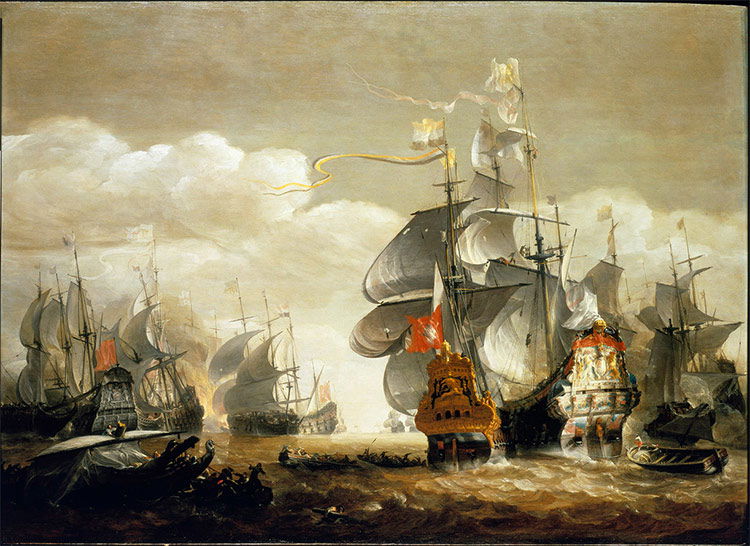 The causes of the tension which prevailed for most of the 17th century between the two Protestant powers on opposite sides of the North Sea were many and varied. Among the most important and persistent were the disputes over the 'Great Fishery', the struggle for the cloth markets, competition for the Muscovy trade, rivalry in the colonial world from Manhattan to the Moluccas, and arguments over the definition of contraband and the freedom of the seas.
To take the last point first, as the greatest seaborne carriers of the world for over a century, the Dutch early formulated their determination to uphold the principle of 'free ship, free goods'. In 1608 the Provincial States of Holland passed a secret resolution that they would never 'in whole or in part, directly or indirectly, withdraw, surrender, or renounce the freedom of the seas, everywhere and in all regions of the world'.
They eventually persuaded the States-General of the United Provinces of the Free Netherlands to adopt the same standpoint; and this august body solemnly affirmed in 1645 that 'the existence, welfare and reputation of the State consists in navigation and maritime trade'. This conviction was not confined to the merchant-oligarchs who played the leading part in guiding the destinies of the Dutch Republic, but it was shared by the middle and lower classes in the maritime provinces of Holland and Zeeland, which formed the core of this loosely federated state.
Even in the other five provinces there were a fair number of people who were convinced that the inhabitants of the United Provinces must strive to overcome any restriction on free navigation, must reserve the right to sail on all seas, to fish off all coasts, to trade with all nations, to respect the rights of neutrals in wartime, and to limit the definition of contraband as narrowly as possible.
These pretensions were bound to clash with those of the English, who, just at this period, were reviving, defining and extending an ancient and somewhat nebulous claim of English kings to the exclusive sovereignty of 'the British Seas'. In 1609, the same year in which Grotius's celebrated Mare Liberum first saw light, a royal proclamation announced that any person fishing off the British coasts would henceforth require a licence. James I was never able to enforce this measure effectively, for lack of adequate naval power; but the 'ship-money' fleet built by Charles I and the further strengthening of the navy under the Commonwealth had placed the English in a much stronger position by 1652.
Might was supported by right in English eyes through the publication of John Selden's Mare Clausum Seu Dominum Maris in 1635. This counterblast to Grotius claimed all the seas 'which flow between England and the opposite coasts and ports' as waters where English warships were entitled to exact 'the honours of the flag' from all foreign vessels they encountered. These latter were to lower their topsails and strike their flags on such occasions, in acknowledgement of the King (or of the Commonwealth) of England's supremacy in the Narrow Seas.
As with the Dutch claims to the freedom of the seas, these English pretensions were not merely asserted by self-important rulers or by pedantic antiquarians, but were emphatically endorsed by Englishmen in general and by those who gained their livelihood at sea in particular.
The rivalry, often amounting to enmity, which existed between the merchants and mariners on the opposite sides of the North Sea was greatly exacerbated by their clashes in the colonial world. The incident that generated most bad blood was the summary trial and execution of some Englishmen on the Moluccan island of Amboina by the local representatives of the Dutch East-India Company in 1623.
Dutch and English historians still differ for the most part in their assessments as to how far, if at all, the defendants were guilty of the plot of which they were accused; but public opinion in England was firmly convinced by a stream of pamphlets that poured from the press that they were innocent victims of the 'unjust, cruel, and barbarous proceedings' of the Dutch East-India Company.
In much the same way as Bishop Bartolome de las Casas's account of Spanish atrocities in the West Indies (Brevísima Relación de la destrucción de las Indias, 1553) was reprinted in French, Dutch, and English translations whenever it was desired to inflame public opinion in those countries against Spain, so the English versions of 'The Massacre of Amboina' were trotted out whenever our relations with the United Provinces became acrimonious.
If nationalistic war-fever was, on the whole, somewhat stronger and more widespread in the Commonwealth of England than in the United Provinces during the first Anglo-Dutch war of 1652-54, neutral foreigners did not think that there was a great deal of difference in this respect, as Protestant Swiss and Scandinavian would-be mediators learnt by experience. An exasperated Swedish diplomat wrote to Queen Christina from London in June 1653, that she might as well abandon her well-meant but futile efforts at mediation, and leave the two contenders to fight it out.
'Both these states and nations, but especially this one here, are insufferably arrogant, and it is possible that God will yet humble their pride.' To some extent Largerfeldt was right; but although both sides were glad enough to make peace in April 1654, the English had the most reason to be satisfied with the outcome of the war. Dutch successes in the East Indies and in the Mediterranean had been of no avail against English victories in the decisive theatre of the North Sea, where a catastrophic drop in the Dutch Customs yields and the loss of many rich prizes proved the magnitude of their defeat.
But if English seaborne trade had profited by the crippling of the Dutch merchant-marine in 1653, and if many English merchants and mariners could look back on the result of the war with considerable satisfaction, this convinced them that they could easily beat the Dutch another time. This widespread conviction profoundly affected English thought and policy in the early years of the Restoration by engendering that pride which commonly goes before a fall.
During the Protectorate interlude of 1654-60, Anglo-Dutch rivalry was centred chiefly on the Baltic and on the implementation of the Navigation Act of 1651. From the English point of view, the working of this Act, even when strengthened and better enforced in 1660, left a good deal to be desired, and the Dutch made a disconcertingly rapid recovery from the economic depression into which the first war had temporarily plunged them. Sir George Downing, the English envoy in Holland, affirmed in 1662 that 'commodities of all sorts are carried for England and Ireland, and in Dutch ships even as if there were no such Act, nor is there more miscarriage to any port than to London itself'.
Cromwell's dream of a crusading Protestant alliance against Roman Catholic Europe, with a division of the colonial world between the two republics – somewhat on the lines of the Hispano-Portuguese Treaty of Tordesillas in 1494 – foundered on the fact that Spain quickly became Holland's best customer after the Treaty of Munster in 1648. But though Cromwell complained that the Dutch 'preferred gain to godliness', he took care to avoid a renewal of hostilities. His restraint was matched by that of Johan de Witt, who directed the foreign policy of the United Provinces from 1653 onwards.
After the Restoration, King Charles II and Clarendon for some years acted as restraining influences on the growth of anti-Dutch bellicosity among all classes in England; but the Anglo-Dutch Treaty of friendship signed in September 1662 settled none of the outstanding disputes between the two countries and proved even more ephemeral than most treaties.
The Diary of Samuel Pepys reflects the belief that the Court, the City of London, the Duke of York, and the shareholders of the Royal African Company were all 'mad for a Dutch war' by 1664. On the other side of the North Sea, Sir George Downing reported with equal accuracy from The Hague that the Dutch were all for 'mare liberum in the British Seas, but mare clausum on the coast of Africa and in the East Indies'.
Negotiations for the abortive treaty of 1662 were still in progress when the Dutch envoy in London wrote to De Witt in July of that year:
'The people in general and the merchants of London most of all, are very hostile towards our nation, having convinced themselves that they would be able to monopolise all the [seaborne] trade and ruin ours completely by means of a war, which they would inevitably win, and then the King could dictate to us whatever terms he chose'.
Lower down the social scale, the editor of the Hollandtse Mercurius for October 1661, referring to the increasingly bitter rivalry between Dutch and English fishermen in the North Sea, observed:
'The brave Hollanders could noi endure that the English (who would rather play the Monsieur with gloves on their hands than do any work) should deprive them of the use of a common element, which they have possessed for over a hundred years'.
The English fishermen on their side alleged that their Dutch rivals taunted them jeeringly: 'You Englishmen, you will yet be glad to wear our old shoes!' Scurrilous pamphlets published on both sides of the North Sea, under such revealing titles as Dutch Boare dissected; or a Description of Hogg-land, and [in translation] Answer of the Deputies of the Netherlands East-India Company to the frivolous request presented by the English East-India Company, reflect this mutual animosity in several spheres. A comparison of their contents as well as of their titles discloses that the English allegations were, as a rule, couched in the more virulent language.
The war when it came at the end of 1664 was undoubtedly much more popular in England than it was in the United Provinces, where naval warfare was apt to be regarded by many of the inhabitants of the landward provinces as the exclusive concern of Holland and Zeeland. But there is also no doubt that the English had seriously underestimated the determination of the Dutch to fight if pushed (as they saw it) too far. Apart from anything else, there was a general feeling in the Dutch Republic, as in other European countries, 'that the King's people are not such fighters as were the Crom-wellists'.
Downing alleged in December 1661, that several prominent Dutch officials 'would make the King, as some of them have not stuck to say Roy Corel Roy des Cartes, and no sooner is one blind story over than presently another is broached to keep down His Majesty's reputation'. Downing himself was largely to blame for the English Government's risking a war by such provocative acts as the seizure of New Amsterdam (promptly renamed New York) in time of peace.
Incited by his own pathological envy and hatred of the Dutch, he kept assuring his Government 'what an apprehension the people here have of a breach with England, let some huff and puff and seem to brave it as they please'. He further emphasized that De Witt, if hard pressed, would 'continue sailing between Scylla and Charybdis', and 'would shuffle and cut capers', but that he would never actually fight a full-dress war with England. In this he was profoundly mistaken. De Witt meant what he said when he declared:
'No doubt good policy demands that we should show the greatest deference towards so great a King, but if it is assumed that the King of England's authority should oblige free States to do anything by force, I shall oppose it in the name of Holland; supposing that Holland does not agree to this opposition, I shall oppose it in the name of the town of Dordrecht, of which I am the Deputy; if the town of Dordrecht will not authorise me, I shall oppose it in the name of my family; and finally, in the event of my family not being of my mind, it will remain to me to oppose it alone, as far as I am able.'
Johan de Witt had a large section of Dutch public opinion behind him in his determination to resist English acts of aggression with counterblows, such as the dispatch of Admiral de Ruyter to recover the forts that the English had filched in Guinea early in 1664. But it was symptomatic of the acute political differences in the Dutch Republic that he had to circumvent possible Orangist opposition to this move by tampering with the official procedure in the States-General.
Downing saw this too late, and consequently the English preparations for war were made not so much in real earnest as in the hope of effective bluff, and the country was not really ready for the struggle upon which it so gaily embarked. Some of the more perceptive people understood this at the time, and their thoughts are echoed in Pepys's entry in his diary on December 31st, 1664:
'Public matters are all in a hurry about a Dutch war. Our preparations great, our provocations against them great; and, after all our presumption, we are now afraid as much of them as we lately contemned them.'
Pepys's pessimism, although justified in the long run, was not shared by many of his compatriots at the time; and the great naval victory off Lowestoft on June 13th, 1665, seemed to confirm the optimism of the war-party. The Dutch were correspondingly downcast at the result of this battle, as Downing gleefully reported from The Hague, whence he continued to send a stream of racy intelligence reports to London until his belated departure in September.
The safe return of De Ruyter in August 1665 from his successful cruise against the English in West Africa and the West Indies restored the Dutch morale, which was further raised by their victory in the Four-Days' Fight, June 11th-14th, 1666, and not noticeably lowered by the reverse they sustained in the ensuing Two-Days' Fight, August 4th-5th. The English, on the other hand, began to be disillusioned with the prospect of a quick and easy victory after their failure to intercept De Ruyter with his booty-laden squadron, and the subsequent miscarriage of their attack on Dutch homeward-bound convoys which had taken refuge in the neutral port of Bergen, August 12th, 1665.
Financial troubles also hampered the English war effort sooner and more severely than they did that of the Dutch. Charles II had inherited from the Protectorate a deeply indebted naval administration, and efforts to improve the situation had not progressed very far when the outbreak of hostilities made matters much worse. Whereas during the war of 1652-54, the English navy had been relatively well paid, manned, provisioned and maintained, and the sick and wounded had received reasonably adequate treatment, the course of the Second Dutch War revealed a sharp deterioration on all these counts.
Able seamen were usually in short supply in wartime, and there were complaints on this score as early as December 1664, when we find Pepys writing to Lord Sandwich:
'The want your Lordship observes of able seamen, wherein we ought principally to excel, and on which we so greatly value ourselves above our neighbours, doth (methinks) too much discover by what ill measures we are contented to calculate our strength, when before one stroke is strook and not half the fleet equipped (which a Dutch war will ask), we are forced to rob the plough etc., for a third of those men we have already in pay.'
It was not only ploughboys who were seized by the naval press-gangs, for on occasion they were given orders to press whoever they could get, 'if necessary taking men in bed from the side of their wives'. A sailor's pay in the navy was usually less than could be earned aboard a merchant-ship, which was a further disincentive to naval recruiting.
But the chief drawback was that even this meagre naval pay – 19s. a month for an ordinary seaman and 24s. for an able seaman – was issued for the most part in the form of vouchers or tickets, which the recipient could seldom find anyone to cash at their face value, since the credit of both the Crown and the Navy Office deteriorated to vanishing point in the course of this war. Bad food, stinking beer, and insufficient clothing formed the common lot of the sailors on both sides; but it was the chaotic financial maladministration that finally crippled the English war effort and gave the last round to the Dutch.
The increasing unpopularity of the war in England is reflected not only in the diaries of Samuel Pepys and John Evelyn, but in confidential reports to the Crown from a wide range of localities in 1666-67. A London (lady) informant wrote: 'the people curse the King, wish for Cromwell, and say come Dutch come devil, they cannot be worse, so that where one would fight for His Majesty, ten would fight against him. People say: 'Give the King the Countess of Castlemaine and he cares not what the nation suffers.'
At Walmer in August 1666: 'our common people cry out peace with Holland and war with the unworthy French'. At Hull in June 1667: 'Some do not stick to say things were better ordered in Cromwell's time, for then seamen had all their pay, and were not permitted to swear, but were clapped in the bilboes; and if the officers did, they were turned out, and then God gave a blessing to them; but now all men are for making themselves great, and few mind the King and the nation's interest, but mind plays and women, and fling away much money that would serve to pay the seamen. This is the seamen's discourse.'
By the end of the war, many of the English sailors were forced to sell their monthly wage-tickets for a shilling, and their families were starving. A typical example is afforded by the 'humble petition of the officers and seamen belonging to H.M. frigate Harp and Mary yacht' off the coast of Ireland in 1667. The petitioners complained that they had over 52 months pay due to them, and that all their previous petitions had been disregarded.
They had no money or credit to buy bread for their starving wives and children, who had been turned out into the streets by the exasperated landlords of their lodgings, and the petitioners themselves were going 'like heathens, having nothing to cover their nakedness.'
Even discounting something for exaggeration in these complaints, their volume and frequency leave no doubt that the English seamen now regarded the war with very different feelings from their expectations in the spring of 1664, when they had been, as an eye-witness wrote, 'transported with animosity, hope, and drink'. The Plague of 1665 and the Great Fire of London in 1666 had further hampered our war effort; but lack of ready money was the main reason which led Charles II to take the disastrous step of laying up most of the fleet in the summer of 1667, thus giving the Dutch their chance to effect their celebrated raid on Chatham – the most humiliating disaster inflicted on British arms before the Japanese capture of Singapore in 1942.
On the Dutch side, things went much better owing to the absence of a spendthrift Court and to the financial foresight and administrative genius of Johan de Witt, who managed to overcome the handicaps inherent in the jarring and fissiparous provincial administration. The plague had affected the United Provinces, too, in 1664-65, but to a lesser extent than in England. Moreover, as often happens in warfare, the Dutch had profited more by the lessons learnt from their defeats in 1652-53, than the English had done from their victories, which had led them to believe that the second bout would go the same way as the first.
Admittedly, the Dutch were not without their problems, but they faced and overcame them better than did the English. Their warships were still smaller and lighter-gunned than were those of the English, but the gap between the two navies in this respect was not nearly so wide as it had been in 1652-54. The monthly pay of their sailors was about the same as that of the English – 10 florins for an ordinary seaman and 15 for an able seaman – but it was, on the whole, more punctually paid.
Here, however, one must distinguish between the five provincial admiralties, for only the wealthy admiralty of Amsterdam – much the largest employer, though – was a really prompt and punctual paymaster. The Holiandtse Mercurius of August 1665 admitted: 'The ships of the North Quarter and Friesland were now in a very bad state, and the sailors very unwilling to go to sea, being much more inclined to indulge in dissipation than to serve willingly and well,' thus forming, in the editor's opinion, a sorry contrast with their forefathers who had defeated the Spaniards on the Zuider Zee in 1573.
The Dutch Government did not employ the press-gang as the English did; but they used hardly less forcible measures to obtain recruits for the navy when volunteers were not forth coming in sufficient numbers. In January 1667, for example, the States-General promulgated an edict ordering all seamen who had taken service under foreign flags, or who were engaged in the Atlantic fisheries without special permission, to return home within three months. The wives and children of those who ignored this summons were to be expelled from their homes and sent to join their defaulting menfolk wherever these might be, and the church authorities were strictly forbidden to give their dependents any charitable relief whatsoever.
On the other hand, the Dutch naval medical service and hospital arrangements in 1665-67 were better organized and they functioned more satisfactorily than they had in 1652-54 – just the contrary of what happened in England. Both sides complained, and no doubt with good reason, of the ill-treatment and heavy mortality among the prisoners of war in the other's custody.
This was largely unavoidable, as prison economy was pretty bad at the best of times 'in Good King Charles's Golden Days', which were likewise those of Holland's 'Golden Century'. Neither side had an efficient organization for coping with a sudden influx of hundreds of prisoners – many of them wounded – after a battle; and the complaints of each side on this score roughly cancel each other out.
One common feature, frequently expressed in public opinion on either side of the North Sea, was the mistrust felt by the Protestant combatants for their own Roman Catholic fellow-countrymen, who were regarded as actual or potential fifth-columnists. In both instances, this mistrust was evidently quite baseless; but it was the natural result of so much vociferous anti-Roman Catholic propaganda and the constant reading of works like Foxe's Book of Martyrs. It often reached absurd lengths, as reflected in the Journal of Edward Barlow, who served as an ordinary seaman in all the great battles of this war.
Writing of the division of the English fleet under Prince Rupert and the Duke of Albemarle before the Four-Days' Fight in June 1666, which was occasioned by a false report of the approach of the French fleet (then allied with the Dutch), Barlow blames this move on the machinations of the English Roman Catholics. 'But thus ever English Papists and traitors had ordered it, intending to sacrifice the lives of many a true Christian and subject for the love of the Devil and the Pope.'
Similarly, when De Ruyter made his successful raid on the Medway in June of the next year, Barlow placed the blame for this disaster on traitorous Roman Catholics, who had sent letters 'to the French for to come, for there was nothing to hinder them: and the Hollands fleet being at sea and meeting with the vessel that carried the letters, took the letters and opening them, found them directed to the French upon such accounts, and finding no hindrance, came up themselves and did these exploits to the great disgrace of England.'
Equally silly stories were widely believed by Protestant Dutchmen, whom Calvinist pamphleteers encouraged to look upon their Roman Catholic compatriots as actual or potential traitors, successively to Spain, England, and France.
Given the numerous civil, legal, and social disabilities under which Roman Catholics laboured in both countries, where they were regarded as second-class citizens to be grudgingly tolerated at best, it would not have been surprising if many of them had been traitors to the governments that oppressed them so harshly.
But in fact, most of the spies, 'doubleagents' and other subversive elements were Protestants, including the disgruntled Cromwellian Colonel Dolman who served the Dutch in the Medway, or the Huguenot Colonel Buat, who was executed at The Hague in 1666 for treasonable correspondence with the English in favour of the House of Orange. The real or alleged pro-Dutch feelings of the Noncomformist and Presbyterian supporters of the 'Good Old Cause' scattered throughout England and Scotland bulk large in the reports of Government spies and informers during those years.
Apart from the reports of spies and informers, the fluctuations of public opinion on both sides can be gauged from the pamphlet-literature and the newspapers of the time, particularly from those published in the United Provinces, which then formed the great printing and publishing centre of Europe.
The Dutch pamphlets, or 'blue-books' as they were called from the blue paper covers in which most of them were issued, often ventilated such controversial themes as the conduct of the war in general; the quarrel between De Ruyter and Comelis Tromp after the Two-Days' Fight, which culminated in the dismissal of the latter; the real or alleged pro-English intrigues of the Orangist party; and criticism of the ruling regent-oligarchs by their political opponents.
Some of these pamphlets were distinctly embarrassing to the Government; but it was difficult for the States-General to suppress those they disliked, as blue-books banned in one town or province could often be reprinted in another, due to the jealousy between various municipal and provincial administrations.
The British Government exercised a more effective censorship over the press in England, though it could not always prevent subversive pamphlets printed in Holland from being smuggled into England, or the clandestine circulation of the series of satirical poems entitled Directions [Instructions,] Advice to a Painter, which became increasingly critical of the misconduct of the war.
In addition to this pamphlet-literature, which ranged from the shamelessly scurrilous to the relatively objective, there were also the newspapers, periodicals, and gazettes, which just at this period established themselves as essential reading matter for all those who took an interest in current affairs. The Dutch had pioneered this type of journalism, and their periodicals and news-letters were, for the most part, fuller and more informative than those of the English.
Inevitably, the Haarlemsche Courant and the Hollandtse Mercurius on one side of the North Sea, and the London Gazette on the other, slanted their war news to the advantage of their own side to some extent. But they were often surprisingly honest and objective; and we sometimes find them printing in full the official communiques or dispatches of the other side, even though they usually attached a refutation of such manifestos by the enemy.
As these newspapers and periodicals were aimed at informing and influencing intelligent men of the upper and middle classes, they did not, as a rule, undermine their own reputation with their readers by publishing wild rumours or exaggerated propaganda. The Haarlemsche Courant and the Hollandtse Mercurius, which between them gave a pretty full and fair coverage of the war, were respectively edited by two Baptist brothers, Abraham and Pieter Casteleyn. Their relative objectivity may have been fostered by the fact that Abraham was also in English pay and supplied Mr. Joseph Williamson, Arlington's Under Secretary of State, with intelligence reports in 1666-67.
How far these pamphlets and news-letters influenced public opinion, and how far they merely reflected it, is too complex a problem to discuss in detail. But they certainly had some effect, since then as now many people believed a story merely because it appeared in print. We know from Downing's dispatches that allegations of English atrocities in Guinea were 'immediately ordered to be printed for to exasperate the minds of men, and copies thereof are to be sent to the Dutch fleet to be read to all the seamen for to encourage them'.
Downing urged his own Government to retaliate by printing stories about 'the cruelties and inhumanities exercised by De Ruyter or any of his people at Newfoundland' but as the great Dutch Admiral always treated his prisoners with exemplary humanity, the suggestion proved abortive.
English disillusionment with the war of 1664-67, which ended so badly after such a promising beginning, was accurately mirrored in the Fourth Advice to the Painter 'upon the coming in of the Dutch to the River and end of the war, that made my heart ake to read, it being too sharp, and so true', as Samuel Pepys noted in his Diary for the 16 September, 1667.

