

Oxford Votes to Save its Bacon
The Oxford by-election of October 1938 became a referendum on the Munich Agreement of the previous month. As such it was watched closely by Roosevelt, Mussolini and Hitler. Christopher Farman describes the event.
 In the early hours of September 30th, 1938, the British prime minister Neville Chamberlain, the French premier Edouard Daladier and the Axis dictators, Hitler and Mussolini, signed the Munich Agreement, requiring Czechoslovakia to hand over its mainly German-speaking border region of the Sudetenland to the Third Reich. Hitler, who had been threatening to go to war over the territory, was now awarded his prize without firing a shot and Chamberlain and Daladier flew home to rapturous receptions.
‘No conqueror returning from victory on the battlefield’, proclaimed The Times on October 1st, ‘has come home adorned with nobler laurels than Mr Chamberlain from Munich yesterday.’ The profound sense of relief that war had been averted was shared even by critics of the agreement. One such was Harold Macmillan, the Tory MP for Stockton. His son ‘would stay at school and go to Oxford in the autumn ... my home and children, like all the other homes and children throughout the country, would be spared – at least for the time’.
However, as the euphoria began to subside and thousands of Czech refugees streamed out of the Sudetenland, Britain became bitterly divided between those who acclaimed Chamberlain for achieving ‘Peace With Honour’ and those who denounced him for betraying the only democracy in Central Europe. Winston Churchill’s close confidant, Brendan Bracken, whose later achievements would include the founding of History Today, wryly observed that there was one funk in the German cabinet, and 22 in the British.
It was in this feverish political atmosphere that the Tory MP for Oxford, Captain R.C. Bourne, suddenly died, prompting the so-called Munich by-election. With polling day fixed for October 27th, the City of Dreaming Spires was turned into a battleground between supporters and opponents of appeasement.
Among those applying to be the Conservative candidate was a 22-year-old undergraduate at Balliol College, named Edward Heath. When asked what qualifications he had for fighting the seat, he replied that, as he was opposed to the Munich Agreement, he would make a better foreign secretary than the present incumbent, Lord Halifax.
The Oxford Tories were not impressed and chose, instead an ambitious young lawyer, Quintin Hogg (later Lord Hailsham), son of a government minister, a Fellow of Christ Church and a former president of the Oxford Union. A passionate admirer of the prime minister, Hogg described the Munich Agreement as ‘the greatest miracle of modern times performed by a single man’.
Hogg seemed set for an easy victory. The city had been a Tory seat for 51 of the past 53 years and the opposition was split between Labour and the Liberals. However, after several weeks of in-fighting, both parties decided to back a single anti-Munich candidate. This was Dr A.D. ‘Sandy’ Lindsay, the widely respected master of Balliol, who had just retired as vice-chancellor of the university.
Thanks to the wrangling in the Labour ranks, Lindsay was unable to start his campaign until 11 days before polling. He was himself a member of the Labour party but entered the fray as an ‘Independent Progressive’, ‘because in the present crisis I wish to take no reckoning of our ordinary party differences’. A Christian Socialist and one-time tutor for the Workers’ Educational Association, he is said to have banned the serving of Lobster Newburg at Balliol, a particular delicacy of the college chef, as an act of solidarity with the unemployed.
Lindsay’s supporters ranged from the Communists to dissident Tories, including Macmillan, who spoke on his behalf at a crowded meeting at Oxford Town Hall, chaired by a Labour city councillor Frank Pakenham (later Lord Longford). Churchill, the most formidable of Chamberlain’s critics, was unwilling to attack him openly on a public platform, but made his view clear. Randolph Churchill held up the receiver during a telephone call to his father so that everyone in the room could hear Winston’s voice booming out: ‘Lindsay must get in!’
Although the working-class areas of Cowley and Headington were then still outside the constituency, large contingents of Cowley car workers turned up to cheer at Lindsay’s meetings. Many undergraduates also joined enthusiastically in the campaign. Edward Heath, undeterred at being rejected as the Tory candidate, cycled about Oxford canvassing for Lindsay; and at the Oxford Union he proposed a motion ‘That this House deplores the Government’s policy of Peace Without Honour’. The motion was carried by 320 votes to 266. Despite their differences Heath and Hogg would one day find themselves serving together in a government headed by Macmillan.
Prominent among the Communist students working for Lindsay were Iris Murdoch and Denis Healey. Healey, a friend of Heath’s at Balliol, would go on to become a Labour defence secretary and chancellor of the exchequer, and scourge of the Left. He would later recall Lindsay as:
... a tall shambling bear of a man. Wisps of white hair floated around a large innocent pink head. He lectured in a light, sing-song voice, twisting the ends of his gown in front of him. As the first confessed socialist to head a college in Oxford he was regarded as a dangerous revolutionary by many of his colleagues ...
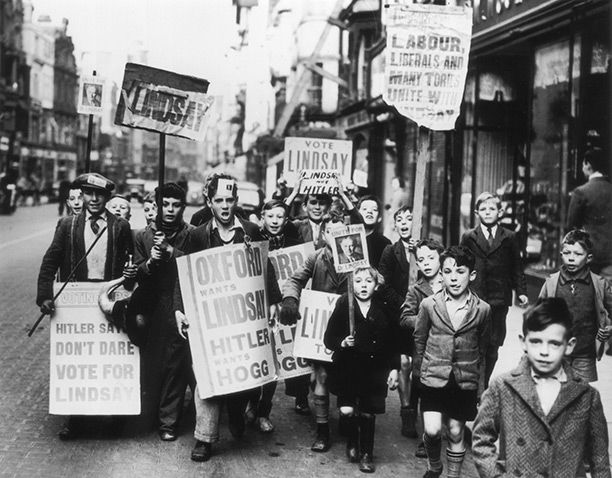
While the university may have been transfixed by Lindsay’s candidacy, he seems to have made little impact on the ordinary voters of Oxford. He found canvassing ‘a harrowing experience’ and disliked the rough-and-tumble of street-corner meetings. The ever pugnacious Hogg was in his element, but Lindsay, as one of his supporters, Elizabeth Pakenham (the future Lady Longford), would later recount, was ‘both too amateurish and too lofty’ for the in-fighting. He was shocked by some of the tactics adopted by his own side, most notably the slogan ‘A Vote for Hogg is a Vote for Hitler’. Hogg’s breezy rejoinder was, ‘Vote for Hogg and Save Your Bacon’. For good measure the Hogg camp also put it about that Lindsay had received a message of support from Stalin.
The intensive campaigning produced a 76.3 per cent turnout – almost 10 per cent higher than in the general election of 1935. So vast was the crowd that gathered outside Oxford Town Hall on polling night that many were crushed and had to be hauled inside the iron gates to be treated by St John Ambulance men. As the night wore on scuffles broke out between rival enthusiasts and the police were hard-pressed to keep order. The mayor announced the results from the balcony at 11.15pm. There were 15,797 votes for Hogg and 12,363 for Lindsay. ‘It is not my victory’, Hogg told his cheering supporters. ‘It is Mr Chamberlain’s.’
A series of six more by-elections would follow in November, each showing a serious slump in the government’s fortunes. The Tories would actually lose two seats – to Labour, in Dartford, and to an anti-Munich Independent, in Bridgwater. Even Oxford was hardly an unmitigated triumph for the government. Despite facing a lacklustre candidate, who had not even started campaigning until just over a week before polling, the Tories found their majority had been almost halved. But Chamberlain had survived the first major test of public opinion since Munich and the appeasers were well satisfied.
So, too, were the Nazis. As a leading Berlin daily, the Börsen-Zeitung, observed: ‘Without under-estimating the 12,400 votes for the policy of the war party, it must be admitted that the result of the Oxford election represents an encouraging strengthening of those forces in Britain which seek to make the Munich Agreement the permanent basis of British foreign policy.’

