

The Oracle at Delphi: Vessels of the Gods
The priestesses of Delphi played a pivotal role in the religious life of the ancient Greek world, connecting the human to the divine.
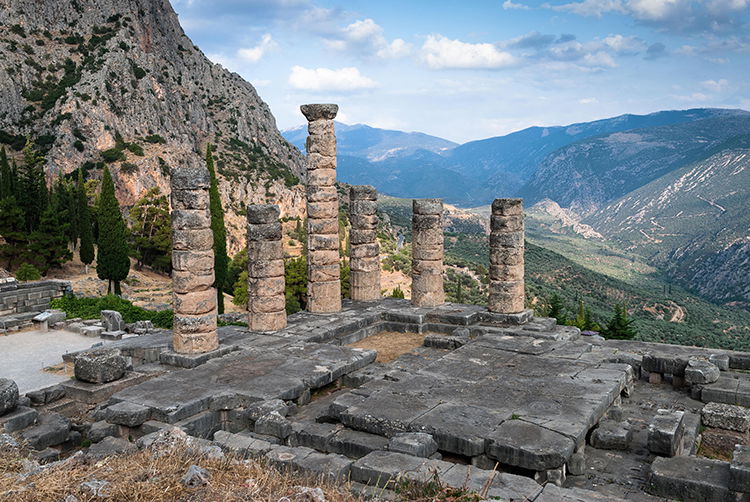
The Delphic Oracle, known as the Pythia, was a priestess who channelled prophecies from the ancient Greek god, Apollo. Over 1,000 years, from approximately 800 BC to AD 380, many local women took on this prominent role at the head of the spiritual centre at Delphi. Yet, although the oracular sayings were esteemed by rulers and dignitaries across the Mediterranean, we know little about the lives of the individual priestesses who gave them voice.
The Oracle offered advice on how to deal with matters of importance: the death of a family member or friend; the raising of children; combating plague, famine or illness; whether to go to war or to bring a conflict to an end; how to found a new city or colony. Details of the exact oracular process are fogged by time but, whatever the reality, it was widely believed that the sacred was connected to the profane by the Pythia, as the classicist Michael Scott points out.
Apollo’s sanctuary was founded in Delphi, possibly by settlers from Crete, between the 14th and 11th centuries bBCc. For five or six centuries before Apollo’s arrival, the region’s residents had worshipped a female deity, the Mother Earth goddess, Gaia. According to legend, Apollo killed the python that had guarded the Oracle of Gaia and established a sanctuary in his own name. Pytho, the original name of Delphi, is derived from the Greek word for ‘rot’, a reference to the decomposing snake. The stone temples to Apollo and Athena were built in the seventh century BC, though, frustratingly, much of the history of Athena’s temple remains a mystery.
Athena is, like Gaia, a casualty of the usurping of female divinity and the role of women in childbirth. Not only is Athena’s temple set away from the main site, she was born not from her mother’s womb, but from the head of Zeus, king of the gods.
 The lack of a single, reliable source makes it hard to know how Delphi functioned. The practice of consulting the Oracle was, according to the classicist Herbert Parke, ‘so completely established in classical Greece that no author thought it necessary to give a plain account of what happened’. Plato and Plutarch (the latter was a priest at the Temple of Apollo), along with historians, playwrights and archaeologists, recorded and mined the political and geographical background of Delphi’s oracular site and continue to do so. But there is almost nothing about the personal lives of the women at its centre.
Priestesses and prophets
The paucity of source material is an obstacle to uncovering the identities of these women. We know the names of only three of Apollo’s influential interpreters: Phemonoe, Periallus and Aristonice. For one thing, their personal lives were of little interest to the elite of ancient Greece, a patriarchal society with few legal rights for women. Socrates, for example, sent his wife, Xanthippe, away so that he could die ‘in peace’, surrounded by his male friends. Women were defined by what they were not: ‘infertile males’, as Aristotle described them in his Generation of Animals. Even though the Pythian Games, one of the four panhellenic sporting contests including the Olympics, were established in honour of the priestess, there are no records of women competing in them before the AD 40s.
The mythical poet Phemonoe is often regarded as the first priestess at Delphi. Her name translates as ‘prophetic mind’ and she was said to be Apollo’s daughter. Phemonoe is also credited with the invention of the hexameter (a verse line of six metrical feet, a form in which some of the Oracle’s sayings were recorded).
Periallus was named and shamed for her part in a plot by Cleomenes of Sparta, which sought to overthrow King Demaratus. Cleomenes asked the Oracle – Periallus – whether Demaratus was illegitimate. He bribed her to answer that he was and, as a result, Demaratus was exiled. When the plot was uncovered, Periallus was stripped of her priestess role. Was she exiled, too? Or did she return to her home? If so, did her friends and family support her or condemn her? What did the other priestesses say to her, if anything, if they were allowed? Such questions remain unanswered.
Periallus was replaced at Delphi by Aristonice. All we know about her is that, when consulted by Athens in 480 BC about the war against Persia, her reply was that they should ‘trust in their wooden walls’. This could mean, as Scott points out, either building a palisade around the Acropolis or building more wooden ships, which is in keeping with other ambiguous oracular responses about the Persian invasion, during which Delphi was left unattacked.
There is, Edith Hall writes, some speculation that the mathematician Pythagoras was tutored by a Delphian priestess. If true, then the Delphian women must have been better educated than we suppose. It is interesting to speculate, given our knowledge of women’s position in ancient Greek society, how high profile any such tutors might have been and, in the context of Delphi, whether such women were ‘head hunted’ for the post of Oracle because of their education.
At the height of Delphi’s influence, in the late eighth and seventh centuries BC, as many as three priestesses might be available for consultation on any one day, although there seems to be no extant list of all those who took on the position. The Delphian women join the ranks of numerous influential and notable women of ancient Greece whose lives and work have been overshadowed by their male counterparts. Hypatia of Alexandria, for example, was a mathematician, astronomer and philosopher. Her knowledge, and the Alexandrian library where she worked, were seen as a pagan threat to Christianity. She was murdered by a Christian sect in approximately 415 and her death marks the beginning of the decline in Alexandrian learning, with the destruction of pagan institutions and the exodus of scholars.
Telesilla, according to the traveller Pausanias, was apparently told by the Pythia to ‘serve the muses’ and so she devoted herself to poetry. She was also an influential political and military leader of Argos; Pausanias records how she defended the city from an attack by Spartan troops.
The philosopher and priestess Diotima is cited in Plato’s Symposium as the woman who taught Socrates about the nature of love. Aspasia, partner of Pericles, is mentioned in Plutarch’s Pericles and Plato’s Menexenus. She was highly regarded for her political and intellectual influence. The classicist Madeleine M. Henry said that, ‘To ask questions about Aspasia’s life is to ask questions about half of humanity’, a statement that applies equally to the Delphic Oracle.
While we do not know whether the women applied or were approached for the role of priestess, we do know that they came from ‘the soundest and most respected’ local families and, Scott suggests, would have led ‘irreproachable’ lives. They served for life and remained at the sanctuary, away from their friends, siblings, husbands or children, even after they were no longer acting as Apollo’s interpreters.

Chastity was one requirement for becoming a Pythia and, in the earlier days of the sanctuary, they were virgins. Then, in the third century BC, one of the girls was kidnapped and raped by the military commander Echecrates of Thessaly, who abducted the Pythia when he came to consult the Oracle. In keeping with the orthodoxies of the society, it was the identity of the priestesses that had to change to adapt to the behaviour of the male supplicants. Priestesses now had to be over 50 years old; no changes were demanded of her consultants.
The Oracle continued to wear ‘the dress of a maiden’ though, either to emphasise the asexuality of the priestesses, or ‘in memory of the original virgin prophetess’.
This back-handed compliment, of being invited to act as Apollo’s interpreter, but only because one is too old and unattractive to affect his consultants, finds parallels in the medieval text, the Ancrene Wisse, the Guide for Anchoresses (c.1225-40). Like the Pythia, medieval anchoresses, such as Julian of Norwich, the 14th-century mystic, were spiritual counsellors. The author of the Ancrene Wisse wrote of how chaperones were not needed for middle-aged anchoresses:
One is old and unprepossessing and gives less cause for anxiety, another is young and beautiful and needs to be guarded more carefully.
The judgement on an anchoress who knowingly tempts a man is harsh: a man, after all, is nothing more than a dog ‘who will go in wherever he finds an opening’. Given this assessment, it is no surprise that anchoresses are warned to be wary of any man who ‘looks towards the bed’ and asks where she sleeps, even if he is a bishop.
Day of the priestess
The Pythian priestess began her consulting days at dawn, bathing naked in the Castalian spring near the temple, and would then drink from the sacred waters of the Cassotis, home to the Naiad, a female spirit. The modern supplicant can still drink from the spring at its entrance, despite the difficulties in getting there. The priests would check that Apollo was ready to be consulted by sprinkling water on a goat. If the goat trembled, it would be sacrificed on an altar outside the temple, signifying that the Oracle could be addressed. The consultants, too, would purify themselves at the spring, a welcome refreshment after the steep mountain climb.
One of the few images we have of the Pythia is on a fifth-century tondo, a circular painting in the centre of a vase. It gives us a rare glimpse into the life of the Pythia. Dating from around 440-430 BC, the priestess is shown sitting on a tripod with Aegeus, King of Athens as her consultant. She is holding a bowl, which probably contained barley meal, burnt as an offering to Apollo. In her other hand is a laurel sprig. She is veiled, as was customary for women in ancient Greece.
The consultation took place in a restricted area of Apollo’s temple. The Pythia is sometimes depicted sitting next to a laurel tree. The evergreen laurel was dedicated to Apollo and was central to the oracular process. The prophetess held a sprig in her hand as she consulted. It was the only wood used in the temple fires; it was burned as an offering and the priestess may have chewed it ‘for inspiration’.
Early historians, such as Plutarch and Lucan, suggested that the Pythia was affected by vapours rising from the earth under the temple, although modern scholars, such as Joseph Fontenrose, have cast doubt on the theory. If it were the case, what part might these vapours have played in connecting the priestess to the divine? Some geologists have suggested that underground fault lines at Delphi may have allowed mind-altering gases, such as ethane, methane and ethylene, into its enclosed space. Such chemicals have been identified in shamanic traditions of central Asia, which may have travelled west to Greece. Certainly Plutarch noted the effect on the priestess’ physical health, reporting that she went into a calm, trance-like state, speaking in altered tones. Lucan, by contrast, said that she raved during the trance.
Consultations with the Oracle were not on a first come, first served basis. There was an established hierarchy: locals first, then Delphi’s governing council, followed by other Greeks, then foreigners. After waiting at the back of the queue, the average man was still not guaranteed an audience. Favours were, however, granted to individuals and cities: after dedicating an altar to Apollo, the island of Chios was given promanteia (the right to consult the Oracle before others).
Women were not allowed to consult their Delphian neighbour; nor, apart from the women who tended the fire, were they allowed inside the temple.
Whereas an anchoress advised visitors all year round, the Oracle spoke just once a month. In winter, Apollo went to live with the mythical Hyperboreans ‘at the very edges of the world’. His half-brother Dionysius took his place. Apollo, via the Pythia, could only be consulted on nine days of the year, usually the seventh day of the month, because the seventh of Bysios (March and April) was the god’s birthday.
It is intriguing to speculate on the daily life of the priestess during the rest of the year. Whereas Julian of Norwich lived an entirely interior life in the inclement physical and social climate of medieval East Anglia, never leaving her anchorage, the Pythia spent much of her time outdoors, in Delphi’s Mediterranean mountain setting. Physical exercise was integral to her life. The supplicants at Delphi took part in physical rituals, embodied in the Pythian Games, as opposed to the cerebral worship of Julian’s religion.
Himalayan parallels
There are intriguing parallels between the Oracle and the Kumari, who still practises as the Living Goddess of Nepal. The gods in the Himalayas are the agents of daily human life, just as they were in ancient Greece, and the Kumaris, always young girls, are the living embodiment of the Buddhist goddess Vajradevi and the Hindu goddess Taleju, or Durga.
The heart of Kathmandu, the Nepalese capital, is, like Delphi, a sacred place. Just as Apollo marked the centre of Delphi by killing the python, Manjushri the bodhisattva, or enlightened being, marked the centre of Kathmandu with his sword. The spot is said, writes the author Isabella Tree, to generate ‘prosperity for the kingdom and bestows blessings on everyone who passes through it’.
Both Kathmandu and Delphi are remote. But, because of the flow of international travellers, both developed into a global melting pot of ideas.
The Kumaris, like the Delphian priestesses, come from ordinary local families and advise from a throne room surrounded by a small inner circle. Supplicants to both the Pythia and Kumari go through a process of ritual purification and the questions posed to them tend to be on the same universal topics (health, crime, politics).
The sanctuaries of the Pythia and the Kumari share a hierarchy of visitors, important architectural monuments and the respect of powerful leaders. There is similar speculation about the use of hallucinogens during their consultations.
Unlike the anchoress or Delphian priestess, though, the Kumari can return to her community. The former Kumari, Rashmila Shakya, wrote of the trauma of leaving the Kumari Chen, or residence, and returning to her family home at puberty. Christine Carpenter, the 14th-century anchoress of Shere in Surrey, wanted, on the other hand, to leave her enclosure, perhaps a symptom of the difficulty of doing so. We can speculate that ancient Greek women might also have struggled moving into or away from their sacred province. The priestess, anchoress and living goddess inhabit a dual world: the interior, closed circle, mentored by male priests and the outer, public self, who is visited by her supplicants. Both worlds are separate from and unlike the lay world from which they came.
At the centre of the earth
We do not know the extent to which the Pythia’s replies to the range of questions presented to her were the sole result of the meditation of a Delphian woman and how much they were interpreted by male priests: ‘It is hard to believe’, argues Sue Blundell, ‘that the Pythia was not being manipulated in some way by the administrators of the shrine.’ She may have been more like a constitutional monarch – a figurehead – or she may have been, like an anchoress, autonomous.
 It is the mythical Apollo, not the real Pythian priestess, who Socrates calls as witness at his trial on charges of being a corrupter of youth, yet, as the historian Hugh Bowden points out, ‘the fact that a woman had so pivotal a role in the functioning of the Oracle, speaking directly to male practitioners on behalf of a male god in a world where women were usually required to remain silent, is certainly striking, particularly because there was no restriction on what she might say’. Even more so, given that the omphalos stone, which sat in Apollo’s inner temple, was seen to represent the centre of the earth.
Although some of the priestess’ responses were recorded, for example by Herodotus and Demosthenes, as having been given in verse, it is difficult to judge how likely it was that a Delphian woman could instantly compose a response in hexameter. But she might have been taught the skill, or have been assisted by Delphi’s resident poets. According to Plutarch, the responses were always given in prose, so it is likely that any poetic form was composed later, by the priest or another Pythia (although there is no evidence to suggest the latter), rather than at the time of the consultation.
The questions posed by the Pythia, as we have them recorded, were commonly formed as a choice: ‘Would it be better to ... or … ?’ Another format might be: ‘To which god should we pray that … ?’

The Pythia’s answers lent themselves to ambiguity, which served both thepriestess and the supplicant. According to Herodotus, when King Croesus asked whether he would succeed if he invaded Persia, the Pythia answered that he would ‘overthrow a mighty empire’. But it was Croesus’ own empire, not Persia, which was ultimately overthrown.
Another answer was at the heart of Socrates’ trial. His friend, Chaerephon, asked: ‘Is anyone wiser than Socrates?’ The reply was: ‘There is no man wiser.’ Socrates interpreted this to mean that he had recognised the limits of his own knowledge.
Such ambiguity is a valuable tool in prompting reflection and debate. Supplicants would take the priestess’ pronouncements away to talk over them with family, friends or colleagues.
There were significant changes in Greek society during the eighth and seventh centuries bc: for example, transformations in how wars were fought. There was major development of civic constitutions and growth in trade and communities, as well as in sanctuaries to the divine. As a result, as Scott observes, Delphi provided a ‘solution ideally suited to the particular and unfamiliar circumstances created by Greek social and political development’.
The water of speech
Delphi was, claims Scott, ‘decidedly international … a space that offered a range of opportunities for individuals, cities, and states to consult on difficult issues, tell and retell the past, as well as crystallise their own identities’. The sacred status of the Oracle led to the establishment of amphictyonies, (‘groups of neighbours’) around Delphi, an association of cities and states which defended the temple and supplicants to the Oracle, solved conflicts, supported trade and maintained the town’s infrastructure. As the classicist Eva Tappan pointed out: ‘The amphictyonies did much to make the Greeks feel that they were of one race and that, even if they did quarrel, they all belonged to the same family.’
In the 1920s Eva Palmer-Sikelianos, an American choreographer who lived in Delphi with her husband, the Greek poet Angelos Sikelianos, tried to organise revivals of the Delphic festivals in a spirit of peace and harmony. ‘The religion of Apollo (by which I mean the history of the Delphic sanctuary)’, she believed, ‘is the only one in the history of Europe which was completely innocent of military aggression, and also of domineering priest-craft; and it surpassed the non-fanaticism of India in being positively educational all along the line, and definitely seeking for world unity beyond national boundaries.’ Palmer-Sikelianos spent much time and money on the project and the success of the first Delphic Festival was such that plans were set up for a national lottery to pay off its debts and organise a second. Unfortunately, this never came to fruition. Despite this, she held a second festival, which was also a success.
The longevity and scope of the Pythia’s influence is remarkable. Fundamentally, there was a core of negotiation and unification in her words, made concrete and durable in the legacy of the Pythian Games and later attempts to reinstate them. The Oracle’s 1,000-year reign ended in AD 391, when the Roman Emperor Theodosius banned paganism. It was the messenger of Julian the Apostate, the last pagan emperor, who carried away the Pythia’s final poignant declaration: ‘Tell the king that fair wrought hall is fallen to the ground. No longer has Phoebus a hut, nor a prophetic laurel, nor a spring that speaks. The water of speech even is quenched.’
Libby Ruffle is a translator. She is writing a history of quiet women.

