

Garibaldi - Luck or Judgement
Graham Darby reassesses the contribution of one of the key players in the establishment of the Kingdom of Italy.
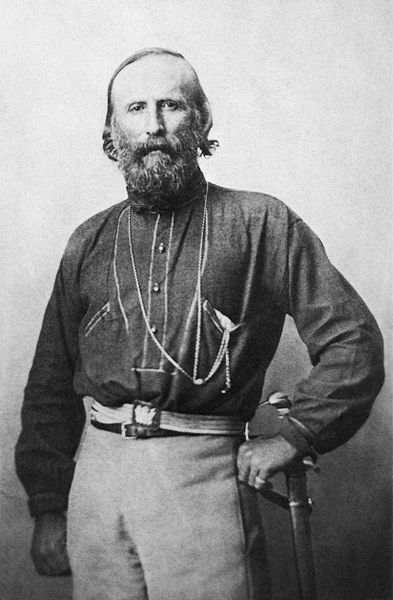
A.J.P. Taylor famously described Giuseppe Garibaldi (1807- 1882) as ‘the only admirable figure in modern history’, and whether or not we agree with that judgement there is no doubt that Garibaldi’s reputation has survived the rigours of modern historical scholarship. His reputation as the most sincere exponent of the Risorgimento and a genuine architect of Italian Unification remains pretty much intact. However, to what extent was his success due to luck rather than judgement? We know in our own lives that we certainly do not have complete control over events as they unfold, and the same was true for Garibaldi.
If we look more closely at many of Garibaldi’s achievements we can see that his success owed a great deal to luck rather than forward planning. He did not of course create the Sicilian Revolt – he merely took advantage of it. He had actually intended to fight the French army over Nice. How realistic was that? Could he have anticipated that General Lanza would wish to abandon Sicily, and that, in similar fashion, King Francis II would simply abandon the city of Naples? Could he have defeated the remaining Neapolitan army after the battle of Volturno? How sensible was his plan to overthrow the Pope? Could he have really conquered Venetia? And who unified North a n d S o u t h ? Not Garibaldi, that’s for sure. And what of the disastrous events of 1862 and 1867 that served to sully his reputation? It is clear that there is some scope for reappraisal.
Early Life
Giuseppe Garibaldi was one of those unique historical figures who possessed that elusive quality, charisma, and for a while must have been the most widely known figure in the world (when he came to London in 1864 thousands of well-wishers filled Trafalgar Square). He was the archetypal romantic hero, the swashbuckling adventurer who was able to command the devotion of both men and women. He was admired for his honesty and integrity, and his humble origins and way of life provided him with an understanding of ordinary people that was itself one reason for many of his successes. Moreover, he was unconventional and believed strongly in personal freedom, for himself and for his followers. His unconventionality made him both admired by the common folk and feared by the establishment.
Garibaldi was born in Nice in 1807 and became totally committed to Italian unification after his meeting with the Italian nationalist leader Giuseppe Mazzini in 1833. Ten adventurous years of sailing in the Mediterranean and the Black Sea were followed by ten years of exile in South America where, among other things, he was a spaghetti salesman! In addition he became a soldier, acquired the techniques of guerrilla warfare, and fought for the state of Uruguay. However, the most important part of his career began after 1848, when he was over the age of 40. His valiant defence of the Roman Republic in 1849 against superior French forces became a legend of the Risorgimento. However, he subsequently abandoned Mazzini and returned from exile in 1854 when he saw that the Piedmontese monarchy was a more realistic vehicle for the Italian cause than republican revolution. And so it proved to be.
Cavour
The other so-called architect of Italian Unification was Count Camillo Benso di Cavour (1810 - 1861) who was prime minister of Piedmont from 1852 to his death in 1861, excepting a short and crucial six - month break in 1859. Socalled because unification was not his aim; his aim was to create an enlarged Piedmont, a kingdom of Northern Italy that would involve removing the Austrian Habsburg presence from both Lombardy and Venetia. Cavour was realistic enough to realise that Piedmont could not take on Austria alone – that had been the lesson of 1848/9 – and that French help was required. However, Cavour’s attempts to win over the Emperor Napoleon III to his plan proved fruitless until, in the summer of 1858, the Emperor took the initiative himself and proposed a deal at Plombières. Napoleon III did not do this out of any sense of altruism: his main concern was for French interests. Expelling Austria from Italy would hark back to the great exploits of his uncle Napoleon, overthrow the 1815 settlement and give France some control of the peninsula (French troops already occupied Rome). Beyond that Napoleon III’s thoughts were not fully formed, though he insisted on a marriage into the House of Savoy for his cousin. War with Austria followed in 1859 but because of the murderous firepower of modern weaponry it proved to be a bloody and indecisive affair. Accordingly Napoleon decided to pull out and Cavour resigned in protest.
The situation in Italy was now quite fluid: with Austria crippled there were opportunities for Italians to control their own destiny. Lombardy was given to Piedmont but the key area proved to be the duchies of Parma, Modena and Tuscany, and the papal province of the Romagna where the rulers had fled and been replaced by Cavour’s Piedmontese ‘agents’. Originally Napoleon III had wanted the rulers restored but when it became clear that this was unrealistic he once again took the initiative and proposed that Piedmont could have these territories, providing she ceded Nice and Savoy to France (part of the original secret deal of Plombières). Cavour came back into office to do this deal and it was done and dusted by April 1860. It should be noted that, at this stage, neither Cavour nor Napoleon envisaged any further developments. Neither had got what he wanted: Venetia remained under Austrian control but Cavour had achieved an expanded Piedmont (King Victor Emmanuel now controlled one third of Italy, with half its population) and the acquisition of Nice and Savoy proved very popular in France. Unification was not on the agenda. This is where Garibaldi comes in.
Although Cavour had made him a Major General in the Piedmontese army, Garibaldi was sidelined in the 1859 war with only 3,300 volunteers in a difficult, but successful, Alpine campaign. He was sidelined because he was considered potentially dangerous and not really trusted. However, the real breach between the two came in 1860 over the cession of Nice, his birthplace.
The Sicilian Uprising
Garibaldi’s reaction to the cession of Nice was to contemplate a wholly unrealistic military expedition to prevent the annexation taking place. With this in mind he began to form the volunteer force that was to become the ‘Thousand’. At the same time Sicily broke out into revolt. The rising which began in Palermo on 4 April 1860 was soon suppressed but subsequently other risings began to occur throughout the island. These were mainly peasant uprisings, social in character, but they had the effect of breaking down local government and Bourbon control. Here, then, was an opportunity. Garibaldi was persuaded, principally by Francesco Crispi (later a right-wing Prime Minister of Italy but a Mazzinian in 1860), to abandon his ridiculous plan for Nice and concentrate on the island of Sicily.
The General sailed from Genoa on 5/6 May in two small paddle steamers with a motley crew of slightly more than one thousand poorly armed volunteers who mainly consisted of young professionals, students and urban workers from the north of Italy. His success against a Neapolitan army of 25,000 astonished contemporaries and has been described as ‘one of the most extraordinary victories won by an ill-equipped guerrilla force in the history of warfare’ (Grenville). However, he was greatly helped by the natives who threw the island into complete chaos, and by the breathtaking incompetence of the Neapolitans.
He landed at Marsala unopposed on 11 May because, it is believed, the Neapolitan soldiers nearby mistook the red shirts of his volunteer force for British forces! On 14 May Garibaldi declared himself Sicily’s ‘Dictator’ (this word did not have the pejorative twentieth-century connotation, it simply referred to temporary emergency authority) and the following day he won a difficult, small-scale but decisive victory at Calatafimi. This was, to borrow Wellington’s phrase, a ‘closerun thing’ and Garibaldi could easily have been stopped in his tracks at the first hurdle. However, the psychological impact of this victory was immense and it persuaded the islanders of his invincibility. Large numbers of volunteers now swelled his ranks, though it should be recognized that Sicilian ‘patriots’ were inspired by the wish for independence and by hatred of landlords and the Bourbon government – not by a desire for Italian unification. Still, Garibaldi’s courage, sincerity and honesty won him the devotion of the people. ‘There is magic in his look and in his name,’ as Giuseppe Abba, one of the Thousand, put it.
The bulk of the Neapolitan garrison (20,000 out of 25,000) was bottled up in Palermo and the viceroy, Ferdinand Lanza, took the first opportunity to give up and get out. Clearly, given their numerical superiority, the Neapolitans could have and should have dealt with Garibaldi’s irregular band. The fact that they did not was largely due to the spineless performance of the incompetent Lanza. After a cunning feint had drawn some of the garrison away, Garibaldi entered Palermo, the capital, on 27 May. The Bourbon troops remained in the fortress and the viceroy immediately requested an armistice (30 May). Given that the island was now slipping into chaos and he had no instructions, he decided to negotiate an evacuation (7 June ) and on 19 June the Neapolitan garrison steamed away in 24 ships. After the battle of Milazzo on 20 July, and once he took Messina on 27 July, Garibaldi faced no further Bourbon resistance, and the island was his to control. Luck or judgement? You be the judge. Cavour desperately tried to regain the initiative by arranging a quick annexation. However, Garibaldi would not hear of it – he wanted to keep Sicily as a base for his next campaign, against the Bourbon monarchy on the mainland.
The Conquest of Naples
Lanza’s incompetence was merely a reflection of the incompetence of the entire regime. The mainland campaign was not dissimilar to the island campaign. The peasants rose up, chaos ensued, the King retreated, and the government gave up. Some would say (Gladstone in particular) that it was a fitting end to a rotten dynasty! But once again we should not, by stating all this and emphasising the element of luck, in any way demean Garibaldi’s remarkable achievement. His personal qualities and military skill translated into popular support and military success. However, it is interesting to note that when he tried to repeat this sort of campaign in 1862 and 1867, and came up against determined opposition, he was easily stopped. The line between success and failure can often be a very fine one.
Insurrections had already broken out in Calabria and Basilicata in August 1860 in anticipation of Garibaldi’s arrival. The General was able to undertake two successful crossings between 18 and 21 August, despite Cavour and Napoleon’s misgivings. This was to some extent due to the goodwill of the British Mediterranean Fleet, the support of which largely negated any Piedmontese or French naval threat. After the landings, spontaneous revolts in peasant villages and towns destroyed the power of the Bourbon police and administration and led to the defection of many soldiers. Wherever he went Garibaldi was greeted with popular acclaim – ‘Il nostro secondo Gesu Cristo’ (our second Jesus Christ!) being just one of the (more extreme) assessments. His advance from Calabria up to Naples became a triumphal procession as he was virtually unopposed.
The 24-year-old old Francis II, who had only been king for just over a year, was not the right person to handle this emergency. Already in June he had granted a constitution, but by replacing loyal monarchist ministers with unreliable liberal ones he had in fact weakened his government still further. When an insurrection occurred in the city of Naples itself, Francis ordered his 50,000-strong army north to the fortress at Capua and he himself sailed north to Gaeta. Thus the city of Naples was abandoned and Garibaldi was able to go ahead of his forces by train and capture it with a mere 30 colleagues (7 September)!
Garibaldi now announced that he would march on Rome and overthrow the Pope (he had named his ugliest donkey on his home island of Caprera, Pio Nono!), while those around him urged him on to Venice and Nice. Was this wise? Both Cavour and Napoleon III were alarmed. Even the supportive British government urged caution and Cavour feared that this would lead to a clash with France and might well undo all he had achieved thus far. However, he was able to use Garibaldi’s intentions to regain the initiative: he played on French fears and persuaded Napoleon to sanction his plan to send an army south via the Papal States to stop Garibaldi. Napoleon for his part was increasingly alarmed at Garibaldi’s open expressions of hostility towards France and was not unhappy at Cavour’s suggestion. What this meant of course was that Cavour was inadvertently forced into unifying Italy just to stop Garibaldi.
In actual fact the truth of the matter is that Garibaldi had not really been in a position to march on Rome at all – the 50,000 strong Neapolitan army was in the way. Indeed on 1 October the Neapolitan forces attacked at Volturno. Garibaldi conducted a very effective defence and the attack was successfully resisted. However, his forces had suffered losses and were weakened militarily. Indeed given the fact that the Neapolitans were still not completely defeated, and also that peasant risings in the south were already getting out of control, Garibaldi seems to have become demoralised. He now realised the game was up and he needed the Piedmontese army to finish the job. Accordingly, he requested Victor Emanuel’s assistance. Thus Cavour did not prevent Garibaldi’s march on Rome, the Neapolitans did; and the Piedmontese army did not have to confront Garibaldi, merely finish off his work.
In October, Victor Emanuel joined his army in the Papal States and it was clear that Piedmont had regained the initiative. Cavour was able to intervene in the south to thwart democratically elected local assemblies and impose one-off plebiscites instead. Moreover no mention was made of annexation to Piedmont, voters were simply required to vote in favour of (or oppose) ‘Italia e Vittorio Emanuele’– the slogan under which Garibaldi had fought. The votes on 21 October registered overwhelming approval for the proposition, though in truth they were more an expression of admiration for Garibaldi than anything else. Many voters were illiterate and some thought Italia was the King’s wife! In Naples 1,302,064 voted yes – 10,302 no; in Sicily 432,053 yes – 667 no.
On 26 October Garibaldi and Victor Emanuel finally met at Teano where the General agreed to hand over his conquests. This was undoubtedly an act of selfless patriotic generosity but, given Garibaldi’s weakened military situation, it is probably true to say that he really had little choice in the matter. The next two weeks were painful for Garibaldi as he had to take a back seat and allow Victor Emanuel to finish off the campaign. The Piedmontese army finally took Capua on 2 November and, though Francis II held out in Gaeta until February 1861, to all intents and purposes the campaign was over. Then on November 7th, Victor Emanuel and Garibaldi made a formal entry into Naples though the latter was embarrassed by the crowds shouting, ‘Viva Garibaldi!’ when he felt they should be shouting ‘Viva il Re!’.
The King and the General got on reasonably well but Victor Emanuel was firm with Garibaldi and told him that his army of irregulars had to be disbanded and that he could not be the first governor of Naples. Garibaldi himself refused all honours and gifts including the title of prince and a castle, not least in protest about the shabby treatment of his soldiers, and left for his rocky homeland of Caprera on 9 November with little more than a bag of feed for his animals! On 27 January 1861 elections took place for the First Parliament of Italy which met on 18 February. Victor Emanuel was finally proclaimed King of Italy on 17 March 1861 after Francis had given up and abdicated. Italy had come into being at last.
Conclusion
Italy had come about by accident and was to all intents and purposes, given the north/south divide that exists to this day, an artificial creation. Contemporaries were amazed: Palmerston thought it ‘miraculous as no one in his senses or in his dreams could have anticipated [it]’, and Gladstone described it as ‘among the great marvels of our time’. Of all the major protagonists only Garibaldi was committed to unification. Napoleon was not, Cavour was not, and Victor Emanuel was too much of a realist to consider it a possibility. Yet it is clear that even in the case of Garibaldi, accident – and luck – played a large role. For one thing he did not initiate the revolt in Sicily – that this occurred when it did was quite fortuitous. Garibaldi was reacting to events rather than moulding them. His success led to similar circumstances on the mainland. He was able to take advantage of a weak and unpopular regime, but ultimately was unable to conquer the kingdom of Naples on his own. However, Garibaldi was a man of principle. He did not conquer the major part of Bourbon Naples for himself but for Victor Emanuel and Italy.
Garibaldi, then, is fundamental to the unification process. Fundamental in another way too, because it was he who forced Cavour to embrace unification. Cavour himself knew nothing of the south, never went south of Florence and aimed at an enlarged Piedmont only as far south as Ancona. He did not envisage full unification except at a much later date, possibly another generation in the future. However, Garibaldi’s phenomenal success transformed the situation. Cavour was opposed to his expedition and, after his conquest of Sicily, was opposed to the mainland campaign. He did not see Garibaldi’s work as part of a great process of unification, but as a threat to everything he had achieved. He could not believe Garibaldi was a man of principle and would hand over his conquests; and he could not believe Austria and France would stand idly by while the General marched up the peninsula – in particular to Rome. He had to be stopped. And the only way this could be done was by conquering part of the Papal States and taking over the southern kingdom. Cavour unified Italy not because he believed in a united Italy but to stop Garibaldi. It was a desperate gamble to preserve an enlarged Piedmont – and it succeeded in enlarging Piedmont still further!
Of course once Cavour had achieved unification he became a firm advocate of it and subsequently he was dubbed its architect. However, this was not true. Cavour was not a planner, but he was a great opportunist. He himself stated, ‘Everything depends on accident’. The alliance with France was not of his making. That this alliance created opportunities for Piedmont was as much to do with Napoleon’s lack of resolve and Austria’s subsequent weakness as it was with Cavour’s talent and foresight, and, as we have seen, unification itself was forced upon him by Garibaldi’s remarkable achievements. If Garibaldi’s success was due more to luck than judgement then the same is true for Cavour and the whole process of unification.
Nevertheless Garibaldi remains the principal hero of unification. His luck does not detract from his admirable qualities. This writer has lost count of the number of roads called Via Garibaldi, of statues and squares Italians have dedicated in his honour (even the French have a fine square in Nice, his birthplace). They far exceed those devoted to Cavour, which is probably about right.
Issues to Debate
- What qualities helped to produce Garibaldi’s charisma?
- In what ways did the Bourbons in Naples and Sicily make it easy for Garibaldi to win victories there?
- Does Garibaldi or Cavour deserve more credit for unifying Italy?
Further reading
- Robert Pearce and Andrina Stiles, The Unification of Italy 1815-70 (Hodder Murray, 2006)
- Jasper Ridley, Garibaldi (Constable, 1974)
- Lucy Riall, Garibaldi Invention of a Hero (Yale, 2007)
- Alfonso Scirocco, Garibaldi Citizen of the World (Princeton, 2007)

