

The Foreign Policy of Woodrow Wilson, Part II: The Dream of Reason
Esmond Wright offers the second part of his study of the early 20th century American president and moralist.
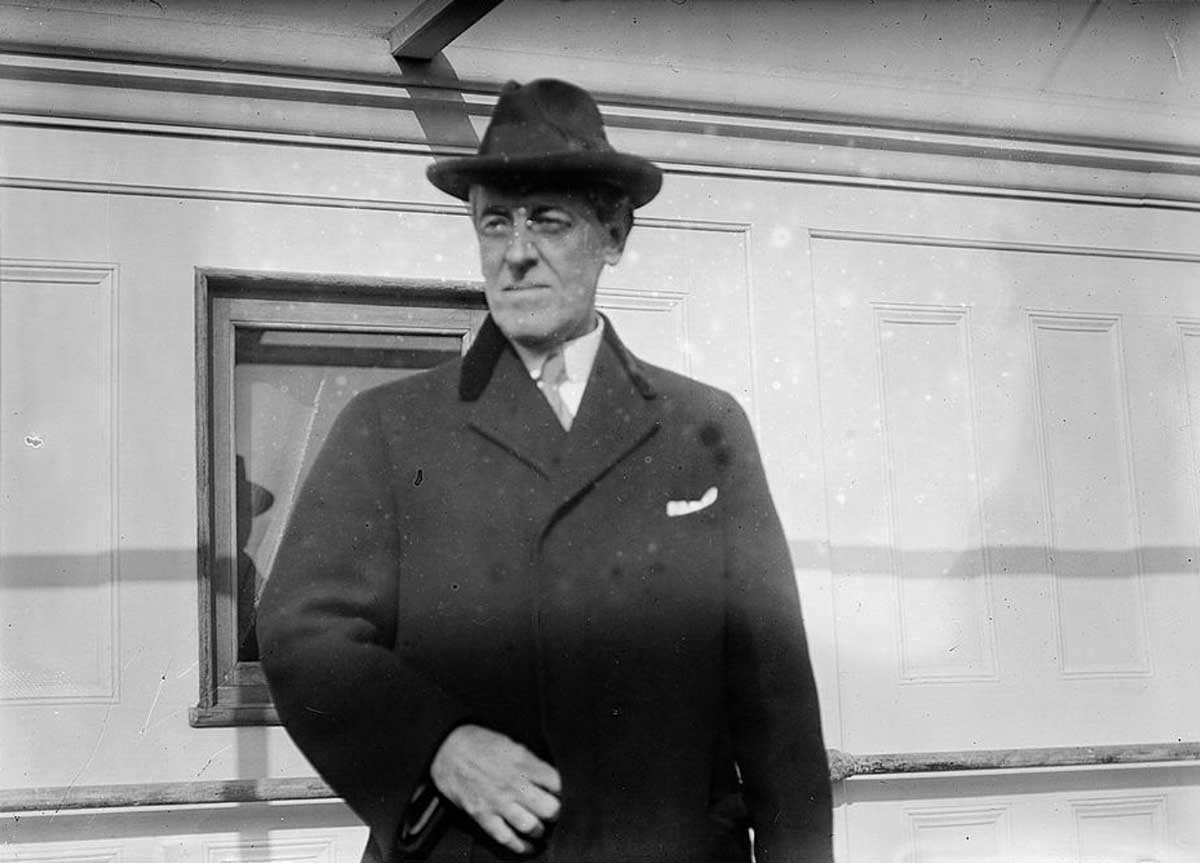
The decision to go to Paris in person in 1918—about which there has been so much debate—was for Wilson itself a logical result of the decision to go to war in April 1917. If the world was to be re-made, it could only be done in Europe.
And it was indeed only in the months in Paris, when he was almost at the end of his physical and nervous resources, that Wilson came to make any compromise with his principles. To Paris he went as a Messiah, cheered by returning troops as the George Washington sailed down the Hudson, fêted in London, Paris and Rome, his image worshipped—for a time—in little shrines in Northern Italy.
By the time of his return, though the crowds were out in Washington, so were his enemies in the Senate; the high idealism soon cooled in Europe and at home; and the Capitol was but dimly lit for his homecoming. The great test of Wilson, as negotiator, diplomat and President, was his conduct abroad and at home from January to September 1919.
Hailed as saviour though he was on his arrival in Europe, Wilson was already a heavily committed politician. There was bitterness among Allied leaders that the German offer to negotiate had been made to Wilson; by his notes to the German Government, it was felt, he had allowed a peace mood to develop in Germany that threw awry the careful plans of the soldiery for a knock-out blow in the spring of 1919, and thus saved Germany from invasion and unconditional surrender.
Germany itself was afterwards to make quite contradictory criticisms; that, far from being saved, she was offered conditions that were not in fact fulfilled, that she had been lured into a false confidence in Wilson’s ability to carry out his undertakings. Out of this came the myth that she was not defeated in the field. Wilson had even sharper troubles with the Allies. The basis of negotiations with Germany was the Fourteen Points speech of January 1918. Yet, until November, the Allies had treated these with scant respect and had refused to approve them.
Lloyd George never accepted the second clause committing the Allies to the freedom of the seas; and Clemenceau insisted on reparations from Germany for war damage to civilian populations. It is even doubtful if, before the armistice, Clemenceau had ever read the Fourteen Points speech. Only on House’s insistence had the Fourteen Points been accepted by the Allies as a basis for the armistice; and this approval had led to the so-called “Pre-Armistice Agreement.”
Moreover, the awe in which Wilson was held by the European crowds was not shared by their more cynical leaders. Clemenceau’s savage references to Wilson’s piety and moralism are well known—“he speaks like Jesus Christ but he acts like Lloyd George” was only one of his pleasantries; Wilson’s confreres in Paris were shrewd judges of a politician’s strength and weaknesses; newspapers as sympathetic to Wilson as the London Times had already been speaking of “the reign of righteousness.”
And, by January 1919, there were many gaps in Wilson’s political and personal armour. His ill-judged appeal for the return of Democrats in the Congressional elections of November 1918 had failed; the Republicans had a majority of two in the Senate; and the control of the Senate Foreign Relations Committee had passed into the hands of his bitter critic, Henry Cabot Lodge; it was possible for European politicians to see Wilson as one already repudiated at home.
His peace commission—General Tasker Bliss, Lansing, House, Henry White and Wilson himself—was thoroughly unrepresentative; it included neither a Senator nor a major Republican—White, the sole Republican, was an ex-Ambassador of small influence in Republican circles. Wilson brought with him to Europe a cohort of advisers, many of them selected from the group known as the Inquiry; and he needed a liner to carry them.
There were distinguished figures in this intelligence service, from its head, Sidney Mezes of the College of the City of New York, House’s brother-in-law, to its youthful secretary, Walter Lippmann; and they included some academic figures who then and later were to be among the outstanding men of their day—James Shotwell, Isaiah Bowman, Charles Seymour and C. H. Haskins, to name only a few.
It was Lippmann and the journalist Frank Cobb who drafted that “interpretation” of the Fourteen Points that became Wilson’s working guide at Paris. Yet this assistance, expert though it might be, was not weighty in influencing the Senate or the House back home; and it was not particularly effective in quickly pre-digesting material for Wilson’s use in Paris. Harold Nicolson has left a scathing indictment of Wilson and the American delegation at work in his Peacemaking 1919.
With some of his advisers Wilson was to have sharp differences of opinion—as over Italy; and they did not save him from revelations of profound ignorance of history and geography. Somewhat casually, he had already “created” certain “new” countries—like Czechoslovakia; he only afterwards learnt of the size of the German population in northern Bohemia.
His faith in national self-determination was hard to translate into reasonable terms for the populations of Eastern Europe. He was never very certain about his Near Eastern geography; and he had a perennial difficulty over the location of Baghdad. If his confusion over the status of the Tigris-Euphrates valley was in 1919 all too understandable—and reflected, be it said, the contemporary confusion in Baghdad itself—his frequent inaccuracies and vagueness augured ill for the bigger inquest ahead of him at home.
Knowledge of the idealism but vagueness of Wilson’s approach, and of his somewhat amateur intelligence service, was perhaps among the reasons why Colonel House, who had spent a few months in Europe as his emissary, had urged him not to come to Paris in person. In House’s view—and Seymour’s—this was his supreme mistake. “He was the God on the Mountain,” wrote House, “and his decisions regarding international matters were practically final.
When he came to Europe and sat in conference with the Prime Ministers and representatives of other states, he gradually lost his place as first citizen of the world.” House and Lansing both urged him not to attend—and House reported that his view was supported by Reading, Wiseman and Clemenceau.
This may well have begun the process of Wilson’s own disenchantment with House himself; by March 1919 he came to discern and dislike House’s own easy acceptance by the French and the British, to be sensitive about House’s conferences with them, to feel that House was “giving away” all he had stood for.
Wilson’s difficulties at Paris, however, were, in the last analysis, a matter of personality. He distrusted even his closest advisers; and, after his quick visit to the United States in February-March 1919, the distrust deepened. It brought a break with House; and in the end the break was complete.
He refused to see House again after he left Paris and House never could discover why. As the conference progressed, he relied more and more on the rightness of his own judgment, and more and more drew on his own reserves for assurance. White, once Ambassador in Paris, was never used as an intermediary with Clemenceau. Wilson took the decision to send troops to Siberia without discussion with his Secretary of War, Newton D. Baker—though Baker was his favourite Cabinet officer.
The view that he had expressed on the George Washington en route to Europe, that he would be the only disinterested member of the Conference because he had no territorial demands to make or reparations to ask, grew in certainty as the months passed.
None of his advisers could obtain specific or concrete statements from him. His very frankness in stating his views, at the outset of an argument, made retreat difficult; for the retreat was always so much an abandonment of a very general principle. Anything other than firmness, however, became, in his eyes, a form of surrender.
To bargain was to play a European—and an immoral—game. Lloyd George described him as “a missionary whose function it was to rescue the poor European heathen from their age-long worship of false and fiery gods.”
This remained the fundamental tragedy in Wilson—a tragedy bound up with his own fineness of character and transparent honesty of intention—the belief, so close to naivete, that there was a right in politics of which he alone was the champion. “Tell me what is right and I’ll fight for it” was a dangerously simple view to bring to a war-torn world in 1919. Parliamentary politicians had long lost such illusions.
Moreover, Wilson was at a tactical disadvantage vis-à-vis Lloyd George, Clemenceau and Orlando. They were wilier men than he; and they were certainly more adept in the ways of the coulisses. Wilson had the disadvantages of one over-dependent on the document and the printed word.
He stayed up night after night wrestling with written material, in a constantly losing effort to keep pace with the problems that awaited him next day; his associates—whom he was prompt to see as enemies quite as tangible as the Germans—were far better trained in learning from conversation and from quick summaries, and were better acquainted with the nature of the problems themselves.
He had only two stenographers at the Conference, had made no plans for adequate secretarial staff, and made far from efficient use of the service House provided for him. Once again, Wilson had to draw on his reserves of nervous and mental energy.
“The rest of us,” said Lloyd George years later, “found time for golf and we took Sundays off, but Wilson, in his zeal, worked incessantly.” Soon there came testiness and ill-concealed anger; in April came influenza and conversations through bedroom-doors; occasionally there were evidences of utter tactlessness—in the failure to voice appreciation of the sufferings of Britain or France, the brusque refusal to visit the battlefields or devastated areas of Northern France, or the folly of the Fiume appeal to the Italian people over the heads of their chosen leaders.
The errors have their own nobility—the high temper and will-power of an overworked and over-dedicated man, fighting against error and wickedness that he was prompt to see personified in those about him. The admirer of Bagehot refused to accept, as binding on himself, the master’s respect for a liberal society as “a polity of discussion.” For him, politics was an affair of pronunciamientos.
This, however, is not to say that Wilson failed at Paris. A critic might even argue that it was only his brusqueness and inflexibility that won any concessions from the selfish European politicians. He had not achieved all his Fourteen Points; but without them the Treaty would have been a great deal worse than it was. He had wanted a fixed amount of reparations to be agreed on, and a definite type of payment specified.
There were to be no “punitive damages.” He had been compelled to accept the inclusion of the cost of pensions in addition to direct damages; but he had at least succeeded in keeping the demands made on Germany short of the total costs of the war. By promising an aid to France that the Senate later was to ban, he prevented the complete separation of the Rhineland from Germany, and the annexation of the Saar by France.
He had the ex-German colonies “mandated” to the League, and thus probably speeded the process whereby they are reaching their ultimate independence. If he lost to the Japanese on Shantung, at least he extracted a promise of the eventual return of sovereignty over Shantung to China. If it was far from the idyllic hopes of December, the Treaty agreed on in May 1919 was, as Wilson put it to Ray Stannard Baker, “the best that could be had out of a dirty past.” This is what Charles Seymour has in mind when he refers to “the Paris education” of Wilson.
And, for Wilson, the gloom was offset by the creation of the League of Nations. It had been set up with astonishing ease by a Commission over which he had himself presided; the Covenant was drafted, and approved by a plenary Conference, before his visit to Washington was made in February; and to all the mounting problems of the period after March—consequent on what R. S. Baker described over-dramatically as the February “plot”—it was in the League that Wilson put his faith.
The more difficult the issues to be resolved, the more there would be for the League to do. His very success here contrasting with the battle of words with Lodge and the Round Robin of the dissenting Senators before he sailed back to Paris, brought both exaltation and exasperation. The Covenant became bound up with the Treaty and with the man—a symbol of his European achievement.
II
Despite Lodge and the die-hards, the attitude in Washington towards the League and the Treaty in July 1919 was not hostile. Most Democrats and most Republicans supported it; so did Taft and Root. There is no reason to doubt Seymour’s view that “a few conciliatory gestures by the President would have sufficed to win the two-thirds vote necessary to ratification.”
They were not forthcoming. He acted gracelessly and, in its eyes, unconstitutionally towards the Senate, and peremptorily towards its Foreign Relations Committee. On Colonel House’s pressing, he gave a dinner to the Senate and House Committees; he thought it unsuccessful. Senator Brandegee said it was like wandering with Alice in Wonderland and having tea with the Mad Hatter.
For Wilson there would be no changes in Covenant or Treaty—even though Grey brought evidence later that Europe would have been ready to accept any changes the Senate thought necessary. By September, Wilson saw the issue as sharp and personal, a battle between himself and Lodge. Once again, the people should be the judge. Once more, the liberal optimism held, and for the last time. “Whoever knew truth put to the worse in free and open encounter? ”
On September 3rd, 1919, Wilson set out, against his doctor’s orders, on his famous crusade in the West; thirty-seven speeches in twenty-three days, and the last the greatest of all. “My clients are the children,” he said. “My clients are the next generation.” But, on September 25th, at Pueblo, Colorado, when he thought the tide was turning towards him in the country, he reached the limit of his nervous and physical strength.
Brought back to Washington, he suffered a stroke on October 2nd, and for seven and a half months conducted no official business. He was guarded with possessive, even perhaps over-zealous, devotion by his wife—the second wife, Edith Bolling Galt, whom he had married in December 1915. Only four or five people were allowed to visit him. So complete was the isolation, that a Senate and House Committee had to insist on seeing him—“the smelling Committee,” as Wilson called it, led by one of his critics, the opprobrious Senator Fall.
Whatever the cause, however vigilant Mrs. Wilson might be, there was no leadership from the White House; and there could be no compromise. He had been forced into compromises at Paris, and had emerged with some results to show. He might have done so once more in Washington, had he been fit. But, leaderless, his Democratic Senators held to an all-or-nothing attitude, enough, in alliance with the dozen irreconcilables in the Senate, to prevent the necessary two-thirds majority.
This was not Lodge’s fault, in November at least; he was for the Treaty, heavily amended. The Democrats, uncritically loyal to their stricken master, would not budge. In November the Treaty, with the Lodge reservations attached, was defeated (55:39). In March 1920 it had a majority, but this was seven short of the necessary two-thirds. Irony was added to tragedy by the fact that, in the end, the Treaty was defeated not by its enemies but by its friends.
The fault was hardly Wilson’s, since he was incommunicado; he had made his contribution to the result, however, by his earlier intransigence. Lodge had contributed, by a political tactic that was quite remarkable; for it had succeeded by March 1920 in undoing what in November some eighty per cent of Americans had wanted. And Lodge had done this by an uncanny skill in reading Wilson’s mind, and assuming its inflexibility.
Only an emissary close to Wilson’s heart could now have acted as an interpreter of his obstinacy, his dedication and his faith. But House was not permitted an entrance. The circle of friends was now very small. And the democracy that depended so heavily on the leader drifted under Harding towards isolation and Normalcy. For the next three years Wilson led a retired life, a crippled figure in a bath-chair. He died on February 3rd, 1924.
The defeat was that of Wilson and the League, far more than that of the Treaty of Versailles. Indeed, when in the end the United States made its peace with Germany by the Treaty of Berlin (August 1921), it did so by incorporating into that Treaty many of the less happy terms of the Treaty of Versailles. The United States accepted the decisions on colonies and reparations, on war-guilt and on the military occupation of Germany.
What it rejected were, in fact, the more constructive aspects—the League and the International Labour Organization—although, here again, the reality was less disturbing than the myth, and to many League conferences it sent observers, and joined the I.L.O. in 1934.
What was rejected in 1919 and 1920 was Wilsonian idealism and Wilson’s effort at justice, and the risky ventures of Article X.1 The United States was not acting from motives of a superior morality; it was being neither noble nor isolationist, but at best cautious, and at worst blindly vindictive.
It, too, had cried for revenge against Germany; and by the terms of the 1921 Treaty it was quite as responsible as any other Power, in law and morality, for the events that unfolded in Europe. All it had done was to weaken the one institution, which its own President had laboured to build, that might have been able to control them.
One has then not to look far to understand the reasons for the lack of a Wilson legend. Failure alone would not prevent its growth—though, as with everything in politics, it is success that breeds admiration and anecdote. But legends are part of folklore; and Wilson remains not only an idealist who failed but a forbidding figure. His ways now seem cold, and his language stilted and pious.
Even the efforts to present him as warm and human, dancing a jig on station platforms in the 1912 campaign, coaching the football squad, composing limericks and telling dialect stories, read oddly in our own world, at once more folksy and more sophisticated. What fun there may have been was less in evidence after 1912, and especially after his wife’s death in 1914. The academic turned politician is seen to have been from the first more politician than academic; despite the record as student and as teacher, his range of learning was narrow, his tastes administrative rather than original.
He made few contributions to his chosen field, domestic reform; what he voiced was familiar. He made no attempt to solve the racial question, or to check the Red Scare, caused largely by his own Attorney-General, Mitchell Palmer. The crusade against the special interests and against “privilege” was rooted in a faith in the judgment of the people that it is now harder to accept than it was then. He applied it lavishly, and sometimes disastrously, at the expense of other people’s leaders in Mexico and Italy, in ways that showed a grave lack of patience and an incapacity to appraise political realities.
There was an undercurrent of national pride in Wilson that marks him of the age of Burgess, Mahan and T.R.: there was not so much to choose between the New Nationalism and the New Freedom—and neither of them was very new. After each initial success in his career—as professor, as Governor, as President—came a reaction and some degree of failure. On each occasion he escaped and started afresh elsewhere. The ideals were of the highest; but each time the edifice crumbled in his hands.
The greatest defeat of all—over American entry into the League—is now seen in the light of our own experience since 1946 not to have mattered so much anyway; international organization is no longer seen as the great panacea for the world’s ills. It is now generally agreed that, if Wilson was not the most culpable figure in the great debate in 1919, by his intransigence he made compromise impossible.
And psychologists, as well as historians, have seen deep personal malaise in the man’s loneliness, his frequent headaches, his need for women friends, the speed of his second marriage, the final break with House and Tumelty. He never lived at peace with himself, says Garraty. Some psychologists have argued that it was his personal maladjustment that bred the driving energy and ambition. “I want people to love me,” Wilson said, “but I suppose they never will.” The incapacity to elicit affection, for which he strove harder than most, is in the end the reason why there is here little material for legend.
This is, however, not the final verdict; for verdicts reflect our own age and our own needs. In 1940 and 1941 Wilson was seen by Paul Birdsall as one who, “With all his mistakes... emerges as the only man of real stature at Paris.”
The case for intervention in 1917 is now made less in terms of Wilsonian idealism, British propaganda or American bankers, than as a matter of sober self-interest, as by Lippmann and Buehrig. It is no longer seen as a matter for controversy; and Wilson’s own anxious heart-searching is minimized—as is his long fight to keep the United States out of war.
Wilson at Paris is judged by the now professional standards of cold-war diplomacy, and in the light of the disillusion that attaches to much international action. He thought that he had but to declare his truths for the people—in the United States in 1912 or 1916, in Germany in 1917, and in Italy in 1919—to heed his call. Even for Clemenceau this was noble candeur.
Today his idealism is even more clearly out of fashion. Yet few would challenge the man’s integrity, his honesty or his battle for what he thought was right. The criticisms made of him are primarily criticisms of method. Even his failure to realize what Salvador de Madariaga called “the dream of reason”—as, in the short view, a failure it must be described—has the elements of Greek or Roman tragedy about it. His career, like that of Coriolanus, is far nobler in its defeat than the success stories of many lesser men.
1 Article X of the League of Nations Charter was an attempt to guarantee the territorial status quo against aggression.

