

Slaves and Indians
Europeans did not introduce slavery to North America – although they did change the way it was practised.
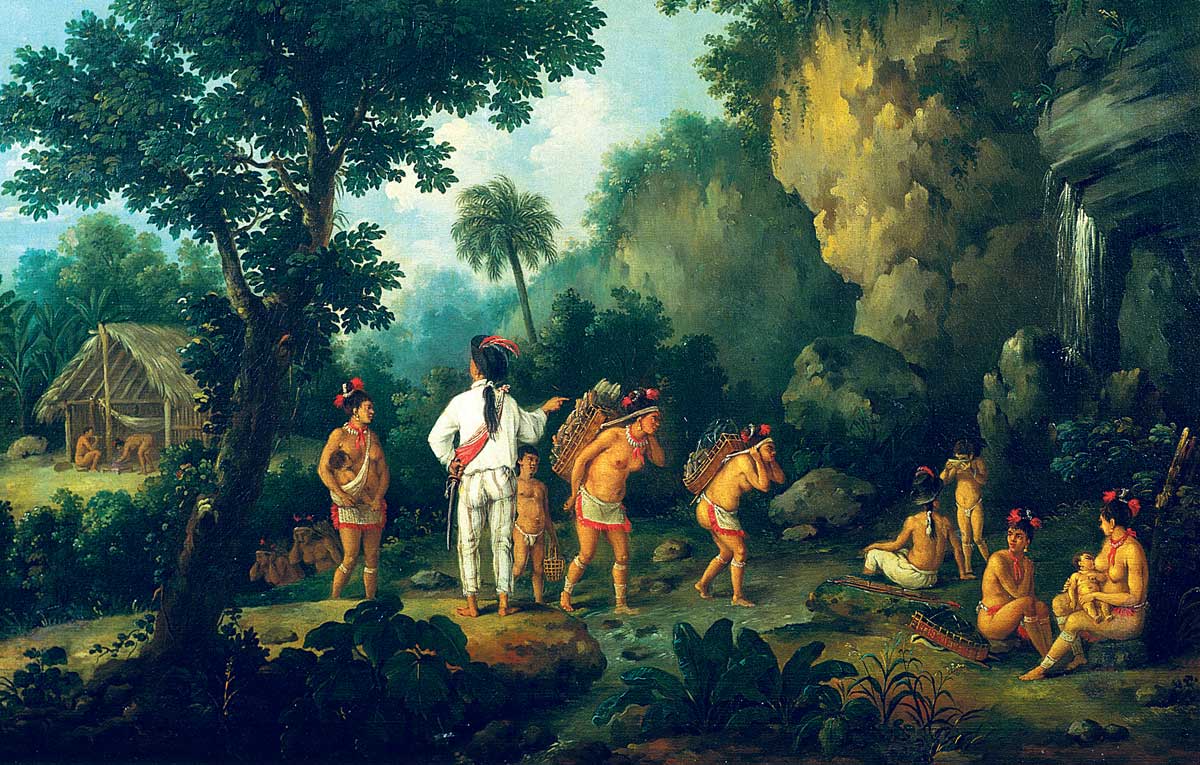
In his autobiography, My Bondage and My Freedom (1855), the American abolitionist Frederick Douglass wrote:
The slave finds more of the milk of human kindness in the bosom of the savage Indian, than in the heart of his Christian master. He leaves the man of the bible, and takes refuge with the man of the tomahawk.
Douglass echoed a popular view in the 19th century and one that remains largely in place today: that Native American slaveholding was more lenient than the slavery practised by whites, as the Indigenous peoples of North America were natural allies to enslaved Africans. Native American slaveholding was in fact an institution with a long history, yet was rarely as compassionate as Douglass thought.
The role of Native Americans in the history of North American slavery is beginning to be properly quantified. This does not only mean highlighting the large numbers of Indigenous people that were taken as slaves in North America, but also exposing the many ways in which Native Americans were active participants in the economy of slavery and slaveholding. Europeans did not introduce slavery to the New World, but settler colonialism changed the emphasis, scale and characteristics of the practice.
Captives
Since prehistory, captives have played an important role in Native American communities. Captive-taking during war was the means by which Indigenous groups first brought slaves into their settlements. A variety of fates could await a captive, from immediate execution to excruciating, prolonged torture. The Cherokee, who primarily fought as an act of vengeance, were known to burn captives alive and then scalp them. This was a fate usually met by men because, as warriors, they were expected to die a warrior’s death. Being taken as a slave, therefore, might be a preferred outcome for a captive.
As opposed to the economically motivated slavery in the European colonies, Native American slaveholding before the 18th century was dominated by prestige. Rather than putting the captive to work, Native Americans held slaves as physical markers of their dominance. The man who held the most slaves in a town was likely the chief, or at least a man of high standing. This was true among many nations in the Native South through to the 19th century. Of the Creeks, the US Indian Agent Benjamin Hawkins reported in 1848 of one chief named Efau Haujo that:
He is one of the best informed men of the land, and faithful to his national engagements. He has five black slaves, and a stock of cattle and horses; but they are of little use to him; the ancient habits instilled in him by French and British agents, that the red chiefs are to live on presents from their white friends, is so riveted, that he claims it as a tribute to him, and one that never must be dispensed with.
This account demonstrates the longevity of holding slaves for reasons of prestige. Hawkins attributed the chief’s view on slaves to the ‘French and British’, but it is likely that Efau Haujo was also influenced by a wider, long-lasting belief in the Native South that slaves were personifications of a master’s power and served as deterrents to any would-be adversary.
Prior to the creation of larger, more cohesive Indigenous societies in the 18th century, during the period known as the Mississippian era, the Native South was made up of small chiefdoms. It was rife with inequality and captives played a central role in upholding the mores of the system. Importantly, captives lacked kinship-ties to their captor’s society, instead existing as a ‘social opposite’ – a representation of what a society considered to be unworthy. The captive played a vital function in establishing the hierarchy of Native American societies: a community was brought together by a shared understanding that they were above those who lacked kinship-ties: the captives.

Slaveholding was not a codified institution across Mississippian-era Native American communities. The fate of a captive varied greatly depending not only on which nation the captive found themselves in, but also which town within that nation. Among the Iroquois of the 17th century, for example, some towns favoured the ritualistic killing of captives, while others preferred to keep their captives as slaves. Captives were also used as diplomatic tools with neighbouring tribes and Europeans. Jesuits reported in 1646 of an instance of a Huron girl, who had been taken by the Iroquois:
Mention has often been made, in the Relations, of this girl: she is a Huron, who, having been instructed at the Seminary of the Ursulines, was captured by the Iroquois, with her relatives, when the latter were taking her back to her own country. The Ursuline Mothers not being able to endure that this poor little creature should remain in that captivity, remote from all the helps which could open for her the gates of salvation have spared no pains, and have moved Heaven and earth to procure her liberty.
Evidently, the Iroquois saw the advantages of holding onto this captive as she gave them leverage. The fact that attempts were being made to ‘procure her liberty’ suggests it was not unknown for the Iroquois to release captives.
Even before the first African slaves were transported to North America in the early 17th century, a system of slavery was well established on the continent. Such was the prevalence of captive-taking that the artist Theodor de Bry chose to illustrate it in his 1590 engravings of the Indigenous peoples encountered in Virginia. In one engraving de Bry shows how these people celebrated the taking of captives. These were practices developed by Native American communities, independent of European influence. In time, however, the influence of white settlers would greatly transform the nature of Native American slaveholding.
Slave trade
By the 18th century, European settlements were firmly established in North America and larger Indigenous confederacies saw many benefits in establishing trade networks with English, French and Spanish colonies. The most coveted items were muskets, with which Native American communities could exert dominance over one another.
These trade networks created the perfect conditions for the rise of the Native American slave trade, which enveloped the colonial South around the turn of the 18th century. The trade was so prolific that, during the period 1670-1715, more enslaved Native Americans were exported from Charles Town than enslaved Africans. The active participation of Indian confederacies in this trade brought with it the move away from traditional forms of captive-taking towards the European system of trade and exploitation.
The southern British colonies encouraged the Indian slave trade as it weakened threats to their own survival and fulfilled their labour shortage. European settlers offered enticing goods in return for slaves from Indigenous traders, which ensured that Native communities were pitted against one another. As a consequence, Native communities in the south-east were ravaged, old alliances collapsed and the balance of power constantly shifted. Indeed, an Indian nation that was once successful in procuring slaves for the settlers could soon find itself the target of these raids. The creation of a lucrative yet hostile market for slaves changed not only the face of Native American slaveholding, but also the colonial South, as colonies like South Carolina swelled in power and influence.

Many large Indigenous nations became proficient at procuring captives to sell in South Carolina. The focus of these slave raids was on the women and children. Acting in the belief that grown men were not good slaves, raiders killed the warriors and kidnapped the women and children. Usually, a small party of scouts was sent ahead to scope out the targeted village, followed by a large attack force of warriors who went to capture the vulnerable. The victims were then tied with cords, which went around their necks and strangled them if they attempted to escape. They were held in pens until enough slaves had been captured and could be sent to the British or French settlements. By 1710, the Chickasaws were masters of slave trading in the south-east and the system was self-perpetuating, as an account from an official of New France, Pierre Le Moyne d’Iberville, shows:
I gave a gun, a blanket, a hooded cloak, an ax, two knives, some powder, and bullets to a Chicacha as payment for the Chaqueta slave.
By trading slaves for firearms and other items that would support a raid, Europeans encouraged Indian slavers to capture more slaves for better rewards.
The propagation of the Indian Slave Trade was not confined to the British and French colonies. In Spanish New Mexico, the Comanche increased the strength of their confederacy by supplying the Spanish demand for Indian slaves. The burgeoning Spanish ranches developed an insatiable appetite for enslaved Indians around the turn of the 18th century, requiring them to fill a diverse number of roles to maintain the lucrative profits they were pursuing. The key to Comanche success was their powerful mounted warriors. In the face of the Comanche’s highly effective slave raids, smaller tribes, such as the Navajo, were virtually defenceless. Even the Spanish colonists recognised that the Comanche were the true powerbrokers in New Mexico. Soon, the Comanche exhausted the borderlands of the South and expanded eastwards into the grassy plains. So successful were the Comanche that they defied conventional wisdom and prospered by exploiting the changes that settler-colonialism had brought.
Such an intensive system could not last in the volatile climate of colonial America. In the south-east, Native American nations that had become trapped in the vicious cycle of the slave trade rallied together to destroy the grip of the settlers once and for all. In the Yamasee War of 1715-17 – which pitted British settlers against the Yamasee and other peoples – seven per cent of the white population in South Carolina was killed, which almost led to the colony’s annihilation. It also destroyed the Indian slave trade. Even without the conflict, it is likely that the trade would have dwindled as the 18th century progressed due to one factor: the growth of the Atlantic slave trade. The ease of acquiring black slaves usurped the costly and dangerous means of capturing Indian slaves.
Colonial values
Protracted conflicts, disease and the chaotic collapse of the Indian slave trade left nations in the Native South in a state of flux by the end of the 18th century. This was further complicated by the American Revolution, which destroyed the colonial alliance system that Indian nations had become adept at negotiating. For many Indian nations, the exploitation of enslaved Africans became seen as a necessity for survival.
US Indian agents in the South pressured Indian nations to adopt Anglo-American norms. This affected everything from their clothing to slavery. Native American nations gradually began to rely on agriculture instead of hunting and the deerskin trade. By forcing them into the market economy, the US hoped to remove the threat of Native Americans at their frontier and to make their lands open for white settlement. Its effect on Indian nations was more complex. Starting in the late 18th century, prominent Indian nations were led by those who embraced these new values, often reflected by their westernised names. John Ridge rose to prominence among the Cherokees, while Peter Pitchlynn and Alexander McGillivray were leading figures among the Choctaw and Creeks, respectively. These men were connected by their white ancestry, views on racial hierarchy that were in line with what was accepted among whites and also their avocation of chattel slavery.

Indian nations began to rely on the labour of enslaved blacks during the first half of the 19th century. A missionary offered this account of Cherokee slaveholding during the period:
The establishment was probably a squarish, two-story house, small by modern standards and quite plain, often unpainted. The farm, for it was a farm, not a plantation, was completed by a few utility shacks, the slave huts, stables and fields. The slaves probably numbered about half a dozen. The men worked the fields with the Indian owner, the women did the domestic work under the direction of the squaw, the children ran free … These Indians were the rich and important men of their tribes, they were men of affairs, and in most cases they were the allies of the missionaries and church members.
Slaveholding Cherokees held strong links to white communities and this example highlights how the ‘civilising’ missions from both church and state were radically altering the shape of Indigenous communities. Slaveholding was a means of reinforcing power, much as it was prior to the Indian slave trade. It is also a misnomer to assume that Native American slaveholding in the 19th century was somehow a more lenient system than white-run plantations. Martin Vann, the former slave of a Cherokee, recalled that his master
built log pens on their place for keeping a negro should he get mean or do something wrong. They called it the bull ring … The master put that slave in the bull ring and lay on with the lash. When the whipping is over the master say: ‘Now go do that again!’ Most always the man didn’t do it again.
Similarly among the Choctaw, Peter Pitchlynn instructed his wife that ‘should any of the blacks get unruly’ she should not hesitate ‘to whip them’.
Exceptional Seminoles
The Seminoles have been seen as an exception to this rule. The Seminole nation of Florida coalesced during the 18th century and formed a unique relationship with African-Americans. To defend against the expanding influence of the US, the Seminole forged an alliance with the Maroon communities of Florida, independent groups of runaway slaves. These became known as the Seminole Maroons, or Black Seminoles, and acted as allies to the Seminole Indians, but also offered their labour in other ways, through agriculture and by acting as interpreters in meetings between whites and Indians. In return, they expected the Seminole Indians to protect them from white attempts to strip them of their freedoms. While they assumed a lesser position than the Seminole Indians, the Maroons still managed to prosper, due to the fact that they lived in their own towns. George McCall, a US Army officer, observed this when he visited a Seminole Maroon town named Pilaklikaha in 1826:
We found these negroes in possession of large fields of the finest land, producing large crops of corn, beans, melons, pumpkins, and other esculent vegetables … I saw, while riding along the borders of the ponds, fine rice growing; and in the village large corn-cribs well filled, while the houses were larger and more comfortable than those of the Indians themselves.
The Seminole Maroons were often mistakenly labelled as slaves by white observers, but the facts of their living conditions proved that they were in essence, free. This was not the case, however, for all black people among the Seminoles.

Much as with the Cherokee and Choctaw, evidence suggests that some Seminole Indian headmen benefitted from a system that was not far removed from chattel slavery. King Payne, who was the principle headman of the Seminoles in the 1810s, held numerous enslaved black people and profited greatly from this system. These black slaves were responsible for his herds of cattle and generated profits that allowed Payne to live in a two-storey house that was similar to a plantation house. Another Seminole Indian slaveholder in the 1810s was Opauney, who used his enslaved Africans to tend to his agricultural produce. One white observer wrote of Opauney’s slaves:
This field is planted principally with corn and rice & attended in the same manner one would expect in Plantations under the directions of white people … He held about 20 slaves who perform the same labor that is generally expected on plantations in Florida.
From this description, we can gather that these slaves lived in the same town as their masters and did not have the same freedoms as the Seminole Maroons. Like Payne, Opauney traded his produce in St Augustine and Pensacola. Such was Opauney’s success with his trade networks that he, too, lived in a two-storey house and upon his death reportedly had an estate that was worth $7,000.
Abolition
The effects of Indian removal in the mid-19th century served to strengthen the racial divide among Indigenous communities. The Cherokee introduced harsh slave codes throughout the 1830s that stripped any modicum of independence the enslaved may have had. Even the Seminoles began to sever their close ties with African communities. Following the bloody and drawn out Second Seminole War (1835-42), a conflict that the Seminoles hoped would oust the US from Florida and leave them in their ancestral lands, both black and Indian Seminoles were removed to Indian Territory west of the Mississippi river, where Africans took the brunt of the hardships.
The Emancipation Proclamation of 1863 did not initially extend to the so-called ‘Five Civilised Tribes’. The Choctaw, Chickasaw, Cherokees, Creeks and Seminoles allied themselves with the Confederate States, partly in an effort to retain their slaveholding practices. It would only be in 1866, a full year after the Civil War’s end, that these Native American nations entered into treaties with the US that officially ended chattel slavery in Indian Country. The complex, flexible and often brutal system of Native American slaveholding had come to an end. ‘I was glad to be free’, recalled Kiziah Love, a former Choctaw slave. ‘What did I do and say? Well, I jest clapped my hands together and said, “Thank God Almighty, I’se free at last!”’ Another freedman, Nellie Johnson, who once belonged to a Creek Chief, recalled a more sombre image of abolition:
One day my pappy come home and tell us all that the Creek done sign up to quit the War, and that old Master send word that we all free now and can take up some land for our own selves or just stay where we is if we want to. Pappy stayed on that place where he was at until he died.
These contrasting scenes of the effect of abolitionism, both jubilation and bemusement, reflect the experience of emancipated black people across the South. To be a slave to a Native American by the 1860s was not a distinctive experience. Indigenous forms of captive-taking altered drastically over the course of the Indian slave trade and the introduction of black slaves, but the impetus remained constant through the centuries: the oppression of the enslaved. The reasons for this may have varied, whether societal or economic, but the system of Native American slaveholding always relied on domination. There was no reason for the enslaved to expect the ‘milk of human kindness’ from a Native American master.
Edward Mair is an early career researcher studying the 19th-century Seminoles and a recent PhD graduate of the University of Hull.


