

The Civil War’s ‘Martyr of Peace’
In an age of political and religious division that ended in Civil War, Lucius Cary and his circle at Great Tew offered a space for debate and compromise.
As Brexit Britain rediscovers the cleansing fervour of political purity and concomitant division, the protagonists of the country’s 17th-century Civil Wars are enjoying renewed attention. But the well-known combatants who exemplify the extremes of history obscure more appealing shadows thrown up midway between their flames. In 1907 a historian and aspiring politician, John Marriott, lamented that:
no sacred fane has been dedicated to the memory of the great ‘apostle of moderation’ …the tomb of the martyr of the Via Media remains … not merely unhallowed but unknown.
Marriott was alluding to one of the few truly amiable characters in Britain’s traumatic 17th century, Lord Falkland, still a neglected figure except among the same sort of intellectual company that he kept during his short life.
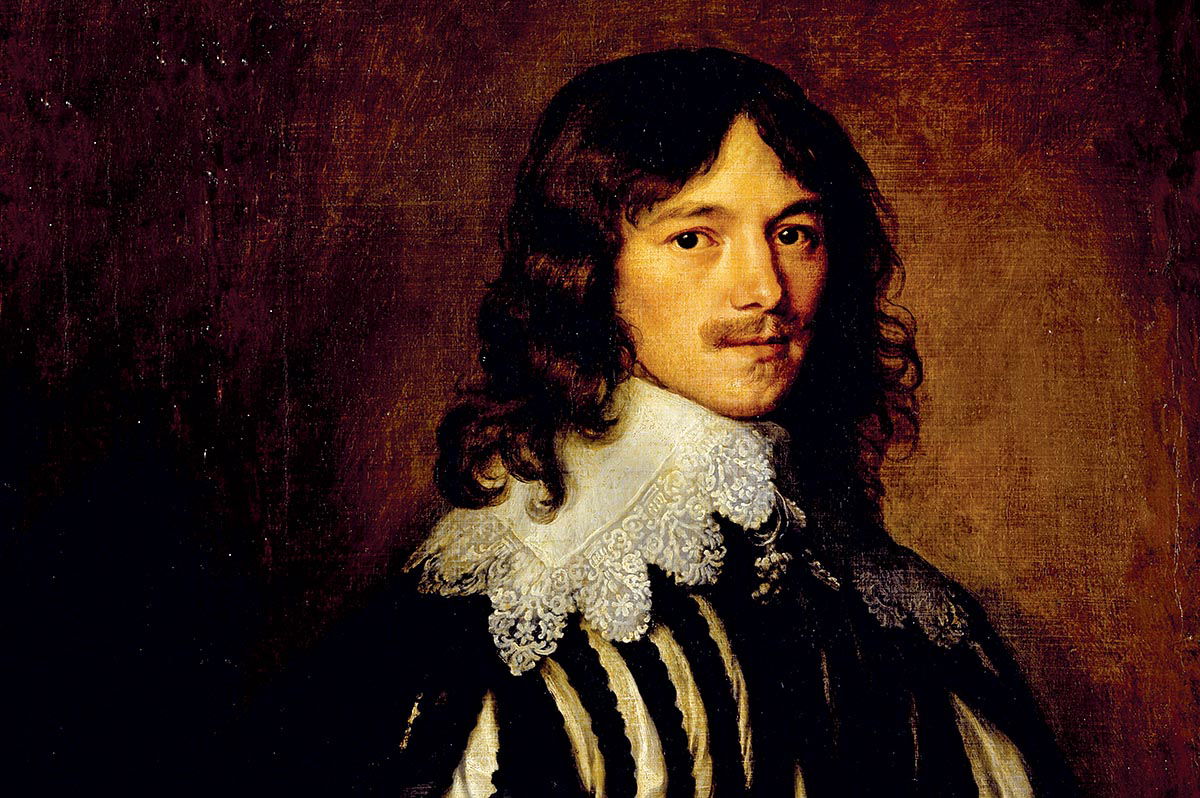
Lucius Cary, 2nd Viscount Falkland, Secretary of State to Charles I, was killed at 33, riding, as his commander Sir John Byron commented, ‘more gallantly than advisedly’ ahead of his companions at the Battle of Newbury in 1643. This first Newbury fight took place at a point when both sides in the Civil Wars were becoming increasingly determined upon victory rather than compromise. Along with his closest friend, Sir Edward Hyde – soon to become the first great historian of the Civil Wars – Falkland was driven to despair by the hardening of extreme Royalist and Parliamentarian factions and the diminishing chances of any negotiated settlement. Hyde implies that Falkland, overcome by his horror of the war, effectively committed suicide by means of repeated self-exposure to danger. Hyde called his friend’s death:
a loss which no time will suffer to be forgotten, and no success or good fortune could repair … if there were no other brand upon this odious and accursed civil war, than that single loss, it must be most infamous, and execrable to all posterity.
It is true that Hyde was writing under the twin pressures of personal grief and political defeat. But such mourning was not confined to the Royalist camp. Immediately after the clash at Newbury, Hyde received a letter from an estranged friend in Roundhead London: Katherine Jones, Lady Ranelagh, a distinguished scientist and philosopher and a childhood playmate and lifelong admirer of Falkland. She deplored Falkland’s passing and urged Hyde, his political heir, to continue to work towards a peace settlement.
Almost a decade later, after the execution of the king and the inception of Cromwell’s Protectorate, Thomas White – a rare and articulate Cromwellian Catholic priest and a political, theological and scientific radical with whom Falkland had once crossed quills – celebrated his former foe as ‘that Martyr of Peace’. After 1649 Anglicans canonised Charles as a royal saint and martyr; late in the reign of Charles’ son, Algernon Sidney would be hailed as the martyr of the Whig and republican cause. But the title of martyr continued to be periodically bestowed on Falkland as the representative of a third political strain. Matthew Arnold, in his 1879 Mixed Essays, calls Falkland ‘the martyr of lucidity of mind and largeness of temper’.
Marriage of two minds
Lucius Cary was born in 1610, eldest son of Henry Cary, 1st Viscount Falkland, and his learned wife, Elizabeth. The first Lord Falkland was an extravagant, impulsive courtier, equipped with literary taste but little political skill, who put in a mediocre-to-poor performance as Lord Deputy of Ireland in the 1620s. Lady Falkland’s scholarly temperament led her to profess a deep – and deeply inconvenient – Catholic faith. Since Lucius’ maternal grandparents were equally appalled by their daughter’s religion and their son-in-law’s improvidence, Lucius was made the heir to their estates in Oxfordshire.
At first the son seemed cut from the father’s cloth, a bad-tempered lightweight with a lick of literacy. In 1630 he was briefly imprisoned for duelling. But from the moment of his retirement to his new Oxfordshire domain at Great Tew, Lucius, who became Lord Falkland on his father’s death in 1633, began to manifest his mother’s scholarly interests without the drawback of her religious fanaticism. He declared that he would not return to the capital until he had mastered the Greek language and quickly earned his passport back to the metropolis, becoming one of the few writers of his day to be conversant with the work of the 12th-century Byzantine princess-historian Anna Comnene. At Great Tew, ten miles from the University of Oxford, Falkland established an open house for the most sophisticated and companionable scholars, poets, theologians and political thinkers, who flourished in the outwardly peaceful England of the 1630s, the decade of Charles I’s Personal Rule.
Contested legacy
The Great Tew circle’s legacy is contested. The Marxist historian Christopher Hill belittled it as a house party of high-born dilettanti. Great Tew’s greatest champion, Hugh Trevor-Roper, defended its moral stature – taking its members’ profession of rational scepticism and pacific politics seriously – and its political effectiveness, seeing Great Tew as a coherent movement that re-emerged to triumph in both Church and State at the Restoration.
Trevor-Roper was challenged in turn by an American scholar, Robert Adams, who saw Falkland’s friends as intellectually consistent Royalist ultras, tainted by association with the king’s court, the increasingly pro-Caroline University of Oxford and the overweening Archbishop of Canterbury, William Laud. Adams’ theory was coloured by his angle on Falkland’s in-house philosopher, William Chillingworth, who was Laud’s godson and possibly an informer for him. Chillingworth combined the adventurous, anti-Calvinist theology favoured by Laud with an uncompromising school of Royalism, which labelled resistance to the Crown illegitimate.
Adams’ view holds plenty of water, as do those of Trevor-Roper and Hill. But all are mistaken when they assume what this ‘circle’ represented. For Falkland’s great achievement was to have created not a side in a war, a faction at court or a political party, in an antagonistic century that would give birth to many such, but a pleasant retreat where friends could talk in peace and delight, free to change their own and each other’s minds.
Forgotten figure
In political matters, Falkland and Hyde were at one – though several of their friends, including Chillingworth, the poet Sidney Godolphin and the then less renowned thinker Thomas Hobbes, disagreed with them – in disapproving both of Charles’ extra-parliamentary rule and of the temporal influence of Laud. Their ideal government was shaped instead by the writings of Hyde’s legal mentor, the barrister, antiquary and parliamentarian John Selden. A figure of unjustly forgotten stature and eccentricity, Selden helped to invent English secular history, was a pioneering Gentile authority on Jewish law and maintained a discreet accommodation with the very rich Countess of Kent.
For Selden, the ancient constitution of England was a delicate ‘mixed monarchy’ that required sensitive and harmonious handling; its constituent parts included king, bishops, lesser clergy, Parliament and people. Falkland and Hyde followed their veteran theorist Selden into the ‘Short’ Parliament that Charles called belatedly in 1639. But when the ‘Bishops’ Wars’ in Scotland spilled over by 1642 into civil war in England, Selden stayed in London, a lukewarm supporter of Parliament, while Falkland and Hyde offered their services to the king, reassuring those waverers who had been alienated by Charles’ arbitrary government.
Selden and Falkland were to be reunited two centuries later, when statues were raised to both of them in Barry and Pugin’s new Palace of Westminster. In 1909 suffragettes chained themselves to both statues, damaging one of Falkland’s spurs. It might be asked what a statue of Falkland, who fell fighting parliamentary forces, was doing in Parliament at all. Partly, his myth was embraced by the Romantic and reconciliatory Victorian conception of Parliament, child as much of Walter Scott as of Pugin. Falkland benefited from the same habit of mind that, literally, cast Richard the Lionheart as the equestrian defender of an institution he predated. But, equally, the ‘Martyr of Peace’ had been claimed by a certain political school of thought. It was not the Conservative or High Tory one that embraced his friend Hyde. Rather, the smoothest, most popular of Whig historians, Lord Macaulay, hailed ‘the excellent Falkland’ as a ‘Constitutional Royalist’ and a ‘resolute champion of liberty’. Macaulay’s admiration was later shared by Liberal prime ministers such as Gladstone and Rosebery.
Comparatively little of Falkland’s oratory, writing, poetry and private correspondence survives, but practically every scrap confirms the lofty estimates both of his contemporaries and of later Whig and Liberal mythology. In the course of his civilised exchange with the Catholic White, Falkland remarks that: ‘I have ever thought that there should be as little bitterness in a treatise of controversy, as in a love-letter’ – a precept which contemporary political discourse shows little sign of absorbing. To Catholic claims of tradition, authority and infallibility regarding Scriptural interpretation, Falkland opposes a flexible application of reason:
I cannot see why we may not in some points join with the one, and with others in other, and besides find some truths which lie … well in the midway between the parties … nay in some points differ wholly of both.
Challenged on his religious orthodoxy, Falkland declared: ‘I profess myself not only to be an anti-Trinitarian but a Turk whensoever more reason appears to me for that than the contrary.’
In his political career before the Civil Wars, Falkland addressed himself in particular to the question of the temporal power of episcopacy. His record, at first glance indecisive, proves upon further investigation consistent and principled. He was tougher on the voting rights of bishops than Hyde or his mentor Selden, who defended the episcopate on the historical grounds that ‘bishops were in parliament ever since there was any mention or sign of a parliament in England’. Falkland feared that Laud’s usurpation of temporal influence led to ‘a blind dependence of the people upon the clergy, and of the clergy upon themselves’. But he came to believe that the greatest threat to liberty of conscience was not Laud and his Church, who seized upon political power but left theology a largely personal matter, but rather Presbyterians after the Scottish model, who reserved the right to legislate over individual and inward belief. As the historian (and descendant of Cromwell) S.R. Gardiner observed, Falkland, like Milton, was motivated above all by ‘the desire to secure intellectual liberty from spiritual tyranny’.
Ultimately Falkland devised the formula that ‘if it is not necessary to change, it is necessary not to change’. This was long before Lampedusa’s inverse aphorism in The Leopard that ‘if we want things to stay as they are, things will have to change’. Falkland’s tag, like Lampedusa’s, is instinctively quoted by reactionaries, but conceals a more ambiguous implication, that positive change is sometimes, if not always, desirable as well as inevitable.
Marriott called him ‘distracted by the difficulties of the present’ but with ‘a special claim upon the future’ and expressed with optimistic confidence that ‘however much critics may continue to differ over the value of Falkland’s political example, there is no longer any danger that it will be ignored’. Arnold said of Falkland and the Great Tew circle that:
by their heroic and hopeless stand against the inadequate ideals dominant in their time, [they] kept open their communications with the future. Their battle is ours too … that we pursue it with fairer hopes of success … we owe to their having waged it and fallen.
In a political era where we hardly share such confidence in ‘fairer hopes of success’ and where ‘inadequate ideals’ seem once again more menacing than risible, Falkland’s own sad end is scarcely consoling. But the humane liberty of thought he displayed throughout his social, literary and political career at least constitutes an inspiring example of civilisation at its most embattled, yet courageous and, in the end, persuasive.
Minoo Dinshaw is the author of Outlandish Knight: The Byzantine Life of Steven Runciman (Allen Lane, 2017).


