

Britain's Digital Reformation
There are striking parallels between state survelliance in the Tudor age and today.
 It is clear that in much of the developed world we are living in a period of widespread and intensive personal surveillance. The ‘Wikileaks’ revelations and the secret documentation made public by the exiled whistleblower Edward Snowden have shown the extent to which the US National Security Agency (NSA) and the British Government Communications Headquarters (GCHQ) have been routinely intercepting and analysing much of the world’s telephone and Internet communications. This involves searching for key words suggestive of terrorist or criminal activities or determining the links between suspected terrorists and criminals. Such surveillance grew out of the activities of the security services during the Cold War but were given a new impetus by the rise of terrorism linked to religious fundamentalism, the 9/11 attacks on the US in 2001 and the suicide bombings in London in July 2005. The subsequent development of a programme for Total Information Awareness (TIA) under the Bush administration aimed to put the entirety of the world’s information flows at the disposal of the US security complex. The full TIA project was halted by US Congress, but elements of it plainly continued to be developed, with the assistance of the British authorities. In Britain, state institutions are involved in intensive surveillance of Islamic institutions. Non-government bodies are now being asked by them to undertake similar activities. Religious fundamentalism is now seen as a force that threatens the state and private citizens alike.
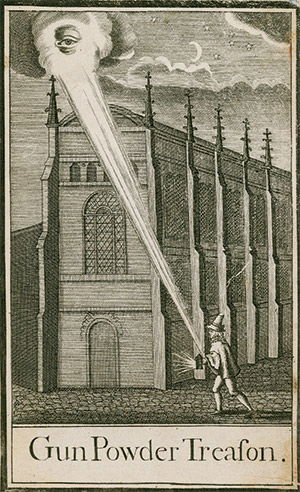
Such concerns over the activities of an external religious movement threatening the British state and citizens via its internal adherents is familiar to those who have studied English history in the period after Henry VIII’s break with Rome in the 1530s. Popular expressions of allegiance to the Roman Catholic faith, such as the Pilgrimage of Grace in 1536, were brutally repressed. Elizabeth I was excommunicated and ‘deposed’ by the pope in 1570 and, subsequently, Catholic priests and, to a lesser extent, Catholic worshippers came to be seen as agents of a foreign power and ideology. The threat to Elizabeth is evident in the plots that swirled around the exiled Catholic Mary Queen of Scots, with the intention of placing her on the English throne. After Catholic conspirators led by Guy Fawkes attempted to blow up James I and Parliament in 1605, extensive spy networks were developed to identify and prevent future conspiracies. Ordinary Catholics who did not attend Church of England services were reported to local magistrates though, just as with the vast majority of British Muslims today, most English Catholics had no intention of threatening the state or their neighbours.
Analogies between modern Britain and early modern England can also be seen in the history of social welfare. Beveridge and the creators of the welfare state hoped that by making benefits universal they would remove the stigma associated with poverty. Welfare benefits would simply be ‘social’ rights that would be as generally acceptable as property and political rights. However, opposition to taxation, benefits means testing and fears over fraud have led to the wholesale sharing of data between government bodies such as the Department of Work and Pensions and HM Revenue and Customs. ‘Troubled’ families are now targeted for various forms of social intervention to prevent them from becoming a burden on the state.
Similarly, during the English Reformation, the Dissolution of the Monasteries led to the destruction of institutions such as hospitals, which had traditionally assisted the poor. The Reformation’s emphasis on salvation by faith also undermined the belief in the spiritual efficacy of charitable works, although that does not mean that Christian charity vanished. These religious, economic and social shifts led to a perceived crisis of welfare. The response of the Tudor state was to supplement the promptings of Christian charity with the legal requirements of the Poor Laws. Each locality was to raise funds through a poor rate and disburse them to those in need via overseers. Over the following centuries this system came to be seen by the poor as a right. Yet the response of rate payers was increasingly to view the poor as a nuisance to be controlled. Consequently the Poor Laws spawned a vast system of surveillance to determine the circumstances of families and the parentage of illegitimate children.
A similar story can be seen over public concern about immigration. The movement of people into Britain, driven by the country’s incorporation into the EU and demands for cheap labour, has fuelled public opposition to immigration and asylum seekers. Migrants are often blamed for reducing wages and increasing unemployment. To control migration the government has introduced measures to restrict the access of migrants to welfare systems and placed legal obligations on civil bodies to police illegal immigration. Universities must ensure that students are legally entitled to study in the UK or risk having their ability to take foreign students curtailed by the UK Borders Agency. Landlords, it is proposed, must ensure that those they let property to have a legal right of residence and, under the 2006 Immigration, Asylum and Nationality Act, employers are required to check that all those they employ have the right to work in Britain.
The 16th century was also a period that was obsessed with the effects of population movements. The population was increasing and the rise of commercial farming was pushing people off the land. The Dissolution of the Monasteries may also have contributed to such movements. Increasingly draconian Vagrancy Laws were developed in order to prevent the movement of ‘sturdy beggars’, seen as potential burdens on welfare systems and the harbingers of crime and immorality. Like East European migrants today, certain groups, such as the ‘Egyptians’ or gypsies, were seen as an alien intrusion. Local justices of the peace, overseers of the poor and constables were charged with patrolling the highways in search of those travelling without visible means of support. Local people were prohibited to take them into their homes. Under the Vagrancy Laws such migrants could be whipped back to their parish of birth, branded and ultimately hanged.
There are plainly important differences between then and now. The modern British state is defending a secular polity, or at least one that is neutral to religion, rather than attempting to impose a particular religious settlement, as in the case of the Tudors. Equally the modern fear of migrants is taking place in a totally different context, in which national sovereignty, rather than local particularism, is seen to be under threat. Also, much modern surveillance is not carried out by the state at all but by commercial organisations such as supermarkets, online service providers and credit reference agencies. However both periods confronted the same issues – the rise of groups ready to die and kill for religion and vast social and economic change – and seem to have reacted in remarkably similar ways. Thinking of contemporary Britain as passing through the Digital Reformation is perhaps a useful way of looking at our present discontents.

