
An Aztec Domesday Book?
Warwick Bray reviews a new illustrated edition of a Colonial 'Domesday Book' for the Aztec world.
At some time during his administration (1535-50) Antonio de Mendoza, Viceroy of newly conquered Mexico, commissioned a report for the Spanish crown. The aim was to describe the condition of Mexico before the European arrival, and the document listed the conquests of successive Aztec rulers, gave an inventory of the tribute paid to Moctezuma by his imperiaI provinces, and concluded with a description of everyday life as the Indians remembered it.
At first glance the report looks like any other bound volume, but this was no ordinary government document. It was compiled, on European paper, by Indian scribes who used the indigenous pictorial script. The native informants then explained the drawings to a Spanish commentator who annotated the pictures with brief descriptions in Roman script and provided longer Spanish texts summarising the content of each page. Parts I and II, dealing with history and taxation, were probably direct copies from lost prehispanic originals; the third, ethnographic, section has no parallel in native Mexico and must have been specially commissioned.
Like so many official reports, Mendoza's was a rush job, and on the final page the compiler, identified only as 'G', makes his apologies:
The interpreter was given this history [i.e. the pictorial version] ten days prior to the departure of the fleet, and he interpreted it carelessly because the Indians came to agreement late; and so it was done in haste and. he did not improve the style suitable for an interpretation, nor did he take time to polish the words and grammar, or to make a clean copy.
He does, though, have confidence in the explanations of the drawings. 'These are correctly presented, because the interpreter of this is well versed in the Mexican Language'. This straightforward, almost chatty, style is characteristic of the text as a whole, and makes it a pleasure to read.
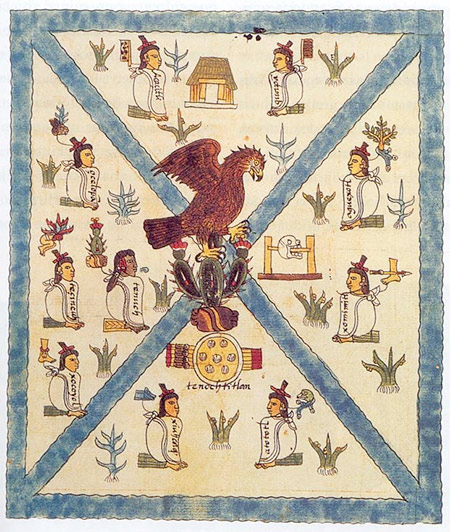
The drawings are in native style, though occasional signs of European influence show that this is a colonial manuscript, not a prehispanic one. The images spread all over the page, with no attempt to give the illusion of space or dimensionality. As in all Mexican drawing, human figures are depicted in profile, with large heads, and with limb and body positions indicating conventionalised actions. The pictures are outlined in black, and then. filled with flatwash colour. In this kind of visual communication, interpretation depends an viewers ability' to recognise the subject matter, so the defining features (uniforms, insignia, etc.) are rendered precisely and carefully. When the objects themselves still exist for comparison, the accuracy of the drawings is confirmed. This in turn suggests that we can rely on the pictures as a source of information about things not preserved in the archaeological record. For this reason alone, the pictorial text is as important as the written one.
The manuscript, now known as the Codex Mendoza, is a major source on Aztec history, economic geography, socio-political organisation, hieroglyphic writing, art styles, indigenous customs and the mundane details of everyday life: clothing, jewellery, weapons, textile designs, looms, pottery, cradles and baby baths, musical instruments, fishing nets, gaming boards, brooms, incense bags and household articles of all kinds are meticulously illustrated. The subject matter is a miscellany of serious themes (negotiation with rebel rulers, the execution of adulterers by stoning) and trivia, such as the listing of rations (two tortillas) issued to thirteen-year-old children, or the menu for a wedding feast. The one important subject not covered by the codex is Aztec religion, a matter of no great interest to Spanish bureaucrats and one best left to the missionary friars.
The later history of the codex is a romance in itself. The ship carrying the manuscript to Spain was captured by a French privateer, and the codex passed to André Thevet, Geographer to the king of France. Thevet signed the volume and added the date 1553 below his signature. Thevet sold or gave the codex to Richard Hakluyt (at that time chaplain to the English ambassador in Paris), and, on his death, Hakluyt willed the codex to Samuel Purchas, who reproduced some of the illustrations in his Hakluytus Posthumus, published in 1625. The manuscript eventually moved to the collection of Purchas' friend, the jurist and antiquary John Selden (who already owned two other Mexican pictorial documents), and after his death all three codices entered the Bodleian library, where they finally came to rest.
Extracts from the Codex Mendoza were published sporadically in both Europe and Mexico, but attempts to produce a facsimile version with an English text were dogged by ill luck. Lord Kingshorough reproduced the work in his Antiquities of Mexico (1831- 48), and promptly went bankrupt. Most of the next English edition, by James Cooper Clark in 1938, was destroyed during the London Blitz in 1940. There was, then, a need for a new scholarly facsimile. The California version, edited by two distinguished scholars and with contributions from some of the best known names in Aztec studies, satisfies all expectations. It is not cheap (though it is very good value for money), but both the production standards and the intellectual quality of the commentary are so high that the book gives delight at all levels.
The edition consists of a boxed set of four volumes. One of these is a facsimile of the Codex, life size and more faithful to the original colour values than is any other version I have seen. Another volume contains the transcription and translation; each of the pictorial pages is reproduced in the form of line drawings, with the Spanish text transcribed in full and then translated into English. The two introductory volumes contain the scholarly apparatus. Volume I (with eight chapters and eleven appendices) is made up of articles dealing with the physical description, history and subject matter of the codex, analyses of its pictorial style and glyphic conventions, with studies of the ethnographic content of the manuscript and of the costumes, textiles, and categories of people depicted in it. What makes this volume so valuable is the way in which the authors codify and examine every detail. Each of the 612 place-name glyphs has a paragraph to itself; the principal tribute commodities are discussed individually: the reign-dates for Aztec rulers in the Codex Mendoza are checked against those from thirty-eight other historical codices; warriors' costumes and the designs of cotton capes are compared with those represented in other pictorial manuscripts. This is painstaking scholarship of the highest order, and the presentation is masterly. What comes out of this volume is not just a commentary on the Codex Mendoza, but also a concordance embracing the whole field of Central Mexican manuscripts.
Volume II is modestly titled 'Description’, but maintains the same standards of thoroughness. Aztec conquests are analysed reign by reign, and every one of the thirty-nine conquered provinces (each corresponding with a single page of the tribute list) receives an essay to itself, with a map (marking each town and translating its name-glyph), a commentary on the tribute paid, and a digest of all that is known about the province's history. Because many of the towns mentioned in the Codex Mendoza still exist, and can he located on modern maps, the tribute list allows us to map the territory under Aztec rule and us define the provincial boundaries within the empire.
Provincial capitals and garrison towns are also identifiable. The lists of goods and raw materials draw attention to production centres and emphasise the ecological contrast between the Aztec homeland, in the temperate highlands, and the tribute-paying lowlands, which provided the luxuries of the Mexican world: gold, jaguar skins, tropical leathers, rubber, cotton clothing and cacao beans. Since quantities of each commodity are given, we can begin to estimate the importance of tribute to the Aztec economy as a whole.
Montezuma’s tribute list has probably been cited more often than any other Aztec document. By contrast, the ethnographic section of the Codex Mendoza has been under-used by scholars but is splendidly rehabilitated in this edition. Every single image, down to the drawings of hearthstones and clay griddles, generates a miniature essay, which draws on the authors' knowledge of all the Aztec source material, written and pictorial.
The commentary to the California edition of the Codex is so rich and detailed that the book is unreviewable in the normal way. It is, in effect, an encyclopedia of Aztec life. There is no central argument to evaluate. All I can say is that coverage is complete, the facts are accurate, the writing clear and elegant, and the illustrative matter generous. The professional will be quarrying this edition for generations to come, and for non-specialists it is both beautiful and a lot of fun. Anyone dipping into these volumes will learn to know the Aztecs as living people, not just as historical abstractions and as losers in the conflict with Spain.
Warwick Bray is Professor of Latin American Archaeology at the Institute of Archaeology, University College, London and author of The Aztecs (Dorset Press, 1987).
If you enjoyed this article, you might like these:
- Home
- Location
- Period
- Themes
- Magazine
- Subscribe
- Archive
- Ebooks
- Reviews
- Blog
- Contact
From The Current Issue
|
Roger Hudson
|
|
Peter Murrell
|
|
Sarah Gristwood
|


