
Coming to Terms with the Past: Northern Ireland
Richard English argues that historians have a practical and constructive role to play in today’s Ulster.
What role should historians perform in relation to the Northern Ireland Troubles? Do – indeed can – the writing and teaching of history contribute to our coming to terms with Ulster’s traumatic past?
It has been a deeply and persistently troubled region. During the post-1968 period over 3,500 people have died in the conflict. Such figures demonstrate that the scale and awfulness of the Northern Ireland Troubles were limited in comparison with those of other famously violent struggles; but they also embody an enduringly – by west European standards, an appallingly – bloody historical experience.
Northern Ireland itself had been born in bloody times. The 1921 Treaty establishing the Irish Free State had recognised the realities of Ulster unionist feeling by providing for the partitioning of the island. A six-county state was thus established in the north of Ireland, its government and parliament in Belfast presiding over a majority-unionist population. Between 1921 and the 1960s this Northern Irish regime prized loyalty. Unionist leaders felt insecure in the face of a perceivedly dual threat: a hostile Irish nationalist state to the south, and a large minority of Irish nationalists within Northern Ireland itself. They consequently allowed (and at times encouraged) discrimination against the supposedly disloyal within Northern Ireland, thereby furthering the process of northern nationalist disaffection which had occasioned such action in the first place.
Political allegiance and confessional background had lastingly been interwoven in Ireland, and when 1960s civil rights enthusiasts pioneered understandable campaigns for reform in the north, the lines of division became the familiar ones of Catholic-nationalist versus Protestant-unionist. Civil disorder, inter-communal clashes, heavy-handed state response, tit-for-tat paramilitary violence – these famously produced the descent into the Northern Ireland Troubles. In 1968 nobody died as a result of political violence; in 1972 nearly 500 people did so.
After many failed initiatives during subsequent decades – and in recognition of a triangular military stalemate between Irish republicans, Ulster loyalists and the forces of the state – a peace deal was ambiguously achieved in 1998: the Belfast (or Good Friday) Agreement. This reflected and reinforced a new and less bloody political context in Northern Ireland. But, in post-Agreement Ulster, sectarian division remains stark. One recent opinion poll demonstrated that even Ian Paisley’s Democratic Unionist Party has more Catholic support than Gerry Adams’ Sinn Féin has Protestant: the respective figures are 1 per cent and 0 per cent.
What can the study of history contribute in such a setting? Can it help towards the creation of a more serene future half century than the one through which we have just lived?
In the post-war atmosphere many voices are now heard in arguments over how Ulster’s past should be seen in the present. During the Troubles themselves, journalistic expertise was sharpened in dealing with the north’s urgent and often shocking realities. History now can still be read through these frequently illuminating journalistic lenses. David McKittrick and colleagues produced in 1999 their movingLost Lives volume, a vast and tragic tombstone of a book which detailed one-by-one the deaths arising from the post-1960s Troubles. Skilled journalistic accounts have also been produced on key subjects – including figures such as Ulster Unionist David Trimble and Sinn Féiner Gerry Adams. And such players have themselves contributed to historical reflection (both Trimble and Adams being among those who have addressed historical questions in print). For intelligent Northern Irish politicians understand the role that historical assessment can play in strengthening – or undermining – current ideologies and arguments. One’s estimate of the fairness of 1921-72 unionist rule in Northern Ireland, or one’s knowledge of the precise details of paramilitary atrocity in the post-1968 period, are likely to affect one’s preparedness to accept or endorse current political stances from unionist or republican politicians. Furthermore, some politically-involved activists have campaigned for a Northern Ireland truth commission, echoing experience in other troubled regions. And the United Kingdom state has engaged in historical projects of a kind, with the lengthy Bloody Sunday Inquiry into events in Derry in January 1972, and the production of a report on Troubles victims, representing two prominent examples. State-funded archives and museums and historically-oriented projects – not to mention the funding of extensive history-teaching at school level – all underline the state’s commitment to furthering historical understanding.
Amid this crowded world of journalistic, activist-political and official history-production, what role should the professional historian fulfil? The sources for studying the Troubles – in official archives as well as in alternative centres such as the invaluable Political Collection at Belfast’s Linen Hall Library – leave little excuse for professionals to avoid the topic. And the seriousness of the recent Troubles compels historians’ attention anyway: the Troubles embodied not only vital issues of Irish and British history, but also arguably the decisive themes within modern world-historical experience – the tangled intersection of nation, state, religion, socialism and political violence.
Without exaggerating the likely – or feasible – public achievements of professional history, there might seem to be four main areas of contribution open to historians in our coming to terms with the north of Ireland’s traumatic past.
The first, and most obvious, is balance. In contrast to the selective memory syndrome characteristic of some activist or partisan creators of historical record, the broadly accepted rules of historical enquiry (rigorous interrogation of all available evidence, full contextualisation of historical decision-making, and so on), compel one to construct an historical account less comforting to any one side in Ulster’s late-twentieth-century war. Yes, history has been (and will continue to be) used for the purposes of contemporary political legitimation; but historians’ accounts should be sufficiently complex and sufficiently honest in the telling to make the cruder versions of such a self-legitimating process at least more problematic. Anachronism has been used in much politically-motivated historical re-telling about the north; historians can and should counteract such tendencies. The challenging of simplistic or self-servingly amnesiac accounts can enable historians to contribute to a more sanely measured reading of the past: as far as evidence compels and human frailties allow, historians should pursue balance rather than tolerating undue bias.
Related to this is a second point, namely that historians’ obsession with context can helpfully clarify what Northern Ireland’s Troubles were not. This may seem a strange point to make. But if the war of analysis is to facilitate appropriate responses to current Northern Irish need, then it is vital that one should dispel some of the more unhelpfully outrageous readings of the past which still claim adherents. This contextualisation will not suit any side entirely: it is not partisan. But historians are extraordinarily well-placed to offer a necessary explanation of the setting for historical decision-making, and equally well-placed to evaluate such settings in comparison with other places and periods. On the basis of such professional analysis, it becomes clear that – for all its flaws – Northern Ireland after 1921 cannot seriously be compared with apartheid South Africa, much less Nazi Germany; that attacks on Catholic communities in 1969 (dreadful though these were) cannot accurately be labelled ‘pogroms’; that paramilitary violence was not mere criminal gangsterism (appalling though its consequences were in terms of human suffering); and that conflicting decisions and political perspectives all made sense within historical contexts deserving of serious appreciation.
This leads to our third point, that – as Eric Hobsbawm once put it – the major task of the historian ‘is not to judge but to understand even what we can least comprehend’. In few places is this a more pressing duty than in twenty-first-century Northern Ireland. There, even more urgently than is common, there persists the notion that one’s own political views deserve to be recognised as right and good because they are, at root, the only truly valid ones to hold. Opponents’ views, by contrast, are held to be inferior, less legitimate, less worthy of support. In contrast to this popular wisdom, a more persuasive approach to understanding Northern Ireland would see a political culture not as essentially right or good, but rather as right and good in terms of the interests of those adhering to it. For the Hobbesian paradox of Ulster is this: that competing attitudes which logically rest for their validity on the invalidity of their rivals, are simultaneously politically valid in terms of advancing the perceived communal interests of their adherents. Thus rival traditions (Irish nationalist and Ulster unionist) rely on each other’s invalidity, yet both remain persistently valid. In this setting, historians’ explanation of what can least be comprehended – the perceivedly less legitimate or valid view of the other tradition – is achingly necessary. The more historians explain rather than accuse, the more likely will be a proper understanding of what we have experienced in Northern Ireland and of how best to improve upon it in the future.
This is an important dimension to historical writing, but also to the formal teaching of history. Great progress has been made in recent years in encouraging Northern Irish school students to encounter in the classroom historical experience different from their own. University – the first occasion on which most Northern Irish students will have been formally educated in a mixed setting, involving both Catholics and Protestants – offers yet more challenges in this respect. The teaching of history should clearly not involve political proselytism on behalf of any specific tradition; but nor should it merely involve a process of enabling students to add footnotes to communal bigotry. Contrary to popular myth, historical memory is very short in Northern Ireland (as it is in most places): with partisan, quasi-historical memoirs flowing onto the bookshelves, it is ever more vital that serious historians of the region establish as fully as possible what people actually did, said and argued at specific points in Ulster’s troubled past.
Most students starting university in 2004 will have been born around 1986, and so most of the Troubles are pre-historic to their memories. They were born one year after the Anglo-Irish Agreement, five years after the republican hunger strikes, and two decades after the eruption of the violent conflict in the late 1960s. They were one-year-old at the time of the the IRA’s Enniskillen Remembrance Day bomb, and around eight at the time of the IRA’s 1994 ceasefire. There will be competition among those wanting to make sense of these events for students who are too young to remember much about them. Historians should be involved in this competition, if we are to avoid the persistence of that most dangerous notion of all – that one’s own sectional and contemporary view of the past is the only truly valid one.
Fourth, historians – now increasingly happy again to entertain counterfactual speculation – can make a crucial contribution to understanding and coming to terms with the north of Ireland’s history by challenging the idea that the eruption and evolution of the Troubles were inevitable. The idea that what emerged in the late 1960s was unavoidable is one which has gained many adherents. The role of various villains (British imperialism, unionist oppression, southern Irish meddling, republican trouble-making), or the sense of something doomedly tragic about Anglo-Irish relations, have led many to accept that something like what we have lived through had to happen. By recreating lost, past worlds through the study of all available records, historians are increasingly showing how contingent at least the nature and extent of the northern conflict actually was. The past – in Ulster as elsewhere – contained not one inevitable future, but seeds for the development of many.
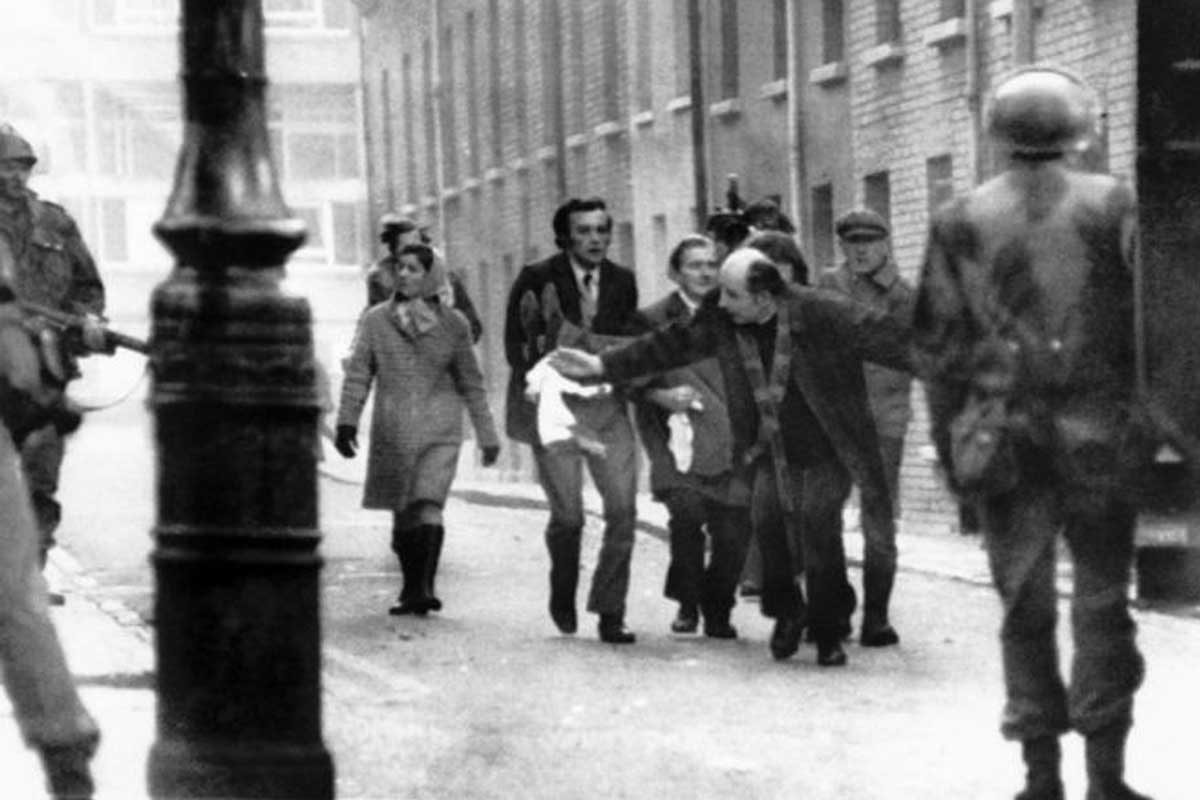
Consider the very emergence of the Troubles, and some of the key incidents which exacerbated tensions disastrously in those early years. At the start of 1969 a radical group of civil rights activists staged the provocative Burntollet march; it was predictably and lamentably attacked by loyalist opponents, northern tensions were further inflamed as a result and a comparatively quiescent period open to potential political defusion was lost. Or again, in the summer of 1970 there occurred large-scale arms searches by the security forces in a Catholic area of Belfast (what became known as the Falls curfew); arms were found, but lives were lost and relations between the British Army and the Catholic working class were fatally worsened. The following year saw the introduction of internment as an attempt to deal with the threat of paramilitary subversion; but the intelligence upon which swoops were based, and the maltreatment of some of those who were interned, deepened the anger among Irish republicans with disastrous consequences. In January 1972 the aggressive Parachute Regiment was deployed to contain an anti-internment march in Derry, and fourteen civilians were fatally shot on Bloody Sunday. It is not merely that these episodes now seem, with decades’ worth of hindsight, to have been ill-judged initiatives. The available record demonstrates that, in each case, sound arguments were indeed offered against each of these actions from informed figures at the time. Real alternatives existed. Many among the civil rights community itself counselled against the Burntollet march, on the sensible ground that the predictable, consequent inflaming of passions would prove disastrous. British politicians at the time saw that the one-sidedness of the 1970 Falls curfew would send out unhelpful and divisive messages. Politicians and leading soldiers argued against internment in 1971, on the grounds that it could only work were there better intelligence than actually existed. And even in advance of the tragedy of Bloody Sunday, people (including soldiers from other British Army regiments) were pointing out that the Paratroops’ record in Ulster was one of aggravating nationalist opinion in such a way as to make them the least suitable group to police Derry in January 1972. Some of these decisions might have been made differently had London intervened with the introduction of direct rule over Northern Ireland in the late-1960s rather than in 1972: and that again – as the archival record now shows – was something for which plans had been made.
Clearly the emergence of the troubles – certainly in the form that they tragically and bloodily took – was not inevitable. Nor was the evolution of Ulster politics an inexorable process in subsequent years: whether in regard to the Irish republican hunger strikes of 1980 and 1981, or the development of the 1990s peace process, richly-sourced historical accounts of the Northern Irish Troubles again and again point to the contingency rather than the inevitability of Ulster history. This may not make the past an easier place for us all to face, but it does mean that current and future political responses can be made with an awareness of the importance (and the range) of the choices in which we can all participate.
Historians are rightly cautious about too programmatic an engagement in contemporary political reconstruction; and they are rightly sceptical about the weight of their influence. But there does seem, in relation to Northern Ireland, to be a good case for professional historians being prepared to produce a responsible form of public history: work that is scholarly yet accessible, and accounts which are both authoritative and balanced. It is not that historians are free from instinctive bias or that they can predict future patterns of politics with any certainty. But the detailed knowledge available from scholarly historians, and the rigour ensured through adherence to proper rules of historical research, might help to provide one part of the foundation on which can be built a measured and sane approach to Ulster’s bloody past.
Richard English is Professor of Politics at Queen's University, Belfast. He is the author of Armed Struggle: The History of the IRA (Macmillan, 2003).
If you enjoyed this article, you might like these:
- Home
- Location
- Period
- Themes
- Magazine
- Subscribe
- Archive
- Ebooks
- Reviews
- Blog
- Contact
From The Current Issue
|
Tim Stanley
|
|
Michael Paris
|
|
Adrian Mourby
|


