Argentina's 'Philatelic Annexation' of the Falklands
Peter J. Beck explores how Argentina's claim to the Falkland Islands has involved diplomacy carried on by cartographic and philatelic means for nearly two centuries.
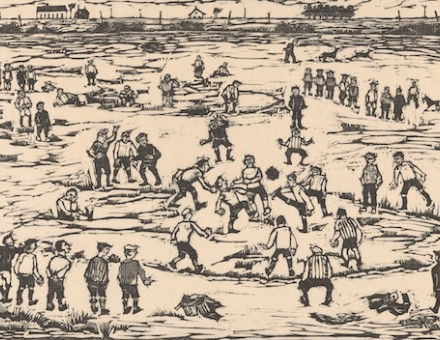
On January 3rd, 1833, Captain Onslow arrived at the Falkland Islands on HMS Clio and declared that he 'had come to take possession of the islands in the name of His Britannic Majesty; he then struck the Argentine flag, hoisted the British and expelled the Argentine garrison'. As a result the year 1933 witnessed the celebrations commemorating the centenary of British rule, during the course of which the islanders received a radio message from King George V emphasising the manner in which they were tied to the mother country 'by the closest ties of kinship and loyalty'. Other activities, which were concentrated upon the period February 12th-18th, 1933, included a radio message from the Colonial Secretary, Cunliffe-Lister, visits from HMS Durban and the Royal Research Ship Discovery II , dances, a stock show, fireworks and horse racing, as well as a football match between the crews of Durban and Discovery .
The main celebrations coincided with what the Falklands' Governor, Joseph O'Grady, described as 'the finest weather of the century', and inevitably most of the islands' population of some 2,300 (the population of the Falklands peaked in the early 1930s at this figure) crowded into the capital, Stanley. O'Grady observed that this feature, in conjunction with the presence of the crews of the two British ships, meant that there had never been so many people in Stanley, which benefited also from the great stimulus to trade. However, there were few other visitors from overseas – and certainly no British ministerial visitors – although the cruise ship, the Reina del Pacifico , called on February 17th. The Governor expressed pleasure that no cases were brought before the islands' magistrates as result of over-exuberance, while stressing that the centenary celebrations had served not only to confirm the durability of British control over the Falklands but also to foster a sense of community among a group of islanders accustomed to an isolated life-style in a range of scattered locations.
However, then as now, there loomed the problem of Argentina which continued to protest against its 'brutal expulsion' from the islands in 1833 as well as against the subsequent 'illegal' British occupation. In January 1928 the Argentine Foreign Ministry provided an apt description of the position: 'If it is true that from 1833 the Falkland Islands had been under British occupation, it was no less true that from that date and on various occasions the Argentine government had protested against such occupation and against the act which gave rise to it.' In fact, the Falklands' Governor anticipated that the centenary activities would not go down well in Buenos Aires, which did not wish to be reminded of either the fact or the length of British rule. There is some evidence to suggest that General Galtieri's desire to pre-empt the 150th anniversary of Britain's occupation contributed to the Argentine invasion of April 1982 , and in this context it is interesting to note the increasing tempo of Argentine pressure against British rule during the early 1930s, which took such forms as interference with postal and telegraphic communications between the British embassy in Buenos Aires and the Falklands or of passport and visa difficulties. Apart from such 'pinpricks', there appeared to be a growing (albeit still relatively small) popular interest: in the campaign to restore the Malvinas, as demonstrated by the representations made to the Argentine government in December 1932 by the Sociedad Popular Educadora de Liniers .
Naturally, the advent of the year 1933 was seen in Argentina as marking the 100th anniversary of the loss of the islands, an attitude reflected in the newspaper La Prensa on January 1st: 'Our nation never forgets that a foreign flag waves over a portion of the Argentine soil which belongs to us geographically and historically.' But Argentina lacked the power to do anything other than to record its position and 'to protest, while the close Anglo-Argentine trading relationship – symbolised by the Prince of Wales' visit to the British Empire Trading Exhibition held in Buenos Aires during 1931, and by the presence of an Argentine economic mission in London in January 1933 (culminating later in the year in an Anglo-Argentine trading treaty) – moderated Argentine intransigence.
Nevertheless, Argentina retained hopes of regaining the islands and, in response to what was regarded as Britain's transitory and de facto occupation, it tended towards a fictional annexation of the Malvinas, depicting them as Argentine territory on maps, or by treating Falkland Islanders as Argentine citizens for passport purposes. Although problems arose from the non-recognition of British passports held by islanders visiting Argentina, it was the maps which provided the most vivid illustration of Argentine territorial aspirations. Thus, on Argentine maps colouring was used to identify the islands – re-named the Islas Malvinas – as attached to the Argentine mainland. Such a process of 'cartographical wish-fulfilment' served not only to record the Argentine claim but also to perform a domestic and international propaganda role.
As early as 1884 the British government had protested about the Argentine practice of including the Falklands as part of its national territory on maps, but this failed to deter Argentina, and during the 1930s postage stamps were drawn into the Malvinas campaign. On January 1st, 1936, a new one peso stamp featured a map of South America upon which Argentine territory, including the Falklands, was shaded in a chocolate brown colour. In fact, the shading even ran on into territory constituting part of Chile, and the latter's protest resulted in a revised map stamp being printed in 1937 in order to reflect the existing mainland boundaries more accurately. But the Falklands were still shaded as Argentinian and in September 1936 the Colonial Office in London had already received a complaint from one islander, the Reverend D. Morse-Boycott, about Argentina's 'chocolate annexation' of the Falklands.
But, unlike Chile, the British government failed to deliver a formal protest as it was reluctant to depart from the traditional policy of treating the sovereignty dispute as non-negotiable. A rather similar stance had been taken a few years earlier when the issue of Falklands centenary stamps in 1933 occasioned Argentine protests. In turn, these episodes highlight the manner in which postal questions during the inter-war period proved one of the chief manifestations of the unresolved Anglo-Argentine dispute, while also providing Argentina with an international platform, the International Postal Union based in Berne, upon which to ventilate its grievances.
Although it is easy to dismiss postal questions, along with the associated passport and visa problems, as relatively minor, especially by comparison with the military clash of 1982, they were important in the context of the dispute's development, for both these matters possess implications for sovereignty. Already in 1908 and again in 1927 Argentina had informed the International Postal Union that the Falkland Islands were under its jurisdiction; these notes represented a response to the inclusion of the islands as British territory for postal purposes. Thus, the Argentine note of October 1927 argued that the islands, albeit under de facto British occupation, belonged to Argentina de jure , and this was followed up in December by interference with postal and telegraphic communications between the British embassy in Buenos Aires and the Falklands. The situation was felt serious enough to warrant not only the submission of the matter to the British Cabinet but also a departure from the traditional policy of ignoring Argentine provocations. As a result, a 'sharp' protest note was delivered to the Argentine government in December 1927, while in May 1928 a note was sent to the International Postal Union re-affirming British postal jurisdiction over the Falklands. Eventually, by July 1928, the Argentine government felt that it had made its point and announced the resumption of postal and telegraphic communications with the Falklands, but only after recording that this action 'does not lessen in the slightest degree the previously expressed rights of Argentine sovereignty'.
The next postal problem occurred in 1933, and was centred upon one aspect of the centenary celebrations; the issue of a commemorative set of twelve stamps from ½ d to £1. The centenary stamps had been announced in the Falkland Islands Gazette in June 1932, and it was stated that the designs, which had been prepared by G. Roberts, the Director of Public Works, had been approved by the Centenary Committee. The stamps would be on sale from the first to the last day of 1933, and during this period the current definitive issue would be withdrawn from sale.
Apart from objecting to any centenary activity on principle, the Argentine government proved very critical of the inscription '1833-1933' included on every stamp, and especially of the 3d. map stamp. Thus, in March 1933 Sir Ronald Macleay, the British ambassador, reported that the stamps had caused 'considerable and unfortunate comment in the Argentine press where the matter is considered as a provocative act and one which cannot be ignored'. La Prensa provides a good example of this indignation, for on March 11th its editorial asserted that the centenary stamps reinforced Argentine arguments that the islands had been 'obtained through the forcible removal of the officials who represented the Government of Buenos Aires... the printing of these stamps compels our Authorities to do or say something that will make it clear that the British Government has no right whatever to do so'. This typified the press campaign for positive action by the Argentine government, and this took the form of a note sent to the International Postal Union on March 16th, 1933. Argentina, while protesting against the centenary issue, announced that the franking power of the stamps would not be recognised in Argentina, thereby compelling recipients to pay a surcharge. In fact, Argentina was surcharging such stamps already, and on March 13th the Daily Mirror drew attention to the practice, as did a parliamentary question one week later.
In addition, there was evidence, like that from the British Consul in Riga (Latvia), that Argentine overseas representatives were urging the governments to which they were accredited to regard the centenary stamps as invalid (but one assumes that few letters, if any, were sent from the Falklands to Latvia). Although the British government stressed its rights to issue Falklands stamps of its own choice and was displeased by the 'childish' attitude adopted by Argentina, the Foreign Office's concern was qualified by a reluctance to depart from the traditional policy of refusing to discuss sovereignty problems with Argentina. As one official, Paul Mason, minuted in March, 'whatever we may think of the alleged action by the Argentine government this is clearly not a moment at which we want to raise any extra difficulties' or to encourage 'inconvenient publicity' on the issues in dispute. Already in 1932, during the preliminary talks on the format of the centenary celebrations, the Foreign Office had counselled both the Colonial Office and the Falklands Governor on the need for caution – the value of not proving 'too provocative' – and hence the problems surrounding the centenary stamps confirmed the worst fears of the Foreign Office, which had just been faced with a somewhat analogous problem arising from Persia's protest to both the League of Nations and the International Postal Union concerning the issue of overprinted Indian stamps for use in Bahrain, another island group in dispute.
As a result, the Foreign Office complained to the Colonial Office that it had not been consulted in advance about the advisability of the centenary stamp issue, and some diplomats, including Sir Robert Craigie, the head of the American department, utilised the occasion to express their irritation about the 'foolish and provocative acts by the Falkland Islands'. In turn, David, Kelly, a member of the F.O.'s American department, complained that 'the local administration of the Falkland Islands are very hard to convince as to the serious way the Argentines take their grievances'. For a while, the Foreign Office, in consultation with the embassy in Buenos Aires, which shared the fears about the controversy's effects upon British economic interests in Argentina, considered various responses, including the issue of instructions to the Falklands' Governor either to advise islanders against the use of centenary stamps on mail to Argentina or to sanction the 'unostentatious withdrawal' of the issue before the end of the year. In the end, the Foreign Office decided against such possibilities, and acquiesced in the course favoured by the Colonial Office and the Falklands' Governor, that is, of recording the British position through the despatch of a note in September 1933 to the International Postal Union.. However, the Foreign Office did take advantage of the episode to warn the Colonial Office and the Falklands' Governor 'not to do anything which might arouse Argentine susceptibilities without first consulting the Foreign Office'.
The next year or so witnessed no real change in the nature of Anglo-Argentine relations; occasional difficulties occurred during 1934-35 which tended to be sparked off by passport problems. The embassy in Buenos Aires reported evidence of a growing Argentine interest in the Falklands, especially among the young, symbolised by such men as Dr Alfredo Palacios who gave a five-hour Senate speech on the subject in May 1934 and by the Senate's approval for a subsidy to translate Paul Groussacs' study of the Falklands question (published in French in 1910) into Spanish. But the British government did not alter course, and in July 1934 Kelly reaffirmed that 'our policy in regard to the Falklands is and must be to maintain our rights, while avoiding all incidents calculated to fan the always smouldering embers of Argentine resentment'. Any problems should be treated 'very fore-bearingly' in order 'to avoid dragging this century-old controversy into the limelight'.
Then, in 1935, and in accordance with the Foreign Office's 1933 instruction, the Colonial Office warned the Foreign Office about the forthcoming Falklands Silver Jubilee stamps. Although the Foreign Office feared that the stamps might provoke a further Argentine 'offensive' for the Malvinas, it was appreciated that the stamps were part of an omnibus issue for the whole empire and that the Falklands had to be included. In the event, the Jubilee stamps caused no problems, probably because the designs were common to all the British territories, and the next complication arose out of the Argentine map stamp, referred to above, issued in January 1936. In the same year two national propaganda postcards were issued (for values of four and ten centavos), and, while the stamp showed a portrait, the postcard included a map, which shaded the Falklands as Argentine territory.
But most British attention was devoted to the one peso map stamp, which was first picked up by the Evening Standard on January 20th, 1936, and then mentioned in a parliamentary question in February. Nevertheless, the Foreign Office tried to play down any problems. No formal protest was made by Britain, although the ambassador in Buenos Aires was instructed to express his concern informally during the course of his conversations with the Argentine Foreign Ministry. But, as Gerald Fitzmaurice, the Foreign Office's legal adviser, pointed out in February 1936, 'in the last resort the only way in which we could prevent them (Argentina) from issuing the stamps if they chose to maintain their claim, would be by going to arbitration and obtaining a decision that their claim was not based on law'. However, at this time the British government was not prepared (in fact it has never been prepared) to submit the sovereignty dispute to arbitration, and hence 'our correct policy is to sit tight on the Falkland Islands and to refuse to discuss the matter'. The 1937 revision of the Argentine map stamp led to no change in this attitude.
Inevitably, the Foreign Office became rather agitated in March 1937 when John Leche, the British counsellor in Buenos Aires, reported a conversation with Roberts, the Falklands Director of Public Works, during the course of a rail journey from Rio de Janeiro. Roberts had been responsible for the centenary stamps, and Leche gathered the impression that a further map stamp was under consideration. Leche, like Fitzmaurice and John Troutbeck, the head of the Foreign Office's American department, advised that the idea should be strangled 'at birth', or else the recent work to improve Anglo-Argentine relations 'will all be undone'. Exchanges with the Colonial Office confirmed that a new set of Falklands definitives was projected for 1938, and that a map design was under consideration, especially as maps were common on the stamps of British colonies. (In fact, the Colonial Office praised the 'educational' value of map stamps, which demonstrated the nature and location of such possessions). But the Foreign Office was unimpressed by the Colonial Office's assessment that a Falklands map stamp would prove 'harmless', and in the face of pressure the Colonial Office confirmed in July 1937 that the new definitive set would include no map.
In April 1937 John Troutbeck complained that 'the question of stamps in connection with the Falkland Islands is a great nuisance', for the occasional postal difficulties drew unwelcome attention to the unresolved – perhaps insoluble – Anglo-Argentine sovereignty dispute. In turn, postage stamp questions served both to cause and to reflect developments in the Falklands' problem, particularly as the various stamps referred to in this artic1e possessed significant implications for sovereignty. Thus Argentina regarded stamp issues as an integral part of its propaganda campaign to recover the Malvinas, for map stamps offered an easy method of 'annexing' the islands which it lacked the power to secure in reality. The Argentine people could also be shown what they were supposed to be agitating for, while the involvement of the International Postal Union provided an international platform for the propagation of the Argentine claim. Thus, in 1938 Argentine ratification of the 1934 Cairo Postal Convention was accompanied by the usual reservation on the Falklands, and in June 1939 the Argentine Post Office, in a publication entitled Revista de correos y telegrafos , claimed credit for its role in defining 'las Islas Malvinas como parte integrante de nuestro territorio ' (the Falkland Islands as an integral part of our territory), and in supporting Argentina's 'indiscutible ' claim to the islands. The 1936-37 map stamps and the various communications to the International Postal Union figured prominently in the publication, as did the need to counter such British moves as the 1933 centenary stamps. In contrast, the British government, and especially the Foreign Office, attempted to ensure that after 1933 stamps should not be allowed to disturb Anglo-Argentine relations, a course accepted somewhat reluctantly by both the Colonial Office and the Falklands' Governor.
After the Second World War Argentina maintained its claim to the Falklands, and, as during the late 1930s, postage stamps performed a major propaganda role both within and outside Argentina. Recent issues supporting the Argentine claim to the Malvinas included a six peso stamp of 1976 and a miniature sheet of 1980, and they formed part of Argentina's growing pressure for control over the islands, a policy culminating in the invasion of April 1982. Although Argentine administration of the islands was reflected mainly through its military presence, its occupation was demonstrated also by such aspects as driving on the right, calling them the Islas Malvinas and re-naming Stanley as Puerto Rivero and then Puerto Argentino . As such Argentina's 'cartographical wish-fulfilment' at last became a reality, and it was perhaps significant that one of the earliest statements of General Menendez, the Argentine commander of the Malvinas, concerned his anxiety to issue stamps for the new part of Argentina. Initially Argentine stamps over- printed 'Las Malvinas son Argentinas ' were issued and cancelled '9409 Islas Malvinas Republica Argentina '. And then, on June 12th, 1982, only a few days before the Argentine surrender, two Argentine stamps denominated 5000 pesos (a sign of inflation) and printed together in the sheet, were issued to commemorate the 153rd anniversary of the creation of an Argentine political and military command on the islands. One stamp featured Don Luis Vernet, who had been appointed civil and military commander of the islands in June 1829, while the other depicted a map showing the Falklands, South Georgia and the South Sandwich Islands as Argentine territory. In fact, by this time Argentina was returning to the old policy of 'cartographical wish-fulfilment', for South Georgia had already been recaptured by Britain, most of the Falklands had returned to British control, while Stanley and the South Sandwich Islands were soon to be lost by Argentina.
Soon after the restoration of British control over the Falklands the Crown Agents announced that the 150th anniversary of British rule would be commemorated by a new set of stamps to replace the existing definitives. The discussions over this 150th anniversary issue began in 1978 and centred upon the objective to provide a balanced view of the islands' history since 1833. Political problems clearly influenced these discussions, as can be seen in the following quotation from a Crown Agents leaflet:
The whole concept of the issue was causing considerable perturbation in official quarters and the [design] Committee agreed to alter some potentially inflammatory wording and review the lowest value design [1p]. An alternative was produced and adopted – only to be finally rejected in favour of the original, when fear of offending Argentina was no longer such an overriding concern.
Although these stamps were planned in advance of the Argentine invasion, the sesquicentennial issue will be unwelcome in Argentina and may lead to the difficulties apparent in 1933. In the meantime, the Anglo-Argentine military struggle has given a further boost to the already-popular Falklands s tamps, which have always provided a useful revenue for the islands. In 1976 the Shackleton Report sought an increase in this revenue through the adoption of a more aggressive marketing policy, a proposal which sparked off a heated controversy among philatelists, several of whom wrote angry letters to The Times . In practice the recent conflict forced stamp values up, a point confirmed in May 1982 by the stamp dealers Stanley Gibbons Ltd, and in September by the revised Shackleton Report. The Report concluded that 'the prospects for philatelic revenue are extremely good…revenue from this source in 1981-82 was in the region of £600,000. Now that the Falklands have been put very firmly on the world map, interest in their stamps should be stimulated, and the likelihood is that forthcoming commemorative issues will be very successful ... revenue will soon be in the region of £l million and possibly more'. The sesquicentennial issue will obviously prove very popular, while in the meantime the Falklands are benefiting from a rebuilding stamp issued on September 13th, 1982: the stamp which is denominated at £l carries a £l surcharge to contribute to the post-war reconstruction of the Falklands.
Peter J. Beck is Principal Lecturer in International History at Kingston Polytechnic. He has been working on the Falklands dispute since 1978.
- This study is based primarily on British official files at the Public Record Office. The following titles deal with certain aspects covered in this article:
- Ian J. Strange, The Falkland Islands (David and Charles, 1972)
- Lord Shackleton, Falkland Islands. Economic Study 1982 (HMSO, 1982)
- Peter J Beck, 'Co-operative Confrontation in the Falkland Islands Dispute' Journal of Inter-American Studies and World Affairs (Sage, 1982)
- M. Falcoff and R.H. Dolkart (eds), Prologue to Peron. Argentina in Depression and War (University of California, 1975)
If you enjoyed this article, you might like these:
- Home
- Location
- Period
- Themes
- Magazine
- Subscribe
- Archive
- Ebooks
- Reviews
- Blog
- Contact
From The Current Issue
|
James Holland
|
|
Peter Murrell
|
|
Ian F.W. Beckett
|