

Vienna, Part II: The Eighteen-Sixties
During a period of Austrian decline as a great power, writes Tudor Edwards, Vienna flourished in an atmosphere of expansive gaiety.
 Viennese social life, in the first year of the decade 1860, is reflected in the Richard Strauss-Hofmannsthal opera Arabella, which, however, was not produced until 1933. Yet, although it provides a bird’s-eye view of the upper-class milieu, it gives little or no hint of the splendours and miseries of the period. Outside the pillared and car-touched Baroque palaces, flunkeys stood in three-cornered hats and fur coats braided with gold, carrying tall staffs surmounted with large golden crowns.
Like other servants, they were probably compelled by their masters to chew orris-root to deaden the offensive smells of tobacco and garlic—a remedy learned from vassal Italy, whence came the root Iris Florentinei. But luxury was not synonymous with the ordinary amenities of life. Apart from the Annabad, or public baths, there were few facilities for bathing, and the aristocracy and the solid bourgeois families contrived regular baths by engaging a firm of specialists who delivered a tub of hot water once a week. In the outer districts, there was usually only one water-point between four, eight, or even ten families.
Meanwhile, an industrial revolution was under way; crafts were being steadily replaced by mechanical weaving looms and spinning machines imported from England, and by quickly improvised factories, run at first by water power alone. New railroad traffic made the traditional exhibitions of merchandise in markets superfluous, and brought the changeover from markets to sample fairs.
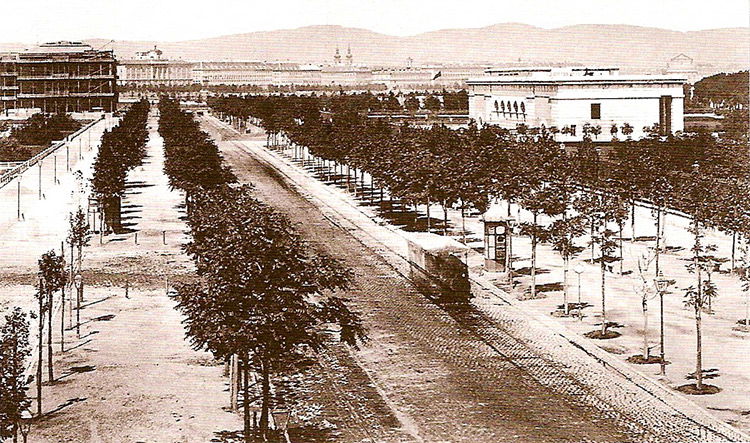
Physically, Vienna was undergoing momentous changes. It was no longer a medieval walled city, though its fortifications had survived until only three years earlier. In 1857, Franz Josef, despite much opposition, had signed a decree ordering the bastions to be razed to the ground and the ramparts levelled. The aspect of the city was now chaotic. The Ringstrasse had begun to be laid out along the horseshoe-shaped line of the walls, a stretch of over three miles; and the glacis, the wide belt of meadows that lay just outside the walls, was being converted into parks and gardens.
Enormous areas of land became available and realized fortunes. Mammoth building projects captured the public imagination. In addition to the Ringstrasse itself, nearly a hundred streets and squares were to be linked up with it. This was the most ambitious piece of town-planning since Haussmann had undertaken to remodel Paris, a project that, with its provisions for civic magnificence, military strategy and the facilitation of traffic, had influenced Franz Josef not a little. Some five hundred major buildings alone were to be created; and the first of them, the Opera House, was begun in 1861, to the designs of Van der Null and Von Siccardsburg.
This phase was marked by the appearance, in 1862, of Johann Strauss’s Demolition Polka (1862); and in August of that year the composer set Vienna gossiping about his marriage—in the Cathedral at seven o’clock in the morning, to Henrietta Treffiz, the attractive singing daughter of a silversmith, years older than Strauss and long the mistress of Baron Todesco, the Jewish financier. A year later, he was appointed Conductor of the Court Balls; and he presided over the festivities in the Redouten-saal, where the walls were hung with Gobelin tapestries to a height of six feet, above which were long mirrors and elaborate gilt panelling, while crystal chandeliers blossomed from a gilded ceiling. Here Strauss introduced the French quadrille.
The Langaus, the whirling dance that led to apoplexy and death, was now out of fashion. So too was the old Sperl hall, which had acquired a bad reputation and, like the Blaue Flasche in Lerchenfeld, another resort of rakes and philistines, was the venue of courtesans of the coarser type. Fashionable people, with the financiers and the intelligentsia, frequented the Volkesgarten and Dommayer’s casino in Hiet-zing. The Spiesbürger, or petty bourgeoisie, still went to the Dianabad.
The general favourite, however, was a new mammoth dance-hall, the Sofiensale, named after the monstrous Archduchess Sophie, mother of the Emperor Franz Josef, and designed by the ill-fated architects of the Opera House; at first a fashionable swimming hall and steam-bath establishment like the Dianabad, it was converted into a place of perpetual carnival where, in midwinter, rosebuds would descend upon the dancers. Johann Strauss, the idol of Vienna, played at all these places, where other orchestras performed under the batons—or fiddles—of his brothers Eduard and Josef.
Indeed, during these years, it was the musicians who set the city agog. Brahms had arrived in 1862, to settle there for the rest of his life. Two years later, just after Wagner had been forced to flee from Vienna by his creditors, Offenbach was staying at the Goldener Lamm in the Leopold-stadt, where he wrote the waltz Die Abendblatter (Evening Papers), which, in direct competition, provoked Strauss’s Morgenblatter (Morning Papers).
With such childish pranks, with music and gossip and the work on the Ringstrasse, the Viennese were held in thrall, and stopped their ears against the ominous rumblings from without. But these rumbles grew more menacing. The political intrigues between Austria and Prussia sank into the background on the death, in November, 1863, of the Danish King Frederic VII, whose demise virtually ended the constitutional alliance between Denmark and Schleswig-Holstein.
Austria and Prussia pledged themselves to attack Denmark, to “liberate” Schleswig-Holstein and to divide the spoils afterwards. On February 3rd, 1864, their joint forces poured into Schleswig; and within a month it was over. In Vienna, the people watched the victory procession in which the Emperor himself took part; while his detestable mother, the Archduchess Sophie, who had dictated so much of Franz Josef’s misguided foreign policy, stood smugly looking down from her casements.
The wrangling over the ex-Duchies now began; and the complications involved were such as to provide an exciting topic of conversation throughout European diplomatic circles. Lord Palmerston, in summing up the situation, remarked that the Schleswig-Holstein question was so involved that only three men had ever understood it—the Prince Consort, who was dead: a professor, who lost his reason as a result: and, thirdly, he himself, who had forgotten the details some time ago. Lengthy negotiations were concluded, in August 1864, with the cession of Holstein to Austria, and of Schleswig to Prussia.
Both William I of Prussia and the astute, but unscrupulous, Bismarck had long ago decided that the problems of Austria, and of German integration, could be solved only by blood and iron. They saw, too, that it was practically impossible, with difficulties of communication, economics and defence, for Austria to hold Holstein, and, indeed, that there was no conceivable reason for the Austrian Empire to extend her dominions to the borders of Denmark. Consequently, in June, 1866, Prussian troops moved into Holstein.
Before taking this belligerent step, however, Bismarck, by holding out the province of Venetia as bait, made certain that Italy would enter the inevitable war against Austria, thus compelling the latter to fight upon two different fronts. Simultaneously, he had secured the neutrality of France by promising Napoleon III considerable Rhenish territories—Napoleon, who had also secretly bargained with Austria, was to pay for his mistakes in 1870. Meanwhile, his impudent and short-sighted intrigue in Mexico blundered on; and the Archduke Maximilian and his wife Charlotte, soi-disant Emperor and Empress of Mexico, were sadly homesick amid the pergolas of their Pompeiian villa at Cuernavaca.
On June 14th, 1866, Prussia withdrew from the German Confederation and attacked several of the smaller States. The trial of strength between the Houses of Habsburg and Hohen-zollern for supremacy in Central Europe had begun. Under Von Moltke’s direction, the Prussian army split into three prongs and advanced into Bohemia. These were dangerous tactics, as Von Moltke knew; but he was influenced by diplomatic considerations and—since the Austrian army was already on the march and in Moravia—by the possibility of an Austrian blow at Silesia.
The Austrian commander Lewis von Benedek, accurately informed by his intelligence of the detached position of the Prussians, planned to lead his forces between the three Prussian prongs, and to deal with one after the other before they had a chance to combine. If it had not been for Von Moltke’s brilliant direction of his divided forces, the Austrian commander might have succeeded. As it was, he managed, on June 27th, to bring off a limited victory at Trautenau, but was defeated at Nachod.
In these initial encounters, the Austrian losses were far heavier than the Prussian; and it was clear that the Prussian tactics were far superior. Von Benedek had proved an excellent soldier in the Italian campaigns; but he lacked the intellect and thorough military education necessary to lead a big army. He was fearless; but his courage was too often the bravery of despair; and he had now made his soldiers storm height and forest with the bayonet, only to be smashed by the Prussian needle-guns, which fired three times as fast as the Austrian muzzle-loader.
Although the Austrian forces had retired to advantageous terrain, and the opposing forces had to advance through mountain passes before they could combine, Von Benedek made a series of miscalculations that led to a further defeat at Skalitz. The two army corps that formed his left wing were now defeated, making his flank and rear vulnerable to attack by forces under Prince Frederick Charles, nephew of the Prussian king. During the ensuing Austrian retreat, the advancing Prussian forces led by King William I and Von Moltke managed to join Frederick Charles.
The Austrians had halted near the Elbe, exhausted after a disorderly night march. Indeed, their commander was now so disheartened that he sent a telegram to the Emperor advising him to conclude peace at any price. Franz Josef’s reply intimated that retreat should be considered only as the enforced outcome of a battle; and this expression of the Emperor’s will seems to have determined Von Benedek to accept the challenge from the rapidly advancing Prussians.
Late in the evening of July 2nd, King William and Von Moltke were informed that the Austrian army stood in battle position before the Elbe. They decided to attack at once, a frontal attack with one army, and on the flank with another. Such strategy—the principle of trapping the enemy between broad advancing masses—was bold and fairly original; and it was to characterize Von Moltke’s successes in the Franco-Prussian war.
The battle of Königgrätz opened on the morning of July 3rd. The Austrian army of 215,000 men were drawn up in close formation. The disadvantage of the position was that the Elbe was in their rear, although bridges had been thrown across it. The three Prussian armies totalled about 250,000 men; but the main army under the Crown Prince was not to be available in the field until later in the day, since it was well in the rear and now on the march. Meanwhile, Prince Frederick Charles’s army attacked the Austrian centre, and King William’s army the Austrian right wing.
The second made steady progress; but the Prince was unable to dent the strong Austrian centre, and an infantry attack was almost impossible because of strong Austrian artillery planted in tiers on the surrounding hills. Frederick Charles was therefore compelled to wait until the Crown Prince’s army could join his left wing. The weak spot in the Prince’s position was temporarily covered up by a determined offensive made by the seventh division, under General Fransecky, who drove the Austrians out of the Swiepwald and, from that position, harassed their right wing, which had been ordered to hold its ground against the expected attack of the Crown Prince.
Hitherto, eleven Prussian battalions had held their ground against fifty-nine Austrian battalions. Von Benedek deliberated whether he ought to bring up his reserves and launch an assault on the Prussian centre; but he was deterred by the gaps in his north flank, left by the struggles in the Swiepwald, and by intelligence that the long overdue Prussian Crown Prince was now approaching. His fears were justified. At noon that day, the Crown Prince’s army, with the Prussian Guards and the sixth corps in the first line, swooped upon the Austrian north flank and flattened it, the Guards then capturing the Austrian key position, the village of Chlum.
The army of Prince Frederick Charles, until this moment held in check, now advanced and the Prussian cavalry went in. The Austrian cavalry held its ground; but the infantry abandoned the field, and in complete disorder swarmed over the bridges across the Elbe. It was a rout. The Austrians lost 44,000 men, killed, wounded and taken prisoner on the field. Prussian casualties amounted to 10,535.
In Vienna, they were already saying that Austria had lost the war with Prussia thanks to a superior school system and an inferior rifle system. There was heavy gloom in the capital; and this melancholy seemed to be accentuated by Grillparzer’s dictum that all endeavour was futile. Neither Johann Strauss nor the novelty of the recently opened Ringstrasse and the beautiful Stadtpark could alleviate it.
The hospitals were filled with sick and wounded from the German and Italian fronts, to whom the Empress Elizabeth became endeared by her visits, though by paying them she displeased Franz Josef and widened the rift between the Emperor and herself, a rift that was now common knowledge. During the middle of the month—it was still July—Von Benedek’s retreating columns were mauled near Olmütz; and he was forced to abandon his march southward and withdraw towards Hungary. The threat of a Prussian army marching on Vienna obliged the Empress and the young Crown Prince Rudolf to fly to Budapest.
On July 22nd, 1866, an armistice was announced. With great cunning, Bismarck prevented his generals from going to the logical limits; and he contrived a peace treaty whereby Austria, losing only Venetia, had merely to dissolve the Confederation of German States established at the Congress of Vienna, leaving Prussia free to form a North German Confederation and to annex Schleswig-Holstein, and to set up an independent South German Confederation—which only too soon would fall into the same net.
The outcome of this brief war augured ill for the future; but it was to have repercussions in an unexpected quarter. Bertha von Suttner, who before her marriage was a Kinsky, suffered as a young girl during the fighting in Bohemia; and her experience led her in later years to write the novel that shocked Europe, Die Waffen nieder (Lay Down Your Arms), its impact causing Alfred Nobel to devote part of his fortune from dynamite to the foundation of the Peace Prize.
Bertha von Suttner was herself to receive the first Peace Prize. The Kinskys were a remarkable family. They had competed with other noble families to have Beethoven’s premieres performed in their Vienna palace; in the ’eighties Count Karl Kinsky, a fine horseman, was to win both the Liverpool Grand National and the Great Sandown Steeplechase; and, later still, the family was to have its place in the correspondence of Raina Maria Rilke. Today the Baroque Kinsky Palace, designed by Lucas von Hildebrandt, architect of the Belvedere and other palaces, is still enriched by its staircase with sculptures by Raphael Donner and its hall with Italian frescoes.
The spirits of the Viennese were soon restored. Once again there were military parades, the cavalry in sky-blue tunics slashed with gold, scarlet breeches, and shakos with aigrettes of horsehair. There was the Changing of the Imperial Guard on the Heldenplatz. There was the annual Flower Parade, when, on Mayday, the Emperor gave a banquet at the pavilion in the Emperor’s Garden, just alongside the entrance to the Prater, Franz Josef and his Empress arriving in a gold open carriage drawn by six splendid Lippizan horses, the lackeys in gold-braided yellow liveries. Then, in the afternoon, nearly a quarter of a million people would watch the Prater-drives, in which the nobility competed, as on a race-course, in phaetons, coaches-and-four and pompous carriages.
Princess Pauline Metternich, wife of the Austrian Ambassador to the French Court, was the instigator of one frolic after another; and scandalous stories of this cigar-smoking Bacchante were bandied about the capital. At the Auersperg Palace, she held soirees and carnivals and staged “living portraits,” in which one might see the Duchess of Ratibor posing as Rembrandt’s Jewish Bride, Counts Dietrich-stein and Mennsdorf bringing new life to The Sons of Ruben, and the Countess Klementine Potocka as the Lute Player of Caravaggio’s painting.
The Potocka family, which held estates in the province of Galicia, produced such impressive women as the Countess Isabella, a doe-eyed beauty whose liaison with the Emperor was an open scandal, and another Countess—perhaps the Klementine of the Auersperg—who kept two dwarfs to run her errands and, clad in Polish silk, to sit on either side of her at receptions.
Countess Metternich also staged plays in the Auersperg Palace, in which the cast were all aristocrats, the Countess herself playing Puss in Boots, or speaking a broad Parisian argot, in a French play. These productions were often introduced by verses written and recited by Franz von Dingelstedt, the distinguished stage-manager and minor novelist, whose two-volume Die Amazone appeared in 1868.
Yet another palatial resort was now established, near the gates of Schönbrunn, by the shrewd and enterprising Karl Schwender. The Kolosseum was indeed a miniature city of pleasure, with three enormous ballrooms, a theatre, several restaurants, magnificent staircases and a shell-like grotto which housed one of the orchestras.
Here the masquerades far outdid those of the Auersperg; for there were balls and “herring feasts,” at which the wealthy dressed in beggars’ rags and wore horrific masks, parodies in bad taste considering the poverty in the capital.
The year 1867 was the year of The Blue Danube, played for the first time by Johann Strauss in the winter ballroom of the Dianabad, today still gutted by bombing, though the bath and entrance hall, with Biedermeier decoration and figures, survive. It was also the year in which the Hotel Sacher, soon to be favoured by the Habsburgs and the aristocracy, was founded by Anna Sacher, who, like the Princess Metternich and Fanny Elssler, the retired ballerina, used to smoke cigars. Above all, 1867 was the year of the Dual Monarchy.
Having lost all influence in Germany and Italy, Franz Josef set about re-shaping the Austro-Hungarian regime. By the device of giving autonomy to Hungary, the Austro-Hungarian Empire was able to survive into the twentieth century. It brought mixed blessings to Hungary, however; for, although it gave her theoretical equality with Austria, it led to the encouragement of national chauvinism, and ultimately to her compulsory and fatal partnership with Germany in the first World War. Kossuth, in exile, categorically denounced the arrangement.
Yet at the time, considering the circumstances, it may be regarded as a brilliant stroke of policy. The credit is generally given to Ferenc Deak, the Hungarian politician, Minister of Justice during the revolution of 1848; but rightly it belongs to Baron Beust, the Austrian Prime Minister, who virtually introduced ministerial responsibility and changed Austria into a modern constitutional State— and to the Empress Elizabeth.
The sixteen-year-old Wittelsbach girl from the provincial court of Munich, who had married Franz Josef in 1854, had become an ethereal beauty dressed by Worth and a fanatical horsewoman who bought her riding suits from Henry Poole of London’s Savile Row; she even rode the circus horses of her friend Ernst Jakob Renz, the son of a trapeze artist, who had founded the most famous circus in Europe. She had also become the champion of Hungary.
She learned Hungarian, travelled extensively in Hungary, and was on the friendliest terms with such influential Hungarians as Count Julius Andrassy, all against the wishes of Franz Josef. It was she who finally persuaded the Emperor to make a State visit to Budapest and negotiate with the Hungarian leaders; and it was she who inspired the affection of the people when, with her own hands, she repaired the historic cloak of Saint Stephen, preserved in the Benedictine Abbey of St. Martinsburg.
The coronation of Franz Josef and his Empress as King and Queen of Hungary took place in the Cathedral of Budapest on June 8th, 1867. The Emperor rode at the head of the procession. The Empress sat in a coronation coach escorted by a squadron of Life Guards, while, on either side, dancing girls strewed flowers along the road.
Immediately behind the coach rode two hundred members of the Hungarian aristocracy, richly caparisoned, some wearing jewels and some even in silver plate armour. Elizabeth wore a dress by Worth; and it was obvious that the cheering was for her and not for the Emperor. That night at a State Banquet, Julius Andrassy, who had been sentenced to death after the 1848 revolution but had gone into exile, sat at the Empress’s right hand as Prime Minister of Hungary.
It was while Franz Josef was staying at the palace of Godollo, near Budapest, that couriers from Vienna brought the news of the execution of his brother, the Archduke Maximilian, at the hands of Mexican revolutionaries on June 19th. The Mexican adventure, with its grim-crack coronation, was over. Franz Josef was conspicuously absent from the great Paris International Exhibition that summer; and, in August, Napoleon and the Empress Eugenie went to Salzburg, ostensibly to express their sympathy, but hoping to form another profitable alliance.
The Budapest coronation had given the people of Vienna much pleasure; but new amusements and diversions were constantly provided. In 1868, the Ostbahn, or Eastern Railway Station, was opened, taking the Viennese to new playgrounds. The Ringstrasse had been opened three years earlier; and now the first of the new buildings was taking shape.
When it was completed, another decade or so hence, the Ringstrasse, for all its pastiche and aesthetic confusion, would represent the ideals of the nineteenth-century liberal bourgeoisie, and would be a visible symbol of the unity between the Spiesburger and the nobility. The ochre-yellow casino-like Kursalon, the cafe-restaurant in Italian Renaissance style, was opened in 1867; and the Kunstlerhaus, where the Princess Metternich was shortly to reign over the Shrovetide masked balls and carnivals, was completed a year later.
And now the new Opera House stood complete in its pristine glory, opening its doors on May 29th, 1869, with a festive performance of Mozart’s Don Giovanni under Johann Herbeck. With its frescoes painted by Schubert’s friend Moritz von Schwind, its neo-baroque gilt and statuary, its colour and sensuality, the Opera House reflected the new Makart period, a period of magnificence named after the famous painter of the day. Hans Makart gave lavish parties, at which he dressed the women in genuine Renaissance costumes, while rose garlands trailed from the ballroom ceiling and, at dinner, velvet-clad pages stood behind each chair.
The Makart vogue produced the “Makart red,” the Makart collar, the Makart rose and the Makart hat, an enormous cartwheel of a hat with flowers and feathers.
Van der Null, co-architect of the Opera House and the Sofiensale, however, had committed suicide. So, too, about the same time, had Adalbert Stifter, the novelist who personified the Biedermeier age. Earlier in the decade, Josef Staudigi—the Elijah of Mendelsohn’s Elijah at its première in Birmingham Town Hall in 1846—had died insane on the outskirts of Vienna.
Mental sickness was prevalent in Vienna, a Vienna that was about to produce Freud and Krafft-Ebbing. Yet, despite psychological strains, the city was on the threshold of a new golden age, a period of prosperity and development that was to increase a population of 650,000 in 1870 to close on two millions by the end of the century.

