

Ukraine: Church and State
The turmoil in Ukraine has a strong religious dimension. Catherine Wanner asks if a common Christian heritage may yet help maintain relations with its Russian neighbour.
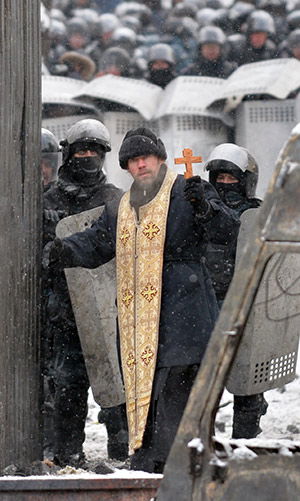
When the protests began in Kiev earlier this year an anarchist group put up a sign that read: ‘Country under reconstruction. Sorry for the inconvenience.’ Following February’s spectacular fall from grace of President Viktor Yanukovych, the country’s reconstruction has barely begun. Tearing down a vicious and corrupt regime will turn out to be the easy part. Building a viable government that accurately identifies the needs of the Ukrainian people and actually serves them will be the challenge. One thing is clear: religion will surely play a key role in this process. Clerical involvement in the protests, even in the new government, reveals the extent to which Ukraine has not only moved away from its Soviet past but also from modern Russia.
There is much concern about the divisions in Ukraine and the possibility of the country splitting. As recently as 100 years ago Ukrainian regions were part of the Russian, Austro-Hungarian and Ottoman empires. The legacy of imperial domination manifests itself most clearly as regional differences that take on a religious cast. At stake for the reconstruction of the country is how these differences might be manipulated today. Some actions inflame them while others soothe.
Ukrainians, Russians and Belorussians share a common Byzantine Christian heritage (not shared by Crimea’s indigenous Muslim Tatars). Russian Orthodox clergy refer to their flock as the ‘Russian world’, an imperial throwback to a vision of the eastern Slavic region as Little Russia, Great Russia and White Russia. As such, Orthodoxy could potentially become a means to maintain links with Russia, regardless of which way Ukraine leans politically. Yet religion could also provide the moral justification for renewed conflict, to challenge how regions and differences are understood, putting to rest Ukraine as ‘Little Russia’ once and for all.
Orthodoxy as a religious tradition is organised on a nation-state model, with each church serving a particular nation. Currently there are four churches in Ukraine, all claiming to be national churches. The Ukrainian Orthodox Church-Moscow Patriarchate is part of the Russian Orthodox Church. The Ukrainian Orthodox Church-Kiev Patriarchate is a non-canonically recognised church that formed after independence in 1991. The Ukrainian Autocephalous Orthodox Church was created in 1921 as part of a struggle for Ukrainian statehood. It was disbanded in the 1930s in Soviet Ukraine but thrived in diaspora communities abroad. The Ukrainian Greek Catholic Church is a hybrid denomination, which has a Byzantine tradition and liturgy but recognises papal authority. Fearing Vatican interference, Stalin outlawed the Ukrainian Greek Catholic Church when Western Ukraine was annexed to the Soviet Ukraine after the Second World War. It remained so until the collapse of the Soviet Union, before which its five million adherents were the largest religious community in the world denied the chance to practice their religion.
Since 1991 each Ukrainian president has had to grapple with demands to establish an independent Ukrainian Orthodox Church to complement statehood. Such attempts have been met with vigorous resistance from Russia and have ultimately always failed. Should the Ukrainian Orthodox Churches unite into one, it would likely surpass the Russian Orthodox Church in terms of importance, because a single Ukrainian Orthodox Church would have more church buildings and a greater number of active believers. Religiosity among the Orthodox has historically been more robust in southern agricultural Ukraine than in Russia. Therefore it would be a mistake to understand religious divisions in Ukraine in terms of a Yugoslav-like Orthodox- Catholic split. There are significant politically motivated splits among the Orthodox, too, some of which are enjoined to Moscow and others emphatically not.
Although the Orthodox Church in both Russian and Ukrainian societies is one of the most trusted institutions, the moral authority of clergy in Ukraine has evolved differently from that of their Russian counterparts. The Orthodox Church in Russia has historically had a symbiotic relationship with the state, referred to as simfonia, or mutual co-operation between church and state. In contrast, during the current crisis in Ukraine, as during the Orange Revolution in 2004, clergy from a wide spectrum of religious organisations were visible participants. Notably missing now, as in 2004, are clergy allied with the Moscow Patriarchate. Ukrainian clergy were prominent on the Maidan, the site of the three-month long protest in Kiev, and clearly supported the protesters against state power. Clergy broke ranks with state interests again when they shielded protesters from Ukrainian special security forces to quell the violence.
Given the complicated history of splits among the Orthodox churches in Ukraine, it is significant that a Baptist pastor, Oleksandr Turchynov, has been chosen as interim president until new elections are held in May. Baptists in the Soviet Union have frequently been subject to severe discrimination and repression. Yet it appears that Turchynov’s religious affiliation and even clerical status is not an issue. Historically there have been more Baptists in Western Ukraine because of early settlements and because believers there only incurred Khrushchev’s anti-religious campaigns, having missed the harsher ones of the Stalin era thanks to the region’s incorporation into Soviet Ukraine after the Second World War. And yet today in the southeast of the country, a region that is supposedly a Yanukovych stronghold, the number of Protestant churches has risen dramatically since 1991 and now rivals the number of Orthodox churches.
Turchynov’s clerical credentials suggest that he may possess a sense of moral restraint, even with state power. This carries some credence among a populace accustomed, yet still shocked, by the greed and egotism of their own political leaders, their indignation freshly ignited by public tours of the lavish opulence of Yanukovych’s compound. One thing is for sure: the ubiquitous presence of clergy on the Maidan from a wide spectrum of faith groups indicates that religion will continue to play a very public role in redefining solidarity, difference and the moral obligations inherent in a new social contract in the years ahead, as Ukraine attempts to reconstruct itself.

