

Teenage Rampage: Mods vs Rockers, 1964
Though it all seems rather mild from the distance of half a century, the riots that took place in English seaside towns during 1964 revealed a shift in values from those of the austere war generation to the newly affluent baby boomers, argues Clive Bloom.
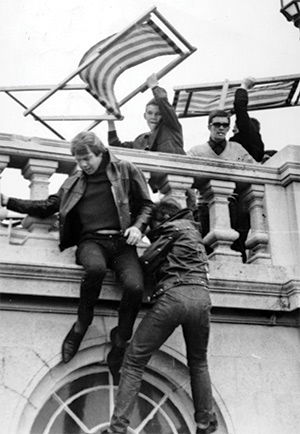 This summer marks the 50th anniversary of the mods and rockers ‘riots’ at the English seaside towns of Clacton, Margate, Brighton and Hastings. The fights on the beaches and on the promenades became symbols of rebellious and uncontrollable youth and, although the participants are no longer young, some still remember those scuffles with a sense of pride that might be unimaginable in other violent circumstances.
The troubles began on Easter weekend in Clacton, Essex, where scuffles broke out between rival groups. Things went quiet until the following Whitsun bank holiday (May 18th and 19th). Foreign travel was still in its infancy and going to the coast was a cheap alternative, especially when the weather over the summer proved so good. Families with buckets and spades and old ladies on deck chairs were treated to the sight of hundreds of teenage mods and rockers, who had come to the seaside towns of Margate and Brighton to enjoy the freedom of a weekend without work (for most were employed), wearing their best clothes and looking forward to hearing their favourite pop group on the end of the pier. This was a perfect way to meet the opposite sex away from prying eyes and perhaps to let off some steam. The Rolling Stones were performing at Hastings that weekend and Johnny Kidd and the Pirates had played Margate Winter Gardens the day before.
The mods arrived mostly by train from London, while others travelled to the south coast on their customised Vespa or Lambretta scooters, symbol of all things Italian and cool. Most lived in the capital, where fashion had begun to herald the ‘swinging sixties’, though some were local and went to school or worked in nearby factories or offices. This was the first generation of young people not affected by war and not affected by the discipline of National Service, with spare money in its pocket and leisure time in which to spend it.
Much has been written about the mods, whose origins can be traced to the jazz and beatnik culture of the 1950s and who were recorded as a subculture by Colin MacInnes in his 1959 novel Absolute Beginners. They hung out in coffee bars, watched avant-garde films and wore sharp suits. By 1963 the intellectual content of the ‘modernists,’ with their bent towards European culture, had given way to the lifestyle choices of aspirational working-class kids, listening to American soul music; the modernists had become the mods.
The Wild Ones
The mods were opposed by the rockers, leather-clad motorcycle riders and their girlfriends, who styled themselves on America’s Hell’s Angels and Marlon Brando in the 1953 film The Wild One. The rockers, on their Triumph, Norton and BSA motorbikes, understood themselves to be the real outsiders, those who refused to conform. They had roadside cafes like the ‘Ace’ at Stonebridge on London’s North Circular, where they would meet perhaps to ‘do a ton’ down the A1 with a girlfriend riding pillion. Dressed in leathers, their ‘scruffy’ looks may have been counter-cultural and offensive to many, but their love of machinery harked back to an older industrial age, which produced technological feats, such as the Spitfire, that was itself coming to an end. There were even motorcycling vicars made famous by the press: Bill Shergold and Graham Hullett of the 59 Motorcycling Club, themselves disaffected pastoral carers.
Culture clash
This new world was portrayed in characters such as Arthur Seaton in Karel Reisz’s film Saturday Night and Sunday Morning (1960) and Denis Tanner in Granada TV’s new soap opera, Coronation Street. Both seemed to represent the frustrations of a generation trapped between British inertia and unobtainable American opportunity. The rockers were older on the whole (though not always, as you could then ride a motorbike at 15) and more aggressive in appearance. They went ‘tooled up’ for the expected bust-up, but they were also outnumbered. It did not take long before the two groups were fighting with whatever they could get hold of, mainly broken deck chairs and their fists.
The holiday crowds that milled around the various scuffles looked on bemused. This was the first set of riots in England to gain the attention of the cinema newsreels and press photographers since those 30 years before at Cable Street in London’s East End, caused by the presence of Oswald Mosley’s British Union of Fascists. It has been rumoured that, when the action flagged, the press were not above passing on a ‘ten bob’ note to get some good action shots. Newsreels show crowds gathered around fights between the gangs or between the police and a cornered individual as if they were at an impromptu show. To the smiling day trippers caught on camera it all seemed like the fun of the fair, Margate’s Dreamland Amusement Park providing the backdrop to some of the worst fighting.
Trouble had started in Brighton, scene of the Who’s 1973 homage to the period, Quadrophenia (made into a successful film in 1979), and it spread along the coast, where fighting continued for the two days of the bank holiday. The troublemakers on both sides were slowly rounded up: 49 were arrested in Margate; 28 at Brighton; and even in Bournemouth 54 found themselves in the cells for a night. Those arrested were treated with rough and ready justice. In Margate mods and rockers were herded into the town’s Dickensian cells beneath the magistrate’s court, while in Hastings many had their transport confiscated, were marched to the railway station and put on the first train home, or had their shoelaces removed and were repeatedly walked up and down the town’s hills until they got fed up. Those keeping out of the way might retire to one of the nearby cafes, where they could end up sitting next to a rival. A visit to the pub was out of the question for the many still too young to buy alcohol.
Fines ranged between £50 and £75 and sentences from three to six months. The press were outraged by events: the Daily Mirror published a full-page picture of a mod ‘putting the boot in’ and the Daily Express quoted a magistrate Dr George Simpson in Margate, who had sentenced 18-year-old Peter Hutchings with the caustic comment that he was one of the ‘dregs of vermin’ who had invaded the town. Wary of bad publicity, the local papers, such as the Isle of Thanet Gazette, played the whole thing down.
Even at the time, these minor fracas (it was estimated that around 200 mods were in Margate) appeared to represent a major turning point, a move away from the war generation’s values and the miseries of rationing into something that the younger generation was able to claim for itself and which did not belong to the traditions of the past or the ‘worn out’ values of their parents. The attitude was captured on film both by the visceral realism of Tony Richardson’s film The Loneliness of the Long Distance Runner and the glamour of the first James Bond film Dr No (both 1962). This was the first expression of the baby-boomer generation, represented by consumer culture, full employment and a love of fashionable clothes. It was also a hint of a growing British counter-culture.
Youthful rebellion was hardly a new phenomenon in the 1960s. The rise of juvenile ‘gangsterism’ had been debated in May 1947 by councillors of the London Borough of Finsbury, the very area where the word hooligan was meant to have originated sometime in the 1890s. The word ‘yobbo’, first recorded in 1859 as slang for a boy, was not used again until 1922, arose briefly in 1938 and only reappeared in common parlance as late as 1956. However, though there was still individual hooliganism in the 1960s and the perpetrators were labelled yobbos, their actions signalled a more profound change; they were heralds of a modern, more individualistic Britain. For those still alive to remember, theirs was a life transformed from the austere, monochrome lives of previous generations of working-class Britons to one lived in the glorious Technicolor of the future. The sixties had arrived, albeit somewhat late.

