

Stranger than the Nights
Justin Marozzi admires Hugh Kennedy’s article from 2004, which offers a nuanced portrait of the great Abbasid caliph, Harun al Rashid, much-mythologised hero of The Arabian Nights.
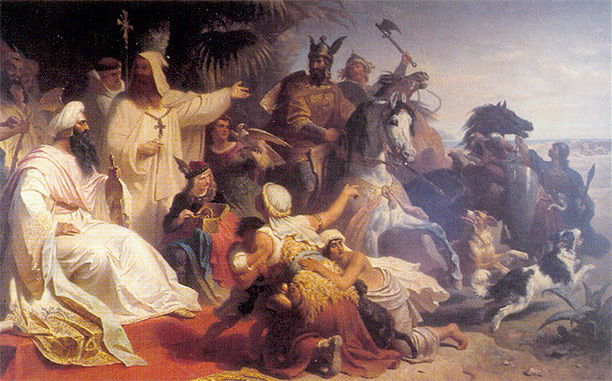 Of the 37 Abbasid caliphs who held sway in Baghdad between 762 and 1258, one name eclipses all others. Harun al Rashid (r. 786-809) owes his fame above all to The Arabian Nights, a collection of fantastical Indian, Persian and Arab tales dating to the eighth and ninth centuries.
The Harun of the Nights is a charismatic, nocturnally street-prowling ruler, always ready for adventure. In the 387th Night his companions are two concubines, from Medina and Kufa. The Arabian is massaging his legs, the Iraqi his arms. Harun gets an erection, which the girls compete to control. ‘I see you’re trying to monopolise our capital and keep it to yourself’, the Kufan complains; ‘Give me my share.’ The Medinan replies with a line from the Prophet: ‘If someone brings uncultivated ground to life, it belongs to him and his descendants.’ Not to be outdone on Islamic jurisprudence, the Kufan shoves the Medinan to one side, ‘takes Harun’s member in both hands’ and shoots back with the Prophet’s saying: ‘Game belongs to the hunter and not to the beater.’
The quest to find the ‘real’ Harun leads the historian to a trio of medieval works, by Mohammed ibn Jarir al Tabari (History of the Prophets and Kings), Masudi (Meadows of Gold) and Abu al Faraj al Isfahani (Book of Songs). The sources are hardly abundant: no surprise given that we are in the eighth and ninth centuries.
Hugh Kennedy in this article sought to provide ‘a more nuanced view’ of Harun than was generally available in the West, where the Arabian Nights version had long prevailed in the popular imagination. Tennyson’s 1830 poem, Recollections of the Arabian Nights, for example, offered a typically Orientalist take on Harun’s ‘golden prime’.
Serious assessment of Harun needs to analyse four aspects of his reign: his military career; the cultural legacy; his plans for the succession; and the astonishing volte face against the Barmakids, his long-serving courtiers.
The military record was solid if not spectacular. As Kennedy observed: ‘he achieved some modest successes and avoided major disasters’, but infidel Byzantium survived.
Harun scored better off the battlefield, taking Abbasid cultural patronage to new heights. He sponsored religious lawyers (Malik ibn Anas and Al Shafi), historians (Wakidi and Ibn Kutayba), poets (Abu al Atahiya and the scandalous Abu Nuwas), musicians such as Abu Ishak al Mosuli and mathematicians. His love of religious and philosophical discussions was such that he was nicknamed Commander of the Unfaithful, a reversal of the traditional moniker Amir al Muminin, Commander of the Faithful. Harun also championed the translation into Arabic of the great works of classical Greek, Hindu and Persian scholarship, which were in many cases revised, improved and circulated across the empire. The first Arabic translation of Euclid was dedicated to Harun.
The succession Harun sought so carefully to manage was botched. He named his son Amin as his heir, to be followed by another son, Mamun, rather than Amin’s own son. The result? A devastating civil war, the first in Baghdad’s youthful history.
Harun’s annihilation of the loyal Barmakids, who had grown rich from caliphal patronage, is a mystery. Since he had exhibited little interest in the affairs of state, delegating them to his vizier Jafar the Barmakid, the brutal execution of this most senior official and the arrest of other family members was both capricious and unnecessarily damaging. It suggests, in Kennedy’s view, ‘a man who could be spiteful, vicious and stupid’.
Kennedy’s achievement was to create a compelling and multi-layered portrait of a figure far more interesting than the technicolour caliph of The Arabian Nights. Harun’s career was astonishing in its own right, coinciding with the pinnacle of Abbasid power and glory. A whirlwind of bloodshed and conquest, pilgrimage and procreation, science and scholarship, palatial building and expenditure on an imperial, unrepeatable scale, it did not require embroidery. ‘So great were the splendours and riches of his reign, such was its prosperity, that this period has been called “the honeymoon”’, Masudi wrote. Few historians today would argue with that.

