

Roger II, King of Sicily
This cultured but energetic ruler left behind him ‘a governmental machine that was the wonder and envy of Europe’.
Few kingdoms have had more inauspicious beginnings than the Norman Kingdom of Sicily. By the year 1130 Count Roger II de Hauteville had already reigned in Palermo for a quarter of a century, since his childhood; and after his acquisition, two years before, of the duchies of Apulia and Calabria, he had become one of the richest and most powerful rulers of Europe.
But a royal crown still eluded him; and he knew that without one he would never be able to treat with his fellow-monarchs on equal terms or to weld his three dominions into a single state. Finally, on Christmas Day 1130, he achieved what he had so long desired; but the crown that was laid on his head on that day in Palermo Cathedral was to prove, for most of the next decade, more of a liability than an asset.
When he had obtained it from the schismatic anti-Pope Anacletus in return for Sicilian support against the latter’s rival Innocent II, it had seemed that this support might prove decisive; all too soon, however—thanks largely to the influence and eloquence of St Bernard of Clairvaux—the rest of Christendom had rallied to Innocent, and Roger had found himself the anti-Pope’s sole champion.
To change his allegiance was unthinkable; it would have meant disowning the one authority for his Kingship. Thus it was only after Anacletus’s death in 1138 and a lucky victory over the papal forces in the following year that Roger was able to wrest from the captive Innocent unwilling confirmation of his royal status.
Then, respectable at last, he embarked on a policy of cautious rapprochement with the Church of Rome—a policy which, three years later, was to lead to the building of S. Giovanni degli Eremiti, the first and only Latin religious foundation he was ever to allow in Palermo.
S. Giovanni—St John of the Hermits—stands today as little more than an empty shell. Nothing now remains there to suggest that during the halcyon years of the Norman Kingdom it was the richest and most privileged monastery in all Sicily. It was founded in 1142, and by the charter he granted it six years later Roger decreed that its abbot should serve ex officio as chaplain and confessor to the King, with the rank of bishop, and should personally celebrate Mass on all feast days in the Palatine Chapel.
He further laid down that in its cemetery—which still exists in the open court to the south of the church—should be buried all members of the royal family except the Kings themselves and all the senior officials of the court.1
The church itself, now deconsecrated, is surprisingly small. It was built on the site of a much earlier mosque, part of which remains to form an extension of the southern transept. But the inside, despite the traces of tile and mosaic and fresco—and even of the stalactite ceiling of the original mosque—holds little interest for the non-expert. The fascination of S. Giovanni is in its exterior.
Of all the Norman churches in Sicily it is the most characteristic and the most striking, its five vermilion domes—each standing on a cylindrical drum to give it greater height— bursting out from the surrounding greenery like gigantic pomegranates, in almost audible testimony of the Arab craftsmen who built them. They are not beautiful; but they burn themselves into the memory and remain there, stark and vivid, long after many true masterpieces are forgotten.
A few yards to the north-west there stands a little open cloister, with gently poised arcading supported on pairs of slender columns, built half a century later than the church and in perfect contrast to it. Sitting there on a hot afternoon, looking up now at the soaring austerity of the royal palace, now at the aggressively baroque campanile of S. Giorgio in Kemonia, yet always aware of those bulbous oriental cupolas half-hidden behind the palm-trees, one is reminded for the hundredth time that in Sicily Islam is never far away. And it is, perhaps, in the church and cloister of what was once the leading Christian monastery of the Kindgom that its presence is most keenly felt.
The confrontation at S. Giovanni degli Eremiti between Muslim East and Latin West is so striking that the visitor tends to forget the third essential strand of civilization that made Norman Sicily what it was. In all Palermo there is no longer a single building whose exterior recalls Byzantium. Despite the number of senior Greek officials in the Curia, despite all the Greek scholars and sages whom Roger attracted to the court in the later years of his reign, the capital itself had never boasted an indigenous Greek population of any size.
It was, first and foremost, an Arab city, scarcely touched by Byzantine influences in comparison with those regions in which Greek peoples had lived since the days of antiquity—regions such as the Val Demone in eastern Sicily or parts of Calabria, where to this day a Greek dialect is spoken in some of the remote villages.
And yet, from the time of the Arab conquest of Sicily onwards, the Greeks had played a vital part in the building of the new nation. First, they had kept the balance between Christian and Muslim on which the whole future of Norman Sicily depended. Roger’s father, the Great Count, had encouraged Latin immigration, both ecclesiastical and secular, as far as he dared; but he could not allow too much too quickly for fear of frightening the Greek and Arab communities and turning them against him.
Besides, such immigration brought its own dangers. If it had not been kept under rigid control there would have been nothing to stop swarms of swaggering Norman barons from the mainland pouring into Sicily, demanding to be given fiefs in keeping with their rank and station and gradually reducing the island to that chaos that always seemed to follow in their wake.
Without the Greeks, then, the Christian element during those early days might have been swamped altogether. But they also performed another invaluable function. They neatly counterbalanced the claims of the Latin Church, and provided both Count Roger and his son with a powerful bargaining—if not actually blackmailing—counter in their dealings with Rome.
It seems in the highest degree improbable that there was any foundation for the rumours, current at the end of the previous century, that the Great Count was seriously contemplating a conversion to Orthodoxy; but it is a good deal likelier that Roger II, at various moments in his long quarrel with Pope Innocent, may have considered renouncing the pontifical authority altogether in favour of some kind of loose caesaropapism on the Byzantine model.
What is certain is that in 1143 the Greek Archimandrite Nilus Doxopatrius of Palermo dedicated to Roger—with the King’s full consent—a Treatise on the Patriarchal Thrones, arguing that with the transfer of the imperial capital in a.d. 330 and the recognition of Constantinople as the ‘New Rome’ by the Council of Chalcedon in 451, the Pope had lost his ecclesiastical primacy, which now properly belonged to the Byzantine Patriarch.
But now, as the twelfth century neared its half-way mark, the situation can be seen to have changed. Sicily, first of all, had grown steadily richer; and as her prosperity increased, so too had her political stability. In contrast to the endemic confusion of the Italian peninsula, the island had become a paragon of just and enlightened government, peaceable and law-abiding, an amalgam of races and languages that seemed to give strength rather than weakness; and, as its reputation grew, more and more churchmen and administrators, scholars and merchants and unashamed adventurers were drawn across the sea from England, France and Italy to settle in what must have seemed to many of them a veritable Eldorado, a kingdom in the sun.
Meanwhile, the importance of the Greek minority had begun to decline. It was inevitable that it should. With no comparable immigration from abroad to sustain it, it was increasingly outnumbered by the Latin. In the prevailing atmosphere of religious toleration and easy coexistence, its value as a bulwark against Islam was now negligible. Finally, Roger had now established so firm a control over his Latin Church that he no longer had any need for a counter-balance.
Not that there was any discrimination against the Greeks. In view of the mixed feelings with which the Hautevilles had always regarded the Byzantine Empire—admiration for its institutions and its arts, distrust laced with more than a tinge of jealousy in every other field—they might have been excused for treating as second-class citizens a foreign minority whose political and confessional loyalties were openly divided. But they never did so.
Roger and his successors continued to support their Greek subjects whenever their support was necessary; they never lost their concern for the welfare of the Greeks, or of their Church. The great and distinguished line of Greek admirals continued throughout the century; at least until the end of Roger’s reign the whole fiscal system of Norman Sicily remained in Greek and Arab hands.2
It was just that the emphasis had shifted. Though from the outset subordinated to the Latin hierarchy, large numbers of Basilian monasteries had sprung up over the past fifty years, notably S. Maria del Patirion near Rossano in Calabria3—founded by the Regent Adelaide at the beginning of the century—and its daughter-house, the monastery of the Saviour at Messina, established some thirty years later. But the Saviour, soon to be the chief of all the Greek monasteries in Sicily, was also the last. Henceforth the royal favours would be lavished on the new Latin houses—S. Giovanni degli Eremiti and, later, Maniace and Monreale.
Fortunately the way was still wide open for private patronage; and it is fitting that the subli-mest legacy of the Greek Church in all Sicily, the only one that still possesses a beauty comparable to that of the Palatine Chapel and .he Cathedral of Cefalù, should have been founded, built and endowed by the most brilliant of all the Greeks in the Kingdom’s history.
Though the original and rightful name of his church, S. Maria del Ammiraglio, stands as a perpetual monument to its founder, George of Antioch had no need of such memorials to ensure himself a place in history. We first meet him as the gifted young Levantine who, after early service with the Zirid Sultans of Mahdia, transferred his loyalties to Sicily and in 1123 used his perfect Arabic and unrivalled knowledge of the Tunisian coast to score the only victory in Roger’s first, ill-fated African expedition.
Since then, as commander of the Sicilian navy, he had served his King with distinction on both land and sea, becoming in 1132 the first holder of the proudest title his adopted country had to offer—Emir of Emirs, the high admiral and chief minister of the realm.4 Despite so distinguished a career, however, his work on the church must not be thought of as the occupation of his declining years, still less of his retirement.
In 1143, the year it was endowed, he must have been in his early fifties; within weeks of the endowment he and his fleet were off on another North African adventure, more successful this time; while before he died he was to carry the Sicilian flag to the very banks of the Bosphorus, returning to Palermo with all the secrets—and many of the leading craftsmen—of the Byzantine silk industry.
The Arab traveller, Ibn Jubair, when he visited the church in 1184, prayed that Allah would soon ‘honour the building with the sound of the muezzin’s call’. Looking at the outside of the Martorana—as it is more usually called today—one almost wishes that his pious supplication had been granted. His co-religionists could hardly have done worse with it than the Christians.
The facade itself he would no longer recognize; in sad contrast to that of the adjoining church of S. Cataldo, whose three heavy cupolas unmistakably if somewhat congestedly proclaim it as a Norman building of the mid-twelfth century, this jewel of all Sicilian churches—as opposed to cathedrals or chapels—has been decked out in lugubrious baroque. Only the romanesque bell-tower, domeless since an earthquake in 1726 but still beautifully proportioned, remains to beckon the traveller within.
There, too, all is not as it was. The eastern extremity is lost, the western bays ought never to have occurred. Miraculously, however, between the two, George’s old church has remained, preserving its traditional Byzantine cross-in-square ground-plan and looking still much as it did when it was first consecrated or when, forty-odd years later, it had so alarming an effect on Ibn Jubair:
The walls within are gilded—or rather, they are made from one great piece of gold. There are slabs of coloured marble, the like of which we have never seen, picked out with golden mosaic and surmounted with, as it were, branches of trees in green mosaic. Great suns of gilded glass ranged along the top blaze with a light that dazzled our eyes and caused us such perturbation of the spirit that we implored Allah to preserve us. We learned that the founder, who gave his name to the Church, devoted many quintals of gold to its building, and that he was vizir to the grandfather of this polytheist King5.
Like most of those at Cefalù and the best of those in the Palestine Chapel, the mosaics of the Martorana were all the work of a single team of superb artists and craftsmen imported by Roger II from Constantinople and working in Sicily between 1140 and 1155. Unlike either of the other groups, they contain no later additions. All three show a close interrelation; yet each, unbelievably, has a style of its own. Only the mosaics in the cupola itself strike one as faintly disappointing.
Enthroned and depicted at full length, the Pantocrator has lost much of the majesty that he shows in the Palatine Chapel, to say nothing of Cefalù; and the four archangels beneath him have bodies so fantastically distorted as to border on the ridiculous. But drop your eyes now to the supporting walls. Look east to the Annunciation, with Gabriel in a slanting swirl of movement, Mary serene with her spindle as the holy dove flutters towards her.
Look west to the Presentation in the Temple, the outstretched arms of the infant Christ on one side and those of St Simeon on the other bridging the entrance to the nave as perfectly as does the great arch they frame. Within its vault, Christ is born and, opposite, the Virgin dies—her soul, like another swaddled child, being carried reverently heavenwards by her Son. Lastly, settle in some comfortable corner and look at everything at once while the dark, glowing gold does its work, irradiating the spirit like a soft and gentle fire.
And now, as you leave the original church, running the gauntlet of those simpering cherubs and marzipan madonnas that mark the real dark ages of European religious art, pause for a moment at the western-facing wall on the north side of the nave near the entrance; and there, in what was probably the narthex of George’s building, you will find, glittering wanly in the half-light, his portrait. It is a dedication mosaic, with the Admiral, looking old beyond his years and distinctly oriental, prostrating himself before the Virgin.
His body has unfortunately been damaged at some period, and the damage compounded by a clumsy restoration which has given him the appearance of a tortoise; but the head is the original work—presumably done from the life—and almost the entire figure of the Virgin has come down to us unscathed. Her right hand is extended towards him, as if to raise him up; and in her left she holds a scroll on which there is written in Greek:
Child, holy Word, do thou ever preserve from all adversity George, first among the archons, who has raised this my house from its foundations; and grant him the forgiveness of his sins as thou only, O God, hast power to do.
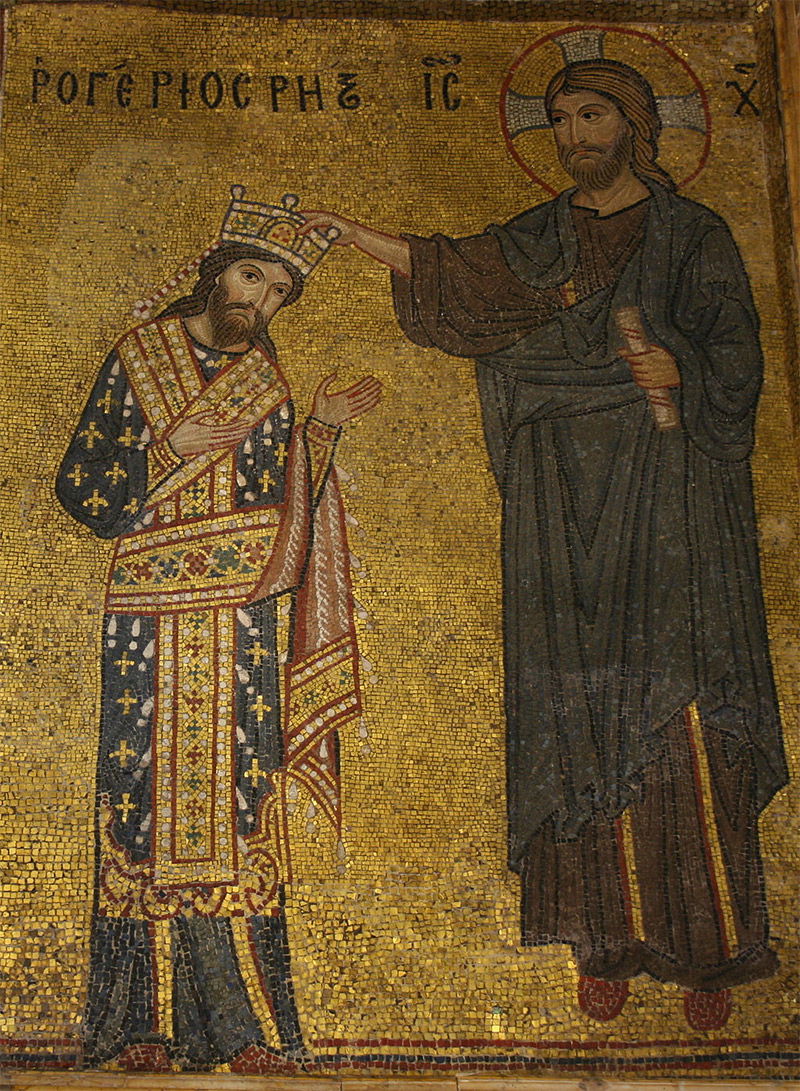
Across the nave, in the corresponding space on the southern wall, is the Martorana’s last and perhaps its greatest treasure—a mosaic portrait of King Roger himself, being symbolically crowned by Christ. There he stands, bending slightly forward, a purely Byzantine figure in his long dalmatic and stole, his crown with jewelled pendants in the manner of Constantinople; even his arms are raised from the elbows in the Greek attitude of prayer. Above his head, great black letters stride across the gold to proclaim him.
Rogerios Rex, it read. This uncompromising use of Greek letters for a Latin word is less curious than it might seem; by Roger’s time the normal Greek word for King, basileus, was so identified with the Byzantine Emperor that it would have been unthinkable in this context. And yet the simple fact of transliteration makes an impact of its own and—particularly after one has spotted the Arabic inscription on an adjacent pillar—seems to diffuse the whole spirit of Norman Sicily.
This, too, is a portrait from the life; apart from coins and seals, which are too small to give much information and are anyway largely symbolical, it is the only surviving likeness of the King which we can safely assume to be authentic.6 Without it we should have nothing to go on but the evidence of Archbishop Romuald of Salerno, a man with a genius for uninformative description.
He writes merely that Roger was tall, corpulent, with a leonine face—whatever that may mean—and a voice that was subrauca; hoarse, perhaps, or harsh, or just vaguely disagreeable. The mosaic tells us far more. It shows a dark, swarthy man on the brink of middle age, with a full beard and long thick hair flowing to his shoulders. The face itself might be Greek, or it might be Italian; it even has a faintly Semitic cast about it. Anything less like the traditional idea of a Norman knight could scarcely be imagined.
It is always dangerous to read too much of a character into a portrait, particularly when the sitter is already familiar and the portraitist unknown. Dangerous, but irresistible. And even in something so hieratic and formalized as the Martorana mosaic, there are surely certain touches, certain infinitesimal adjustments and gradations of the tesserae, that bring King Roger to life again before us.
Here, surely, is the southerner and the oriental, the ruler of subtle mind and limitless flexibility whose life is spent playing one faction off against another; the statesman to whom diplomacy, however tortuous, is a more natural weapon than the sword, and gold, however corrupting, a more effective currency than blood.
King Roger’s coronation on Christmas Day, 1130, had inaugurated a decade of storm, when the thunderclouds hung black over the mainland and when Sicily itself, for all its prosperity, was unable altogether to escape their shadow. Afterwards, the sky lightened. It is in the last fourteen years of Roger’s reign that the sun really shines on his Kingdom.
And the Kingdom responds. Suddenly the art of Norman Sicily, like some rare subtropical orchid after long seasons of germination, at this moment bursts into glory. So, no less spectacularly, does the court of Palermo. Already, at the time of his coronation, Roger had inherited from his father a civil service, based eclectically on Norman, Greek, Latin and Arab models, which compared favourably with that of any Western nation. When he died, he left his successors a governmental machine that was the wonder and envy of Europe.
Under the Emir of Emirs and the Curia, two separate land registries—known as divans7 after their Fatimid prototypes and staffed almost exclusively by Saracens—supervised the gathering of revenues from customs, monopolies and feudal holdings on Sicily and on the mainland. Another branch of the financial administration, the camera, was based on the old fiscus of the Roman Empire and administered by Greeks; another followed the model of the Anglo-Norman Exchequer.
Provincial government was in the hands of the Chancellors of the Kingdom, the camerarii, and below them the local governors—Latin bailiffs, Greek catapans or Saracen amil, selected according to the race and language predominant in their district. To avoid corruption or peculation, the very lowest officials had direct access to the Curia or even, on occasion, to the King himself.
Wandering justiciars, magistrates condemned to perpetual circuit, had responsibility for administering the criminal law, with the assistance of varying numbers of boni homines—good men and true—both Christian and Muslim, often sitting together in what was in effect the forerunner of the modern jury. They too had the right to refer appeals to the King when necessary.
The King: always, everywhere, his people were reminded of his presence, his power, his paradoxical combination of accessibility and remoteness. Himself halfway to heaven, there was no abuse, no miscarriage of justice too insignificant for his attention, if it could not be settled by those empowered to act in his name.
Emirs, seneschals, archons, logothetes, proto-notorii, protonobilissimi—even the titles of the high palace dignitaries seemed to add to the pervading splendour. Yet it takes more than civil servants, whatever their disguise, to give brilliance to a court; and Roger’s court at Palermo was easily the most brilliant of twelfth-century Europe.
The King himself was famous for his insatiable intellectual curiosity and his passion for facts. (In 1140 when, returning from Ariano, he had made his formal entry into Naples, he had astounded the Neopolitans by informing them of the exact length of their land walls—2,363 paces, a figure of which, not surprisingly, none of them was aware.)
With this curiosity went a profound respect for learning, unique among his fellow-princes.8 By the 1140s he had given a permanent home in Palermo to many of the foremost scholars and scientists, doctors and philosophers, geographers and mathematicians of Europe and the Arab world; and as the years went by he would spend more and more of his time in their company.
Outside his immediate family—and he had been many years a widower—it was with them above all that he was able to cast off some of his regality; we are told that whenever any scholar entered the royal presence, Roger would rise from his chair and move forward to meet him, then take him by the hand and sit him down at his side. During the learned discussions that followed, whether in French, Latin, Greek or Arabic, he seems to have been well able to hold his own.
In mathematics, as in the political sphere, the extent of his learning cannot be described. Nor is there any limit to his knowledge of the sciences, so deeply and wisely has he studied them in every particular. He is responsible for singular innovations and for marvellous inventions, such as no prince has ever before realized.
Those words were written by Abu Abdullah Mohammed al-Edrisi, Roger’s close friend and, of all the palace scholars, the one whom he most admired. Edrisi had arrived in Palermo in 1139; he was to remain there during much of his life, for fifteen years heading a commission set up by order of the King to gather geographical information from all quarters, correlate it, record it in orderly form, and so ultimately to produce one compendious work which would contain the sum total of all contemporary knowledge of the physical world.
The results of this work, which was completed in January 1154, barely a month before the King’s death, were twofold. The first was a huge planisphere of purest silver, weighing no less than four hundred and fifty Roman pounds, on which was engraved ‘the configuration of the seven climates with that of the regions, countries, sea-coasts both near and distant, gulfs, seas and watercourses; the location of deserts and of cultivated lands, and their respective distances by normal routes in miles or other known measures; and the designation of ports.’ One would give much for this magnificent object to have been preserved; alas, it was destroyed during the riots of the following reign, within a few years of its completion.
But the second, and perhaps ultimately the more valuable fruit of Edrisi’s labours has come down to us in its entirety. It is a book, properly entitled The Avocation of a Man Desirous of a Full Knowledge of the Different Countries of the World but more generally known as The Book of Roger; and it is the greatest geographical work of the middle ages. On the very first page we read the words:
The earth is round like a sphere, and the waters adhere to it and are maintained on it through natural equilibrium which suffers no variation.
As might be expected, The Book of Roger emerges as a combination of hard topographical facts— many of them astonishingly accurate for a work produced three and a half centuries before Columbus—and travellers’ tales; but even the latter suggest that they have been subjected to stern critical appraisal.
This is, after all, a scientific work, and we are never allowed to forget it; there is no room for tall stories unless they have at least some claim to veracity. But the author, on his side, never loses his sense of wonder, and the book makes fascinating reading.
Though Roger’s court circle was by no means entirely composed of Arabs like Edrisi, they probably constituted the largest single group; while among the Europeans there were many who had been attracted to Palermo by very reason of its predominantly Arab flavour. There was nothing new in this. Unlike Christianity, Islam had never drawn a distinction between sacred and profane knowledge.
During the dark ages, while the Church of Rome—following the dire example of Gregory the Great—feared and even actively discouraged secular studies, good Muslims remembered how the Prophet himself had enjoined his Faithful to pursue knowledge all their lives, ‘even if the quest led them to China,’ for ‘he who travels in search of learning travels along Allah’s path to Paradise’.
Muslim civilization had thus for years been recognized in the West as superior to anything that Christian Europe could boast, especially in the field of mathematics and the physical sciences. Arabic had become the international scientific language par excellence. Moreover there was a number of classical works of learning, both Greek and Latin, which had been lost to Christendom through the barbarian invasions or the engulfing tide of Islam and survived only in Arabic translation.
By the twelfth century, owing largely to the work of the Sephardic Jews of Spain, some of these were beginning to reappear in Western languages; but this did not appreciably diminish the need for any serious student of science to master Arabic for himself.
Yet it was a diabolically difficult language to learn and, in northern Europe at any rate, competent teachers were few. Thus, for half a century and more, men had been travelling to Spain and Sicily, there to unlock, as they hoped, the secrets of the Muslim world—poor clerks, seeking knowledge that would single them out from their fellows and so clear their path to advancement; dreaming alchemists, combing volumes of oriental lore for formulas of the elixir of life or the philosophers’ stone; or true scholars like Adelard of Bath, pioneer of Arab studies in England and the greatest name in English science before Robert Grossetete and Roger Bacon, who came to Sicily in the first years of the century and was later to restore Euclid’s Elements, retranslated by him from the Arabic, to the cultural heritage of Europe.
For certain more specialized fields of enquiry these early Arabists continued to gravitate towards Muslim Spain and in particular to the school of Toledo, which had long been the spearhead of the international scientific renaissance. For others, however, Sicily possessed one overwhelming advantage: while culturally still very much part of the Arab world, it also remained in perpetual contact with the Greek East. In the libraries of Palermo, to say nothing of all the Basilian monasteries in the island and in Calabria, scholars could find the Greek originals of works known in Spain only in extracts, or in translations of doubtful accuracy.
Nowadays we tend to forget that, until this twelfth-century revival of interest in ancient learning, Western Europe was virtually ignorant of Greek; and Roger’s Sicily now became the foremost centre of Hellenic studies outside Byzantium itself. But in Byzantium Arabic culture was unknown and mistrusted.
Only in Sicily could both civilizations be studied at first hand and employed to explain, complement and cross-fertilize each other. Small wonder, then, that seekers after truth should flock in such numbers to Palermo and that the island should have established itself by mid-century as not only the commercial but also the cultural clearinghouse of three continents.
Once again, all this activity was centred on the person of the King. Roger has been accused of being himself uncreative, in contrast to his grandson Frederick II for example, or even to Richard Coeur de Lion, a troubadour poet of considerable ability. It is true that he left no literary compositions of his own; it would have been remarkable if he had, since that marvellous flowering of European vernacular literature that had already begun in Provence had not yet spread farther afield.
Such poets as flourished in Palermo in his day—and there were many—were nearly all Arabs. Besides, the King’s personal preference was for the sciences. Beauty he loved, but splendour too; and one suspects that he did not find it easy in every case to distinguish one from the other. Anyway, he loved knowledge more.
Yet to say that he was not creative is to ignore the fact that without him the unique cultural phenomenon that is twelfth-century Sicily could never have occurred. So diversified a nation needed a guiding hand to give it purpose, to weld its various elements into one. Intellectually as well as politically, Roger provided that hand.
In a very real sense, he was Sicily. His was the conception, his the incentive; he and only he could have created the favourable climate that was a precondition of all the rest. Enlightened yet always discriminating, he was the first royal patron, focusing the efforts and energies of those around him, never once losing sight of his eternal objective —the greatness and glory of his Kingdom.
1 This last decree was never generally observed. Nearly all the royal family were in fact buried in the chapel of St Mary Magdalen next to the old cathedral. When, forty years later, the cathedral was rebuilt and enlarged, the tombs—which included those of Queens Elvira and Beatrice and of four of Roger’s sons, Roger, Tancred, Alfonso and Henry—were transferred to another chapel similarly named. This chapel still stands in the courtyard of the carabinieri barracks of S. Giacomo. Of the graves themselves, however, there is no longer any trace. (Deér, The Dynastic Porphyry Tombs of the Norman Period in Sicily. Cambridge, Mass., 1959).
2 It is noteworthy that, as Miss Evelyn Jamison points out (Admiral Eugenius of Sicily, p. 40), ‘No men of Latin culture seem up to this time to have been employed in positions high or low by the central offices of finance.’
3 Visitors to Rossano are usually content to inspect the Byzantine church of S. Marco and the Archbishop’s Palace, home of the justly-famed sixth-century purple codex. They would be well advised to make the short detour to S. Maria, lying up in the hills on the way to the neighbouring town of Corigliano. The monastery buildings are in ruins, but the church itself is still there, with a superb mosaic pavement which alone is worth the visit.
4 It is perhaps worth recalling that the word admiral current with minor variations in so many European languages, is derived through Norman Sicily from the Arabic word emir; and in particular from its compound Emir-al-Bahr, Ruler of the Sea.
5 Ibn Jubair was writing in the reign of Roger’s grandson, William the Good. To devout Muslims all Christians were polytheists. As believers in the Trinity, what else could they be?
6 The only other certain contemporary portrait to have come down to us is on a curious enamel plaque in the church of St Nicholas at Bari. It depicts Roger’s coronation by St Nicholas, and was probably the origin of the church’s one-time claim that he was crowned there and not in Palermo. (His reputed crown, an immense circle of iron and copper more suited to a barrel than a human head, is also displayed there with some pride.) The portrait may be from the life, but was more likely copied from another, now lost. The essential physical features appear much the same as on the Martorana mosaic.
7 From which comes the Italian word dogana and, through it, the French douane.
8 Henry I of England was admittedly well-educated by the standards of the time—a fact which was considered remarkable enough to earn him the nickname of Beauclerc. But Henry made no effort to form a cultivated court around him, as Roger did.

