

Popular Leisure and Industrialisation
Kenneth J. Baird examines change and continuity in 19th-century British social history.
 Contemporaries and historians have noted the transformation which took place in popular leisure activities in the first half of the 19th century and have generally indicated that industrialisation reduced the time and space available for recreation as well as fundamentally altering popular amusements. Contemporaries especially remarked that the traditional, communal celebrations - such as the parish feasts and fairs of the 18th century - were replaced by noisy, drunken and violent amusements, almost all of which centred on the public house. However, this view is simplistic and requires considerable qualification. Although industrialisation and urbanisation transformed popular leisure activities, there was also a degree of continuity. Furthermore, and even more important, the extent of industrialisation and urbanisation was not as great as the historiography has suggested. Consequently, although there was considerable qualitative changes to popular leisure, there was rather less quantitative change.
But before going on to discuss popular leisure in the first half of the nineteenth century, it is important that some attempt be made to define the term 'popular leisure'. No definition can be perfect, but for the benefit of this article the term will be applied to that portion of time or activity which is spent out of work by those, from unskilled labourer to artisan, who were engaged in manual work. In addition, this article will focus on communal pastimes rather than private or sporting leisure activities.
Industrialisation: Extent and Effects
Any attempt to assess the extent of change in leisure in the first half of the nineteenth century is complicated by the nature of the evidence. Working-class leisure came to be regarded by middle-class contemporaries as a problem and, consequently, was the subject of much polemic debate. This polemic has effected our understanding of the debate since much of the evidence was recorded by middle-class observers who either had imprecise knowledge of the subject or their own axes to grind. Many of those observers therefore tended to highlight what they perceived as the 'evils' of working-class leisure. Much of the evidence can therefore be exaggerated, biased or based on value judgments, but it is nevertheless assumed to contain an element of validity.
One of the major themes which the historiography addresses is that of the effect of industrialisation on leisure time. Most historians have claimed that there was a considerable change and that the new industrial conditions had effectively eroded the industrial population's free time, while mechanisation had simultaneously imposed a punitive working week on the labour force. 'Prior to industrialisation the work pattern was characterised by alternate bouts of intense labour and idleness', as individuals were able to determine how much work they actually needed to do. This led to a very irregular work pattern, with holidays being taken whenever it suited the individual. Monday, in particular, was taken as a holiday and celebrated as St Monday. The calendar provided many more holidays, such as wakes and fairs which could last up to a week, and groups of workers kept their own saints' day, such as the woolcombers with their Bishop Blaise celebrations. The hours which were actually worked were not regular, although a (very) rough average which became established in the mid-eighteenth century was for a ten-hour day.
The onset of industrialisation and mechanisation apparently caused a considerable change to these practices. Early industrialists often believed that leisure for their workforce was unnecessary and expensive and they therefore increased the time and regularity of work. Cunningham has argued that the imposition of work discipline was easiest where labour was weak, and he cites the example of the cotton industry where mechanisation and weak labour had the greatest impact. 'In the cotton industry, the operatives, lacking a custom of their own to refer to, were unable to resist the imposition of between 12 and 13.5 actual hours of work per day.' Elsewhere, miners also found themselves working a 12-hour day as opposed to the six hour day of the previous century.
The number and frequency of holidays had also been reduced. Operatives worked six days a week and only had Sunday free, while the 'pre-industrial calendar of frequent and varied holidays was simply consumed'. The 1842 Parliamentary enquiry found that only Christmas Day and Good Friday were observed as holidays in mining areas. By 1834 there were only eight statutory half-holidays in England and many of the traditional feast days 'had been considerably pruned by employers and the church'.
It therefore seems that the amount of time people had for leisure had been reduced by the onset of industrialisation. However, the extent of these changes varied considerably over the country, so that for many people there was little change; and even in the cotton districts, where the effects of industrialisation were greatest, the effects were not as widespread as Cunningham has claimed.
In the first place, 'industrialisation' did not occur to the same extent over the whole of England but was disproportionately concentrated in the cotton districts of Lancashire. In 1850, 70 per cent of all cotton mills were located in Lancashire, which employed 74 per cent of all cotton operatives with 79 per cent of all power looms used in the country. This meant that, in real terms, 597,000 people were employed in the Lancashire cotton mills from a total population of 21 million. This was a relatively small number of people who were subject to factory hours, and although there were factories in other parts of the country, they did not dominate to the same extent as they did in the north west. Therefore, industrialisation and mechanisation did not affect the vast majority of workers throughout the country and, where it did, the effect was relatively limited.
Furthermore, it would be wrong to assume that industrialisation in the cotton industry automatically meant the curtailment of leisure time for all the operatives. In the 1840s it was found that extra holidays were conceded, 'not due to liberality on the part of the masters, but to custom'. Elsewhere in Lancashire, it was claimed that workers had a two-week break at Christmas and a week at Whitsun. Clearly, even where industrialisation took place in the first half of the nineteenth century, groups of workers were able to resist changes to their traditional practices, and this would have been easier where small masters (and the majority of 'factories' were small) themselves took traditional holidays.
In other parts of the country, where small workshops were the norm, there was even greater success in sustaining traditional practices. This was very much the case in Birmingham where skilled workers dominated workshop industries. Birmingham's workshops differed considerably from Lancashire's cotton industry, in that its industry took much longer to undergo mechanisation. In Birmingham in 1800, steam power produced 127 horse power; the figure for Manchester was 'perhaps ten times as much'. Reid has found that 'wherever unmechanised, small workshop production remained, then Saint Monday might accompany it'. So successful were the skilled workers at resisting attempts to regulate their working patterns that even in the 1840s (and, indeed later) it was reported in Birmingham that the majority of the working classes largely kept Mondays as a holiday. The extent of support for the 'St Monday' holiday can be seen in the number of excursion trains which left Birmingham. Of 22 excursions which left Birmingham in 1846, 16 left on a Monday. The practice of taking the 'St Monday' holiday would continue in many places until the 1867 factory Act established the Saturday half-holiday for most workers, or when employers were able to replace skilled workers with machinery.
The evidence shows the need to be careful when considering the effect of industrialisation on the leisure time of the working classes and that it is misleading to overstate the extent or the speed at which traditional leisure practices declined. It seems acceptable to claim that for a small proportion of the working classes there was indeed a reduction in free time, but for the large majority of workers throughout the country there was little change in their pattern of working, while for those who were effected by industrialisation, change only occurred gradually. However, other changes also took place, the extent of which might be harder to assess, but which certainly affected many places in the first half of the nineteenth century, namely the effects of urbanisation.
Urban Environment
The reduction in the space available for leisure is a major theme which historians and contemporaries have discussed. Bailey has written of the open spaces which vanished before 'the march of bricks and mortar' and a contemporary claimed that 'scarce a foot of ... these common wastes remain for the enjoyment of the industrial classes'. Only the streets were left for people to use for leisure activities and even they were regarded as places for business, rather than public places. The problem of space was certainly noticed by contemporaries (although concerned about the working classes being forced into the pub through the lack of alternative facilities) who in 1833 set up a Select Committee on Public Walks to examine the problem. The committee concluded that 'many inclosures of open spaces in the vicinity of towns have taken place and little or no provision has been made for public walks or open spaces'. This can be effectively illustrated with the example of Enclosure Bills passed between 1837 and 1841, where only 22 acres out of a total of 41,420 acres enclosed were allocated for recreational use. Urbanisation in the first half of the century certainly reduced space for popular recreations, but the extent of urbanisation varied throughout the country. Again, it was the textile districts in the north west which saw considerable growth, as did London. Yet this growth was not as pronounced elsewhere, and consequently it would not be until 1851 that more than half the population would be classed as living in urban areas. If urbanisation did not affect everyone to the same extent, however, it certainly had a profound effect on popular leisure where it did occur. The reduction in open space meant that many traditional activities were entirely inappropriate for an urban setting. In Derby in the 1840s, the street football played on Shrove Tuesday was suppressed because of 'terror and alarm' and the damage to property which the crowds caused.
Suppression and Supervision
Perhaps the single greatest effect of urbanisation was to concentrate the working classes into the towns. This alone may not have affected popular pastimes, but the large crowds and the often violent nature of traditional events created considerable alarm among middle-class elites who perceived rough, traditional celebrations as being close to riot. One foreign observer noted that working class 'play' was closer to fighting than to recreation. This moral panic, coupled with a change in attitude by the middle classes towards popular leisure, probably had a greater affect on popular leisure activities than either industrialisation or urbanisation.
Traditionally, it had been the practice for the gentry and middle classes not only to participate in popular amusements, but also to arrange and organise these amusements. The gentry had a shared interest in popular leisure and tended to be keen supporters of blood sports such as bear-baiting and cock-fighting, whilst horse racing and pugilism would not have existed without gentry support. Patronage also led the gentry or those in local office to provide entertainments or to play their customary role in popular festivities by providing beer and money. However, this attitude seems to have been changing in the 18th century. As a polite and predominantly urban culture began to spread in the second half of the century, elite tastes began to differ from those of the commons and support or patronage for popular activities was gradually withdrawn. This, helped by the spread of Evangelicalism and the need for moral improvement which it preached, meant a barrier developed between the gentry and the people. Furthermore, the middle-class elites, especially in urban centres, not only distanced themselves from popular amusements, but actively worked to suppress what they believed to be the worst excesses of working-class leisure.
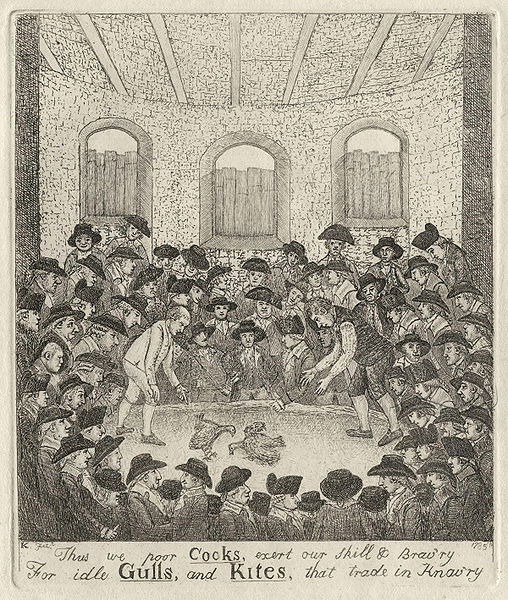
These attacks had a far greater impact on popular leisure than the effects of time or space, largely because they were effective nationally. Reformers and critics all over the country worked to 'improve' or suppress popular leisure activities. The newly created police forces which emerged after 1829 were responsible for the marked reduction in some of the more brutal aspects of popular pastimes. In 1835, under pressure from the Society for the Prevention of Cruelty to Animals, an Act was passed which banned blood sports. Contemporaries commented that blood sports 'died out' after this, but Cunningham believes it was the effectiveness of the police in suppressing them that accounted for their gradual decline. However, although violent sports such as these all but disappeared along with wrestling and pugilism, there were some violent sports which still survived attempts to suppress them. Bull-running in Stamford survived until 1840 and it was only in 1843 that Manchester banned dog-fighting. Even in the 1850s, dog-fights could still be found in some of the 'lower' pubs in Liverpool (and no doubt in other towns and cities as well).
Local authorities were also active in suppressing what they thought to be rough and degenerate amusements. Where fairs came under attack they invariable disappeared, as was the case with Bartholomew Fair which, due to pressure from local authorities, had died out by 1854. Activities such as these, which were actively attacked, were the only instances where there was a complete transformation of traditional leisure activities. Almost all other popular pursuits were able to exhibit a continuity with traditional amusements by adapting to, and becoming absorbed by, the emergent industrial society.
The Drinking Classes
This adaptation can be best seen in the role of drink in popular amusements where it continued to play a central part in working-class life, but also incorporated changes which made it more suitable to the urban environment. Popular leisure in the eighteenth century was, according to Malcolmson and Thompson, characterised by its drunkenness and this does not seem to have changed in the nineteenth century. Indeed, if anything, drink became even more important, and drunkenness more of a problem.
As noted earlier, urbanisation had reduced the alternatives for popular leisure and, consequently, the public house had become, according to Bailey, the 'principal setting' for working-class recreation. Contemporaries remarked that popular leisure in the 1830s was a 'noisy drunken riot' and Hugh Shimmin found that drink played a central role in working-class leisure in Liverpool in 1856. A witness at the 1834 Parliamentary Enquiry into Drunkenness declared that pubs seemed fuller than he could ever remember and the very need for an enquiry clearly suggested that drunkenness had either become a serious problem, or that there was a moral panic over the perceived extent of it. Part of this panic was no doubt caused by the fact that plebeian leisure was now taking place behind the closed doors of the public house and out of the gaze and supervision of the middle classes - in marked contrast to the shared leisure practices of the pre-industrial society. Ironically, legislation had actually aggravated this situation. The Beer House Act of 1830 had increased the number of places selling beer and, in an attempt to avert the competition from beer houses, publicans improved their services by creating larger, brighter and more attractive premises which were clearly preferable to the misery and squalor of working-class homes. They were therefore well attended.
Furthermore, publicans affected a change which would demonstrate the adaptability of popular leisure to the new industrial setting when they converted their premises to include singing saloons and 'free and easies'. These places offered amusement which was derived from the village green which allowed singing, dancing and drinking to continue under more private conditions.
Conclusion
Popular leisure activities certainly went through a period of transition between 1800 and 1850 but the nature of the subject makes it rather problematic to generalise about the extent of the transition. It is therefore crucial to distinguish between the various elements which caused changes, and the consequent changes which altered the form or style of popular leisure.
The effect of industrialisation upon the time available for leisure was relatively limited, even within the urban textile districts; and even when mechanisation became widespread later in the century, government intervention restricted working hours. Urbanisation, however, had a greater and more lasting effect by altering the forms of popular amusements. The need to adapt to urban society transformed leisure activities to a considerable extent and meant that they became more private and commercialised than traditional amusements had been. Popular leisure was no longer tied to the celebrations of the agrarian calendar and had lost its patronage and community spirit. Where traditional celebrations remained, such as the Wakes celebrations in Lancashire, they were devoid of any traditional meanings, becoming instead scenes of disorderly drunkenness.
However, running through these changes to the style of leisure activities was a degree of continuity. With the exception of violent blood sports, which were singled out and officially suppressed, other types of leisure simply adapted to the industrial setting. Drink was still important, if not more so, and street and fairground amusements could now be found in the saloons and pubs which appeared in urban areas. In a wider, national context these changes would not have been so significant, but for those effected early on by industrialisation the transformation was indeed profound. It would only be in the later stages of the nineteenth century, when mechanisation spread further and new opportunities appeared in the form of the railway excursion, that popular leisure activities would be completely transformed and that the transformation would affect the vast majority of people.
Timeline
- 1760s The Spinning Jenny in widespread use.
- 1769 Richard Arkwright opens his mill at Cromford -and influences mill design thereafter.
- 1790s Steam begins to replace water power.
- 1801 Population of Manchester 75,000
- 1820s Power loom adopted - weaving becomes mechanised and handloom weaving begins to decline.
- 1830 Liverpool to Manchester railway opened.
- 1833 Select Committee on Public Walks examined the lack of space in towns for public leisure.
- 1851 The population of Manchester reached 303,000.
Further Reading:
- P. Bailey, Leisure and Class in Victorian England (Routledge, 1978)
- G. Best, Mid-Victorian Britain, 1851-75 (Fontana, 1979)
- H. Cunningham, Leisure in the Industrial Revolution (Croom Helm, 1980)
- R.W. Malcolmson, Popular Recreations in English Society 1700-1850 (Cambridge University Press, 1973)
- D. Reid, 'The Decline of Saint Monday', Past and Present, vol. 71, 1976
- Robert Poole, 'Lancashire Wakes Week', History Today, August 1984
- H. Shimmin, Liverpool Life (Garland, New York, 1985)
- E. P. Thompson, 'Time, work discipline and industrial capitalism', Past and Present, vol. 38, 1967
- J. Walvin and J. Walton (eds), Leisure in Britain 1780-1939 (Manchester University Press, 1983)

