Magic, Medicine and the Viking Way of War
Viking sagas tell of conflict and heroic voyages but are prone to fantasy and exaggeration. How accurate are their scant accounts of the treatment of those injured in battle? Brian Burfield examines the elusive practice of Viking medicine.
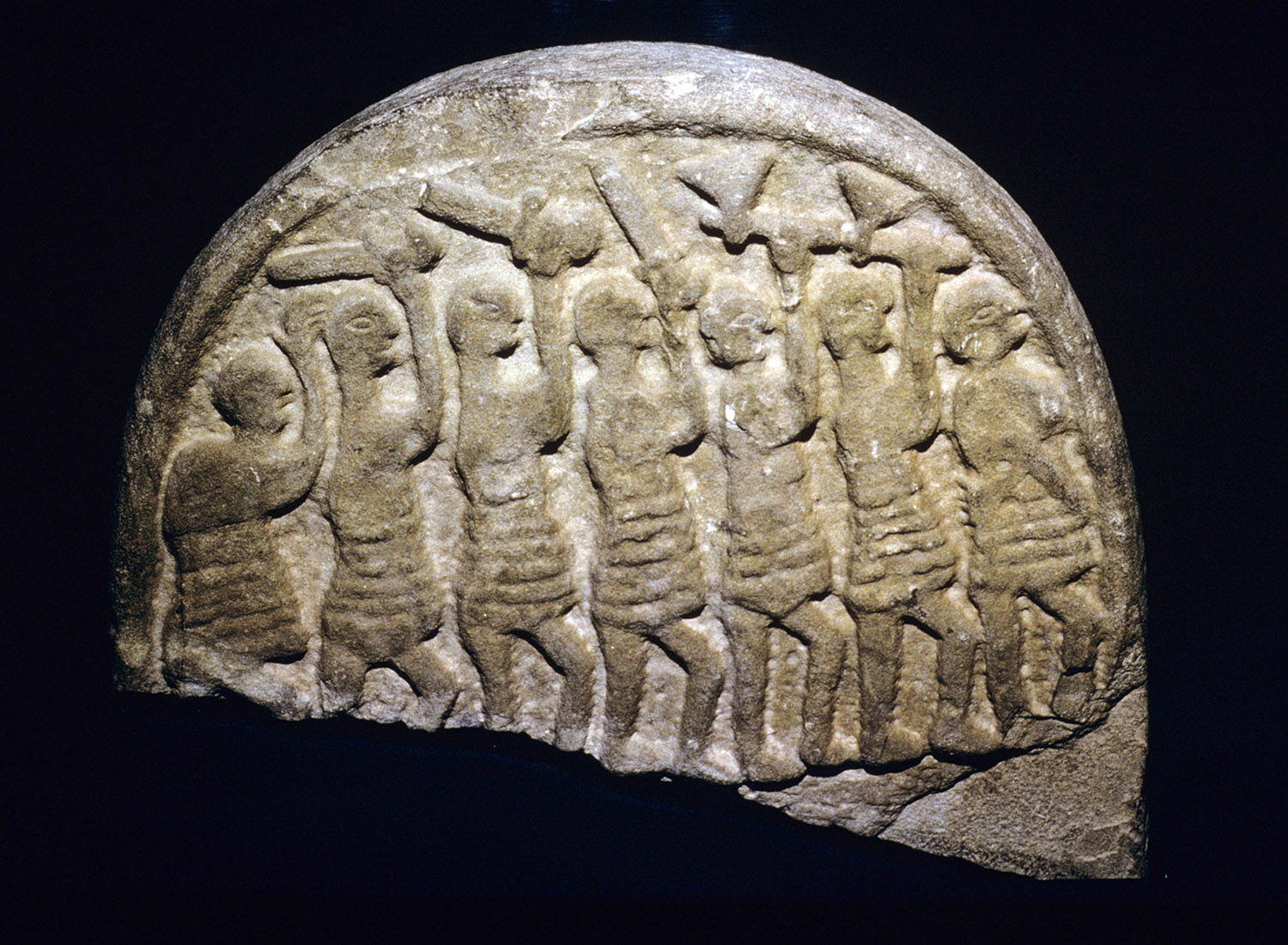
The burning and the smoke, the crush of men, the clash of shields, the cruelty of the blade and the screams of terror: the Viking battlefield must have been a terrifying sight, made all the more horrendous by the inevitable presence of wounded and dying warriors. The shouts and moans of the suffering would slowly replace the noise of battle. Soon, those men and women with ‘the softest hands’, who practised the healing arts, would be tasked with treating those who were still alive. The injuries could be varied and gruesome, from teeth smashed out of heads, arrow punctures and axe and sword cuts to more serious wounds, such as the loss of limbs and brains spilling out of broken skulls.
While we know it must have happened, how the Vikings treated such injuries and cared for their wounded is hard to establish with any certainty. Understanding the medicine and medical procedures used by the Vikings, both on and off the battlefield, requires the scrutiny of a combination of often elaborately fictionalised sources in order to try to catch a glimpse of the reality. Viking poetry and sagas, while full of useful information, habitually include elements of fantasy and exaggeration and were often written long after the events they discuss and describe. Archaeology can help partially to complete the picture, but when wounds and disease are not bone deep, it can reveal little. The leechbooks (a ‘leech’ being a doctor) and medical treatises of those societies, such as the Anglo-Saxons, who came into frequent contact with the Vikings can be useful resources. There are also interesting compendiums, such as An Old Icelandic Medical Miscellany, a collection of northern medieval medical information written and compiled during the 15th century, which contains many cures and treatments taken from earlier works.
A couple of short passages from the Saga of Olaf Haraldson, found in Snorri Sturluson’s epic history of Norwegian kings, Heimskringla (c.1230), give some idea as to what constituted a Viking battlefield ‘hospital’: ‘The wounded were taken home to the farms, so that every house was full of them; and tents were erected over some.’ This is typical: transportation of the wounded to a settlement near the fighting was common across medieval Europe. In a later chapter, the saga describes what occurred inside those houses and tents: ‘There were many wounded men and with them a woman binding their wounds. There was a fire upon the floor, at which she warmed water to wash and clean their wounds.’ A sense of care and kindness for the wounded permeates these descriptions, although the medical details are scant.
It is clear that men and women with special medical skills and knowledge were a necessary part of travelling Viking armies. An excerpt from the Saga of Magnus the Good focuses on the importance of such medical support:
After the battle, the king ordered the wounds of his men to be bound; but there were not so many doctors in the army as were necessary, so the king himself went round, and felt the hands of those he thought best suited for the business; and when he had thus stroked their palms, he named twelve men, who, he thought, had the softest hands, and told them to bind the wounds of the people; and although none of them had ever tried it before, they all became afterwards the best of doctors. There were two Iceland men among them; the one was Thorkil, a son of Geire, from Lyngar; the other was Atle, father of Bard Svarte of Selardal, from whom many good doctors are descended.
While some of this may just be good storytelling, it also must contain a great deal of truth. Certainly, indigenous Viking healers would have been bolstered in both knowledge and manpower by those men and women who were captured from other cultures and who would, willingly or otherwise, share their expertise.
The axe, which was so grimly suited to separating a warrior from his limbs, was the most common hand-to-hand weapon used in Viking combat. The poetry of the age gave the axe such names as ‘the witch of battle’ and ‘the fiend of the shield’. Men like Onund Tree-leg lost limbs to the axe. The sagas and poems are scattered with other names like Thorir Wooden-leg and Egil One-hand. Yet, though these warriors suffered ‘limb-lopping’, as it is so vividly described, they survived.
According to Grettir’s saga, Onund Tree-leg lost his lower leg to an axe during the Battle of Helgeå in 1026. Without prompt intervention and treatment such an injury could still prove fatal today and would have been far more problematic during the Viking era. The injury raises the question of how close those responsible for the medical treatment of the warriors were to the action. The Víga-Glúms saga includes a passage in which a female character, Halldóra, assists a wounded warrior:
When she came up, Thórarinn was just struck down by Márr, his shoulder was cut away in such fashion that the lungs were exposed. But Halldóra bound up his wound, and kept watch over him till the fight was over.
While the scene only describes a skirmish, it highlights the need for those with medical knowledge to be close to the fighting, ready to provide assistance and protection at short notice. Warriors who suffered these types of acute injuries would only survive if they received immediate attention.
The loss of a limb would also result from severe soft tissue injuries and with wounds such as acute compound fracture, as gangrene and other infections set in. Both would require amputation. Evidence of this was discovered in a grave at Lund in southern Sweden. A warrior, who lived towards the very end of the Viking age, had both hands, parts of his forearms and his left foot amputated. The amputations appear to have followed serious battle injuries. Amazingly, his remains show that the surgery was successful and that he survived.

Men like Onund Tree-leg and the warrior from Lund must have received tried and tested medical attention and aftercare. Their treatments must have been effective, but the precise methods employed by the Vikings to successfully treat warriors like these are not known. Clues may be found, however, in the earliest of the surviving Anglo-Saxon medical treatises, Bald’s Leechbook. Written around 950, its contents would have been familiar across northern Europe. It may be a copy of a document originating 50 years earlier in the time of Alfred the Great, showing the longevity of such remedies. The Leechbook contains, among other things, instructions for dealing with the types of limb loss discussed above. They are worth examining, if only for the sheer hopelessness of some of their treatments. One chapter refers to limbs already lost, advising that:
If a limb be smitten off a man, a finger, or a foot, or a hand, if the marrow be out take sodden sheep marrow, lay it on the other marrow, bind it up well for a night.
It goes on to recommend a salve made from hazel lichen, holly, butter and other ingredients. Another notorious excerpt from the Leechbook is often referred to when limb loss from this period is explored:
If thou must carve off or cut off an unhealthy limb from a healthy body, then carve thou not it on the limit of the healthy body; but much more cut or carve in on the hole and quick body; so thou shalt better and readier cure it. When thou settest fire on a man, then take thou leaves of tender leek and grated salt, overlay the places, then shall be by the more readily the heat of the fire drawn away.
These few lines appear to be dealing with gangrenous tissue, conceivably similar to that suffered by the warrior from Lund who required the multiple amputations. In both cases there is a lot of important information missing from the Leechbook’s instructions. If these procedures were ever performed, it is unlikely they were effective. This makes the fact that the Vikings had successful amputation procedures all the more enticing. The Leechbook’s remedies fail, for example, to address vital issues such as controlling blood flow. Modern estimates suggest that 60 per cent loss of blood volume is the point of no return for a wounded person. For an injured warrior a thousand years ago, that threshold was much lower. It is therefore surprising that the Leechbook does not include any instruction for something as simple as a tourniquet. Perhaps we can assume this was such common knowledge it did not need writing down.
While the works of ancient doctors and writers were known to the Anglo-Saxons, their methods were not always implemented. Indeed, the Leechbook’s advice seems lacking when compared with, for example, the work of the Roman medical writer Celsus. Writing in the first century ad, Celsus understood the potential for haemorrhaging and recommends applying pressure to the vessels, wound packing, ligatures around the major vessels and cauterisation.
The risk of the wounded warrior going into shock would also have been a pressing matter, which is again beyond the work of Bald. While he does suggest the stump be cauterised in the second extract (‘when thou settest fire on a man’), he does not address the flap of skin that is needed to be folded over the end of the stump, nor the effort required to stitch it all up. Pain control is another significant problem. While Bald recommends the use of ‘leaves of tender leek and grated salt’ as a source of relief, nothing is mentioned about pain management throughout the procedure. Perhaps, as in later centuries, nothing was used.
*
On the issue of pain there is a strange and interesting passage in the Saga of Egil and Asmund. While the story is pure fantasy, part of it appears to address pain management. Having lost a hand in a fight, Egil meets a hag who says that she can put it back on for him. She begins by dislocating his shoulder to deaden the arm so that Egil does not feel any pain while she trims the stump where his hand used to be. A dislocated shoulder will certainly cause the arm and hand to become numb to varying degrees. The same holds true for a dislocated knee, which will deaden the pain in the lower leg and foot. This procedure would require some skill and knowledge of anatomy. The matter-of-fact way in which it is brought into the tale suggests the knowledge was, to some degree, commonplace.
Prosthetics assisted those who had undergone amputations in returning to a more normal life. They also often provided inspiration for new aliases like ‘Tree-leg’ and ‘Wooden leg’. In the case of a lower leg, for instance, any portion that was left would be flexed at a right angle at the knee and kept in place with a heavy bandage. The bandage acted as padding, softening the contact with the wood. The top of the prosthetic was carved out to form a tray into which the leg would sit and the rest of the prosthetic resembled a stilt. A wooden crutch would be required for balance, leaving the other hand free.
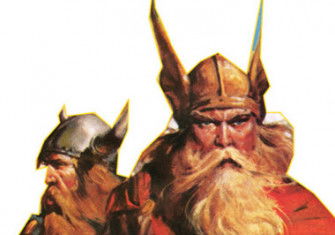
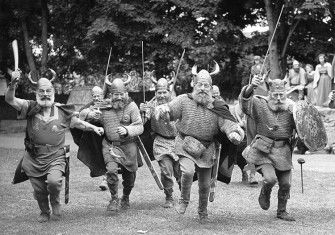
If such injuries were common, what preventative methods against their occurrence was taken? Viking armour has been a contentious subject. The idea of Vikings wearing helmets with horns is a long-debunked myth, but the assumption that Viking warriors wore metal helmets of any sort may also be erroneous. Indeed, a significant question exists as to whether Viking warriors generally wore any type of effective head protection at all. Popular images of the Viking warrior usually include some variety of metal helmet. With the exception of one such helmet, discovered in Norway during the 1940s, and a few other scarce finds, little proof of metal headgear exists. Thousands of warrior graves have been excavated throughout the Viking world over the past decades and, while iron weapons and all manner of items related to war have been discovered, there are almost no helmets among them.
It has been suggested that, instead, leather helmets were worn. This would have been an affordable option, although it would have provided minimal protection to the wearer. Any leather headgear that did exist would have disintegrated by now and on this subject the sagas and stories only serve to confuse things. Excerpts from the Hervarar saga claim that ‘many a thick helmet was cleft’ and describe how one warrior ‘hit his helmet and cut off the part he hit’. Both seem to suggest leather helmets, but they could well be metal. Yet there are other passages throughout the sagas and poems that clearly point to metal helmets. However, at the Fishergate Cemetery in York, injuries to the skulls of 16 of the 30 Vikings buried there show severe damage to the back and top of the skull, which may support the notion that these men were not wearing useful head protection.
Lack of metal helmets, or indeed effective head protection of any kind, would have resulted in numerous fatalities. However, some head wounds could be treated. Trepanning, the practice of drilling a hole into the skull to provide healing or to relieve pressure on the brain because of injury or disease, has been practised for millennia across many cultures with varying degrees of success. There is, however, little evidence of this practice from Viking burials. The few examples that do exist are difficult to attribute to battlefield injury. It appears that trepanning may not have been an option for the Viking soldier. Bald’s Leechbook discusses the treatment of a head wound that includes exposure of the brain:
If the brain be exposed, take the yolk of an egg and mix a little with honey and swathe it up with tow [flax], and so let it alone; and again after about three days syringe the wound, and if the hale sound part will have a red ring about the wound know thou then that thou mayest not heal it. For the same, take woodruff and woodmarche [celery] and hove and boil in butter and strain through a coloured cloth, apply it to the head then the bones come out.
The Leechbook also recommends the following remedy for broken bones in the head:
If a man be wounded in the upper quarter, in his head, and some bone be broken; take solwherf [marigold] and white cloverplants and woodruff; put into good butter, strain through a cloth and so treat the patient. If there be broken bone in the head and it will not come away, pound green betony and lay it on the wound frequently, till the bone comes away and the wound is mended.
Surprisingly, both these remedies reveal genuine insights into healing. Honey, for instance, has antiseptic and curative properties and relieving pressure on the brain by removing the bone fragments is extremely important. While many of the treatments in the Leechbook may seem odd, an experiment at the University of Nottingham in 2015 vindicates some of their suggestions. The investigation focused on a remedy for an eye infection. Researchers accurately identified the specified ingredients and followed the exact instructions found in the Leechbook. They found that, in this case at least, the Leechbook’s medicine is in fact as effective as – if not more than – modern day antibiotics at killing the harmful bacteria that cause infection.

Some wounds were, however, beyond treatment. Receiving a puncture wound to the midsection from an arrow, spear or axe was almost certainly a death sentence. There was no means of repairing wounds to the intestines, stomach or other vital organs in that area of the body. The Saga of Olaf Haraldson describes a method used to determine whether the stomach and intestines had been punctured:
In a stone pot she had stirred together leeks and other herbs, and boiled them, and gave the wounded men of it to eat, by which she discovered if the wounds had penetrated into the belly; for if the wound had gone so deep, it would smell of leek.
This may have been a triage method to determine which warriors among the wounded had the potential to be treated and saved. In this instance, the smell of the leeks and herbs in the area of the stomach would quickly show that nothing could be done. Damage further down the digestive system would take longer to establish as the pungent mixture began to be digested. Those who had punctures in the stomach and intestines could do nothing but await death as the liquid leaked into their bodies.
Along with the serious injuries that would have been part of every battle and skirmish, there must have been many more slash and gash wounds that would require – and respond to – medical attention without the need for amputation. These types of wounds were commonplace: an entire section of the Leechbook is devoted to different wound treatments and the act of binding and bandaging wounds is repeated over and over again in the poems and sagas. While honey had long been a known antiseptic treatment in the healing of injuries, various medical treatises list a number of other salves and ointments. An Old Icelandic Medical Miscellany lists a few things for wound care, stating that ‘Wormwood is good for new wounds if crushed and applied’ and ‘Cabbage cures new wounds and old’. It also includes something known as ‘Caulis romana’, a herb which, when mixed with warm wine or water, cures both new and old wounds. It was to be crushed, mixed and then applied twice a day.
The danger of death did not end with the wound itself, however. The risk of infection – and the lack of medical knowledge about how infection spread – presented a significant threat and sometimes the antiseptic remedies were not enough. Dirty weapons, soiled bandages, filthy water and unclean hands could all contaminate a wound. An amputation or a small sword slash were both highly susceptible to infection. Grettir’s Saga describes a leg wound that has begun to rot under the bandages. Such infections, even from minor wounds, were often lethal, as in the case of the nobleman Earl Sigurd who appears in the Orkneying Saga. His story provides one of the strangest accounts of wounds and eventual deaths in all of the Viking sagas:
In this invasion Earl Sigurd killed Maelbrigd the buck-toothed, a Scottish maormor [royal steward] of Eoss or Moray; and having tied his head to his saddle-bow, ‘the tooth’, which was very prominent, inflicted a wound on his leg, and the wound inflaming caused the death of the earl.
*
Perhaps to help compensate for the apparent shortcomings in their remedies, help often had to be sought elsewhere. As with Roman and Greek healing before it, Viking medicine was a mixture of science, pseudo-science and superstition. Magic and reality were intertwined in a way that is difficult to unpick now: it is fair to say that mystery surrounds Viking medicine. Such supernatural remedies were important, not least because of the so-called ‘placebo effect’ they exerted – the belief that, because one is being treated, one will be healed.

In the poem Sigrdrífumál, Sigrdrífa relates that, if you want to understand how to ‘be a leech and investigate wounds’, then you must ‘cut limb-runes on the bark and the wood of that tree whose branches bend to the East’. The poem Hávamál conveys 18 spells known to Odin that would assist man in everything from safety in battle to relief from mental suffering. The second spell is particularly tantalising. Odin says: ‘I know another [spell], that men’s sons need who wish to live as doctors.’ Unfortunately, the spells themselves are not provided. We know they involve the use of runes, but, frustratingly, no information is given beyond that. The Saga of Cormac the Skald discusses how Cormac’s enemy, Thorvard, is in poor health because his wounds are healing slowly. He consults a witch called Thordis, who suggests that Thorvard should get hold of a bull that has recently been killed by Cormac. She tells him that the blood of the bull should be spread on the side of a nearby hill. This will provide the elves within with a great feast and subsequently Thorvard will be healed. Later, as Christianity began to spread across the Viking world, elves and Thor began to give way to saints and Jesus, but the mix of science and superstition persisted.
Viking approaches to disease and mental illness, however, are much more out of reach. The immediacy of the battlefield and its prominence in literature make limb-lopping and its leechcraft comparatively accessible. Yet, with the exception of a few passages and the writings of other cultures through which we can see glimpses, we still know very little. Amid the tales of bravery and battles in the fantastical sagas, poems and other sources, the world of Viking medicine seems destined to remain elusive.
Brian Burfield is researching medicine and the medieval battlefield.