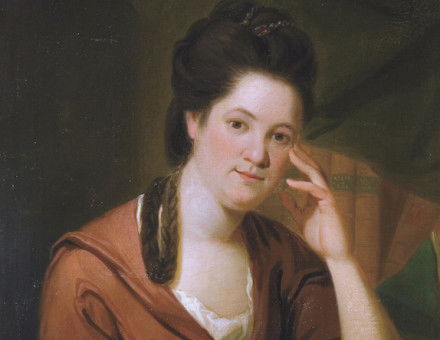
Elizabeth Tollet and her Scientific Sisters
Patricia Fara recounts the moving story of a gifted contemporary of Isaac Newton who came to symbolise the frustrations of generations of female scientists denied the chance to fulfil their talents.
In A Room of One’s Own (1929) Virginia Woolf wondered what would have happened if Shakespeare had had an equally gifted sister, Judith. Such an ambitious young woman might, speculated Woolf, have followed William’s example and run away to the London stage, but she would have encountered a very different destiny – mockery, pregnancy and a lonely suicide. Woolf explained that her imaginary Judith was doubly shackled. Most obviously, she lacked her brother’s education, having been taught the domestic skills her parents felt she needed for attracting a wealthy husband. More insidiously, this phantom Judith had been conditioned from birth into accepting the confining norms of 16th-century society, so that the very act of trying to break free would drive her mad.
Elizabeth Tollet (1694-1754) provides a real-life example of the numerous clever sisters who got left behind at home while their brothers went off to pursue exciting careers. A published poet of some renown and an acquaintance of Sir Isaac Newton, Tollet is remarkable for her interest in scientific investigation and natural philosophy. Her life and poetry provide fresh evidence about women and changing attitudes towards natural philosophy in 18th-century England.
Because not much importance was attached to recording women’s lives, little biographical information about Tollet survives and her dates are mostly vague. We know that she was brought up in London, the eldest of three surviving children, and that her mother died before she was ten. From 1702 to 1714, her father, George Tollet, served as Extra Commissioner of the Navy, and the family resided in the Tower of London. Tollet, who never married, later moved to her father’s country home Betley Hall in Staffordshire; after that at some stage she went to Stratford (in Essex) and then to Westham (now West Ham), where she died, bequeathing to her youngest nephew the substantial fortune she had inherited from her father after he died in 1719.
Despite the frustrating paucity of facts about her, Tollet’s poetry provides an invaluable source for reconstructing her life. She wrote in varied styles on a range of topics. Interspersed between her scholarly poems on religion, natural philosophy and women’s education there are playful elegies on the pleasures of music, academic translations of Psalms and classical poetry, brief epigrams, light-hearted verses and sad epitaphs for lost friends: in 1732, mourning the death of an intimate acquaintance identified as D.D.D., she wrote a poem lamenting that ‘sorrow has untun’d my voice to sing’.
Tollet’s poems demonstrate her extraordinary erudition, which is instantly apparent both from the learned references within them and her footnote amplifications to them. For example, the following lines from ‘The Microcosm’ (1727 or later) reveal her familiarity with the natural philosopher Robert Hooke’s (1635-1703) magnificent illustrations of the insects and plants he examined through his microscope:
When in the Microscope thou canst descry The Gnat’s sharp Spear, the Muscles of a Fly … There the gay Down of Insects to behold, Or Millions crowding in the Plumb’s blue Mold
And in an elegy to Newton (1727) she summarises his experiment showing how light is refracted into coloured rays as it passes through a prism:
Alike exact to penetrate the Ways Of subtile Light, and fine æthereal Rays: What obstacle compels them, as they pass, To march diverted thro’ the pervious Glass; What various Hues the lucid Pencils paint, How deep or glaring soften into faint; By what Degrees their kindred Shades unite, And how their equal Mixture soreads a White.
In 1803, Mary Hays, a campaigning essayist and novelist (1759-1843), reflected that several of Tollet’s poems ‘are on philosophical subjects, and display profound thinking’, but another reviewer commenting in the Monthly Review in 1755 recognised that Tollet also wrote when she was in ‘sprightly humours’. Her first book, Poems on Several Occasions was published in 1724, but she protected her reputation by publishing anonymously.
At this time there was little incentive for women to advertise their interest in intellectual matters, especially natural philosophy. They were denied entry to the universities and to institutions such as the Royal Society; they were held to be intrinsically unsuited to natural philosophy and those who dared show aptitude were made the butt of savage satires. In James Miller’s drawing-room comedy Humours of Oxford (1726), his dastardly Gainlove declares that:
The Dressing-Room, not the Study, is the Lady’s Province – and a Woman makes as ridiculous a Figure, poring over Globes, or thro’ a Telescope, as a Man would with a Pair of Preservers mending Lace.
When Tollet wrote the poem ‘Hypatia’, a heartfelt plea for female rights that runs to almost 200 lines, she revealed her bitterness at the hierarchical system that enabled men to rule over women by depriving them of education:
That haughty Man, unrival'd and alone, May boast the World of Science all his own: As barb-rous Tyrants, to secure their Sway, Conclude that Ignorance will best obey.
Her description of male domination applied throughout the century and beyond. The most famous sister-brother couple of British science, the astronomers Caroline (1750-1848) and William Herschel (1738-1822), originally came from Hanover. William brought Caroline to England to join him in Bath in 1772 with the intention that she would train as a professional singer. However, as his obsession in astronomy developed, she had little choice but to abandon her own career plans and act as his assistant. Teaching her only as much mathematics as she needed to know for transcribing their observations, William conscripted Caroline as his partner in astronomical study. As well as carrying out night-time research, which continued even when the temperatures plunged so low that the ink froze in its well and the telescope mirror cracked, Caroline looked after the house, fed her brother by ‘putting the victuals by bits in his mouth … serving tea and supper without interrupting the work with which he was engaged’, and carried on undeterred when she slipped on the snow in the dark and tore open her leg by falling on a meat-hook.
Tollet was better educated and better off than Caroline Herschel, but in many ways her lot was similar. An unmarried woman, consigned to looking after her widowed father, Tollet wrote a moving poem to her younger brother, in which she enviously compared his carefree career at Cambridge with her own lonely existence:
Still may he live, and justly famous be, Whole Art assists me to converse with thee! All Day I pensive sit, but not alone, And have the best Companions when I’ve none
Her resentment must have been fuelled by knowing that Cook Tollet was notorious for his ‘fiery disposition’ and ‘gay and courtly’ behaviour – and, to make matters worse, her other brother George left Oxford without a degree and antagonized their father by disappearing to the Isle of Man. How she must have longed to take either of their places. Not for her the fashionable fripperies for which girls were supposed to yearn:
On what wou’d I my Wishes fix? ’Tis not upon a Coach and Six: ’Tis not your rich Brocades to wear; ’Tis not on Brilliants in my Ear ... Friends that in any Dress would come; To whom I’d always be at home: My Table still shou’d cover’d be, On this side Books, on that Bohea [tea].
As Tollet realised, the frustrating role of talented but neglected sister was extremely common – so common, in fact, that in the 1760s a fictional model appeared in a scientific textbook aimed at the growing market of affluent, ambitious women with an appetite for knowledge. The author, an enterprising scientific instrument maker called Benjamin Martin, revamped the Greek mode of teaching through dialogue by setting up imaginary conversations between two fictional characters: Euphrosyne, thirsty for knowledge, and her brother Cleonicus, who comes back home from university and expounds to his sister (rather condescendingly) on all the exciting subjects he has studied – optics, electricity, astronomy – while she has been consigned to spending her days singing, dancing and sewing.
Many Euphrosynes existed, although finding detailed information about them is difficult. They are scarcely mentioned in official records and they only rarely published books, yet their letters and personal papers reveal how actively they engaged in scientific and philosophical controversies of the time. Some girls benefited from enlightened fathers who allowed them to browse through their libraries and share the tutors they hired for their brothers. Tollet’s father was just such a man. He made sure that his daughter excelled at the conventional female accomplishments of music and drawing, but ‘observing her extraordinary genius’, he also ‘gave her so excellent an Education’ that ‘she spoke fluently and correctly the Latin, Italian, and French Languages; and well understood History, Poetry, and the Mathematicks’.
Such a diverse education was unusual but not unique. The strict grammatical rules of Latin were considered too rational for girls, who were taught to speak modern languages rather than write the more formal ones of the past. Even so, there are many examples of women who translated to and from Latin (and occasionally Greek). In the early 18th century, mathematics was less exceptional for girls than it would become later on. One widely read journal, the Ladies’ Diary (first published in 1704), regularly printed mathematical rhyming enigmas, many of them contributed anonymously by women. The puzzles included arithmetical calculations with commercial applications, as well as problems demanding Newtonian calculus. Far from being imposed by the editor, this mathematical selection was expanded in response to the demands of female readers.
Before Elizabeth was born, Tollet’s father had astounded the Dublin Philosophical Society by showing off the skills of a ten-year-old girl he had been teaching. ‘Mr Tollet’s Schollar’ impressed the Fellows with her knowledge of mathematics, astronomy and geography, even surviving their interrogation on ‘ye most difficult propositions of Euclid, wch, she demonstrated with wonderful readiness’. Nearly 20 years later George Tollet perhaps made his own daughter perform similar intellectual feats for the entertainment of his visitors at the Tower.
The Tollets’ house guests included one particularly eminent figure – Sir Isaac Newton (1642-1727), who was first made Warden of the Mint in 1696, becoming its Master in 1700. Although the Tollets do not feature in even the most detailed of Newton’s biographies, he paid George and Elizabeth ample attention: ‘Sir Isaac Newton honoured both him and his daughter with his friendship, and was much pleased with some of her first essays [poems]’. Tollet’s admiration for this unusual patron is evident within her poetry. On the night of Newton’s death in 1727, she wrote a long elegy to him, demonstrating her sound grasp of his scientific ideas. Simplified primers had not yet started to appear, but Tollet had studied physics and cosmology sufficiently deeply to ensure that her account would ‘follow the late Improvements of Astronomy’ introduced by Newton. When writing about the planets, many poets made vague references to ‘circling spheres’ and ‘whirling orbs’, but Elizabeth provided a more informed summary of the laws governing their movement:
What Force their destin’d Line obliquely bends, And what in vacuous Space their Weight suspends.
In another poem, Tollet reports on Newton’s conclusion that comets are not one-off events, but orbit round the Sun to reappear like planets:
Comets trail their fiery Hair ... real Stars, which unextinguish’d burn, Thro’ larger Periods of a just Return.
Other home-educated women of the period also possessed Tollet’s ability and determination, although they mostly remain concealed behind their men-folk. For 30 years, Katherine Jones, Lady Ranelagh (1615-91) lived with her brother, the famous chemist and natural philosopher Robert Boyle (1627-91), sharing his laboratory equipment and participating in an intellectual network of wealthy women. Anne Conway (1631-91) benefited from a devoted brother who sent her books and introduced her to his Cambridge tutor, the eminent philosopher Henry More. After marrying a wealthy aristocrat who was often away travelling, Conway invited More and other scholars to stay in her luxurious Warwickshire home, where she worked towards the philosophy book that her admiring intellectual colleagues published after her death. Conway’s reputation spread as far as Germany, where Gottfried Leibniz acknowledged his intellectual debt to ‘that extraordinary woman’.
Like Conway, Tollet wrestled with major philosophical problems, but she chose a different medium – poetry – through which to explore them. Unable on account of her sex to engage openly in contemporary controversies, she could intervene anonymously through her published poems. Reflecting her ambition, she chose grandiose titles – ‘On the Origin of the World’, ‘Against Chance and Fate’, ‘Microcosm’ – that her scientific contemporaries would recognise as major scientific questions of the day. Whereas some natural philosophers maintained that the universe had not been planned, but had arisen by chance, Tollet insisted on a divine creator, arguing that life is too marvellous to be the consequence of random atomic events:
’Tis not wild Chance, or arbitrary Fate, Fond Man! That guides thy fluctuating State... Cou’d wand’ring Atoms, in their casual Fall, Compose the Fabric of this wond’rous Ball ...
Gifted sisters such as Tollet and Conway endured psychological pressures brought about by the restrictions on their intellect through the circumstances of their gender. Throughout her life, isolated in her country mansion, Conway suffered from crippling headaches, which may well have been exacerbated by stress. Tollet perceived herself as a psychological captive, imprisoned by social norms:
What cruel laws depress the female Kind, To humble Cares and servile tasks Confin'd?
She felt oppressed by her domestic situation, a virtual prisoner in the Tower, with its high walls, perpetual noise of clanking machinery, military personnel and wild animals. The English and Irish Mints lined the northern walls, the prisons were regularly occupied and tourists milled through to admire not only the Crown Jewels and the Armoury, but also the loud and smelly menagerie. Tobias Smollett’s novel Humphry Clinker (1760) describes how a maidservant was terrified by a ‘monstracious lion … the beast kept such a roaring and bouncing, that I tho’t he would have broke his cage and devoured us all’.
Trapped in these busy, claustrophobic surroundings and deprived of her brothers’ opportunities, Tollet fretted at her long days spent in solitary study with only her books for company. Empathising with other women who had been held captive in the Tower, she translated the Latin aphorisms that Jane Grey had scratched into the wall of her cell and composed a poetic version of a letter by Anne Boleyn that resonates with her own emotional experiences:
Think how I pass the melancholy Hours, Alone, immur’d in these relentless Tow’rs, My languid Head upon my Hand declin’d, Supported only by the conscious Mind.
It is tempting to equate women like Tollet with early feminist campaigners, but there are crucial differences. Despite having transgressed the social boundaries of her sex by learning Latin, astronomy and mathematics, Tollet refused to publish under her own name and resigned herself to the existence she had been given by God. Although she did protest about female subordination, she complained privately, recording her stifled anger for posterity rather than for her contemporaries. Physically, she became freer as her life progressed, moving from the Tower first to her father’s country estate and later to her own home, yet, emotionally, she never ventured out into the public realm.
Whatever modern feminists may claim, many women of the past colluded in their downtrodden state. ‘I am nothing, I have done nothing,’ wrote Caroline Herschel: ‘a well-trained puppy-dog would have done as much.’ Although Tollet protested bitterly about the unequal educational opportunities for men and women, she seemed to place women lower down in the natural hierarchy. Even in ‘Microcosm’, her sophisticated poem dedicated to the power of reason and the superiority of the human race, Tollet implicitly deprecates her own abilities by acknowledging the female inferiority symbolised by Eve’s behaviour in the Garden of Eden:
Dust is his Origin, and Earth his Place: But on the Mother’s side tho’ Man be base, Sprung from the sacred Sire, to Heav’n ally’d ...
Women used to agree with men that their sex was physiologically governed by emotion rather than by reason. Long after Aristotelian medicine had officially been superseded, its influence lingered on in the traditional distinction between the hot, dry brains belonging to men and the cold, wet brains that supposedly rendered women incapable of abstract thought. Tollet apparently thought that women were intrinsically less suited than men to intellectual work:
Nature in vain can Womankind inspire With brighter Particles of active Fire ...
Even at the end of the 18th century, Mary Wollstonecraft (1759-97), often dubbed England’s first feminist because of her radical claims for women’s rights, held that women were inherently inferior beings who had been allocated an unequal portion of what she termed ‘the heavenly fire’ of inspiration. In language inspired by astronomical imagery, Wollstonecraft maintained that:
... the few extraordinary women who have rushed in eccentrical directions out of the orbit prescribed to their sex, were male spirits, confined by mistake in female frames.
This seems an apt description for Tollet herself, who repeatedly used images of frustrated confinement not only within the Tower’s brick walls, but also within a metaphorical Tower constructed by her own beliefs and the constraints imposed upon women by the rules of Augustan society.