Jump to Navigation

The Great Experiment: The Royal Society

Print this article   Email this article

The Royal Society was founded in 1660 to promote scientific research. Through a process of trial and error, this completely new kind of institution slowly discovered how its ambitions might be achieved – often in ways unforeseen by its founders, writes Michael Hunter.
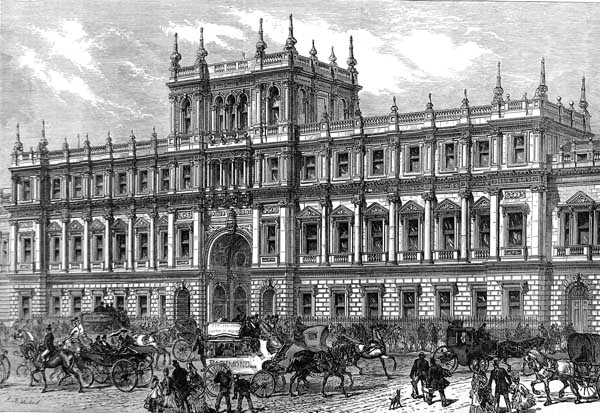
Royal SocietyThe 350th anniversary of the founding of the Royal Society falls on November 28th, 2010 and, appropriately, this year has seen a variety of activities celebrating the occasion. There is no doubt of the momentousness of the society’s foundation: a publicly constituted body, national in its remit, which was devoted to the pursuit and promotion of scientific research. In retrospect, the role that the society soon came to play and the way in which it went about achieving these aims may seem almost self-evident, as the archetype of the numerous comparable bodies that have since followed in its footsteps. But in fact it could be argued that the process by which the society was set up and the way in which it developed in its earliest years was not as obvious as it appears. Since no such body had existed before, it was necessary for a process of experiment, even of trial and error, to occur before the mode of operation emerged that was to prove so effective. It is a process worthy of elucidation, using the remarkable documentation that survives.

 This article is available to History Today online subscribers only. If you are a subscriber, please log in.

Please choose one of these options to access this article:

  • Purchase a online subscription and receive unlimited access to our archive for one week, one month or a year

  • Purchase a print and website subscription, giving you one year's access to all our content and 12 editions of History Today magazine.

  • If you are already a print subscriber, purchase the online archive upgrade for a year's worth of access at a reduced price

Call our Subscriptions department on +44 (0)20 3219 7813 for more information.

If you are logged in but still cannot access the article, please contact us


About Us | Contact Us | Advertising | Subscriptions | Newsletter | RSS Feeds | Ebooks | Podcast | Student Page
Copyright 2012 History Today Ltd. All rights reserved.