
Jump to Navigation

Lessons from Auschwitz

Print this article   Email this article

Kathryn Hadley joins a group of schoolteachers and police officers in an innovative project that seeks ways to better understand the Holocaust.

A display of photographs at Birkenau showing Jewish lives prior to the WarTo stand inside wooden barracks designed for 52 horses, but used to house over 400 female prisoners, is to be overwhelmed by the horror of Auschwitz. No amount of preliminary research or listening to Holocaust survivor testimonies can prepare one for a visit to a place that was carefully planned and constructed as a factory for killing human beings.

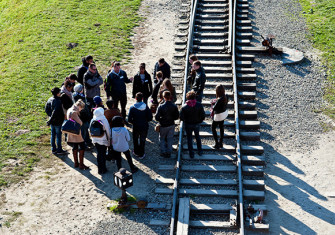
In late June I joined a group of more than 200 teachers from schools and colleges across the south of England to visit the Auschwitz-Birkenau concentration camp with the Holocaust Educational Trust (HET).

HET’s Lessons from Auschwitz Project was set up 12 years ago on the premise that ‘hearing is not like seeing’ and that to grasp the scale of the Holocaust it is necessary to visit one of the Nazi camps.

The project combines a one-day visit to Auschwitz-Birkenau with follow-up seminars which deal with the issues raised. Initially established for students over 16 years of age, the project has been extended to include a professional development course for secondary school teachers. The scheme has enabled more than 10,000 students and teachers from the UK to visit the site. 
We landed in Krakow and took a short drive west to the small town of Oswiecim, where, prior to the Second World War, there lived a community of almost 6,000 Jews, more than 50 per cent of the local population at the time. The prewar Jewish cemetery, destroyed and pillaged by the Nazis in September 1940 but reconstructed after the war, is now abandoned and overgrown. There are no surviving Jews in Oswiecim.

We were then taken to Auschwitz I, the first section of Auschwitz-Birkenau death camp, constructed on the site of a former Polish army barracks. Our journey ended at Birkenau, a subcamp built in March 1941 that was developed into the main extermination centre. Rabbi Barry Marcus, of the Central Synagogue in London’s Great Portland Street, led a memorial service at the ruins of Crematoria II.

Although the project is aimed primarily at teachers, we were joined by a group of British police officers, who were there to gain a more thorough awareness of one of the principal sites of the Holocaust in an effort to combat a worrying surge in antisemitism in communities across Britain.

This is borne out by figures published in the Community Service Trust’s (CST) Antisemitic Incidents Report for 2009. The CST is a charity dedicated to collecting, analysing and publishing statistics relating to antisemitic crime, as well as providing training and advice for the protection of British Jews. Last year it recorded 924 antisemitic incidents in the UK, the highest annual total since it began monitoring such incidents in 1984. The number is almost double the previous record of 598 incidents in 2006.

Could it be that this surge in antisemitic crime is linked to the way in which the Holocaust has been taught in schools?

The latrines in the barracks at Aushwitz where 400 female prisoners were held.Certainly the teachers I met on this visit think that the Holocaust can be ‘overdone’, featuring in the national curriculum in history, English and religious education, and is sometimes poorly taught. Most I talked to refuse to use any of the recommended textbooks in their teaching of it. They complained that the subject is often tacked on to the end of chapters about the Second World War as if it were some by-product of the conflict. They also commented on the tendency to reduce to statistics the victims of Nazism, the sheer volume of whom is difficult for young people to grasp. Furthermore, textbooks are often filled with violent, shocking and sensational images.

The HET’s programme provides  ideas and materials to help approach and teach the Holocaust in a broader and more informed way, seeking to move away from generalisations and impersonal statistics which makes it hard for students to relate to the genocide. 

HET educator Robert Carr believes we need to remove in our teaching the dominant element of horror and revulsion of the Holocaust and the ‘grotesque cheap shots’ of Jewish victims, which risk us ‘almost lending ourselves to Nazi stereotypes’. A key goal is to ‘humanise the Holocaust’ in an effort to present the persecuted as ‘living and breathing people’ who had their own everyday hopes, dreams and ambitions.

Carr added that organising trips to Poland to visit Auschwitz-Birkenau is also a concrete way to place the Holocaust in its wider context: it was not a purely German issue but a hugely complex European phenomenon. For example, it involved the collaboration of French and Greek train drivers in the transportation of Jews to the death camps.

During the follow-up seminar held ten days later, teachers described the impact of the visit and how their teaching will be enriched after seeing the death camp for themselves.

Nicola Wetherall from Wootton Bassett School said that she now placed individuals at the centre of her lessons in an effort to focus on the victims’ real lives. Saskia Edens and Laura Bristow from Marlborough School, Oxfordshire, plan to devote more of their lessons to prewar Jewish life in order to present a more integrated and humane understanding of what occurred. 

For James Bass from St Antony School, Rye, the experience of visiting Auschwitz confirmed the fact that ‘history doesn’t take place in classrooms’. He could now discuss the Holocaust in a more informed way and in offering greater insight to his students had already gained their greater respect.

Many said it had helped them to bring emotion into their classrooms, which they felt could be harnessed in getting their pupils to have a better understanding of the Holocaust. One teacher even confessed to crying when she began to talk about her visit to her students.

On a personal level, without question, the visit is deeply affecting. Viewing glass cabinets filled with pairs of spectacles, suitcases, artificial limbs, children’s shoes and piles of hair destined for the wartime German textile industry is a truly harrowing and scarring experience. It can only be hoped that such exposure to the past will lead to the better teaching and understanding of the Holocaust, and ultimately to reversing the unsettling rise in antisemitic crime.

Kathryn Hadley is the Website Editor of History Today.


About Us | Contact Us | Advertising | Subscriptions | Newsletter | RSS Feeds | Ebooks | Podcast
Copyright 2012 History Today Ltd. All rights reserved.