
Alabama on the Mersey
David Waller on the 150th anniversary of a ship that symbolised Liverpool’s ties to the Confederate states during the American Civil War.
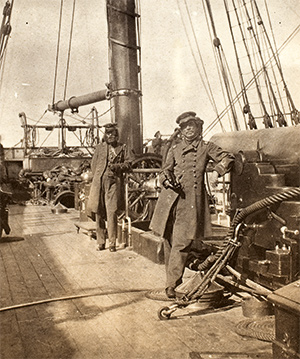
On the morning of Tuesday, July 29th, 1862 the ship soon to be known to the world as the CSS Alabama weighed anchor on the River Mersey and headed out for sea trials. The weather was fine, bunting flapped merrily from the masts and a party of well-dressed Liverpudlian dignitaries and their fashionable wives enjoyed lavish hospitality on deck.
The guests, as well as a naïve Liverpool customs officer, had been assured that the ship would be back at anchor that evening. But at least one observer was not fooled: Thomas Haines Dudley, the United States Consul in the port of Liverpool, had been watching the construction of the vessel in the Laird Brothers yard for months.

One hundred and fifty years since the ship’s launch on that bright summer’s day, this tale of low skullduggery and affairs of state is a maritime anniversary well worth commemorating. In those days control of the sea was akin to air power in a modern conflict and the delivery of this and other vessels from Liverpool’s shipyards threatened to tilt the balance of the American Civil War in favour of the South. It was as if Great Britain was playing the part of Russia in delivering attack helicopters to the Assad regime in Syria.
By the time the Alabama headed out of the Mersey estuary the Civil War had been under way for more than a year. Liverpool, like the north-west of England as a whole, had strong commercial ties with the cotton-producing confederacy and was suffering from the effects of the Yankee-imposed blockade on southern ports.
The Liberal government under Prime Minister Lord Palmerston and his Foreign Secretary Lord Russell sought to preserve Britain’s neutrality. However it was still reasonable to assume that the South would win and London turned a blind eye to any assistance British shipbuilders might provide to the Confederate cause.
Soon after the Civil War began Dudley had commissioned a network of spies to watch the Liverpool shipyards. They told him that James Bulloch, a 38-year old sea captain from the southern state of Georgia, had arrived in Liverpool in June 1861 with abundant money to buy ships. They would be used to break the Union-imposed blockade, delivering food, weapons and other materiel to the South in exchange for cotton.
John Laird (1805-74), the severe patriarch of the Birkenhead-based company that bore his name, was a fervent free-trader with strong symp-athies with the South. He and his sons had met Bulloch soon after the latter’s arrival in Liverpool and accepted a commission to build a number of ships. Unlike most of the Laird ships at the time, the first commission was built of wood. Known at first as Number 290, she was just over 213 feet long, 32 feet wide and 1,044 tons in weight, powered by a combination of sail and steam. She was not equipped with weapons – that would be too flagrant a step – but there was space for guns. She had a retractable funnel, allowing her to hide her true power as she tracked enemy shipping.
The 290 was built for the substantial sum of £43,000, under the pretence that the customer was a Spanish businessman. Clearly this was no innocent trader. She was fast, versatile and fitted out for extremely long voyages. As the ship neared completion, Dudley wrote a series of increasingly frantic letters to Lord Russell pleading that, by continuing to turn a blind eye, Great Britain was violating the terms of its neutrality.
Over the weekend of July 26th and 27th, 1862 Russell finally received legal advice that the ship was ‘intended for warlike use against the citizens of the United States’. But the foreign secretary did not act on it immediately. Only on the following Tuesday afternoon was a telegram dispatched to Liverpool ordering that the ship be detained.
By that time it was too late. At around three o’clock the guests on board were informed that further trials were required. They were sent back to Liverpool on a launch in time for tea, while the Alabama headed off to Moelfra Bay on Anglesey. A Yankee ship, the USS Tuscarora, was already in hot pursuit, but to no avail. The Alabama dodged her pursuers by sailing round the north coast of Ireland and went on to the Azores, where she was joined by Ralph Semmes, a celebrated Confederate captain. Another vessel arrived from England, bringing the armaments required to turn the Alabama into a devastatingly effective commerce raider.
Over the course of the next 20 months the Alabama captured or sunk 65 Union merchantmen, boarded some 450 vessels and took more than 2,000 prisoners, prizes worth at least six million dollars. She harried Union shipping as far afield as Texas, the West Indies, Cape Town and Malacca before finally coming to grief in a sea battle off the coast of Cherbourg in June 1864, a scene captured by the painter Edouard Manet.
After the Civil War the ship was at the centre of the so-called Alabama Claims, international litigation launched by the reconstructed United States of America. The US accused the British state of connivance in the construction of the ship and other raiders, a case which the UK eventually settled with the payment of a gigantic three million pounds in damages.
The Alabama was never likely to change the outcome of the conflict – a fact realised by James Bulloch less than a week after the vessel had set sail. On July 1st, 1862 he commissioned two further ships from the Lairds, at a price of £93,750 each. These were the so-called Laird rams, fearful warships which could indeed have smashed the Union blockade of the southern ports. They could also have held cities such as New York and Philadelphia to ransom. Unlike the Alabama, these were ironclad steamships with two notable innovations: they had manoeuvrable gun turrets and were equipped with steel piercers below the water line at the bow. As their nickname suggests, like a Greek trireme they could crash into and sink wooden shipping.
It was a lot harder for the Lairds to maintain the fiction that these warships were intended for neutral third parties. In this case the customer was supposed to be the Viceroy of Egypt, with the help of a French middleman. This time Lord Russell did not sit on his hands: on August 29th, 1863 the British government seized the ships, long before they, too, could slip away from Liverpool.
Had they been delivered on time, they might just have turned the tide of the war in favour of the South. But they were eventually commissioned by the Royal Navy and were renamed HMS Scorpion and HMS Wivern.
David Waller is author of The Perfect Man: The Muscular Life and Times of Eugen Sandow, Victorian Strongman (Victorian Secrets, 2011)
If you enjoyed this article, you might like these:
- Home
- Location
- Period
- Themes
- Magazine
- Subscribe
- Archive
- Ebooks
- Reviews
- Blog
- Contact
From The Current Issue
|
Kathryn Hadley
|
|
Harriet Tuckey
|
|
Martin Pugh
|