
The Plague in England
Anne Roberts explores the incidence of plague in England from 1348 to 1679.
Ring a ring o'roses
A pocket full of posies
Atishoo! Atishoo!
We all fall down
Cheerful as this children's rhyme sounds, one theory of its origin is as a description of plague. 'Ring o'roses' referred to the skin changes that resulted from it, and sneezing was a symptom of the respiratory form of the disease. The pleasant smell of a posy of fragrant herbs was believed to prevent contagion from bad smells, and many of those who 'fell down' in real life never got up again. Though the rhyme is now all that remains of the plague in English folk memory, it dominated English life for two-and-a-half centuries, from 1348 to 1679, and left its mark on history and literature.
Plague results from infection with the bacterium, Pasteurella pestis , sometimes called Yersinia pestis , and the incubation period is from two to four days. The illness may take a bubonic, septicaemic of pneumonic form. The bubonic form is characterised by buboes, which are masses of tender, enlarge lymph nodes, usually in the groin or axilla. They are painful until they suppurate and drain, usually one to two weeks after the onset of the illness. The patient has a high fever (102-5 F, 38.89-40.56 C) over this period, with toxic symptoms of headache, vomiting and ataxia. He may also show a bleeding tendency, with petechiae and bruising of the skin and internal, visceral bleeding which may prove fatal. The septicaemic form of the disease is simply an overwhelming infection where the patient dies before the buboes have a chance to develop. The pneumonic form probably occurs in about 5 per cent of patients. Lung lesions develop and break down, so that the patient produces blood-stained sputum teeming with the organism. He is then a dangerous source of airborne droplet infection. The proportion of deadly pneumonic cases seems to have varied in different plague epidemics, and its relation to the commoner bubonic type is not clear. Some authorities believe plague was more likely to take the pneumonic form during the winter; others, however, think winter plague unlikely, and attribute the reported winter deaths to some other overwhelming lung infection, Before antibiotics, pneumonic and septicaemic plague were almost always fatal. Modern antibiotic therapy is usually effective, and deaths now only occur when diagnosis, and hence treatment, are delayed.
The way in which plague spreads is one of the most interesting features of the disease. It is not primarily a disease of man at all, but of rodents. In England the rodent affected was the black rat, Rattus rattus . This is essentially a climbing animal which lives in walls and roofs, always in close contact with man. The plague bacillus is carried from rat to rat by the bite of the rat flea. Like most fleas, the rat flea prefers to feed off a single species of animal, and will only bite humans when an outbreak of rat plague has left insufficient rats to feed off. This means that human epidemics always follow rat epidemics - well described in Camus's novel The Plague . Interestingly, though many signs and portents were thought to herald a plague epidemic, there are no European records of an increased number of dead rats before the humans fell sick. However, the Indian writer, Nawab Mu'tamad Khan, seems to have noticed this in the first quarter of the seventeenth century.
The mouth-parts of the rat flea are a very efficient means of transmitting the plague, and function rather like a combined syringe, needle and blood- culture bottle. When an infected rat is bitten, a bloody suspension of living plague bacilli is drawn up into the flea's stomach, where they multiply and block the gut. The flea becomes hungry, but cannot feed until this blockage is disposed of. It is then termed a 'blocked flea', When it sinks its mouth-parts into the next victim, the flea injects its previous meal, now cultured into a teeming mass of living plague bacilli, into the bitten area. At the same time the flea defecates, and scratching the fleabites helps to inoculate faecal plague bacilli. Within a few days the lymph nodes draining the bitten area form buboes, and a new case of plague becomes clinically apparent.
Though a case of pneumonic plague may infect by droplet spread, the new case is likely to revert to the bubonic form. Pneumonic cases, with person- to-person spread, are rare, therefore, compared to bubonic cases, and person-to-person spread of disease used to be the norm; smallpox and the sweating sickness both produced their havoc in this way. The particular dread of plague above all other diseases may have been due to the mysterious way it seemed to be passed on: there was something inexplicable and almost supernatural about a disease which could not be contained by normaI quarantine measures. Only at the end of the last century, with the discovery of the organism and its mode of passage, was the mystery fully solved.
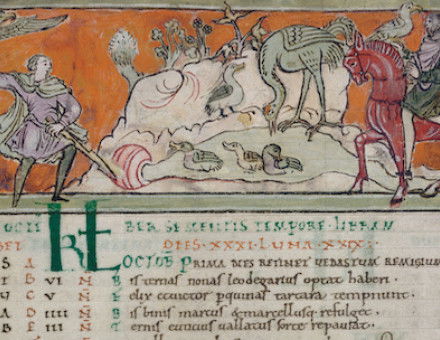
An epidemic of bubonic plague requires the presence of Pasteurella pestis , a rodent host for the bacillus in close contact with man, and fleas to transmit the germ among rats and eventually among humans. Pasteurella pestis seems to have begun causing disease from at least as early as 300 BC, when descriptions of a plague-like illness are first found. The first pandemic was in the sixth century AD, in the time of the Emperor Justinian. Almost all of Europe was affected, as far north and west as southern France, but England was spared, probably because rats had not yet arrived. The earliest certain reference to rats in English literature is a doodle of two rats hanging a cat at the end of a thirteenth-century genealogical roll now in the British Museum. Rats are notably absent from a tenth-century list of pests from which parish priests were expected to protect the altar bread. By the early fourteenth-century there are many references to rats, and Chaucer (born around 1340) mentions shops that sold rat poison. The English rat population was certainly large enough for England to suffer the next world pandemic of 1347-48, and consisted of black house rats, living close to man.
English plague epidemics showed a tendency to start in spring, reach a peak in late summer and early autumn and decline with the first signs of winter. This is because rat fleas tend to hibernate and may even die when the weather is cold. There has been little bubonic plague in recent times; the last big outbreak was in 1896 and spared England. However, this does mean that almost all our knowledge of the plague is pre-scientific, and heavily coloured both by the opinions of those living and writing at the time, and those who study it now.
Plague first ravaged England in 1348, during the second great pandemic. Since the early nineteenth century this epidemic has been popularly known as the Black Death, though before then it was called the Great Mortality or the Great Pestilence. At that time, the poor lived in single-storey thatched wattle- and-daub hovels. Rats burrowed under the earth floor and climbed the walls to build their nests in the roofs, from which blocked fleas could fail to infect the people below. The houses of the more well-to-do included an upper storey. Infection was therefore less likely to occur via a blocked flea, and plague was correspondingly rarer.
Having spread from India through Asia, North Africa and Europe, plague probably entered England via an infected rat or flea at Melcombe Regis (now called Weymouth) about the end of July or beginning of' August, 1348. It then spread through the south-west to Bristol and then eastwards to Oxford and London, which it had reached by the end of October or the beginning of November. Records suggest that it travelled at the rate of about one-and-a-half miles per day, suggesting a 'creeping epizootic'; in other words the introduced germ established itself in the English rat population, which had not met it before, and gave rise to a rat plague epidemic. The disease then spread to humans as the rats died and rat blood became scarce for the fleas to feed on, It is difficult to know how many people died. Parish registers of baptisms, marriages and burials do not start until 1538, and many were lost, especially those of London in the Great Fire of 1666 and the Blitz. School history books give the impression that only a fraction of the population survived, but doubt has recently been cast on this, and it is time to consider evidence again.
Accurate statistics are available for some affected areas during the last pandemic of 1896. Then, in the crowded towns of India, one-third of the population caught the disease and between 70 per cent and 80 per cent of those affected died - that is, about 25 per cent of the urban population. However, it is difficult to relate these figures to fourteenth-century England, essentially a rural community, and one that, unlike India, was without previous exposure to the plague.
Although deaths were not recorded for the general population in fourteenth-century England, it is possible to estimate figures for deaths among the clergy. Diocesan records note whenever a new incumbent was instituted in any diocese, but unfortunately not the reason for the vacancy. Overall, about 40 per cent of the parochial clergy needed replacing, rising to 66 per cent in the heavily populated wool country of East Anglia, which was a badly affected area. However, we cannot be sure that all the replaced clergy had died of the plague; we do not know how many simply deserted a very lonely and frightening position just as the London Blitz provided opportunities for people to disappear. Even less are we justified in extrapolating from clergy figures to a likely death-rate among the general population, for we have no idea how the likelihood of the clergy's contracting the plague compared with that of their flock, nor of their death-rate in other, non-plague areas.
Pessimists among the commentators on the Black Death put the death-rate as high as 20-50 per cent of the population, that is, of an estimated population of four million, 800,000 to two million died. They base this estimate on the high figure for clergy inductions, and on the many pleas for remission of taxes from all over the country on the grounds that there were insufficient wealth and labour to pay them. They also point out that the clergy extended full absolution without confession to all those dying of the plague, because of the shortage of priests. Also, continental writers describe a high proportion of cases of the deadly pneumonic form of the disease in the same epidemic, and thus a higher than usual death-rate. On the other hand, optimists among historians estimate the death-rate far some areas as low as 5 per cent. They doubt that plague can be transmitted pneumonically indefinitely, being more likely to revert to the less virulent bubonic form, and also note that large parts of the country, mainly the north- east, had a population density of less than twenty to twenty-five people per square mile, probably insufficient for a destructive epidemic. They further point out that though local business seems to have been interrupted by the plague, there do not seem to have been any deserted villages, there was no revolution in agriculture or land tenure and the war with France went on. However, some early medieval churches seem oddly situated with respect to later buildings, suggesting the presence of an earlier community which had since disappeared. The shortage of labourers following a high mortality among the poor may well have contributed to the popular movement culminating in the Peasants' Revolt, and to the hiatus in church building between Decorated and Perpendicular Gothic. Certainly, some monastic communities never regained their pre-plague numbers. There is one very moving personal account of how it felt to be alive in those bleak times. On the wall of a church tower in the village of Ashwell in Hertfordshire is a remarkable series of graffiti. One of these translates as:
1350 - Miserable, wild, distracted. The dregs of the people alone survive to witness.
In summary, what we know of the history of the period would be compatible with a death-rate of very roughly 30 per cent, mainly among the poor, in a time when life expectancy was generally low. No estimate of mortality can however be more than an informed guess.
Between 1348 and 1665 there were repeated plague epidemics in England, with very few years without some plague deaths recorded. It is sometimes difficult to decide on the cause of an historical disease, though descriptions by contemporary physicians may be helpful. The word used is no guide: the Latin pestis was used before plague arrived in England, and plaga (Latin: a blow) was used quite indiscriminately. Summer occurrence is suggestive of plague, and where more than 66 per cent of epidemic deaths occur between July and September, bubonic plague is almost certainly the disease responsible. Famine is another cause of death which it is easy to forget for, like the plague, it has substantially disappeared from rich European countries. Mortality from starvation in a famine year seems to have been substantial: one estimate puts this as high as 30-60 per 1,000 population no mean figure compared, say, with 3 per 1,000 in the 1918 influenza epidemic.
Food shortage usually followed bad weather, particularly rain in late summer and autumn, so that the harvest rotted in the fields. The diversification of crops which became commoner during the eighteenth century helped to prevent famine in England, while disaster followed total reliance on the potato in Ireland as late as 1845. Increase in prosperity with the development of industries such as coal-mining and shipping in areas that were previously purely agricultural also helped to protect against death from starvation.
It is usually fairly easy to distinguish an increase in mortality from hunger from one due to disease, especially plague. Most obviously, contemporary accounts mention famine conditions and the resulting misery, while not recording a disease. Also, communities which were less vulnerable to epidemics could be affected by starvation; towns such as Carlisle were wracked by plague in 1598, while the surrounding villages had too small a population to support an epidemic. Food shortage tended to hit wide areas regardless of population density, with winter the hungriest time, while summer was plague-time. Again, starvation killed a different section of the population from plague children and the economically precarious, such as beggars and widows were particularly vulnerable when times were hard. Plague, on the other hand, was commonest in the crowded rat-infested hovels of the poor townspeople, had a distinctive clinical picture and on the whole caused the greatest mortality among young adults.
After the Black Death, the main plague epidemics occurred in 1563, 1593, 1625 and 1665. The first, in 1563, probably caused the greatest proportional mortality of all the London outbreaks, accounting for one-quarter to one-third of the city's population: probably as many as 18,000 people died. By mid-August the death-rate was more than 1,000 per week and Queen Elizabeth, then aged thirty, left London for Windsor with all her court. At Windsor she ordered a gallows to be erected, to execute anyone arriving there from London in case they brought the plague with them. Although the Queen had nearly died of smallpox the previous year, plague alone among diseases seems to have been the one that frightened her.
The rest of the country was infected then or in the following year, the fleas having hibernated through the comparatively mild winter. Stratford-upon-Avon suffered severely, losing nearly one-third of its 1564 population. The disease mercifully missed John and Mary Shakespeare's new baby boy, christened William on April 26th, 1564. It was as a result of this epidemic that the English finally lost their French possession, Le Havre, which was being held as a hostage for Calais. Plague broke out among the occupying garrison, so the town was surrendered in June, and Calais was lost for ever.
The first hint of the 1592 epidemic came in September, when the Thames Fair was postponed, as was the later induction of the new Lord Mayor of London. Again London lost about 18,000 of its people, mainly in the rat-infested slums around the docks. The winter of 1592-93 was a mild one, and the fleas only partially hibernated. The disease, which had smouldered through the winter, flared up again in the spring of 1593 and was only extinguished in the cold winter of 1593-94.
To this epidemic we owe Thomas Nashe's poem 'In Time of Pestilence', which includes the verse:
Beauty is but a flower
Which wrinkles will devour.
Brightness falls from the air,
Queens have died young and fair.
Dust hath closed Helen's eye,
I am sick, I must die.
Lord have mercy upon us.
Nashe, then twenty-six, was one of the golden boys who adorned literary London in the late 1580s and early 1590s and included Marlowe, Ben Jonson and Shakespeare among their number. Nashe did not in fact die in the 1592 epidemic, but at the age of thirty-four in 1601; the cause of his death does not seem to be recorded.
Minor outbreaks of plague were re- corded in 1603 and in 1610-11, but the epidemic of 1625 was again a disastrous one, especially for London. All those who could afford to leave the capital did so, magistrates and doctors included. Desertion by the clergy, who felt an urgent need to visit their country parishes (held in plurality with London livings) was particularly resented. It is interesting to note that by the end of this epidemic, P. pestis seemed to be becoming less viruIent. Sir John Coke records on October 18th, 1625, that fewer than one in ten of those affected seemed to die of the disease, and that the plague seemed 'changed into an ague'.
The so-called Great Plague started in London in June, 1665 when Bartholomew Fair was cancelled. It raged through the summer and early autumn, started to decline in October and was finally killed by sharp frosts in November and December. How great was it in fact? Again, it is difficult to know how many people died. The official Hills of Mortality, published weekly, were almost certainly unreliable as the strictness of the quarantine measures made it worthwhile to bribe the official searchers to certify death as being due to another disease. The official figure is 69,000 deaths, including those in the liberties and outparishes beyond the city walls. Some people, however, put the mortality figure as high as 100,000 because of concealment. If the population of London beforehand was of the order of 500,000 people, then something like one in five, or 20 per cent of the inhabitants died.
Though seventeenth-century documents and official records are comparatively plentiful, the truth about the 1665 epidemic is still surrounded by a great deal of myth. Sensational writing started with Daniel Defoe's Journal of the Plague Year , which purports to be an eyewitness account. It has two failings as an historical document: first, Defoe was only four or five years old when the plague was abroad, and so he cannot be considered a reliable witness. Second, he did not write the journal until 1720, when the memories of those who had endured it were clouded by the passage of fifty-five years.
Samuel Pepys's Diary , written in plague-time for his own use, and neither to impress his readers nor to tell a good story, is a less suspect source. Pepys, who lived from 1633 to 1703, was educated at St. Paul's School and at Cambridge becoming Clerk of the King's Ships in 1660. He was obviously a very able man, rising rapidly through the Navy Office and having the ear of King Charles II and the Duke of York, later James II. He fell out of favour when William III displaced his patron and he subsequently lived in retirement at Clapham until his death. His Diary starts on January 1st, 1660, and finishes on May 31st, 1669, when Pepys thought (wrongly) that his eyesight was failing. He wrote a complicated cipher shorthand with the racier bits in a strange personal blend of foreign languages, and it escaped decipherment until 1825. He was a tremendously vivid writer, and his diary gives an immediate insight into seventeenth-century life. Pepys normally lived in Seething Lane, not far from the Tower of London, and his parish church was St. Olave's, Hart Street. He sent his wife to Woolwich during the worst of the plague, but went on with his own work at the Navy Office in Whitehall. Until August 28th, he lived at home and then spent a month at the height of the plague with his wife at Woolwich. He then moved into Navy lodgings at Greenwich until the New Year, when the whole family moved back to Seething Lane.
The overall impression that one receives from Pepys is that though London was sick and sorry, it was certainly not buried under a pile of putrid corpses. He first mentions the plague in April, and notes by the end of May that 'The quality are wont to leave town'. The King and court left, as did most of the doctors and clergy. London's government was largely held together by three brave men, the Duke of Albemarle, formerly General Monck of Civil War and Restoration fame, the Earl of Craven, who kept his house in Drury Lane open to shelter the distressed, and Sir William Lawrence, the Lord Mayor. By June 21st, Pepys remarked that the town has almost gone 'out of town'.
In July Pepys put his affairs in order. He was given a bottle of plague water as a specific against the disease, and noted that there was very little traffic on the streets. At the end of July he recorded that 'the sickness has got into our parish', and noted the inaccuracy of the mortality bills, with a particular case of suppression of information confided to him by the parish clerk.
Even at the height of the disease, the worst Pepys mentions is that burying by day had become necessary, the night not being long enough for all the funerals. In this he was mainly bothered not by fears for his safety but by the tolling bell that disturbed him at his paperwork! Once and only once did he come across an unburied corpse in the street, and he recorded this as a remarkable incident.
Indeed by September 24th, Pepys was writing: 'it having pleased God that in this sad time of the plague, everything else hath comprised to my happiness and pleasure, more for these last three months than in all my life before'. The general impression that Pepys gives of life in London during the plague was that things were worse, say than during the Three-Day Week, but not so terrifying as during the Blitz.
The rest of the country followed London, with epidemics in 1665 or the following year: the best known of these was at Eyam in Derbyshire. The first victim was George Vicars, a tailor, who received and opened a box of clothes from London in September, 1665 and almost immediately fell ill with plague. The box must have contained a blocked rat flea. There were occasional plague deaths in the village during the winter, and when the hibernating fleas awoke with the warm weather of the following spring an epidemic broke out in earnest. As usual, those who could afford to left the stricken village. Unusually though, Eyam harboured a man with a strong social conscience, William Mompesson, the rector. He was afraid that the people would carry 'the invisible seeds of the disease' with them out of the village and spread it to the healthy folk of the unaffected villages around Eyam. Accordingly, he persuaded the remaining inhabitants to stay in Eyam, and caused a circle of stones to be put round the village to mark the boundaries. Provisions and other necessaries were left outside the ring at pre-arranged points, and money was put into running water. Church services were held in the fields, with the people kept apart from each other.
Plague victims' bodies were buried quietly in their gardens or in the fields. Eyam then lay in self-imposed quarantine, awaiting its fate with helpless courage. By the time the plague was extinguished by the cold November weather of 1666, Eyam had lost about 260 of its pre-plague population of 350. Mompesson's wife was among the dead - she refused to leave him, though their children, who survived, were sent away at the first sign of the epidemic.
In the light of present knowledge of how the plague is transmitted, it seems sad that someone with Mompesson's qualities of leadership should have been so wrong about the nature of the plague. If person-to-person contact or droplet infection had been the means of spread, Eyam's sacrifice would indeed have spared their neighbours. As it was, the rat-flea-man chain of infection required quite different tactics. If Mompesson had persuaded the inhabitants to leave the village empty and camp out on the hills for a few weeks in June, 1665 only a few of them would have died, infected by blocked fleas carried on their persons. Meanwhile, in the temporarily deserted village the infected rats and the starving blocked fleas would have died out and the plague disappeared. Nevertheless, though we can regret the futility of the villagers' action, we must admire their heroism.
Over the years, much medical and administrative thought was given to ways in which the plague might be avoided. John of Burgundy in 1390 thought that the root cause of the disease was a pestilential atmosphere invading the body of a patient with receptive humours. The atmosphere entered through the pores, so to escape contagion he suggested the avoidance of activities tending to open the pores, such as exercise, bathing, luxurious living and sexual intercourse. He also thought that the 'pestilential atmosphere' could be dispersed by bonfires, house-fires and aromatic perfumes. Once the disease was established in the body, however, the only possible course was to bleed the patient to get rid of the noxious, infected humours. The carrying of a 'pocket full of posies', a bunch of pleasant-smelling flowers and herbs, has become traditional for judges on assize and some of the Lord Mayor of London's civic functions. Though now purely decorative, the flowers were originally an anti-plague device. Physicians usually carried scented pomanders, also to counteract the 'pestilential atmosphere'.
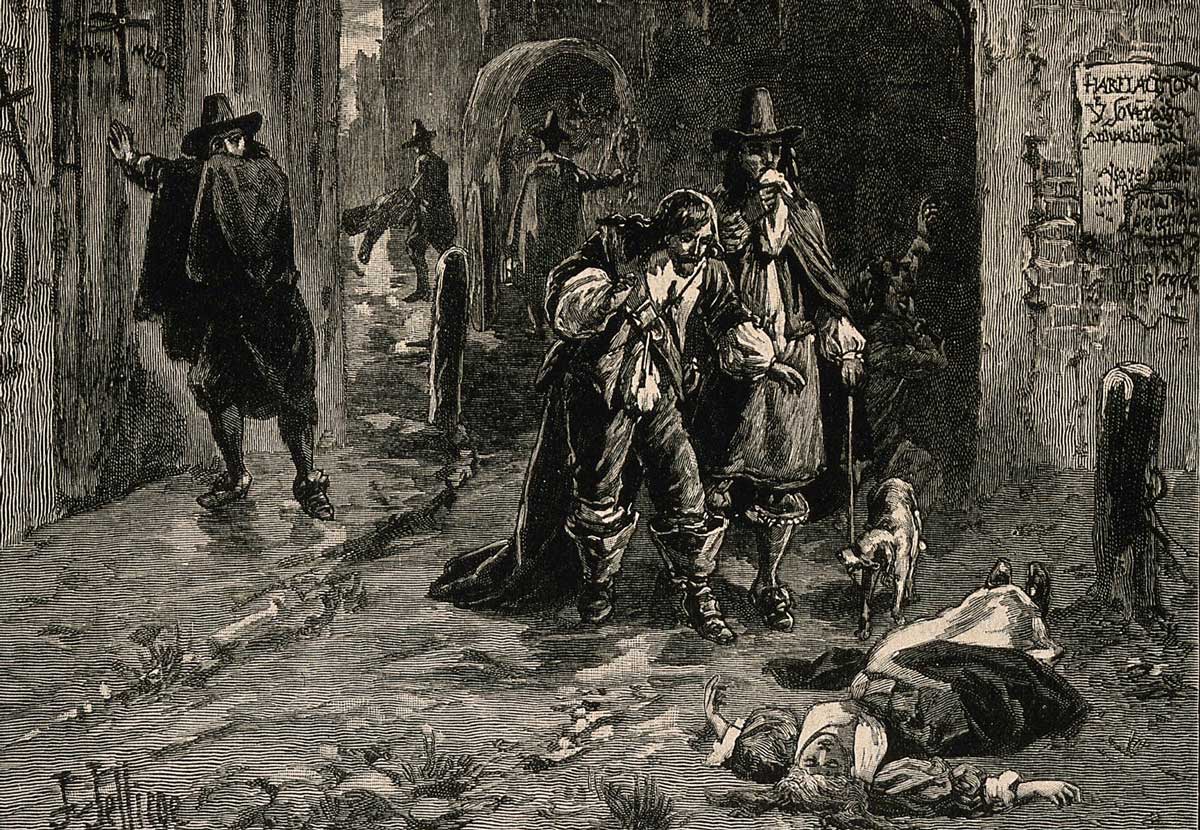
The civil authorities were less concerned with causes than with quarantine procedures to isolate the sick or potentially-infected from the healthy. In towns, infected houses were marked, usually with a cross and the words 'Lord have mercy upon us'. The inhabitants were shut up within, sick and well together. By 1665, regulations provided for the compulsory closing of houses and the posting of watchmen to prevent traffic in and out of them, Bodies were examined by official searchers to establish the cause of death, and burial had to be performed at night without mourners. Public assemblies were prohibited, apart from those dedicated to prayer for relief from the pestilence. These measures were instituted on the advice of the Royal College of Physicians. Because of the mode of transmission of the disease, the measures were not only useless but harmful, effectively increasing the number of cases. Worse still, having published their suggestions as a pamphlet, the distinguished doctors then left afflicted London bag and baggage; fugitives included Alston, the College President, and the great Sydenham.
In 1665 the Earl of Craven, a veteran of the plague, deposed to the Privy Council that the shutting-up of families in their houses, with sick and well together, was ineffective as well as inhumane. He suggested the use of pest-houses as isolation hospitals to which the sick should be removed. Happily these were never needed to any great extent, as the plague had its last great fling with sorry England in 1665-66. There were comparatively minor episodes over the next fourteen years, but for the 300 years since 1680 England has been substantially free of the pestilence. On several occasions the bacterium seems to have been re-introduced notably in East Anglia in the early years of this century. A rodent epidemic has occurred, with a few human cases, but it is interesting to speculate as to why no greater damage resulted; after all, the Black Death seems to have begun in a similar way. Why the plague no longer afflicts England is yet another puzzle in its mysterious history. Contrary to popular belief, this certainly had nothing to do with the sterilising effect of the Great Fire of London of 1666. This was confined to the City of London, while the plague of 1665, as always, had had its stronghold in the overcrowded slums of the liberties and outparishes outside the walls.
The decline of each single epidemic was probably due to several factors: first, the rat epidemic which precedes the human one may leave too small a population (and that of mainly resistant rats) to act as a reservoir for the disease. Secondly, death or flight may leave too few people to maintain human epidemics. (This is believed to have been the case in 1625.) Thirdly, hibernation or death of the fleas as the cold weather comes eliminates the disease vector. Fourthly, P. pestis may decline in virulence, as we have noted for the seventeenth-century epidemics.
Consideration of these factors (essentially concerning the rat population and the bacterium) may help to explain why the plague left England altogether. Probably the main reason was the change in the means of transporting goods to Europe from the East, where the plague persisted. By the end of the seventeenth century, the traditional overland route, by which infected rats or fleas were so easily transported, was declining, and goods were travelling by sea. This meant that any infected rats would die on the voyage, before they could reach an English port and infect the native rat population. Plague could then no longer be reintroduced. At the same time, the building style in England was changing, picturesque but insanitary wattle-and-daub being replaced by stone and brick. This gave much less opportunity for the burrowing house-rat to get close to man. Also, the rat population was changing, Rattus rattus being largely replaced by Rattus norvegicus , the brown field or sewer rat. This animal lives in less close contact with man, and its particular flea has mouthparts less well adapted for the transmission of plague. Rattus norvegicus plague would therefore be less likely to affect man than that carried by Rattus rattus . However, the brown rat was not recorded in England until 1730, sometimes being known as the Hanover rat for that reason, so it cannot really be credited with the disappearance of plague fifty years before! It is also possible that human resistance to plague may have increased, but this can only be surmised.
The old legend of the Pied Piper has been thought to be an allegory of a fourteenth century plague epidemic. His particoloured clothing was thought to represent the skin discoloration of a plague victim, the drowned rats to correspond to the rodent epidemic and the children to have 'disappeared' into the Koppelberg Hill cemetery in Hamelin. The story would then be of interest in being an early pre-scientific record of a rat epidemic preceding a human one.
If it is easy to ridicule the medical ignorance of our ancestors, it is difficult not to respect their bravery that of the doctors and clergy who did not desert their afflicted people, and of the whole village of Eyam.
Further Reading:
- A.N. Appleby, Famine in Tudor and Stuart England , Liverpool University Press (Liverpool, 1978)
- A. Camus, The Plague , Hamish Hamilton (London, 1947)
- D. Defoe, Journal of the Plague Year , Penguin (London, 1978)
- M. Greenwood, Epidemics and Crowd Diseases , Williams and Northgate (London, 1934)
- J. Langdon-Davis, The Plague and Fire of London, Jackdaw Publications (Jonathan Cape, London, 1963)
- R.C. Latham and W. Matthews (eds.), The Diary of Samuel Pepys , VI, Bell and Hyman Ltd. (London, 1972)
- T. Nashe, In Time of Pestilence from Oxford Book of English Verse , Oxford University Press (Oxford, reprinted 1960)
- J.F.D Shrewsbury, A History of Bubonic Plague in the British Isles , Cambridge University Press ( Cambridge, 1970)
- S.S.R.C. Local Population Studies, The Plague Reconsidered - a new look at its origins and effects in 16th and 17th century England. In association with S.S.R.C. Cambridge Group of History of Population and Social Structure.