Jump to Navigation

Napoleon and Empire

Print this article   Email this article

Matthew MacLachlan asks how far Napoleon defeated himself.
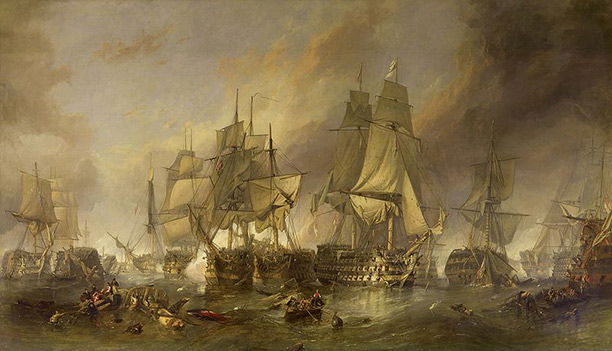
"The Battle of Trafalgar" by Clarkson StanfieldPivotal to any consideration of Napoleon’s ultimate defeat is the fact that he did not inherit a foreign relations strategy, but developed his own. Therefore he should bear a high degree of responsibility for its failure, perhaps because of his inexperience. Yet, it is also necessary to explore the self-destructive qualities of Napoleon’s character and to note the effects of such miscalculations as the Continental Blockade and the ‘Spanish ulcer’.
The Opposing Argument

Many historians, notably Philip G. Dwyer and Albert Sorel, assert that Napoleon merely inherited a foreign policy not of his own making. ‘Napoleon’, Dwyer argues, ‘inherited a situation … and instituted solutions that were largely in keeping with previous regimes’ responses’. Albert Sorel’s view – that Napoleon was fighting for the long-established French aim of ‘natural frontiers’ – is used to corroborate this. Similarly, François Furet develops this argument by claiming that Napoleon’s campaigns derived from the revolutionary Girondins of the 1790s. We can summarise these arguments with the view that Napoleon merely executed the will of previous French foreign policies. Presumably, therefore, he cannot be held accountable for their ultimate failure. Yet there are stark flaws with such an argument.

Firstly, to address Furet’s view: the suggestion that Napoleon’s policy was founded in the revolution is irrational when one considers Napoleon’s ascent to power and his own personal contributions to foreign fighting. This late-revolutionary period saw him emerge not only as a highly successful general but also a non-conformist one. There are many examples which demonstrate his frank disobedience to the politicians in Paris. One is that he abandoned his troops in Egypt, in 1799, to return to France. Another is that he frequently stretched his authority beyond its limits, as by signing an armistice with the Pope over Bologna in June 1796. It is clear that the rebellious Napoleon did not want to conform with any traditional policies but delighted in constructing his own. Even whilst acting within a traditional foreign ‘situation’, Napoleon was able to manipulate it to establish his own foreign policy. 

If we also look at the years after Napoleon gained power, it becomes obvious that his dictatorship allows no room for anything but his own personal foreign strategy. After establishing the Empire in 1804 he governed via appointed officials who were mere puppets to his will. Even those advisors closest to him – Talleyrand and Fouché – were largely ‘dutiful technocrats’ enforcing their Emperor’s command. It is indisputable, therefore, that Napoleon’s own actions were the primary cause of war after 1803. Similarly, there was no premeditated system which would rule in the Emperor’s absence. This fact helps explain the Empire’s downfall and throws into relief the personal nature of his dictatorship. It is here that the contradictions in Dwyer’s argument emerge, as after insisting on an inherited foreign situation, he concedes that Napoleon’s actions ‘did not fit within any patterns that could be associated with traditional French foreign policy’. Therefore, as the foreign policy was established and moulded by Napoleon, he should certainly take the responsibility for the flaws which caused its downfall. 

Napoleon the Hero?

Napoleon built the Empire through his skill. But in what ways can the decline of his Empire be attributed to his own personal faults? The answer lies in his inexperience – he failed to create a set of realistic long-term goals and so could not fulfil the policy aims established in the 1790s. On St Helena, Napoleon ‘claimed that he would have captured London within four days of a landing and arrived as “a liberator, a second William III, but more disinterested and generous than he”’. But we must take into account the Emperor’s actions throughout the 1800s, which define his motives. The Continental Blockade could be referred to here, but I shall comment on this later – more important was Napoleon’s most profound militaristic desire to be the glorious French hero who defeated the British once and for all. When this backfired, his inexperience helped cause the imperial decline of 1814. 

Dwyer is undoubtedly correct in pointing to Napoleon’s personal faults, above all his ego, presumably the product of his Corsican upbringing and military acquisitions, and sense of destiny. He had an idealised self-image which he simply had to live up to, come what may. The result was self-destruction. 

By 1812 France was at its peak in terms of territorial expansion and this, along with the effects of certain military losses in Russia, led to the necessity for heavy conscription, even of the ‘Marie Louises’ (16 and 17 year old conscripts). Naturally enough, there was huge resentment in France. But what could Napoleon do? 

Dwyer precisely encapsulates Napoleon’s predicament when he states that: ‘to compromise was seen as weakness and an attack against his self-image. Only by fighting … could he maintain the fiction that destiny had reserved a special fate for him’. This was made clear by Bonaparte himself: ‘Is there man blind enough not to see that destiny directs all my operations?’ Nevertheless, whether through destiny or the struggle not to betray his image, Napoleon felt he had to keep pushing on, introduce more conscripts – and, effectively, flog the dead horse. 

The Effect of the Grande Armée 

However significant character-analysis of Napoleon is in determining the reasons for French imperial decline, we must refer to the events that fell out of his control. Perhaps the most significant factor was popular resistance to French presence in the ‘outer Empire’. Many historians define the ‘outer Empire’ as the satellite states and annexed lands which were further afield (such as the Vendée, Britanny, Spain, Naples, East Pyrenees and North Germany), whilst the ‘inner Empire’ consisted of the Rhine and northern Italy. The ‘inner Empire’ was generally more stable and had adapted to French rule and Napoleonic law more easily. The ‘outer Empire’, however, has often been described as in a constant state of ‘traumatic disruption’, with administrative collapses, rebellion and passive resistance being rife. Effectively, there was a ‘climate of popular hostility that was not primarily political but rather economic, social and cultural’. To corroborate Esdaile’s view we have only to consider the results of taxation, conscription and rape in damaging Napoleonic rule in these areas. 

Let us take the effects of French rule in the ‘outer Empire’. With the French army came French politics and thus the abolition of feudalism, with forced work for the peasantry. Clearly these factors bore heavily on the peasants, and now new restrictions on religious establishments eradicated much of the charity previously available to them. Along with the effects of increased taxation – and in Holland, for instance, financial ‘reforms’ increased the ordinary revenue from 30 million florins in 1805 to 50 million in 1809 – this led to mass disgruntlement and demonstrations.

Furthermore, as the French Empire grew vaster, Napoleon relied on more and more troops to govern, and so conscription became customary. A standing army of 300,000, for instance, was necessary to keep control of Spain by 1812. By this means the dominated peoples were forced to fight for what seemed to them a foreign oppressor. It is hardly surprising, then, that in Belgium over 42 per cent of conscripts absconded in 1805-1809. Many thousands of these deserters were forced into crime and, effectively, began to terrorise the Empire. The issue of conscription and how this exposes Napoleon’s weak organisational system is certainly most significant.

Finally, we should examine the effects of the Grande Armée’s passage through Europe. In order to achieve ‘lightning war’, Napoleon needed to liberate his army from long, extensive support lines which slowed down most armies. To do this, the strategy of ‘living off the land’ was adopted whereby soldiers would pillage and, effectively, steal crops and grain from whichever region they currently presided over, in order to supplement their rations. As Esdaile rather neatly puts it, the French soldiers were regularly guilty of ‘bullying, bluster and braggadocio’. Far from being disciplined, the French troops were, if anything, encouraged in their actions as Napoleon himself would infamously levy heavy fines to support his war effort. In addition to this, the French soldiers would carry themselves with ‘a ferocious sense of French nationalism…[and] a marked sense of superiority’ which naturally enraged and humiliated the subject peoples even more, especially when rape was commonplace. In short, these factors crippled each area’s economy and led to food shortages and serious riots. 

Can Napoleon be blamed when the root cause of these problems was a lack of discipline in the French army? While on one level, factors seem completely out of Napoleon’s control, on another we may say that his over-stretched organisational ability and failure to instil a sufficient level of discipline added to the decline of his Empire. 

The ‘Spanish Ulcer’ 

Crucially, we need to consider Napoleon’s biggest failures – the annexation of Spain and the Continental Blockade. These were solely his responsibilities and not the products of chance. Flawed personal decisions led ultimately to failure. 

With regard to the 'Spanish Ulcer' (so called as Spain quickly became known as the ‘ulcer in the side of Napoleon’), it is easy to see that French rule came at such a late stage that the consolidation of Napoleonic governance proved to be nearly impossible. One key factor in the failure was that Napoleon tried in vain to secure the interests of the local Spanish notables. Along with the presence of the Spanish guerrillas, this proved to be positively disabling for the French administrative forces there. 

After the deposition of Ferdinand VII (who had recently forced his father, Charles IV, to abdicate), Napoleon placed his brother, Joseph, on the Spanish throne. Far from soothing the political wounds, he made them much worse. Joachim Murat, the French lieutenant-general there, showed the French to be mere oppressors after the murder of Spanish captives in Madrid in 1808. In a half-hearted attempt to appease the demanding Spanish elite, church property was confiscated and auctioned. Naturally the local peasantry, who certainly had no affinity for the landed gentry or the French oppressors, were massively aggrieved. The emergence of ‘guerrillas’, or armed bandits, who resisted French occupation was to be the result, and this further exposes Napoleon’s political failings. 

Esdaile is right in saying that the guerrillas did not ‘identify themselves with progressive politics’ – they were more concerned with their own welfare and such ‘common grievances’ as defeudalisation, heavier taxes and other intricacies of the 1804 Napoleonic Code. The guerrilla forces only once battled officially with the French army, at Baylen in1808, and the defeat of Napoleon’s subordinate – General Dupont – was very significant in consolidating their morale and resolve. It showed that Napoleon could be defeated. Now widespread rebellion throughout Spain brought the notables under pressure, and they ultimately rejected Napoleon, who responded merely by ensuring that enough troops were present to keep reasonable control. ‘All in all,’ writes Correlli Barnett, ‘the Spanish war offers an outstanding example of Bonaparte’s habit of retreating from reality once it ceased to be congruous with his wishes.’ Thus one should argue that, despite King Joseph’s enthronement, Spain was very much Napoleon’s responsibility and his apparent uninterest resulted in revolts, warfare and the rejection of the French ‘liberators’. 

The Continental Blockade 

The very fact that the Continental Blockade backfired shows that, by 1814, Napoleon’s Empire had fully extricated itself from his control and comprehension. 

Napoleon’s idealised self-image brought him the heroic prospect of defeating the British and revelling in the glory this would bring. After the Battle of Trafalgar, in 1805, it became clear that the British navy would rule the waves. Napoleon now felt it imperative to ‘defeat them on land’ and also devised the Continental Blockade, a system whereby he would bully and enforce a ban on all European trade with Britain. The ‘nation of shopkeepers’ would be starved into submission. It transpired, of course, that this decision was completely unworkable and, in fact, it consolidated British alliances. 

It is unsurprising that the first country to break the blockade was Portugal, a military ally and trading partner with Britain since the 14th century, a fact that stimulated Napoleon’s invasion of Spain in 1807. Portugal also offered a passage into Spain for the British army, under Wellington. This led to a British presence in Spain and, ultimately, the defeat of the Grande Armée and the collapse of a Napoleonic continental Empire. 

Furthermore, far from crippling Great Britain’s economy, the Continental Blockade actually saw a flourishing of commerce with the Americas. Most important, though, are Napoleon’s self-granted exceptions which emphasise its underlying flaws. A commonly known fact was that such industrial towns as Kettering actually manufactured and supplied the French army with their boots despite the French ban on trade. One can only suppose that Napoleon did this because it was good, cheap business. However, can one really take Napoleon seriously if he deliberately (and obviously) ignored his own system? Some historians even argue that it was the French and not the British who suffered lost business, and in consequence suffered unpopular food shortages and high prices. The concept does not seem too far-fetched. Three factors, therefore, led to the collapse of the Continental System: loyal trading allies, trade with foreign countries and smuggling. Effectively, the ban backfired and certainly Napoleon’s over-ambition can be blamed. 

Russia, the German States and Nationalism 

In order to fully clinch this argument, it is necessary to comment on Napoleon’s actions in Russia in 1812. This provides the most significant evidence for his self-induced downfall. 

Portugal’s disobedience to the Blockade was symbolic of a new anti-Napoleonic resolution which surged through Europe at this time. It was this that led to Napoleon’s occupation of Russia, which proved to be utterly catastrophic. In 1812, after Russia too had broken the Blockade, Napoleon needed a quick, decisive victory in order to consolidate his influence there. To do this, he raised a truly enormous army totalling 400,000 mixed-race troops – a force designed to speedily eliminate any Russian opposition. However, this ideal proved to be most ineffectual. The Russian General Kutosov managed to buy much time by adopting ‘retreat tactics’ and disappearing into the vast landmass of the Russian countryside. With each step back the Russians took, Napoleon’s supply lines became over-extended, and disease and desertion took their toll. The Battle of Borodino, for example, was the first major conflict between French and Russian forces and by this time the French army had fallen to only 185,000 troops. It was precisely these losses – not only troops but also horses, veterans and artillery – which led to disillusionment in France and the consolidation of European nationalism. 

Napoleon, in France, was seen as a liability, whilst his European enemies saw him as defeatable – as demonstrated by the French loss at Leipzig, in October 1813. This battle, in particular, was fought as part of the new Germanic befreiungskrieg, or the War of Liberation, which demonstrates the emergence of nationalism in the face of French oppression. The British army and its allies were, by this time, funding the Russians’ war effort, but they ultimately defeated Napoleon at Toulouse in 1814. Following this, Marshall Mamont opened the gates of Paris to the allied forces in March. Certainly, then, Napoleon had truly ‘over-reached himself’ by pushing on with his campaigns in Russia, stimulating the continental military defeats that lost him the Empire. His European enemies’ resolve corroborates this, as does the actions of allied forces and the entrance into Paris in 1814.

Conclusion

It is evident that Napoleon lost his Empire in 1814 due to personal failings, especially his grandiose self-image which led him to desire the defeat of Britain instead of constructing long-term realisable goals. Equally, it is imperative to understand that he did not inherit a foreign policy, but developed his own – one that, ultimately, self-destructed. Napoleon was inexperienced, over-ambitious and disorganised – shown by the revolts which occurred in the weakened ‘outer Empire’, due to the conscription, taxation and lack of discipline the French brought with them. This argument is developed by Napoleon’s campaigns in Russia and the emergence of nationalism, which led to military defeat in Europe. He acted too late in the day to secure the peaceful government that had been established in the ‘inner Empire’ from 1801. Specifically, his defeat stemmed from such crucial miscalculations as the invasion of Spain and the Continental Blockade. 

Perhaps the best conclusion lies in Napoleon’s own words: ‘In a disordered imagination lies the source of human unhappiness. It makes us wander across the seas from one fantasy to another, and if its spell leaves us in the end … the man dies.’

Issues to debate 

  • In what ways was Napoleon’s foreign policy distinct from that of previous French rulers?
  • What personal failings help account for Napoleon’s downfall?
  • How could Napoleon have achieved better control over the ‘outer Empire’? 

Further Reading:

  • Charles J. Esdaile, The Wars of Napoleon (Longman, 1995)
  • D.M.G. Sutherland, The French Revolution and Empire (Blackwell, 2003)
  • Robert Tombs, France 1814-1914 (Longman, 1996)
  • Europe (Hodder & Stoughton, 1993)
  • Robert Gildea, The Past in French History (Yale University Press, 1996)
  • Sharif Gemie, French revolutions, 1815-1914: an introduction (Edinburgh University Press, 1999)
  • Correlli Barnett, Bonaparte (Allen & Unwin, 1978)

Matthew MacLachlan is a freelance historian and private enthusiast. He has written several essays on both revolutionary France and Napoleon's rise to power.


About Us | Contact Us | Advertising | Subscriptions | Newsletter | RSS Feeds | Ebooks | Podcast | Student Page
Copyright 2012 History Today Ltd. All rights reserved.