The Last Death of Catholic England
The grand funeral of Anne of Cleves, the neglected fourth queen of Henry VIII, took place during the reign of Mary Tudor, when English Catholicism was resurgent.
It was a pivotal year in English history. In July 1553, Edward VI died aged 15, probably of generalised septicaemia following a pulmonary infection. The Duke of Northumberland’s attempt to secure the Protestant succession by installing his daughter-in-law, Lady Jane Grey, on the throne collapsed after little more than a week. Edward was succeeded by his sister, Mary, half-Spanish and ardently Catholic. For the time being, it seemed, Protestant England was dead, as a programme of wholesale re-Catholicisation began, intended to bring the English Church back into the papal fold.
The apparent triumph of Catholicism had profound implications for the concept of death and the status of the dead, for this had been one of the critical points of controversy during the English Reformation of the 1530s and 1540s. For Catholics, the dead were part of the Christian community just as much as the living and there was an intricate and intimate relationship between the two. Central to this relationship was the notion of Purgatory, that halfway house, neither Heaven nor Hell, where the souls of the departed were purged of their earthly sins. These souls had the duration of their stay in Purgatory decided according to their behaviour in life. The living could intervene to assist the inhabitants of Purgatory, either by praying for intercession or by paying for a priest to sing Masses and prayers on behalf of the departed. They were, therefore, bound up in a dependent relationship with the souls of the dead.
Evangelical reformers rejected this idea. From the 1510s onward, they questioned and eventually denounced the very existence of Purgatory and of the connection between the fate of souls and the behaviour of the living. For evangelicals, salvation was to be attained only through faith in God – sola fide, faith alone, was their rallying cry – and it was their belief that this salvation had already been decided by God. Men were predestined for Heaven or Hell and this created a mental world which had no need for Purgatory.
In England, good works, Purgatory and intercessory prayer had been fiercely contested since the 1520s. In 1529, Simon Fish had published A Supplicacyon for the Beggers, a simple but devastating tract in which he asserted ‘that there is no Purgatory, but that it is a thing invented by the covitousnesse of the spiritualtie, only to translate all kingdoms from other princes unto them, and that there is not one word spoken of it in all holy scripture’. For Fish, as for many evangelical reformers, Purgatory was a money-making enterprise for the Church and, worse, one which had no biblical foundation.
Although Catholic commentators, such as Sir Thomas More in his A Supplication of Souls of 1529, leaped to the defence of Purgatory and intercessory prayer, the progress of the Reformation in England and, especially, the increasingly radical religious agenda adopted by Edward VI’s government after 1547, meant that Catholics were, at least in the short term, fighting a losing battle. The superstructure that supported intercessory prayer had been swept away; the English monasteries were dissolved in the 1530s and 1540s and, in 1547, the network of chantry chapels, established to pray for the dead, was also abolished. Purgatory, it seemed, was no longer part of the English Church’s conception of the afterlife.
All of this changed in 1553. The accession of Mary Tudor, determined to re-establish Catholicism, saw Purgatory reinstated as part of an attempt to heal the division between the two halves of the Christian community, the living and the dead, which the Henrician and Edwardian reformations had created. In October 1553, the Dean of Westminster, Hugh Weston, preached a sermon at Paul’s Cross, in which he instructed his listeners: ‘You shall pray for all them that be departed that be neither in heaven, nor hell, but in a place not yet sufficiently purged to come to heaven, that they may be relieved by your devout prayers.’ A similar message was delivered at St Michael’s, Cambridge by Leonard Pollard a fortnight later. Nor was sermonising the only tool used to restore what the historian Eamon Duffy has called ‘perhaps the defining doctrine of late mediaeval Catholicism’. At Cambridge, for example, scholars were required to profess credimus post hanc vitam esse purgatorium, in quo animae defunctorum purgantur – ‘We believe there to be a Purgatory after this life, in which the souls of the dead are purged.’
Gradually, the old cult of the dead began to gather force. Political considerations had forced Mary to observe what were, for her, unsatisfactory obsequies for her half-brother, Edward VI. On the advice of the Imperial ambassador, the king was given a Protestant funeral at Westminster Abbey, while Mary herself attended a requiem mass at the Tower of London. But in the spring of 1555, Queen Juana of Spain died (she was Mary’s aunt and mother-in-law, remembered as Juana la Loca, or Joanna the Mad). A requiem mass for her was celebrated in St Paul’s Cathedral in June by the Dean, John Feckenham.
Enormous undertaking
Allied to this increasing emphasis on traditional Catholic ideas about death and the dead was one of the projects closest to Mary’s heart, the refoundation of England’s monasteries. It was an enormous undertaking. Before the Dissolution of the 1530s, there had been some 850 religious houses in England and the majority of their former estates and possessions were now in private hands, beyond recovery. Progress was therefore necessarily slow, but the first monastery – an Observant Franciscan friary at Greenwich – was founded in 1555; three more houses were founded the following year, culminating in the re-establishment in November 1556 of the Benedictine community at Westminster Abbey, which was to be the flagship of Marian monasticism.
The restoration of the monasteries was inextricably linked to the doctrine of Purgatory and the efficacy of intercession, because monasteries were, in essence, ‘prayer factories’, which existed to pray for the souls of the departed. That Mary’s government was willing to devote time and substantial financial resources to the re-establishment of these religious houses demonstrates its commitment to reviving pre-Reformation practices and customs with regard to the dead.
For the final two years of Mary’s reign, Westminster Abbey, a monastic church once more, would become the focus of state ceremonial. On St Andrew’s Day 1556 the Archbishop of Canterbury, Cardinal Pole, and senior members of the court travelled to Westminster for the annual celebration of England’s reconciliation with the Church of Rome. In March 1557 the shrine of St Edward the Confessor was repaired and the saint’s body, hidden away since the spoliation of the 1530s, was formally restored to the tomb. It was at Westminster Abbey in August 1557 that Anne of Cleves’ funeral was celebrated.
Generosity and respect
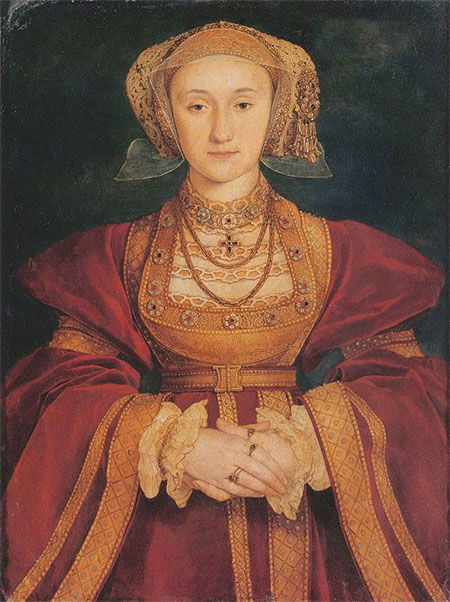
Anne of Cleves, so briefly Queen of England in the first half of 1540, seems a curiously insubstantial figure now. Anne was 24 when she was promised in marriage to Henry VIII, as part of a plan by Thomas Cromwell to ally England with the Lutheran princes of Germany. But after the king refused to consummate their marriage, reputedly referring to Anne as ‘the Flanders mare’, she soon faded from public view. Given the fate of some of Henry’s wives, Anne was treated with generosity and respect. She was declared a Princess of England, given a financial settlement (which included Hever Castle in Kent, ironically the childhood home of Anne Boleyn) and treated as a sister by the king.
We know relatively little about the last 17 years of Anne’s life. She never truly settled in England, suffering from bouts of homesickness and, at times, making plans to go back to Germany. During this time, however, she befriended Mary Tudor and her last public appearance was at Mary’s coronation in September 1553. Anne also at some point converted to Catholicism. She spent her retirement in poor health, suffering from a range of undefined illnesses, but her condition took a decisive turn for the worse in July 1557. On 12 and 13 July she made her last will and testament, in which she stipulated that she should be buried as a Catholic, ‘that we may have the suffrages of holy church according to the Catholic faith, where we end our life in this transitory world’. Within a few days, she was dead, at the age of 41.
In the Abbey, the choir was decorated with funeral hangings and the floor was covered with black cloth. The coffin lay in state overnight, surrounded by candles, attended by the chief mourner, Elizabeth, Marchioness of Winchester. The next morning, 5 August, a requiem mass was sung in the presence of Lady Winchester, Lord Howard of Effingham, the Lord High Admiral and other notables, as well as the members of Anne’s household. Abbot Feckenham delivered the sermon, taking the Psalms as his text, after which the coffin was carried to the grave on the south side of the choir by 12 officers of Anne’s household. In time-honoured fashion, the household officers then broke their staves and placed them in the tomb along with the coffin.
The funeral had been redolent with symbolism. In part, it had been a demonstration of reconciliation with the Henrician past – the marriage of Henry VIII to Anne of Cleves had been the handiwork of Thomas Cromwell, in many ways the architect of Protestant England, part of a strategy of alliance with the evangelical states of northern Europe. More, though, it had been a reinforcement, a grand display, of Catholic mourning. The requiem mass was an assertion of orthodox doctrine, but had been reinforced by the setting, a monastic church, wherein the Benedictine brothers prayed day and night for the souls of the departed. Abbot Feckenham’s sermon was in part aimed at a wider audience. That he took the Psalms was highly symbolic, as one of the key texts in the Marian exposition of the doctrine of Purgatory was John Fisher’s Treatyse concernynge the Fruytfull Sayings of Davyd, published in 1555, which had dwelt especially on the seven penitential psalms.
The attitude of the English Church towards Purgatory at this point must, however, be subject to some qualification. Although the concept of the halfway house between Heaven and Hell was upheld, 25 years of bitter controversy had made many English theologians wary of the actual word ‘Purgatory’. It appeared nowhere in Bishop Bonner’s Profitable and Necessary Doctryne, nor in his Homilies. Thomas Watson’s Holsome and Catholyke Doctryne of 1558 was similarly silent, speaking only of the dead ‘being for a tyme deteyned in the temporall afflictions and purgacions’.
There had also been a subtle shift in the place of Purgatory in Catholic doctrine. What had once been an accepted part of the mental world of ordinary Catholics had now become a shibboleth of orthodoxy. Subscription to the doctrine of Purgatory had become, for example, a necessary condition of study at Cambridge. Likewise, Bonner, in his visitation articles for the diocese of London, enquired whether any of his flock had spoken out against Purgatory and a number of arrests as a result of such outspokenness demonstrate that such a crime existed. Perhaps it is a reflection of the fresh imposition of an idea long neglected which brought about a situation in which, according to the historian Peter Marshall’s neat phrase, ‘practices that had once been occasion for the communal celebration of memory were increasingly framed as a doctrinal test’. This should not come as a surprise. It is merely a return to the situation of the early 1530s, when Purgatory had emerged as a favourite target for the evangelicals and, consequently, an ever-more-cherished belief of religious conservatives.
Purgatory represented the bonds which connected the two halves of the Christian community, the living and the dead. Its attendant theology, in the shape of intercessory prayer and good works, provided a means by which there could be a kind of dialogue between those two halves. It acted as a punitive sanction that guided people’s moral behaviour; there was, for the Catholic Church, an intimate and easily intelligible relationship between a man’s conduct on earth and the fate of his soul after death, a relationship which was conspicuously absent in the evangelical traditions which subscribed to the notion of predestination. Purgatory, in effect, transformed everyday life into a never-ending morality tale, offering with one hand the carrot of salvation, while reminding Christians that its other hand held the stick of eternal damnation.
The Catholic restoration did not last. In November 1558, Mary died, aged 42, without having produced a child. It is the bitterest of ironies that the last of her phantom pregnancies may have been the ovarian tumour which probably killed her. Within 24 hours, her Archbishop of Canterbury, Cardinal Pole, was also dead, a broken and exhausted man. With what seems, in hindsight at least, remarkably little unrest or disorder, the Lady Elizabeth, Anne Boleyn’s daughter, became queen. During the last months of 1558 and the beginning of 1559, she negotiated a settlement for the Church of England that revived most of Henry VIII’s religious changes. Catholicism as a state religion in England became a thing of the past. The Church of England’s 39 Articles of 1563 reinforced what the interim 11 Articles of 1561 had stated, which was that Purgatory, that doctrina Romanensium, was to be condemned. This time the reformation of religion imposed on the long-suffering English people would endure.
The death of Catholic England took place, therefore, in 1558. The final assertion of Protestant supremacy was not merely a matter for politicians and theologians, but had profound implications for the way in which ordinary men and women viewed this life and the next. Purgatory was not simply abolished by the Act of 39 Articles; Parliament could do many things but it could not tell people what to think and what to believe. But Catholic notions of death required action as well as belief. The proscription of intercessory prayers, of the ringing of bells on Hallowe’en and the dissolution anew of the few monasteries and chantry chapels which Mary had restored chipped away at the foundations of Purgatory, until, eventually, it withered on the vine (though Anglican theologians and churchmen remained vigilant for signs of Roman doctrine until well into the 17th century).
The never-ending morality tale which Catholic dogma had offered was replaced by a vision of death and salvation that was in some ways much starker and more uncompromising. The afterlife for Protestants became strikingly bipolar, with Heaven and Hell the only possible destinations. Calvinist dogma, which was so influential in the Elizabethan Church of England, taught that souls were predestined for one or the other, regardless of their earthly conduct, and had been since before the creation of the world. The intimate relationship between the living and the dead, which Catholicism had expounded, and the interdependence which existed between them, gave way to a more distant system of commemoration. A duty to the dead remained and could be fulfilled by the erection of monuments and the commissioning of laudatory sermons, but these were essentially for the benefit of the living. The dead either had no need of them, or else were beyond redemption.
For the Englishman or woman of the 16th century, death merely altered rather than ended the relationships with friends and loved ones. But as the century wore on and the Elizabethan settlement of religion took ever-firmer hold, those bonds were stretched to breaking point and beyond.
Eliot Wilson is a clerk in the House of Lords and an alumnus of the University of St Andrews Reformation Institute.