The Colonial Robespierre: Victor Hugues on Guadeloupe, 1794-98
H.J.K. Jenkins profiles a dictator and liberator in the West Indies under the first French Republic.
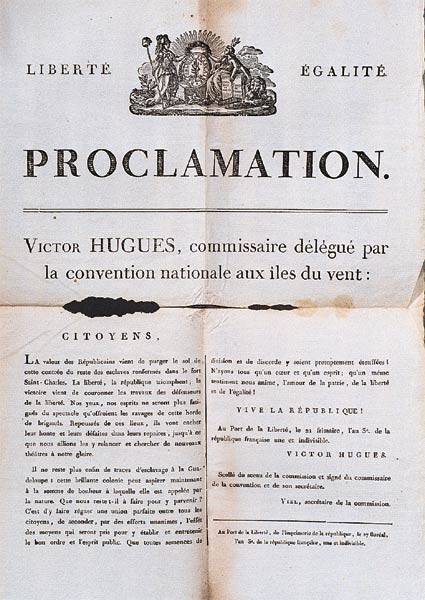
Among the lesser figures of the French Revolution, few excited such a volume of abuse as did Victor Hugues. Contemporary writers- English, American and French - vied with each other in describing him as ‘the demon of republicanism’, ‘the well-known brute’, and even ‘disgustingly lewd cynic’. Certainly he was a womaniser, a spoilsman, and a savage opponent. But he was also a most capable administrator, an early and successful exponent of racial integration, and a master of his own particular brand of warfare.
During the late eighteenth century, the economic significance of the West Indian sugar islands was an important matter in the considerations of both the British and French governments. Early in the Revolutionary Wars, intensive British efforts resulted in the virtual elimination of French control from the Windward and Leeward Islands. Caught off-balance by the political upheaval in the home-country, such French islands as Tobago, St. Lucia, Martinique and Guadeloupe capitulated one after the other.
Then, just when it appeared that a complete British hegemony had been established in that theatre, the situation underwent a remarkable change. Early in June 1794, a small expedition from France reached Guadeloupe: among its personnel was Victor Hugues, newly appointed as civil-commissioner by the Committee of Public Safety.
Hugues was to restore Guadeloupe to French possession, and establish himself as a virtual dictator on the island. He was also to turn his domain into a potent base for a variety of operations that caused the British serious difficulties in the Caribbean, driving Admiral Laforey to report to London in these words: ‘Victor Hugues keeps us in constant agitation’.
Hugues was in his mid-twenties when he reached Guadeloupe, and his earlier life had formed a useful apprenticeship for what was to ensue. Much was made of that earlier life, by contemporary detractors. All sorts of tales were spread about an unsuccessful start as a hairdresser, an innkeeper, and even as the proprietor of a brothel. In fact, Hugues seems to have belonged to a family of minor merchants, living in Marseilles, and this commercial background had first taken him to the West Indies when still a boy.
On French Hispaniola he had built up a business, but, with the onset of the French Revolution, he had become involved in political agitation which had resulted in his deportation to France. There he had won the approving notice of Robespierre, and this had led to his appointment as Public Prosecutor in a number of Revolutionary Tribunals. His brisk measures in that role paved the way for the Guadeloupean mission entrusted to him in 1794.
The French recapture of Guadeloupe was a remarkable feat, especially as Hugues’ expedition had never been intended for such a purpose, but merely as a reinforcement. Indeed, it had reached West Indian waters in ignorance of the fact that the island had recently yielded to British occupation. Upon learning the truth, landings were swiftly effected. In his usual florid style, Hugues reported that the French troops had ‘attacked in the manner of the old-time buccaneers... their bayonets their only siege-engines... their bodies their only ramparts’.
Circumstances favoured the enterprise, for the British had established a relatively small occupation-force. Within a month, the whole eastern part of Guadeloupe had been restored to French control. Thereafter, a skilful campaign completed the matter: by the first days of 1795 the last of the British garrison had taken flight. Less fortunate were many of the inhabitants, Royalist sympathisers, who had sided with them against Hugues. Several hundred of them were butchered in a series of mass-executions.
Victor Hugues was quick to establish himself as the unquestioned master of every aspect of the colony’s activity. Les Guerres des Antilles de 1793 à 1815, de Poyen, the French military historian, has referred to him as having become, in effect, ‘an absolute monarch’. Following the overthrow of the Committee of Public Safety, Hugues was confirmed in office by its successor, the Directory, and he continued on his way with a chilling combination of ferocity and acumen that swiftly earned him the soubriquet of ‘The Colonial Robespierre’.
For most of his governorship he shared control, in theory, with other officials of equal rank. In practice, he concentrated real power in his own hands. Some of his titular colleagues succumbed to the unhealthy climate; others were simply browbeaten into submissive compliance. One of them, Lebas, was left with so little authority that he devoted most of his time to landscape gardening.
In their reports to London, the British West Indian authorities were quick to comment on Hugues’ role in the emancipation of the slaves on Guadeloupe, referring to what they viewed as the ‘active Spirit of the Enemy who is circulating the diabolical Decrees of the Convention, giving Freedom to the Slaves’. Shortly after the British withdrawal, Admiral Caldwell dwelt at some length upon the ‘wild and pernicious Doctrine of Liberty & Equality... so successfully established on Guardeloupe (sic)’.
To a large extent, however, Hugues had merely substituted military discipline for the old servitude. Turning the whole island into a vast armed camp, though taking care to preserve its agriculture and commerce as far as possible, he mobilised the entire population, in effect. All inhabitants, of whatever racial origin, found themselves subject to martial law. The guillotine, the firing squad, and a complex network of spies were combined into a system that prevented any serious challenge to Hugues’ regime from emerging.
Faced with this situation, the British abandoned any plans for a speedy attempt at a fresh invasion and contented themselves with efforts to blockade Guadeloupe. Soon, though, they had to contend with a new development, Hugues’ efforts to extend French control so as to include such islands as St Vincent, Sta. Lucia, and Martinique. In the ensuing campaign, Hugues introduced slave-rebellion as a major weapon. Moreover, he invented a non-existent ‘Carib Nation’ which, he insisted, was the faithful ally of France.
Thus, he exploited to the full the disruptive impact of French Revolutionary ideology upon a zone characterized by a slave-based society. Flotillas of canoes and other small craft constantly evaded British naval patrols, and ferried supplies, emmissaries and troops to wherever they might injure the British interest.
To judge by contemporary correspondence, the British were alarmed by these developments, seeing in them not merely the danger of lost colonies, but the destruction of the whole system upon which the colonies rested. They were also astounded by the apparent solicitude which Hugues exhibited for the well-being1 of ‘Black Republicans’. Indeed, he issued a stream of declarations and decrees about what would ensue if the British maltreated such combatants.
A particularly striking instance involved a black soldier named Saint-Jean. This man was a fugitive slave from British-occupied Martinique who had found his way to Guadeloupe. Pressed into military service by the French, he was subsequently taken captive by the British and returned to his former master.
This procedure infuriated Hugues. In an official communication to the Governor of Martinique he threatened to place two high-ranking prisoners in chains, and set them to hard labour, unless Saint-Jean was at once accorded the status of a bona fide prisoner-of-war.
Understandably, the ferocity that underlay such threats seems to have daunted Hugues’ opponents. But it was the affair of General Dundas’ corpse that evidently caused the greatest consternation. Dundas served as Governor of Guadeloupe during the brief British occupation and had died there during his term of office: his rule had been characterized by draconian measures.
Hugues, upon enquiring into such matters, determined upon a posthumous reprisal. At his personal order, the body of Dundas was exhumed and flung into a common sewer. To commemorate this act of vengeance, a suitably inscribed monument was erected on the spot.
Despite initial success, Hugues’ scheme to restore French control upon Guadeloupe’s neighbours was eventually to fail, largely because of British seapower. Guadeloupean forces might evade British patrols, by using canoes and small craft, but the maintenance of regular convoy-links with the home-country was a different matter.
Whereas the British were able to introduce massive reinforcements into the theatre, Hugues was consistently denied fresh support from France. Guadeloupe’s communication with the Directory became so limited, in fact, that the island began to assume the status of an independent state. An early edition of Biographie Universelle commented that, in the days of Hugues, Guadeloupe developed into ‘a type of isolated power in the midst of the seas, retaining the name of being French simply to make it even more formidable’.
By mid-1796 Hugues had recognized that he must change his style of attack. Abandoning his plans against other islands, he concentrated his efforts upon damaging British seaborne commerce in West Indian waters. Lacking orthodox naval forces, Hugues had to depend upon privateers for this purpose, and what followed formed one of the most notable episodes in privateering history. Every vessel that might conceivably be pressed into service was prepared for sea.
Many of these craft were small, some of them mere row-boats, but in total they were able to inflict severe losses upon merchant shipping. The despatches of the Royal Navy’s Leeward Islands Command for this period reveal mounting concern at the proliferation of Guadeloupe’s diminutive and elusive commerce raiders. Such craft were regularly described as ‘the principal annoyance to the Trade’. During early 1798, Admiral Harvey reported that Hugues’ ‘sole Object’ seemed to lie in ‘fitting out a great Number of Privateers’.
An interesting by-product of Guadeloupean privateering was its considerable contribution to the provocation of the Franco-American hostilities of about 1798-1801 which are generally referred to as ‘The Quasi-War’. Infuriated by the way in which American traders supplied many of the needs of the British in the West Indies, Hugues developed an almost pathological hatred for everything connected with the United States. Thus, American merchant vessels became a prime target for what the US Secretary of State was to describe as Guadeloupe’s ‘licensed piracies’.
Despite the fact that Hugues had proved so useful an instrument in damaging the British interest in the West Indies, the Directory gradually came to view him in an unfavourable light. During 1797-98 a mounting volume of complaints filtered through to Paris about the malpractices of Guadeloupe’s Governor.
Enquiry and remonstration produced little result. When it was pointed out to Hugues that he had failed to implement various items of metropolitan legislation, he airily informed the Directory that the French Constitution was ‘impracticable’, and that he had no intention of altering his current methods of administration.
Hugues also proved reluctant to divulge information upon his various commercial interests and his handling of the colony’s revenues. Considerable evidence exists for the belief that he was guilty of peculation on the grand scale, and that the proceeds were diverted into a number of Guadeloupean firms, notably Le Maitre et Cie, in which he held the controlling financial interest.
Moreover, Hugues evidently arranged privateering matters so as to favour himself, partly by manipulating the distribution of prize-money, and partly by overcharging for the issue of letters of marque.
As to his private life, innumerable accusations were to emerge regarding his passion for women. Doubtless these contained a measure of exaggeration, but it is certain that he used his great personal power to coerce a variety of women into his bed. As early as 1795, the respected chemist, Hapel la Chenaie, interested himself in the plight of such victims, insisting that Hugues was a menace to all women and girls.
To the accompaniment of clamorous complaints, and nettled by Hugues’ increasingly arrogant attitude, the Directory at last decided to remove him from office. In late 1798, his successor, General Desfourneaux, reached Guadeloupe with a sizeable expedition. But the actual transfer of power proved difficult, and it was only by arresting Hugues (by means of a ruse) that Desfourneaux was able to assume control. Thereafter, ‘The Colonial Robespierre’ was hurriedly deported to France: his days as the master of Guadeloupe had ended.
In reviewing Hugues’ four years of control on the island, one is faced squarely by the complex and enigmatic nature of the man. His achievements were plainly to be seen: quite against ‘the run of the play’, he had resurrected French influence and power in the eastern Caribbean, thus denying the British a free hand in that important theatre. Moreover, he had implemented the abolition of slavery on Guadeloupe, and had welded the heterogeneous population of his domain into a cohesive entity in which racial discrimination was largely suppressed.
To illustrate this point, one might cite many expressions of American surprise at finding Guadeloupean privateers ‘manned & commanded by Blacks’.That such developments were negated by later Napoleonic measures cannot be taken as a reflection upon what Hugues tried to accomplish.
On the other hand, despite his Robespierre-soubriquet, there can be no doubt that Hugues’ conduct fell far short of the disinterested republican virtue he professed during the 1790s. Power, women and money seem all to have been equally attractive to him: in his pursuit of them, he did not scruple to use any means available. In later decades, he became more and more of a political opportunist.
Despite the circumstances of his replacement by Desfourneaux, he argued his case successfully before the Directory and was given a new appointment as Governor of the colony of Cayenne. Subsequently he held a number of offices under the Consulate, the Empire, and even the restored Bourbon monarchy. It was his time of power on Guadeloupe, however, that made him memorable - what preceded those four years was but a prelude, and what followed them was an anticlimax.