Women and the Early Church
Brent Shaw offers a reassessment of the women martyrs and heroines whose activities on behalf of the faith provoked unsettled admiration from the church fathers.
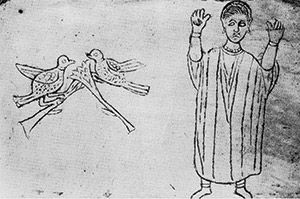 Consider a tombstone from late fifth-century southern Italy: 'Leta, the priest (presbytera), lived 40 years, 8 months, 9 days. Her husband set this up for her'. Or a Latin inscription from Salona in Dalmatia, dated earlier in the same century: 'I Theodosius purchased this grave plot from the holy priest (presbytera sancta) Flavia Vitalia for three gold pieces'. Two notices that would seem to attest the existence of female priests – not unusual in the world of Graeco-Roman antiquity, except that these women were Christians. As late as the fifth and sixth centuries AD women like these were found exercising priestly authority in Christian churches in locales as diverse as the cities of Asia Minor, Greece, Gaul, Sicily and southern Italy. It is also known how very unusual most of these cases were.
The women in Sicily and southern Italy who assumed the power and duties of priests did so in circumstances of considerable local social upheaval where, apparently, few qualified men were available. Their usurpation of male authority was harshly condemned by Pope Gelasius in a letter to the churches of the region (AD 492-96). However significant their mere existence might be for staking out current theological claims, or as ammunition in contemporary ecclesiastical conflict, they are exceptions that prove the rule – that women were gradually, inexorably, and deliberately excluded from formal positions of authority within the organisation of the Christian Church. A whole series of church councils, between those at Nicaea (325) and at Orange (441), repeatedly issued 'canons' or formal decrees that prohibited women from the ranks of the priesthood and from any involvement in priestly liturgical duties, such as baptism and the eucharist.
Yet the changes in the societies that made up the Roman Empire which were provoked by the new religion of Christianity – ones that transformed the face of what we now somewhat hesitatingly call 'Western Civilization' – must have involved the half of the population who were women. Modern students of that process, however, have advanced much stronger claims than those of mere involvement. They have asserted that women, especially in the ranks of the aristocratic élite, were in the vanguard of the process of conversion and of the evangelisation of the new faith. It has been argued that women were far more influential in the forging of actual early church communities than has been generally recognised in the past. Scholars claim that women once widely performed liturgical roles, including those of baptism and giving the eucharist, later denied to them – a history of early empowerment deliberately obscured, in part, by the later re-editing of church documents; Finally, there are claims concerning the liberating effects of a Christianity that opened both new avenues of action and formal powers to women from which they had previously been barred. Any attempt to test these claims, and to understand the actual historical experience of women in early Christianity, however, is unendingly blocked by the nature (indeed, the sheer lack) of the surviving historical evidence. There is no doubt that some of the relevant records still exist. More assiduous searching in the last decade or so has brought many previously known but obscure and marginalised documents to the centre of the historian's agenda. But these records are almost entirely written by men. Although they do mention women, debate their roles and behaviour, provide interesting details about their lives, and sometimes even place them at the centre of their accounts, almost none of them were actually written by women themselves – a critical caveat that must constantly be borne in mind in all that follows.
After all, what historians can know depends on available records. The production of such records depends on an active literacy that specialises in the writing and the canonisation – the systematic organisation and preservation – of textual materials. What evidence there is clearly suggests a very limited literacy of this type amongst the women of the Roman Empire in which Christianity emerged. Literacy itself was probably restricted to a sizeable, though proportionately small, part of the whole population. Within the sector that might be deemed literate, women's literacy had a rather special character that matched the dominant moral codes of the time. It tended to be passive and consuming rather than active and producing. Women of the aristocratic élite, of whom we know the most, were literate in the sense that they were taught to read – usually, it seems, by their mothers. 'Saint' Jerome, who was especially close to these women, and pairasitic on their wealth and social rank, writes at length in one of his letters to a mother how she should cut out little shapes of letters and with them teach her daughter, by this conventional method, to feel and thus to learn her letters. And of reading itself, there are good indications that they did a lot. The fourth-century Roman aristocratic woman Paula knew her scriptures, and certainly her Hebrew, better than her spiritual guru Jerome. Her contemporary Melania (the Elder) had read 'seven or eight times' the 'three million lines' of the Greek theologian Origen; and, similarly, 250,000 lines of the writings of other Greek 'Fathers' of the church.
When it came to the production of literary texts, however, a whole series of empowerments, conventions, and active restrictions meant that this remained, from the beginning to the end of the antique world in which Christianity evolved, a sphere of activity almost wholly controlled and dominated by men. When women who were literate did advance beyond the passive skills of reading to writing, with certain striking exceptions it was to the private sphere activities of composing letters and of keeping diaries (adjudged by men to be a morally inferior activity). Where active expression was involved, the evidence that we have indicates that it took place in a vast and amorphous world of oral communication labelled talk, conversation, innuendo, and gossip – but not formal public rhetoric. This was a powerful, potentially dangerous, and largely uncontrollable, realm of communication where reputations could be made or destroyed by persons as low as household slaves. But this world is largely, and one fears, permanently, lost to modern-day historians.
The developmental path traversed by Christianity, from the domain of personal to institutionalised power, itself provoked problems of integration. This is true despite the great diversity of structure and belief found in early Christian communities, since the various divergent movements within it, including those labelled schismatic or heretical, developed their own formal organisations or 'churches', and were just as committed to their institutions as any orthodoxy. Donatism – a separate regional variety of Christianity in North Africa from the early fourth century AD – was viewed as dissenting, heretical, schismatic, and dangerous by its orthodox critics, but was every bit as committed to its own texts, hierarchies, church buildings and edifices, readers, deacons, priests, bishops, and elaborate defences of their authority and prerogatives, as were any 'orthodox' Catholics in Italy or elsewhere. The problem is that Christianity, which ended by developing powerful and complex ecclesiastical institutions, had begun life as a quasi- millenarian prophetic 'Jesus movement' in the region of Palestine. It had spread westward by the dual agencies of individual effort, will and charisma, and the social unit of the household or family. In both eastern and western Mediterranean worlds, therefore, the model or image of the family, so crucial to the spread of early Christianity, became subject to intense ideological scrutiny and regulation. But eventually the family basis of a nascent Christianity soon had to be integrated with, and made subordinate to, formal organisations that embodied values quite different from those of the rebellious expectations of a new personal faith that offered its converts the hope of a substantially changed future.
In Pauline writings, those millennial expectations of the repressed are clearly signalled. Slaves who converted, especially those who were slaves of Christian masters, quickly assumed that the end of time was now at hand and a whole new order was dawning. Since they were just as much the 'brothers' and 'sisters' of their masters and mistresses, and since all were equally the 'sons' and 'daughters' or 'the slaves' of the one God, they reasonably expected that they would be freed from the conventional ties that both bound and ranked them. This misapprehension had to be corrected – as Paul himself made clear in his reply to one Philemon about his escaped slave Onesimus. The case was not an isolated one. The parallel message, and opportunities, broadcast to women of free status no doubt evoked similar expectations and responses. The problem was: however they to be contained? This was not as easily solvable a problem as that of the slaves, many of whom, it must not be forgotten, were women. Slave women who had millennial expectations of more freedom were, no doubt, like slave men, simply ordered (as Paul himself specifically ordained) to get back to their proper place. The larger problem was with free women.
Mediterranean male protocols of both Greek and Roman societies had rather blunt and severe prescriptions on the proper place of women of free status, especially that of wives. What actually happened in the circumstances of daily life was, no doubt, something rather different. The existence of a strong conflict between prescription and reality is indicated by need constantly to restate the protocols themselves in every conceivable form of communication, oral and written, from the high literature of the city-state, in its poetry and drama, to the more mundane extra-canonical technical treatises of doctors and architects. Another indication is that even a male ideologue like Aristotle was forced to concede that although a father and husband's authority over the children and slaves of his own household was 'like that of a king' (the absolute power to command obedience), his relationship to his wife was 'political'. That is to say, the latter relationship was a process of constant negotiation, debate, and arbitration typical of the distribution of power in a democratic polity. The man was always supposed 'to win' this contest, and a specific order with in the household, with the man as 'head', was to he maintained.
But any strong millenarian or ecstatic religion, and not just Christianity, that attracted adherents from the 'inferior' elements in the family, by its very nature constituted a threat to family order. In most cases, household heads that faced such systematic threats could be expected to be backed by strong action from their state that would both reaffirm existing norms of the family and the traditional position of women. The so- called Bacchanalian conspiracy in Rome in 186 BC was just such a case. It was a hysterical reaction against the perceived threat of cult cells in Rome and Italy supposedly dedicated to vile secret rituals dedicated to the Greek god Bacchus, groups including free women and slaves that were corrupting young men, and were forming a dangerous and subversive 'state with- in a state'. Revelations and betrayals led to a systematic repression throughout Italy by the consuls and the Roman senate that prohibited women from such worship and ordered that guilty daughters and wives be handed over to their families for punishment in household courts headed by their fathers and husbands. But early Christian communities did not have this advantage. They had to stabilise the order of the family and household, probably the principal formal container of the new religion down to the end of the first century, while simultaneously facing increasingly hostile local communities that actively courted the violent intervention of officials of the Roman state.
Christian communities responded by restating, with categorical fervour, traditional family relationships in a series of formal regulations. These are exemplified in the so-called 'Household Tables' found in several of the New Testament books (Ephesians 5.21-6.9; Colossians, 3.18-4.1; 1 Timothy, 2.9-6.2; 1:Peter 2.18-3.12 are the main texts) – tables whose prescriptions were ceaselessly re-iterated in the West by the church 'Fathers' from Tertullian to Augustine, and beyond. The imperatives of these texts insisted that all persons – father-husband, mother-wife, children, and, finally, slaves – were to be maintained in a fixed, hierarchical social order, all subordinated to each other and, finally, all were to be subject in fear to God the Father and Lord (dominus meaning 'slave owner') as his children and slaves. This much desired 'proper order' was threatened in numerous structural ways. One of these was that of differential conversion – the main problem here (not necessarily an overwhelming statistical regularity, but rather a perceived problem) being those cases where wives converted to Christianity ' while their husbands did not. The: problem was a long-standing one that: characterised the many religious movements into local societies where the new beliefs were not neatly contained as state or civic cults under the supervision and control of the male heads of household who constituted the fully recognised citizens who con- trolled the levers of government.
As an extension of the rule of order within the household, out of which a good part of the early and formative existence of the church was derived, rules of bodily space and of voice were gradually, but surely, imposed on the architecture of the church itself. Women and girls were seated separately from men and boys women were ranked: matrons were separated from virgins, widows from those groups, and young girls from all of them. There was also a gradual but finally decisive move to impose head coverings on women (some- what misrepresented in many modern discussion as 'veils') as a symbol of submission to the 'head' of house- hold and God the Father. These measures had different tempos and regional variations in the Christian communities of the ancient Mediterranean. A recently published sermon of Augustine, for example, attests the new provision of separate entrance doorways for men and women in the main basilica at Carthage – an innovation imposed only in the early 400s AD. The general tendency of all these measures, however, was in one direction: a purposefully imposed inconspicuousness and silence.
A current meliorist strain in historical interpretation finds it difficult to face the near obvious. Repression can be successful. The vast written records of the early church preserve not one female theologian, even though there is consistent evidence of women's involvement in theological debates and in teaching. Although there might have been some lower order officials, the priesthood and other high offices became closed to women as the church gradually constituted its own 'public sphere' parallel to that of the state. Of course, the process involved constant struggle, and a repression that was never completely closed or finally achieved. Although the church in the west was finally to draw the line at the level of the priesthood, as late as the fifth and sixth centuries women deacons were both ordained and recognised as a formal clerical part of the ecclesiastical hierarchy. In the ritual by which new Christians were created, that of baptism, the 'born again' had to have evil demons driven from their body – a critical function performed by exorcists. Exorcists were just as much a part of the formal hierarchy of church offices as were priests. And women regularly held the office of exorcist – women who were therefore seen to wield considerable spiritual, and secular, power. Moreover, the constant emergence of forms of Christianity that challenged orthodoxy, or of esoteric brands of Christian or 'near- Christian' beliefs and thought, such as those called 'gnostic', produced milieux in which orthodox norms were constantly challenged and questioned. But those who would find 'feminine' emphases in the alternative theodicies of 'gnosticism', must face the unpleasant fact that the feminine principle in this theodicy, however important, was roughly the equivalent of the Devil in 'main- stream' Christian ideology, and that even the 'gnostics' held that the perfected being was going to be male, and that each woman would have to be transformed into a man before achieving that final perfection.
While the church could define and close off specific times and physical spaces that defined its offices and formal powers, it would always have to face challenges that would well up out of the non-ecclesiastically controlled personal behaviours. There were several distinct spheres where the simple actions, experiences or given social positions of individuals bestowed power on them that could not be immediately or directly controlled by the church. These included: transcendent personal experiences such as dreams, prophesies, and ecstatic performance; extraordinary demonstrations of personal bravery and fortitude that even élite Roman men would value as a species of manliness (virtus); and the possession of independent status in the secular world outside the direct control of the church – high social rank and wealth. Finally, there were new opportunities offered by the emergence of 'heretical' movements which were, by definition, not under the control of the authorities. In any one of these areas (or better, in combinations of them) women effectively circumvented, and therefore challenged, the continuing efforts of men to monopolise the institutional powers of Christian churches.
A typical phenomenon that exemplifies some of these opportunities, much studied because well-documented cases are so rare, is the movement labelled 'Montanism' (after Montanus, its supposed male head). Emerging from the remote heartlands of Asia Minor in the mid-second century, Montanist adherents exhibited ecstatic experience – dreams, prophetic utterances – with tendencies to separate themselves from the formal churches of the region. What- ever roles and powers 'Montanist' women like the Quintilla, Maximilla, and Priscilla were able to assume, they seem to have had no substantial known impact on the powers of women in the 'orthodox' church. These women may well have been able to denounce their husbands, abandon their marriages, and assume priestly roles (all of this, however, reported in a later hostile rhetoric), but by the time 'Montanism' can be identified in a western Mediterranean context – at Carthage in North Africa at the end of the second century and beginning of the third, it was being effectively tamed to orthodox ends. Women could and, indeed, did prophesy – but, as Tertullian reported of his congregation in Carthage, only at the appropriate time, in church, and the publication of the message was permitted only after the woman had been debriefed by the male presbyters in seclusion after the service. The views of Tertullian (himself labelled a Montanist) on these 'heretical women who dared to teach, exorcise, heal, and baptise' was blunt:
Women are not permitted to speak in church, to teach, to baptise, to offer eucharist, to undertake any other male duty, or to arrogate to themselves any priestly task whatsoever.
The combined elements of independence from direct male control in the household, personal wealth, and the breakdown of the controls of a single central church could produce opportune circumstances in which a woman could become unusually effective. In AD 312 at Carthage, Lucilla, a wealthy woman of high social standing, refused to apologise for her practice of bestowing a kiss on a holy relic. Caecilian, the priest who dared to reprimand her, suddenly found himself opposed for election to the vacant position of Bishop of Carthage by a male slave from Lucilla's own household, This servant, named Majorinus, was trained, funded and supported by Lucilla and defeated Caecilian in the election. The ensuing battles within the church at Carthage led directly to one of the greatest of the 'schisms' in the history of the church in the West – the emergence of a separate North African or 'Donatist' church. Lucilla, however, was not alone. A century later, Augustine could refer to at least two parallel cases of independent wealthy women who stood at the head of the creation of more schismatic or break- away movements within the church in North Africa.
The ideology of a church that placed such a high value on virginity was naturally hostile to remarriage and exalted the status of the widow. Because of this, and its prohibitions against divorce, Christianity created a new social group, that of widows, in numbers and with a definition never before seen in the pre-Christian world. But the very existence of a new order of independent women with their own wealth posed a constant threat to the church's desired order. Jerome could condemn a very wealthy woman, a widow, whom he saw ostentatiously distributing alms as a quintessential hypocrisy – but then she had found her place, as much of any of Jerome's highly touted virgins. Reality, however, often confounded the rhetoric. After much sweating and effort, and in hand- wringing despair, Jerome's contemporary, Ambrose, the Bishop of Milan, confessed that there were only twenty known virgins in the large Italian city of Bononia (Bologna). It was not for want of numerous lengthy exhortations to virginity, amongst them Jerome's letter to the noble- woman, Eustochium, that preached the new ascetic ideals. But even Jerome had to admit that his treatise was stoned by the people of Rome.
Indeed, it was the wealthy élite women whom Jerome himself so castigated and fawned upon, 'small women weighed down by sins', who were, in his view, the cause of 'heresies'. But in his own letters we can trace his changed attitudes to a wealthy woman as she shifted status from dependent wife to independent widow. While her husband was still alive, the Spanish noblewoman Theodora merited only perfunctory reference. After her husband's death, she became the object of special attention. She was now one of those widows upon whom Christian ideology bestowed so much prestige. That standing, and her wealth, meant power – and hence the need of incessant instruction from men like Jerome on proper behaviour.
In the critical period of its growth and institutionalisation, and of attacks on it from those who detested and feared Christians, the church could not control the fact that the very process of persecution drew women as well as men into the public arenas of the empire where these matters were finally settled. In their public demonstration of courage, or bodily resistance, of iron-willed and open confrontation with supreme figures of authority – from their own fathers to the Roman governors who put them on trial – women martyrs were perhaps the most difficult case with which the church had to cope. They became central actors in public venues, and active front-line defenders of the faith in a conflict that pitted them against the diabolical forces of the state. Given the prevalent moral codes of that world, the actions of these women meant that great power and glory accrued to their names. So, for example, the pogrom against Christians in the city of Lugdunum (Lyons) in AD 177, highlighted the achievements of a Christian woman who would otherwise have been regarded as 'contemptible' and 'cheap' by the prevalent male values of her world: the slave woman Blandina. But in the words of the man who reported her death, by enduring the almost unspeakable tortures vented on her body, Blandina acquired a fame and renown like that of a 'noble athlete'. She had proven to the population of a major Roman city that she had greater endurance and fortitude than many men. Reports of such achievements by women that confuted the normative values placed on them were subsequently most difficult to explain away.
Much the same could be said of Perpetua, a woman who was executed in the arena at Carthage in AD 203 on the charge of being Christian. The difference in her case is that she was not only a freeborn, wealthy woman of high social standing, but she was also a woman who wrote. It is from her hand that there survives one of the very few, if not only, extensive pieces of narrative prose written by a woman during the whole period of the high Roman Empire. The challenge presented by women like Blandina and Perpetua was to be found in the ideological backwash following their deaths. Their behaviour and achievements in huge public arenas, before crowds of spectators who witnessed their trials, and before tens of thousands who watched their deaths in amphitheatres of the empire, was systematically to refute both assumptions and claims about 'feminine fragility' and 'unworthiness' that underwrote the subordination and silence so insisted upon by Paul and his successors.
The general response to this was to control the very accounts by which persons through time would come to know of the achievement of women martyrs. In most cases, this was easily- done because the male ideologues who were the only recorders of the acts of the martyrs, could directly rewrite these women's experiences in a theological form that left only divine interpretations (and explanations) open for their actions. For the most part, this reduced to the truism that they were able to act like men because of the infusion of the spirit of the Christian deity into their bodies. Perpetua's case, however, was more problematic, since she had left a detailed record of her own experiences in her own words. This account then had to be rewritten, reshaped, parodied, mimicked, and preached about till the end of the Roman Empire in the West. Like her bodily martyrdom, her words were an implicit threat to the assumed norms that underwrote the institutional power of the church.
Though signs are notably few in the records that have survived – what else would one expect? – there is nonetheless a myriad of little clues, micro-points of evidence, that point to recurrent resistance to the edifices of male power in ecclesiastical institutions. Such were women in Tertullian's Carthage in the late second and early third century who prophesied, who taught, who told him that he had no business imposing dress codes on them, and still others who insisted on following their modes of worship and actively proselytised for their own beliefs – whose 'silliness', 'madness' and 'unspeakable arrogance' were sufficient to provoke from Tertullian a terrible anger, and a litany of regulatory prose. Despite his efforts, women like these were still present in the Christian congregation of the North African metropolis as late as the fourth and fifth centuries women who refused to take direction from male priests in the matter of proper behaviour. And in fourth- and fifth-century Rome there were those who, like the noble Marcella, assumed that they could teach the Christian message, and who could: hold their own in acrimonious theological debate.
The examples need not be multiplied. They are sufficient to show that, with each generation, there was: a continual struggle, a conflict of Aristotle's "political type’ between the men and women who contested the new resource of the church, the new family of Christ. That is why- church councils had to keep reiterating those laws that systematically excluded women from its ranks. And that is precisely why the heavy overlay of male ideology (of which the vast bulk of surviving ecclesiastical and theological writings were an important part) had to be restated with every new generation. And why, although those records are indeed 'our history', we must rewrite them.