Boris Godunov, Tsar of Russia
Ian Grey profiles Boris Godunov; Chief Minister after the death of Ivan the Terrible, and then himself Tsar, Boris served Russia during a most troubled period.
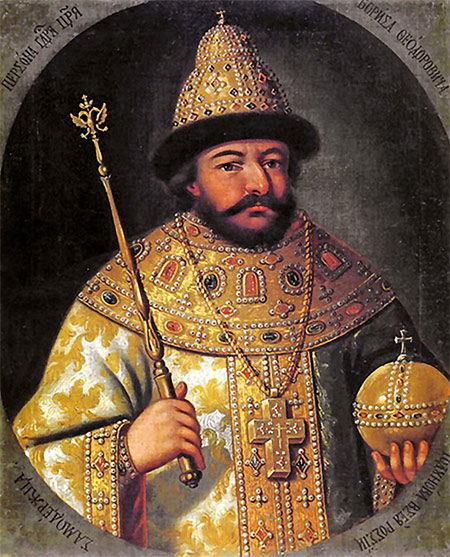
Boris Godunov is probably best known as the ruthless ill-fated Tsar of Mussorgsky’s opera. The libretto of the opera was provided by Pushkin’s historical drama, Boris Godunov, and he took his material wholly from N. M. Karamzin’s History of the Russian State. This lengthy and impressive history bears special responsibility for the distorted portrayal of Boris which historians, with only a few exceptions, have followed until the present century.
Nicholas Karamzin was a conservative who championed autocracy and idealized old Russia. The Emperor Alexander I virtually made him an official historian. He could write powerfully and, indeed, contributed much to the development of the Russian literary language. But he could be biased in his judgements, as he showed in his condemnations of ‘the criminal ambition’ of Boris, ‘this power-loving man’ of whom he observed that ‘the punishment of Heaven awaited him’.
Boris has suffered, in fact, from consistent and unjust denigration. The gravamen of the charges against him was that he so lusted after power that to attain it he resorted to deceit, violence and crime, including even the murder of a nine-year-old child, Tsarevich Dmitri, who was said to stand between him and the throne. It is now generally accepted that Boris was not guilty of, or even involved in, the death of Dmitri. Other accusations rest on flimsy evidence and conflict with all that is known of the man. Indeed, it is clear that Boris not only served his country well in one of the most troubled periods of its history, but also that he made outstanding contributions to its defence and expansion. Moreover, in wielding power he sought to restore standards of conduct that had been debased during the reign of Ivan the Terrible.
The charges against Boris were nevertheless set down in chronicles and official biographies, endorsed by the Orthodox Church and thus bore the stamp of ‘official truth’, which in the seventeenth and eighteenth centuries no one questioned. In the second half of the nineteenth century it became possible to re-examine such dogmas. But Solovyev and Klyuchevsky, the two greatest Russian historians, remained unsympathetic. Klyuchevsky, for example, wrote that Boris ‘attracted by his presence, his intelligence, and his ability, but repelled by his failings of heart and conscience’. It is a judgement reflecting three centuries of calumniation and not arising from the known facts of his life.
The Godunovs were of Tartar origin. Their ancestor was a Mirza, or Prince, who enlisted in the service of the Muscovite Grand Prince, Ivan Kalita, about 1330. A number of Tartar Princes went over to the Russians in this period. According to one authority, no fewer than 156 Russian noble families were of Tartar or other Oriental blood. The Godunovs served the Grand Princes of Moscow faithfully for more than two centuries, but failed to distinguish themselves. In fact, the family might well have passed unnoticed from the pages of history but for Boris Fedorovich who, contrary to all expectation, became Tsar of Russia.
Boris was born about 1550. At the age of twenty, he married Maria, daughter of Grigori Lukyanovich Belsky-Skuratov, known as Malyuta, who was the closest and most trusted favourite of Ivan IV, the Terrible. Malyuta was a ruthless henchman, prompt and savage in carrying out the Tsar’s missions, and feared and hated by the boyars. This marriage brought Boris to court where he made a favourable impression on everyone. He was extremely intelligent and able, a natural politician, and strikingly handsome. Soon he was a member of the Tsar’s personal suite. He was appointed Kravchy, an important office, involving the duty of tasting each dish to ensure that it was not poisoned before placing it before the Tsar. The office was more than a formal honour. Tsar Ivan actively feared that enemies might try to poison him. The deaths of Anastasia and Marfa, his first and third wives, were rumoured to have been caused by poison.
The most significant demonstration of the Tsar’s favour towards the Godunovs was the marriage of his son, Tsarevich Fedor, to Irina, the sister of Boris. This union brought the whole Godunov family to prominence at court as part of the Tsar’s own family. In 1580, when only thirty years of age, Boris was advanced to the rank of boyar.
Life at the court of Ivan the Terrible was exacting and uncertain. The Tsar was a man of violent extremes. As a boy and later, he had known treachery and terror at the hands of powerful boyar factions. He never forgot these experiences, and became obsessed with fears and suspicions that boyars and princes were meditating treason. In 1564 he established the Oprichnina, which was in effect a separate state within the Tsardom. He personally recruited the Oprichniki, or special guards, who owned loyalty only to him and were outside the law. They wore uniforms of black and on their saddles were the emblems of a broom and a dog’s head, signifying that they would sweep and hound treason from the land. This was the beginning of a period of terror when the Oprichniki plundered and harried the people, when many nobles were executed or murdered; and in Novgorod the Tsar personally directed a massacre in which some 60,000 people lost their lives.
Boris managed somehow to keep himself apart from the Tsar’s savageries and, at the same time, to remain in favour. He was not given to outbursts of anger or to violence, but was generally courteous and mild in manner. He impressed his contemporaries by his humanity and concern for the weak. Moreover, he was courageous and even dared to try to restrain the dreaded Tsar.
The year 1581 was a time of defeats and personal tragedy for Tsar Ivan. He had pursued certain policies consistently and with success. He had imposed his absolute rule upon the nation and had eliminated the boyars and princes who had challenged or seemed likely to challenge the autocracy. He had conquered Kazan and Astrakhan; and, having brought the whole of the Volga under the rule of Moscow, he had begun the conquest and colonization of Siberia. But in the west his long struggle to secure direct access to the Baltic had failed. The Polish King, Stefan Batory, had captured the important towns of Polotsk and Velikie Luki, and was laying siege to Pskov. The Polish troops were, in fact, exhausted and the Russian army, standing nearby, could certainly have put them to flight. But, fearing that Pskov would fall, the Tsar was anxious to come to terms. He sent envoys to the Polish King with the offer to surrender all that the Russian armies had won earlier in the Livonian War in return for peace.
As he anxiously awaited the Polish reply, Tsar Ivan became more ill-tempered. The smallest disagreement threw him into rage. At this time his elder son, Tsarevich Ivan, from whom he was inseparable, approached him concerning the war or some other matter. It is not known what he said. Tsar Ivan exploded in anger. He struck at his son with the iron-tipped staff which he carried. Boris Godunov, who was present, quickly thrust himself forward and warded off the blow, but was severely wounded. His interference merely aggravated the Tsar’s fury. He struck again and this time the blow fractured the skull of the Tsarevich. Four days later the young man died.
Tsar Ivan was beside himself with grief. He had killed his favourite son with his own hand and had deprived the Tsardom of the successor on whom he and all Russians were counting as a strong and able autocrat. But, far from bearing any anger towards Boris, the Tsar was distressed by his absence from court. A malicious report that Boris was staying away deliberately caused the Tsar to call unexpectedly at the Godunovs’ house. He found that Boris was recovering from his wounds. He embraced him warmly and showed him the greatest favour, treating him as a son.
On the death of Tsar Ivan in 1584, Fedor, his surviving son by his first wife, ascended the throne. He was physically and mentally feeble and exceedingly devout. A simple monk by nature, he was totally unsuited to the role of autocrat. His father had dismissed him as a Postnik (keeper of fasts) and as a Molchalnik (a monk maintaining the rule of silence). But his legal right to the throne could not be denied.
A small group at court tried to oppose his succession, but failed. The leaders of this group were the Nagoi who were the family of Tsar Ivan’s seventh wife. She had given birth in 1582 to Tsarevich Dmitri, who was a sickly child, and since church law admitted only three wives, his legitimacy could be questioned. But the Nagoi planned for the day when Fedor died. He was constantly ailing and not expected to live long or to father children. They would then be able to advance the claims of Tsarevich Dmitri to the throne. The devotion of the Russian people to the dynasty was so strong that they would never question the right of the sole surviving son of Tsar Ivan to the succession. The Nagoi would then occupy the position of power and privilege enjoyed by the family of the monarch. They were, however, so brazen in their efforts to champion the cause of Dmitri that, soon after ascending the throne, Fedor, acting on the advice of the Boyar Council, had the whole family removed from Moscow to Uglich, the apanage granted by Tsar Ivan to Dmitri.
The reign of Tsar Fedor was not the disaster that most Russians had feared it would be. Within a few months of the Tsar’s coronation, Boris had become the leading minister. His powers became wider and by 1588 he was formally recognized as ‘Pravitel’ or ruler. His authority was absolute and he was given powers to deal directly with foreign governments. Moreover, he took care to acquire all the outward trappings of power. He had built up an enormous personal fortune and, according to the report of Jerome Horsey, the English Muscovy Company’s agent, he could mobilize 100,000 well-equipped troops from his estates within forty days. He had his own court and devised a special protocol to impress all with his exceptional position, not as chief minister or senior boyar but as co-ruler.
Ambassadors arriving in Moscow were received in audience by the Tsar, and then were presented with no less ceremony to Boris at his separate court. They brought him rich gifts and addressed him as ‘Most Excellent Majesty’. All were made to understand that the affairs of Muscovy were carried on ‘by the will of the great autocrat, but on the orders of his Tsarish Majesty’s brother-in-law’. Boris was not merely concerned with personal glory and the panoply of power; he was a conscientious and active ruler and throughout the reign of Tsar Fedor he demonstrated his immense abilities.
Muscovy was in a critical state at the time of Tsar Ivan’s death. The Oprichnina and the terror had disrupted social life. Of the numerous princely caste only ten or so of the leading families remained; the others had fled or had been executed and murdered. The break-up and re-allocation of their vast estates had led to a disorderly movement of peasants from the central Muscovite region to the frontier lands in the south and east. The country’s immediate needs were the restoration of order and confidence and the easing of the heavy burdens of taxation.
One of the first steps taken by Boris was to abolish all taxes and levies until the economy showed signs of recovery. In order to provide labour on the lands of the serving gentry, increasing restrictions were imposed on the freedom of the peasants. New cadastral registers were completed by 1592 and they had the effect of reducing further the mobility of labour and of making the task of recovering fugitive peasants far easier. Inexorably the enserfment of the peasants was developing. Indeed, many historians have blamed Boris for the founding of serfdom in Russia; but Klyuchevsky, Platonov and others have shown that the evolution of this evil system was already under way, and that Boris cannot be held responsible for its growth during his rule.
The question of the peasants proved insoluble in the sixteenth as in subsequent centuries. Boris was not able to resolve the problems of giving the country a real and enduring stability. Russia also needed peace, and especially relief from the burdensome Livonian War. King Stefan Batory did not consider himself bound by the Russo-Polish armistice of 1582. He had grandiose plans for the occupation of Muscovy as the first step in a campaign to conquer the Ottoman Porte. But in December 1586, Batory died and, in August of the following year, Boris managed to negotiate a fifteen-year armistice which relieved Muscovy of the threat of a new war with Poland-Lithuania. At the same time, expecting that the Turkish Sultan would make a strong effort to capture Astrakhan, while urging the Crimean Khan to step up his attacks on Muscovy, Boris sought alliance with the Shah of Persia and actively promoted Moscow’s influence and prestige in Transcaucasia.
The policies, adopted by Boris as ruler in the reign of Tsar Fedor and then as Tsar himself, were in fact essentially the same as those of Ivan III, Vasily III, and Ivan IV. He was notably successful in pursuing them without imposing excessive strains on the country. The objectives in the east and south were to entrench the Tsar’s rule over the Volga lands and to expand eastwards into Siberia, while also strengthening defences against the Crimean Tartars. Boris had taken a special interest in the eastward expansion, as had been recognized in his title ‘Keeper of the Tsardoms of Kazan and Astrakhan’ and in his appointment as head of the Kazan Office (Kazansky Prikaz) which was responsible for Siberian affairs. Within a period of some ten years, he established a network of fortified towns on the middle Volga and lower Kama and as far eastwards as the Ob and Irtysh Rivers. The local tribes were won over gradually by generous and tolerant treatment and, as Russian rule became firmly established, merchants peasants, and others moved there from the west to settle.
The Tartars of the Crimea had long been the scourge of Muscovy. They made frequent destructive raids, seeking booty and prisoners to sell in the slave-markets of the Eastern Mediterranean. In 1571 Khan Devlet Girei had advanced on Moscow with an army of 120,000 troops and had burnt the city to the ground, leaving only the Kremlin which he had been unable to capture. In 1591 Boris received reports that the new Khan, Kazy Girei, was about to invade on the same massive scale. Boris did not repeat the mistakes of Tsar Ivan. He made extensive defence preparations and mobilized a large army. In July, the Tartars neared Moscow and met with such strong resistance that they retreated hurriedly, pursued by Russian cavalry.
A further threat by the Crimean Tartars in 1598, soon after Boris had become Tsar, did not materialize. The Khan was deterred by the concentration of Russian forces on the Oka River. Already, however, Boris was planning to set up new lines of fortified towns farther to the south and, when completed, the new defence lines gave Moscow greater protection. Boris did much to beautify and raise the prestige of Moscow. He was always an ardent builder. He was responsible for the erection of the famed ‘White Wall’ of stone around the city and timbered walls around the outer suburbs. He built the bell-tower, Ivan Veliky, in the Kremlin as well as other buildings and churches. His work was to be seen in many parts of Russia and particularly in the stone walls of Smolensk, four miles long and with 38 high towers.
In addition to buildings and the new defence system, Boris made an important contribution to the prestige and authority of Moscow and of Russia as a whole in the creation of the Russian Patriarchate. The Russian Orthodox Church had been autocephalous since 1448; but especially after the capture of Constantinople by the Turks in 1453, the conviction had grown that Russia should have its own patriarchate. The difficulty was that such elevation required the consent of the Patriarchs of Constantinople, Alexandria, Jerusalem, and Antioch and, jealous of their status and reluctant to add to their number, they had not responded to approaches made to them.
In 1588 Jeremiah II, Patriarch of Constantinople, arrived unexpectedly in Moscow. Tsar Fedor received him with great ceremony. Then for several weeks Boris discussed with him the creation of the Russian patriarchate. Finally, Jeremiah agreed to ordain the Russian Patriarch. The Council of Russian Bishops elected three candidates from whom the Tsar chose Metropolitan Iov and on January 26th, 1589, he was solemnly ordained. In the spring of the following year, Jeremiah convened a church council in Constantinople and the new patriarchate was approved. Although Moscow argued persistently that the Russian Patriarch should have higher precedence than the fifth place accorded to him, the Russians were jubilant about this great advance in the status and authority of their church, which also enhanced the prestige of Tsar Fedor and of Boris himself, for all knew that it was his achievement.
In May 1591 at a time when the standing of Boris was high among his people, a tragic event took place in Uglich which was to give rise to destructive rumours, and long after his death these rumours cast a dark shadow over his name. In Uglich the Nagoi, resenting their banishment from Moscow, were restive and troublesome. Mikhail Bityagovsky, the senior official appointed as comptroller of the palace and court of the Tsarevich, was often in conflict with Mikhail Nagoi, who demanded increased allowances. Also the Nagoi were unwilling to provide troops, levied from all landowners and needed urgently at this time to meet an attack by Sweden. Furthermore, Bityagovsky had upbraided Mikhail Nagoi for consorting with sorcerers and seeking predictions of the dates when Tsar Fedor and his Tsaritsa would die. The Nagoi openly expressed their impatience that this should happen soon. It seems that they were planning an uprising to coincide with the Swedish attack so that in the confusion they could seize power.
On May 15th, however, Tsarevich Dmitri, aged nine, died of knife wounds. He was an epileptic and subject to severe fits. He had been playing a knife game, known as Tuchka, with the four boys who were his usual playmates. Suddenly a violent fit overcame him and he wounded himself mortally with the knife that was in his hand. His nurse, Irina Tuchkova, was nearby. She rushed to help him, but he died in her arms. The mother, Tsaritsa Maria, and her brothers were not present at the time of the accident. They had always feared that an attempt might be made on his life. They declared at once that Bityagov-sky’s agents had murdered the boy. Bells were tolled to sound the alarm. An angry mob gathered and hunted down Bityagovsky, killing him and his son, and plundering the houses of other government officials.
News of the death of the Tsarevich reached Moscow on the evening of May 16th. A commission of enquiry, headed by Prince Vasily Shuisky, was appointed and departed for Uglich without delay, accompanied by troops to put down the local unrest. The commission’s function was to interrogate witnesses and report the facts concerning the accident and also the conspiracy by the Nagoi. It submitted its findings to the Tsar on June 2nd. He referred the matter to the Patriarch and the Council of Bishops and they declared that the Tsarevich’s death was an accident and an act of God, but that the Nagoi were guilty of shedding blood and conspiracy and should be punished. Tsaritsa Maria became a nun and her brothers were banished to distant towns. The body of the Tsarevich was buried quietly in Uglich.
On January 7th, 1598, Tsar Fedor died. The dynasty of Rurik came to an end. On his deathbed Fedor had bequeathed ‘the sceptre of the Tsar-dom’ to his wife, Tsaritsa Irina. The Patriarch, the Boyar Council, and the people of Moscow at once swore loyalty to her. But Irina, grief-stricken over the death of her husband and the extinction of the ancient dynasty, refused the throne. She retired into the Novodevichy Nunnery and took the veil.
In the interregnum, Patriarch Iov acted as regent. He made preparation to convene the Assembly of the Land (Zemsky Sobor) to elect a new Tsar. There were three, possibly four, candidates, of whom Boris Godunov and Fedor Nikitich Romanov had most support. But Boris was in the stronger position because he was known throughout the country as an able and just ruler. The gentry, Streltsi or Musketeers, and the people generally favoured him as Tsar. Fedor Romanov had the support of many of the boyars.
On February 17th the Assembly, comprising 512 representatives of the people, met in Moscow. The names of the candidates were not put to it formally. The Patriarch found that the great majority wanted to elect Boris and he set about persuading the minorities to support this decision. Finally the Assembly elected Boris unanimously.
Boris himself had retired to a cell in the Novodevichy Nunnery before the Assembly met. He had told the Patriarch that he would not accept the throne. On being informed of his election, he declined to acknowledge the decision. Without doubt he wanted to be Tsar. He had courted popularity; he was ambitious, and he knew that he was more experienced and able than the other candidates. At the same time, he was aware of the opposition that he would meet among the princes and boyars. They would try to impose restrictions on his powers as autocrat and to ensure that, following practice in Poland-Lithuania, the Muscovite throne was no longer hereditary. Evidently he had decided to accept election only on the acclamation of the people as a whole and on the understanding that he would be the founder of a new dynasty.
On February 18th the Patriarch called the Assembly to meet in the Uspensky Cathedral in the Kremlin and there he threatened to excommunicate as traitors all who failed to recognize Boris as Tsar and his son, Fedor, as his successor. On February 20th, and again on the following day, he led the members of the Assembly and the people of Moscow to the Nunnery. The pressures exerted by the Patriarch and the popular demonstrations finally persuaded Boris and he accepted the throne. But he returned to Moscow only on April 30th and he postponed his coronation until September 1st.
On receiving reports of invasion by the Crimean Khan, Boris hastened to join his army, making Serpukhov his headquarters. When the Tartars did not appear, he remained there to parade and entertain his troops. Again, after his coronation, he treated the army and all other sections of the people with great generosity. But he was popular also because he was humane and concerned for the poor and oppressed. His court was orderly and dignified. He acted firmly against corruption and put an end to all forms of debauchery and terror which had marred the court life and the country generally in the reign of Ivan the Terrible. Already, however, certain princes and boyars were conspiring against him. Fedor and Alexander Romanov and Bogdan Belsky attempted to gain support for the election of Prince Simeon Bekbulatovich as Tsar, but they had no success.
For reasons of prestige and to establish his dynasty securely, Boris had decided to marry his daughter, Tsarevna Ksenia, and his son, Tsarevich Fedor, to members of royal families in the west. He was devoted to his children, both of whom were, according to contemporary reports, strikingly handsome and intelligent, but it was generally accepted that dynastic considerations must dictate their marriages. An attempt to arrange Ksenia’s marriage with Prince Gustavus of Sweden failed, mainly because he refused to be converted to Orthodoxy. But Prince John, brother of King Christian III of Denmark, raised no such objection. He arrived in Moscow in August 1602 and made an excellent impression. Suddenly, however, he died after a brief illness, and the possibility of poisoning cannot be ruled out. For his son, Boris made extensive enquiries and corresponded with Queen Elizabeth about a suitable English wife for him. But his plans for his son and the negotiations for a Georgian Prince to marry Ksenia were overtaken by events.
In seeking links with the West, Boris was also demonstrating his predilection for Western Europe. He was deeply interested in all that happened there. He was always ready to welcome to Moscow and to entertain foreigners who were learned or masters of special skills. He showed exceptional favour to English merchants who were active in seeking trade in Russia. But his interest was practical. He knew that Russia was backward and must learn from the West. He made plans to enlist teachers in Germany to found a university in Moscow, but opposition by the Russian church was so strong that the project was abandoned. He took the initiative in sending a party of young Russians to study in the West, but none of them completed the course of study or returned to Russia. In fact, in many of his ideas Boris was a forerunner of Peter the Great.
The subversive campaign, promoted by the Romanovs and Belsky, gathered force and began to undermine the loyalty of the people. The rumour was spreading that Tsarevich Dmitri was alive. Other evil deeds were attributed to Boris by rumour. Lithuanian and Polish agents conspired with the Romanovs. In particular Andrei Sapieha, who had reported to the Grand Hetman Radziwill on the election of Boris in 1598, and then in 1600 led an important embassy from the King of Poland-Lithuania to Moscow, evidently played a sinister role. Soon Russians were hearing allegations that Boris was guilty of the deaths of Tsars Ivan and Fedor and even of his own sister, Irina, who died in September 1603 and was widely mourned. But it was the charge that he had murdered Tsarevich Dmitri that made the real impression.
Boris relied on agents and informers and on the security office, headed by his cousin, Simeon Godunov, to uncover conspiracies and scotch rumours. In the spring of 1601 the treasurer of the household of Alexander Romanov informed against his master. Interrogations incriminated the whole family. The Romanovs were arrested and found guilty by the Boyar Council of conspiring to kill Boris by sorcery and poison. Tsar Ivan would have had all of the accused summarily executed. Boris was always reluctant, however, to impose the death sentence. Fedor Romanov, the most able and forceful member of the family, was compelled to take monastic vows and other members of the family were banished to monasteries and villages in the far north of Russia. Bogdan Belsky was imprisoned and Vasily Shchelkalov, head of the Foreign Office and a man of great ability and experience, who was implicated, was dismissed. The immediate plot to overthrow Boris had been thwarted; but in his clemency he had permitted the survival of the family that was to provide his successor and to establish the dynasty that would endure for three centuries.
The period from 1601 to 1603 was a time of exceptional hardship for the Russian people. Ten weeks of heavy rain in spring 1601, followed by early and severe frosts, caused a failure of the crops and led to a great famine, lasting two years. Boris had the state grain stores opened in Moscow and other towns for the hungry, and he ordered that grain prices should be pegged. Despite all his efforts to control the situation, prices soared because of profiteering by lay and church landlords. Peasants with their families surged into Moscow to benefit from the Tsar’s relief measures, which were unable to cope with the influx. Thousands died of hunger and the city was filled with the stench of rotting bodies. In Moscow alone 500,000 people died and in other parts of the country the death rate was far higher. Meanwhile crime and especially brigandage increased on a scale that threatened the breakdown of law and order.
In the midst of this upsurge of discontent and disorder, a leader and a figurehead to whom the disaffected could rally was discovered in Poland. A young monk had appeared in Volhynia in the summer of 1601. His true identity remains one of the great enigmas of Russian history; but he claimed to be Tsarevich Dmitri, son of Tsar Ivan the Terrible. He was probably a Russian, but he was fluent in Polish and a Latin scholar, as well as being a fine horseman and swordsman. The Russian government claimed that he was Grigori Otrepev, an unfrocked monk who had been a serf on one of the Romanov estates. Whatever his origins, the young man showed himself to be talented and persuasive; and he gained support among the Poles.
The False Dmitri, as he has become known, set up his headquarters at Sambor, the home of Yuri Mniszek, the voevoda of Sandomir, an extravagant and dissolute Polish nobleman who saw in the pretender to the Russian throne a means of acquiring wealth and honours. Mniszek’s plans were encouraged when Dmitri fell in love with Marina, his beautiful and ambitious daughter. In April 1604 Dmitri embraced the Roman Catholic faith, both to enable him to marry Marina and also to gain wider Polish support for his campaign. King Sigismund was unwilling to affront the Tsar openly, especially as he had received strong protests about the pretender from Moscow, and he refused to recognize Dmitri and his cause officially. He allowed him, nevertheless, to enlist Poles and to make preparations on Polish soil.
Meanwhile, Mniszek was working actively on Dmitri’s behalf. He had exacted pledges from Dmitri to pay him a vast sum of money and to grant Marina both Novgorod and Pskov on attaining the Russian throne. The church in Poland was also advancing Dmitri’s plans, seeing in their success the possibility of the union of the Eastern and Western churches and the promotion of Catholicism in Russia. In August 1604 Dmitri set out from Poland with a motley force of some 2,000 Polish and Ukrainian adventurers. Crossing the Dnieper River above Kiev in October, he was joined by 2,000 Cossacks and turning northwards he marched on Moscow. He defeated government forces sent against him in Severia. As he marched, peasants, townspeople, and the gentry acclaimed him and his army grew.
Boris was able, nevertheless, to muster a strong army under the command of Prince Vasily Shuisky, who had headed the commission of enquiry in Uglich in 1591. On January 21st, 1605, Shuisky routed Dmitri’s army, but he made no attempt to follow up and destroy the pretender and his supporters. In Putivl, where he had taken refuge, Dmitri was joined by 4,000 Don Cossacks and another Cossack force occupied the town of Kromy.
Boris was impatient to crush this challenge to his throne, but disaffection was spreading. His voevoda, M. G. Saltykov, commanding the troops sent to recapture Kromy, withdrew his cannon just as his men were about to storm the town. Boris might still have rallied his forces against the pretender, but suddenly on April 13th, 1605, at the age of fifty-three, he died. He had dined and was rising from the table when he suffered a severe haemorrhage. Blood gushed from his nose, mouth, and ears. He was in great pain, but he managed to give his blessing to Tsarevich Fedor as his successor before he lost consciousness and died.
The people swore the oath of loyalty to Tsar Fedor without demur; but he reigned for only six weeks. He was an intelligent and talented youth; but he could not unite the nation and crush the pretender, especially as the boyars on whom he had to rely were wavering in their loyalty and going over to Dmitri. Early in May, the army declared its support for him. Soon afterwards, Tsar Fedor was arrested. His mother was strangled before his eyes, and he himself was later murdered with great brutality. Ksenia was kept in safe custody on the orders of the pretender who had heard of her beauty. He made her his mistress during his brief reign which ended in violence in May of the following year.
Boris had acted honestly and humanely. He had pursued sound policies with some success. Unlike nearly all of his predecessors, he had shown genuine concern for the welfare of his people, but their strong support for him had changed into a wholesale betrayal. Suddenly the country was engulfed in anarchy in the tragic period known in Russian history as the ‘Time of Troubles’. As a medieval morality play the reign of Boris might have had the title of ‘The Triumph of Evil’. Indeed, this very factor impelled churchmen and historians to find or invent crimes committed by Boris to explain and justify his fate which they called ‘the punishment of Heaven’.