The Dark Side of Samuel Johnson
Roy Porter discusses the life of the 18th-century essayist and critic.
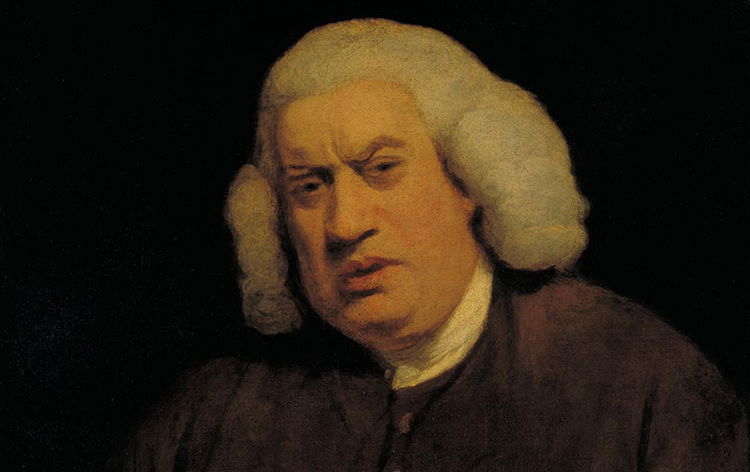 ‘Ursa Major’, The Great Bear, was the pet name many of his friends used for Samuel Johnson; and we habitually think of him now as some indestructible great beast, larger than life, typical of that ‘John Bull’ character of which 18th-century Englishmen grew so proud. Tall, big boned, big featured and inclined to fat, Johnson ate with gusto, not to say greed (‘I mind my belly very well, for I look upon it that he who will not mind his belly will scarcely mind anything else’) and could knock back the drink (claret for boys, port for men, brandy for heroes, was his watchword). Constitutionally, he was strong as an ox, and despite an assortment of medical afflictions such as asthma and dropsy he lived to the very respectable age of 75. And in his heyday he was surprisingly athletic, a strong swimmer who also had a penchant for climbing trees. When he was well into his sixties, he stood up remarkably well to his gruelling jaunt round the Highlands and Islands with Boswell.
Johnson was fearless and indifferent to danger – he had no hesitation about taking on ruffians in the street, and his physical courage reflects that moral strength and conviction which seems the very heart of the Great Cham. Sometimes Johnson would unflinchingly champion unpopular causes, such as the plight of minorities and the oppressed (‘here’s to the next insurrection of the negroes in the West Indies’, was the toast of that great hater of the un-Christian institution of slavery and the hypocrisies of the slave-owners). Sometimes his trenchant judgments would be in the service of prejudices we would now regard as bigoted and reactionary (‘the woman’s a whore, and there's an end on ’t’, was his verdict on a divorcee who sought to remarry). But whatever the subject we are accustomed to hearing Johnson as plain-speaking, forthright, manly, sure of himself, uttering his convictions as a man of principle. From Boswell, and from his own moral writings such as the Rambler essays, Johnson comes across as rock solid, a mountain of common sense humanity.
It can then come as a shock to hear the other Johnson. ‘I have been mad all my life, at least, not sober’, he confided to Boswell. Or let us peer over his shoulder as he pens his diary entry fox Easter Day, 1777:
When I survey my past life, I discover nothing but a barren waste of time with some disorders of body and disturbance of the mind, very near to madness.
And nor were these casual exaggerations or loose talk. Through all his adult life, Johnson was recognised by his friends to have some very peculiar habits. He muttered to himself, developed tics and spasms and startled people with his obsessional compulsions like touching posts as he lurched down the street. Running into Johnson for the first time at Samuel Richardson’s, William Hogarth said:
perceived a person standing at a window in the room, shaking his head and rolling himself about in a strange ridiculous manner, and concluded that he was an ideot, whom his relations had put under the care of Mr. Richardson.
Fanny Burney was no less staggered at her first meeting:
He is, indeed, very ill-favoured, tall and stout but stoops terribly. He is almost bent double. His mouth is almost constantly opening and shutting as if he were chewing. He has a strange method of frequently twirling his fingers and twisting his hands. His body is in constant agitation, see-sawing up and down.
Sometimes he even seemed to be losing control of his behaviour. In June 1766 Henry and Hester Thrale dropped in unexpectedly on their new friend. They were horrified to find him grovelling in front of a clergy-man, Dr Delap, ‘beseeching God to continue to him the use of his understanding’. The embarrassed Delap fled, whereupon Johnson cried out ‘so wildly’ in self-condemnation that Henry Thrale ‘involuntarily lifted up one hand to shut his mouth’.
The kindly Thrales gave Johnson hospitality at their home in Streatham, which did much to restore his spirits and composure. Yet even there, Johnson underwent a dark night of the soul, brooding on what he feared to be his impending lapse into insanity. ‘De pedicis et manicis insana cogitatio’ he scrawled in his diary in the decent obscurity of Latin: an insane thought about fetters and manacles. And dreading that if he lost his mind he’d be carried off to Bedlam or some other public madhouse, Johnson entrusted Hester Thrale with a padlock, so she could look after him privately if he became demented.
So what do we see here? Another face of Johnson – depressed, despairing, phobic, teetering towards total breakdown, a far cry from the rock of judgment the world knows, the father figure whom Boswell craved. It would of course be a great mistake to jump from the common image of bulldog Johnson to the other extreme, and paint him instead as a bag of nerves, a manic depressive, a disturbed personality, or a Romantic melancholy genius forever vacillating, wallowing in morbid introspection. For Johnson was indeed a fundamentally sociable man (‘clubability’ was what he loved); he possessed enormous powers of self-command and vast discipline for productive work, and his capacity for endurance was matched by his talents for enjoyment. He loved, and was loved, and carved out for himself a good share of life’s fulfilments. Contrast him to many of the writers who were his friends and contemporaries – Savage, Smart, Collins, Cowper, Chatterton – and he still seems a sane, sensible, normal man indeed.
Yet the other face has its truth too. Johnson grew unbalanced in his life habits, lurching from gross overindulgence to abstinence, pledging to reform himself but rarely succeeding. He came to dread solitude. He delayed returning home at night and going to bed, for he had grown a chronic insomniac, brooding, tortured by nightmares. From time to time he became paralysed with inactivity. ‘A kind of strange oblivion has overspread me’, he confided to his diary at Easter 1764, ‘so that I know not what has become of the last year’. In the grip of melancholy – ‘that general disease of my life’ – everything could look black: ‘life is progress from want to want’, he judged, ‘not from enjoyment to enjoyment’.
So how do we explain these black phases, his terror of losing hold on his mind? Many have thought the some organic disease was at the root of it all. Doctors have diagnosed Johnson’s tics and spasms as caused by St Vitus’ Dance or some similar physical syndrome. It has been suggested that his difficult birth – he was born ‘almost dead’ – and his contracting scrofula in infancy (he was one of the last people in England to be touched for the King’s Evil by Queen Anne) may both have undermined his later mental health. But there is little positive evidence to back up these surmises and Johnson himself was insistent that his tics were not physical in origin, but stemmed from bad habits.
In this century of psychoanalysis, Johnson could hardly have escaped being put on the couch, and Freudian explanations have been offered of his neuroses, harking back to his parental background (that ‘house of discord’) and his sexual problems. There is something in this. Johnson himself spoke of his ‘vile melancholy, inherited from my father’; and he clearly had a fraught love-hate relationship with his mother, whom he revered out of filial duty, but also found demanding and impossible to please. Once young Sam had escaped to London, he didn't revisit his mother during the 19 remaining years of her life, not even on her deathbed, so great were the pressures and tensions between them. And there is no doubt that after the death of his wife Elizabeth (‘Tetty’), Johnson suffered grief and lasting sexual frustration, mingled with guilt and desire. He never remarried, but carried on a protracted tangled platonic relationship with Mrs Hester Thrale, probably wanting her to act towards him more like a mother than a lover.
But prying into the intimate secrets of figures so far back in the past is a risky business; and in Johnson’s case there is no real need to probe deep in to his infancy and his unconscious to explain his traumas, for they lay closer to the surface than that. For Johnson’s dreads and depressions arose out of the way his life had turned into a constant struggle.
Winning recognition as a writer cost Johnson enormous psychic effort. Born (as he told Fanny Burney) ‘nothing and nobody’, and humiliated by being forced through sheer penury to quit Oxford without a degree, he became a writer in London’s Grub Street; and it was only by dint of mind-destroying literary drudgery – first hack journalism, and then the gargantuan labours of the Dictionary (1755) – that he won a name and some financial respite. Proud but embittered, Johnson envied the cultivated leisure of gentlemen of letters. Escaping from overwork, he took refuge in bouts of dissipation and indolence.
But the combination of idleness and solitude proved psychologically disastrous for Johnson. For he became a prey to his thoughts. He brooded on the past and saw phantoms in the future; he chewed over his temptations, his guilt, and pondered the ‘vacuity of existence’. And, most dangerous of all, seeking oblivion from the burdens of consciousness, he would give himself over to ‘vain imagination’. But this ‘disease of wishing’ was bound to prove the road to madness, for reason thereby surrendered its control over his mind. Johnson himself was only too well aware of this; he had already pictured it all in the episode of the monomaniac astronomer in his moral fable, Rasselas. But habits of oblivion-seeking were hard to break, and Johnson’s fears only fanned his anxieties, as Hester Thrale pointed out:
Mr Johnson’s health had always been bad since I first knew him, and his over-anxious care to retain without blemish the perfect sanity of his mind, contributed much to disturb it.
To break the grip of sloth, Johnson looked to religion. A Christian by conviction and feeling, Johnson prayed and devised religious disciplines to strengthen his resolve to lead a regular life, free of dissipation. But for every hope that Christianity gave him, it multiplied his fears tenfold. For Johnson constantly viewed himself as a guilty sinner in the eyes of God, whom he regarded as a severe task-master (indeed vengeful, an ‘implacable Omnipotence’ possessing the ‘quiver of Omnipotence, stored with arrows’). Johnson dreaded death and annihilation, and religion quenched those fears; but only at the cost of another fear, no less grave, the terror of damnation. And when asked what he meant by damnation, he replied, ‘being sent to Hell, and punished everlastingly’.
It was the bitterness of his early days, the struggles of a proud and singular man against neglect, that left Johnson prey to depression, caught between the agonies of a life of endless striving and the guilty indulgence of relaxation. But it was his theology which sharp-focused his terrors, redoubling his conviction of unworthiness in his Maker’s eyes.
Boswell knew Johnson when he was at the height of his success and fame; through Boswell’s eyes we see Johnson in song, expansive, triumphant. Boswell’s is a faithful, but a partial portrait. We should never forget the anguish and the agonies Johnson had to undergo to get himself there, transforming himself from a nobody into the ‘great Cham’ of English letters.
Roy Porter is senior lecturer in the social history of medicine at the Wellcome Institute.