Youth Rebels of the Third Reich
Tom Neuhaus looks at the subversive young Germans known as Swing Youth who refused to have their hobbies and tastes dictated to them by the Nazis.
On March 2nd, 1940, police and Hitler Youth patrols raided a dance party in Hamburg’s Curio-Haus. What they found was contrary to all National Socialist notions of proper German behaviour. The people present:
"... were dancing virtually exclusively Swing, from its tamest to its wildest forms. Doing that whereby they would project their upper torso and wiggle their lower body. Also, on several occasions four to six people would dance in circles, jump, clap with their hands, yes even roll the back of their heads... Many girls wore make-up and conspicuous hair-styles, with a touch of demimonde."
A month before, a similar party had been raided and the police reports had complained that ‘with some people you could seriously doubt what their state of mind was, considering what was going on on the dance-floor’. The term coined by the Nazis for the young people they encountered during such events was Swing-Jugend – Swing Youth, reflecting the appetite for English and American jazz and jitterbug. Together with the so-called Edelweiss Pirates (tightly-knit gangs of anti-authoritarian youths, first formed in Western Germany at the end of the 1930s, and who often targeted the Hitler Youth) they were the most prominent group of non-conformist adolescents and young adults in the Third Reich (usually aged between fourteen to twenty). Followers of Swing jazz, however, were not just to be found at large parties. Many Swing kids frequented smaller bars and cafes, hung out in parks or at railway stations, or simply met at home to listen and dance to their favourite music. The phenomenon was especially widespread in Berlin and Hamburg (Swing kids here were particularly drawn to British influences reflecting the port city’s strong shipping links with England), but it was also present in most other German cities.
One thing the police and the Hitler Youth patrols did during the second big raid in Hamburg was to establish what numbers of those present were members of the Hitler Youth, the male youth organization of the Third Reich. They discovered that of the 237 male participants fifty-two had left the Hitler Youth while fifty-eight had never even joined. Among the 171 girls, five had left the German Girls’ League (BDM) and sixty-nine had not joined in the first place. This constituted a significant proportion given that membership of both the Hitler Youth and BDM had been compulsory since 1936. Of course, membership in one of the youth organizations of the Third Reich did not necessarily preclude attendance at a Swing party. In fact, there existed occasions when entire Hitler Youth groups consisted of friends who were opposed to the official line. One Swing fan Hans Peter Viau recounted that he liked going to Hitler Youth evenings, where he and his friends ‘were among like-minded people and laughed about the slogans of the Nazis’. In other cases, and as the authorities very much feared, staunch members of the Hitler Youth were actively converted to Swing by their friends and suddenly started to grow their hair long and wear extravagant clothes.
The Swing Youths resented the rigid, conformist codes of behaviour advocated by the Third Reich and pressed upon young Germans by the regime. They expressed their rebellion in a number of ways, most obviously in terms of their dress and hairstyles. Boys often grew their hair long and wore it slicked back. Key elements of the Swing costume included English-style double-breasted suits, long jackets, American-style zoot-suits as worn by Black American musicians, hats and coats, provocatively accessorized with a foreign newspaper. Heimo Gericke described himself and his friends as people who
... preferred Swing steps to goose-steps, wearing long hair but never a uniform, letting the Daily Mail dangle out of the pockets of overly long jackets, behaving in a rather un-German manner.
The look was deliberately and startlingly different to the uniform of the Hitler Youth, which kept young people in shorts and sober brown shirts until the age of eighteen, their hair short (for boys) or in neat plaits (for girls). Swing Girls attempted to resist the conformity of the German Girls’ League by emphasizing their individual femininity. For Charlotte Heile, for example, fashion was of supreme importance. She described her appearance, including conspicuous make-up and lilac lipstick, as the ‘crass opposite of Hitler’s ideal woman’. The notion of the independent woman who went out, smoked and drank had been abhorrent to large parts of society from the 1920s, and even earlier, and was seized upon by the Nazis as the anti-model to the obedient housewife and mother idealized by National Socialism.
The eccentric, conspicuous appearance of the Swing Youths was mocked in several Hamburg newspaper articles. In August 1940, a journalist ranted:
Gross-Flottbek [part of Hamburg] is not Mayfair. Anyone who does not like that, can emigrate... And smart boys, crouching at the bar, at smoketime playing nightclub with the shagpipe are not up-to-date – if they ever have been.
What was particularly hard to swallow for the Nazi authorities was the admiration Swing Youth displayed for British and American culture. The appetite for, and interpretation of, these particular foreign influences took on an increasingly subversive edge after the outbreak of the Second World War. The majority of Swing Youths were opposed to the conflict. In February 1943 an incident was reported in which Hamburg students (one of them an English citizen) had organized a party in an old church. During the event one of the youths began to imitate the Joseph Goebbels, asking, in a mock speech, whether Germany wanted to continue fighting Britain, to which all those present replied no. A Reichsjustizministerium Report of early 1944 observed:
They do not appreciate the success of our forces in the field, and even disparage the ultimate sacrifice of our men in uniform. What follows next is the inevitable and clearly discernable hostility toward any military service of their own. Clique members show off by dressing audaciously in British-style clothing ... They mimic the decadent English way of life, because they worship the Englishman as the highest evolutionary development of mankind.
Jazz, may have been one way of escaping the fear of being conscripted and sent to the front. Swing Youth Heiko Haupt recalled how before he and his friends were sent off to Russia they came together for a final party:
The night before we left we put up a last unique Swing evening in our barracks, played music from the gramophone. And we said goodbye – not only to the music. Many of our comrades I would never see again. They died in the name of the Führer.
The style-conscious affectations of the Swing kids took on a class dimension. Walter Jens remembers that the Swings at his school:
... really were snobs. Snobby and conspicuous. At that time you wore shorts until you were sixteen. Then knickerbockers. Long trousers were only worn when one was older. And they were looking spick and span, those boys with their jazz.
But their aristocratic appearance belied the truth about their backgrounds. Many poorer young people found their own ways of following the trend. Günther Discher, for example, bought a cheap second-hand gramophone and earned money dealing in Swing records. (After the Nazis placed more and more restrictions on the production of these records from 1937, this proved quite a lucrative business). Others, including Heiko Haupt, tried to earn extra money by grocery shopping for neighbours including the prostitutes of Hamburg’s red-light district. Ernst Jandl managed in the time-honoured teenage way by only going to the cheaper bars, such as the Dohner Diele, where he would sit ‘nursing one cocktail for the entire night’. Poorer youngsters went to cheaper places, such as the ice-skating arena in the Hamburg park Planten on Blomen, the Cap Norte or the Café König, and rich ones frequented more elegant establishments, such as the Trocadero or the Tarantella Bar, but their motivations and attitudes were roughly the same.
Whether rich or poor, the aristocratic appearance of many Swing Youths was further provocation to the Nazi authorities. In official rhetoric, National Socialism was supposed to transcend all barriers of class and status. Nazi propaganda could be used against any members of society who behaved in a conspicuous way. The Swing Youth were accused of ignoring the welfare of German society as a whole in favour of their own individual well-being. Swing Youths were portrayed as a cancer to the social body, and as a sexually licentious phenomenon decried as Hot-plague that posed a danger to society.
While many young people who joined the Hitler Youth in its early period may have experienced it as a sanctuary and an escape from authoritarian parents, those who joined during the second half of the 1930s came to regard it as an organization dominated by uniformity, rigid discipline and violence (many who became Swing Youth were born in the mid-20s and fell into this latter group).
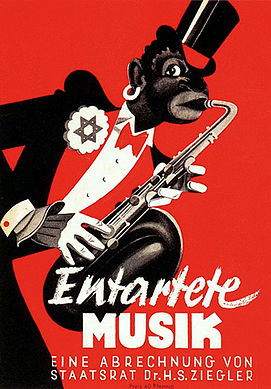
Nazi notions of physical conformitity also extended into the realm of dance. Advice manuals suggested that Germans should dance ‘as if a stick was going though the entire body from head to feet’. Swing jazz, on the other hand, was wild, free and unpredictable, and was therefore quite unacceptable to the regime. Swing dance was depicted as slovenly and monkey-like. The derogatory association of monkeys, Swing musicians and African Americans, was developed in both propaganda posters and films. In the propaganda film Around the Statue of Liberty, the commentator suggested that Swing dancing New Yorkers could easily be mistaken for African ‘savages’. The police report of one of the Hamburg raids on Swing establishments compared the Swing Youths to ‘hysterical negroes at war-dances’.
The National Socialist government was far from powerless in its fight against the Swing Youth. From the early 1930s there had been some regional prohibitions of jazz-like music, such as the one on Berlin Radio from April 6th, 1933. In October 1935, Reich Broadcasting Director Eugen Hadamovsky had officially pronounced a ban on ‘Nigger-Jew Jazz’ on the radio. The brief reprieve for American music during the Berlin Olympics in 1936, when Germany wanted to present itself as open and peace-loving, was followed by a backlash that culminated in the exhibition of Degenerate Music in Düsseldorf in 1938, described by one commentator as:
... a picture of a veritable witches’ Sabbath portraying the most frivolous intellectual and artistic aspects of Cultural Bolshevism... and the triumph of arrogant Jewish impudence.
But none of this was sufficient to eradicate the influence of Swing and similar dance music. Two years into the Second World War Goebbels realized that ‘our people and our soldiers want light music’. Consequently, he created the German dance and entertainment orchestra (Deutsches Tanz- und Unterhaltungsorchester), which, he hoped, would draw people away from foreign radio stations. At the same time, it fulfilled a propagandistic role by producing anti-Allied skits such as ‘Goodbye England, your golden days are over; Goodbye England, German guns are shelling Dover’. Some listeners may well have preferred to listen to dance music without incurring the risk of being prosecuted by the police, Gestapo or Hitler Youth patrol. Most Swing Youths, however, were thoroughly unimpressed: Emil Mangelsdorff, a Frankfurt jazz musician, felt that the music of the German dance and entertainment orchestra was ‘not that good’ and posed ‘no competition at all for American jazz’.
But not only did the Nazi regime set out on a crusade against American culture and music, it also occupied itself with the question of what to do with the Swing Youths themselves. During the Second World War, German authorities in many cities feared that the moral degeneration of the German youth would lead youngsters to reject soldierly and patriotic values – in effect, a ‘heroic’ death on the front. At a meeting held by the Hamburg youth authorities in February 1940 ‘the growing decline of the youth’ was heavily deplored:
Female and male youngsters below the ages of 16-18 loiter about in dancing establishments ... There they are looking for opportunities to immerse themselves in excesses of all kinds – especially moral ones. Proof of this is the stark increase in venereal disease, by which today’s youth is touched to a great extent.
In order to combat this surge of degeneracy, young people were bombarded with a wealth of propaganda. Articles in the Hamburger Gaunachrichten, a fortnightly newspaper, reminded their readers that the Swing Youths were ‘playing hell with the dignity of their home country at war’. Maybe it was hoped that describing the Swing Youth in such terms would encourage denunciations from ordinary citizens. Equally, newspapers implicitly attacked the lifestyle of the Swing Youth by discrediting America and Britain as ‘world pirates’. As educational material of 1942 put it, America, ‘as a result of its rapid growth and its tendency to gigantomania has become a perversion of European culture’. The Hitler Youth, on the other hand, was extolled for producing toughened, sun-tanned, enthusiastic boys. Drawing attention to the benefits of the Hitler Youth was certainly a safer method of propaganda than pointing to an implicit example of the failure of the regime, such as the Swing Youth.
But the regime was prepared to go one step further in order to establish both mental and physical control over the Swing Youths. Even though many Swing kids never consciously denounced National Socialism and their lifestyle was merely a coping mechanism to survive the Third Reich, the regime nevertheless felt threatened by them. One of the mildest forms of intervention was suffered by Günther Lust who was sent to get his hair cut and forced to watch the anti-American propaganda film Around the Statue of Liberty, in which a commentator fumed at shots of African Americans dancing to Swing music. However, for many Swing followers the consequences of their passion proved more serious. Many of the Hamburg Swing Youths were arrested and detained from 1939 in the police prison in Fuhlsbüttel. The flimsiest of charges or denunciations became sufficient grounds for arrest. ‘Before you were put into the cell,’ recounted Werner Krebs, ‘you had to stand facing the wall. Next to me two people were whispering. Paul [one of the most infamous policemen in Fuhlsbüttel] grabbed one of them by his hair and banged his head against the wall’. The political scientist and Swing fan Ralf Dahrendorf remembered that, after being arrested, ‘[the Gestapo] man pulled a cane out of his desk and hit me on my fingers’. From the confiscation of records via the enforcement of paramilitary training to the detention of Swing Youths in Fuhlsbüttel or, for longer periods of time, the Jugendarrestanstalt Bergedorf, the Nazi authorities had a range of measures at their disposal. In most cases, these had been greatly facilitated by the abolition of the separation of powers between the judiciary and the executive, as well as the forced co-operation between police authorities, schools and Hitler Youth. After the new ‘police regulation for the protection of youth’ (Polizeiverordnung zum Schutze der Jugend) had come into effect, joint Hitler Youth and Gestapo patrols roamed the streets and bars of many large cities to find youngsters who were ‘loitering about on public streets and in public places after dark’.
The role schools played in this is more ambivalent. On the one hand, many teachers wrote reports on the Swing Youths, and one teacher in Munich even addressed the Ministry of Schools and Culture with the plea to make use of teachers in juvenile courts so that juvenile delinquency could be dealt with more effectively. On the other hand, Hamburg’s Oberschulrat Mansfeld criticized the Hitler Youth as ‘very often boys had come to him and said that they no longer wanted to do service, as the service had nothing to offer’. During a conference following the raids against the Swing Youth in 1940, Mansfeld apparently ‘became quite abusive towards the Hitler Youth during his talk’. Some Swing Youths that had been expelled from their schools were also able to find private schools that took them on.
The final step that the government in Berlin had in store for the Swing Youths was taken when Heinrich Himmler, head of the SS, and Reinhard Heydrich, head of the security service of the SS, decided (from 1940), ‘to put into a concentration camp all leaders of the Swing Youth, the male and the female ones, and among the teachers those who are hostile towards the Third Reich and support the Swing Youth.’ A special youth concentration camp was adapted from an adult camp and opened to accommodate them in August 1940 in the middle of Moringen, a village near Göttingen in the centre of Germany. A similar concentration camp for girls was opened in Uckermark in 1942.
In Moringen, inmates were separated into different blocks with the Swing Youth being held in the St-Block – for political prisoners. Other blocks were reserved for juvenile delinquents and young people who were supposedly ‘genetically and racially inferior’. The daily life was designed to be as harsh as possible, and, as the report of a visitor to Moringen states, punishment consisted of ‘eight, ten or fifteen cuts and detention of up to twenty-one days’. Hans Peter Viau remembers that in the concentration camp of Neuengamme ‘punishment was the only means of education. It consisted of fifteen cuts with an ox-whip... After the fourth cut [the person being punished] would have stopped crying. He was already unconscious.’
The Swing Youths imprisoned in Moringen were forced to work in the nearby ammunition factory of Volpriehausen. Günther Discher had to work in the salt mines where he:
... manufactured grenades and stacked cartridges. Ten or twelve hours a day, even on Saturdays. It was sheer torture, especially if you were half starved. On Sundays we often had to report for work with the farmers of the surrounding areas.
But Günther also reports that imprisonment in a concentration camp did nothing to quell his enthusiasm for music. He and his friends continued to improvise jazz rhythms vocally and with makeshift instruments while working in the shafts of the salt mines. ‘Well, it was a memory, and it was something to hold onto; it was very, very positive for cheering up I may say.’
After the end of the Second World War, jazz remained popular among many young people. Indeed, music continued to provide a means of escaping from the dire realities of everyday life. Gradually, however, Swing jazz began to be superseded by other forms of music, most notably, of course, by rock’n’roll. Many Swing bands broke up as demand for their music decreased. Yet, over the past fifteen years there has been a certain jazz revival, and the case of the Swing Youth has begun to be used to teach young people in German secondary schools about the issue of resistance in everyday life. The legacy of the Swing Youth, therefore, goes beyond its music.