When is a Slave Not Really a Slave?
After bringing slavery in the West Indies to an end in 1834, Britons differed over how to treat other forms of oppression around the world, says Richard Huzzey.
 Sir Arthur Helps, author and later dean of the Privy Council, turned his eyes to the stars and cast his imagination towards alien life in far-off places. Writing in 1855 he mused that other planets in the galaxy might be very similar to Earth in their histories and developments, throwing up equivalent civilisations and institutions, but that any visitors from those worlds would sadly discover that the most unusual thing ‘in the records of our Earth may be its commercial slavery and its slave trade’. He viewed an inter-racial, intercontinental slave trade as distinctly aberrant and abhorrent because it existed outside the patterns of history that he assumed to be natural, inviolable and progressive. Helps discerned that there was a ‘natural’ phase of slavery in ancient societies, such as Greece or Rome, which was ‘gradually modified by Christianity and advancing civilization’. However, he believed that the early modern slave trade of the New World indicated Christendom sliding backwards, with Europeans re-establishing forms of slavery in their Atlantic empires.
Not everyone in 1855 thought about extra-terrestrials when they imagined the schematics of history, civilisation and labour. But Sir Arthur was typical in considering slavery in these broad terms as he and other Britons attempted to categorise and explain the great variety of forms of human labour and servitude they encountered around the globe. In the 20th century, bodies such as the League of Nations and the United Nations have struggled to create their own concrete and legal definitions of slavery. Their problems mirror those that Victorians faced when projecting British power or ruling imperial territories. Following the acts that abolished the slave trade in 1807 and West Indian slavery after 1833, Britain’s empire was transformed into a declared enemy of human bondage. Yet the inadequacies and omissions of subsequent debates over slavery do not simply reveal the limits of British abolitionism; they also demonstrate the complexities of Victorian thinking about race and empire.
Closer to home
Deciding how to recognise slavery was not simply a question for imperialists or diplomats abroad. Plenty of reformers within Britain used the popular campaigns for slave-trade abolition and Caribbean emancipation to demand that similar attention be paid to the political rights or material comfort of working people at home. The industrialist Richard Ostler, in an 1830 letter promoting factory regulation, pitied those children:
... who are compelled (not by the cart-whip of the negro slave-driver) but by the dread of the equally appalling thong or strap of the over-looker, to hasten, half-dressed, but not half-fed, to those magazines of British infantile slavery – the worsted mills in the town and neighbourhood of Bradford!!!
His description of industrial toil as ‘Yorkshire Slavery’ caught on with American slaveholders in the following decades. Eager to rebut British taunts or deride visiting abolitionists, partisans of the US South produced pamphlets, such as the White Slaves of England (1853), or cartoons contrasting happy African Americans with miserable factory employees in Manchester.
Because Victorians overwhelmingly rejected human slavery as a barbaric, savage practice, there was great advantage for any domestic cause appropriating the motif, whether in the manufacturing squalor of northern England or the rural poverty of Ireland. The British actress Fanny Kemble, criticising the slave system she had seen in America, rejected such crude comparisons, with the oft-repeated logic that while ‘the negroes are fed, clothed, and housed, and though the Irish peasant is starved, naked, and roofless, the bare name of freemen – the lordship over his own person, the power to choose and will – are blessings beyond food, raiment, or shelter’.
While there were plenty of rhetorical appeals to make comparisons between slavery and other forms of suffering, the ownership of human beings as property was commonly accepted as a literal definition. Poverty, political exclusion or dependence on wages were usually compared with slave ownership, rather than defined as forms of slavery. However British radicals’ comparison of New World slavery with British industry was influential enough for ‘wage slavery’ and ‘chains’ to figure prominently in the work of Friedrich Engels and Karl Marx. While they differed from liberal economists in casting wage exploitation as a new manifestation of the evils of slave ownership, Marx and Engels shared with most Victorian Britons a view of past human civilisations progressing through stages of development. This model of social change is familiar today as part of Marxist theory, but their view of slavery owed far more to British abolitionist debates than the historical realities of the ancient world or feudal Europe. If an establishment courtier like Sir Arthur Helps disagreed over parallels between slavery and industrial waged labour, he and other authors shared this historical perspective with Communist thinkers.
Civilisation and the Americas
At an 1858 meeting of Liverpool’s Historic Society the local attendees listened to a paper about Anglo-Saxon and Norman slavery and villeinage, quite conscious of the parallels between African slavery in America and the coerced labour of the ancient Britons. The vote of thanks noted an important distinction, however, as US slavery ‘was a perfectly new thing’ since it placed ‘an active, commercial, intellectual race’ in dominance over ‘a race occupying a position in the social scale distinctly lower’. While the ‘study of past slaveries would be valuable’ in contemplating the dismantling of modern ones, the society’s grandees saw the racial difference of skin colour (and with it presumed inferiorities of mind or culture) as marking a sharp break from historic systems of coercion and human ownership.
Among those Britons travelling to the early United States, many authors committed to paper their impressions of the South’s so-called ‘peculiar institution’. One of them was James Stirling, a reformist free trader, whose Letters from the Slave States (1857) offered some crude remarks about American slavery. It was doomed to die within the young republic, Stirling thought, because ‘[s]lavery may subsist in Brazil or Cuba, among degenerate, sensual races, but it cannot exist side by side with Anglo-Saxon civilization’. By drawing a distinction between Anglo-American cultures and those empires of Mediterranean extraction, Stirling offered an unusual interpretation of slavery between races. For him the abuses southern European whites wrought on Africans might continue as a symptom of Brazilian or Spanish degradation, but British and American civilisation could not be likened to such a primitive throwback. He was on safer ground in advising fellow Britons that ‘[t]he course of all modern civilization has been from serfdom to freedom’ and that maintaining slavery in a modern society would be ‘to reverse the course of history and civilization’.
Still, if most Victorians agreed that human slavery moved against the grain of modern civilisation, they disagreed quite violently about how it should be dismantled and when or where it was Britain’s place to intervene. In some cases this hinged on technical or ideological differences over a matter such as using the Royal Navy to suppress the transatlantic slave trade. Even more problematic, some radical abolitionists wanted to see Victorian Britons abstain from importing or purchasing the produce of slave labour. Clashes over the practicality or desirability of this tactic necessarily ventured onto questions of how far an ‘advanced’ power like Britain should hold trading partners or allies to the same moral standards. Debating the importation of sugar from Brazilian and Cuban slave plantations, the MP and founder of the Economist James Wilson admitted in 1848 that ‘as soon as civilisation had sufficiently advanced, it was the duty of every country to increase the liberty of her people as far as possible, and to put an end to slavery’. However, he explained, no nation ‘in the course of its rise from barbarianism to civilisation had not passed through a condition of things, wherein a great mass of her population were exposed to slavery’. On this basis, he suggested, it would be impractical and counterproductive to cut off commercial and fraternal links with the slaving powers of the New World, which could not be expected to embrace enlightened Victorian views of anti-slavery.
While trade allowed businesses to profit legally from slavery in such circumstances, ownership of slaves or participation in slave trading was wholly forbidden. In the years after the emancipation of West Indian slaves in 1834 a series of further laws or instructions had closed the possibilities for British slave ownership on foreign soil. However there were semi-legal and illegal evasions, many of which we will never uncover. In a rare documented example the St John d’el Rey Mining Company, based in London, maintained a contract hiring Brazilian slaves from their owner. This was legal because it was signed before the 1843 British ban on the practice and treated them as contractors supplied by an employer, not slaves leased by their owner. However in 1879 Brazilian campaigners revealed that the company retained them in slavery, even though the contract of hire had expired a decade earlier. Some dodgy accounting and fictional contracts did not convince the British government, who left the company to the mercies of Brazilian law. However there was never any prosecution in the British courts of the directors, who were conveniently oblivious.
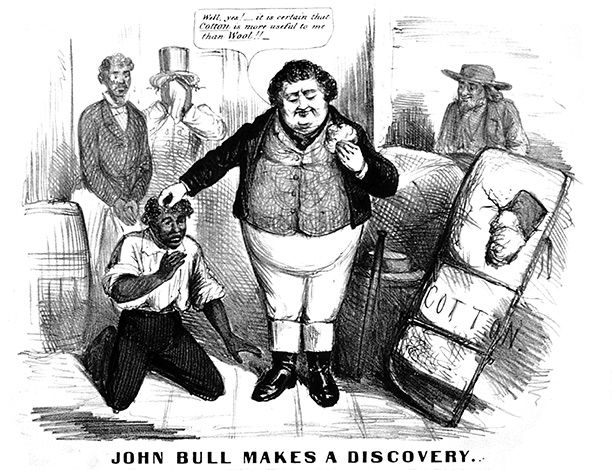
Members of the Bradford Chamber of Commerce discussed their own concerns about profiting from slave labour in August 1858. The merchants were debating a possible alternative supply of cotton, from West Africa rather than the slave plantations of America. While their mills’ dependence on the raw produce of slave labour was morally or politically embarrassing, the West Yorkshire entrepreneurs were more worried about the security of their supply. While advocates of a scheme to develop cotton plantations in Africa admitted that forms of slavery did exist in that continent, they argued that ‘[s]lavery in Africa was a very different thing from that which prevailed in America. It was domestic slavery, in which the intellectual condition of the slave owner was very little raised above that of the slave. Indeed there was such an equality between the slave owner and the slaves that they stood on nearly the same footing and there was none of the degradation associated with the condition which prevailed in America’. This meant that intraracial slavery could be accepted as a feature of their cotton supply chain, especially since this ‘traditional’ slavery was stable and natural for an ‘uncivilised’ society, unlike African-American servitude.
The racial distinction – between the evils of slaveownership amid ‘civilisation’ and the naturalness of ‘domestic slavery’ amid ‘barbarism’ – would take on new prominence in the years after the American Civil War. While the Bradford merchants and other investors enjoyed little success in cultivating alternative sources of cotton, their tolerance for African slavery, as distinct from its western form, illustrates an important body of thought. Some Britons, unlike the cotton dealers, thought that this was a weak excuse. One newspaper letter-writer noted that when seeking cotton from Africa, as advocated by missionary David Livingstone as the best way of breaking dependence on US slave cotton, ‘you must, in the first place, in my opinion, do away with the African system of domestic slavery, or, otherwise, I fear, you would only be shifting the locality’. In general, though, in the 19th-century British Empire, administrators and the public following their deeds back home clung to these historical excuses for ‘domestic slavery’ in very different societies, shaping the context of colonialism and revealing the intricacies of racial and civilisational thinking.
Slavery and empire
If traders could accept the produce of slave labour legally, then recognising or encouraging slavery in Britain’s overseas colonies was definitely unacceptable. This was less of a clear-cut rule than we might expect, however, given the fluid way that Britons define what was (and what was not) slavery or what was (and what was not) one of their colonies. Before the last quarter of the 19th century little of Africa was occupied by Britain or its European rivals. However, from narrow coastal bases such as the Cape Coast colony British administrators could wield powerful military and political influence beyond the formal borders of colonial occupation. In 1842 a government inquiry had exposed problems in the Cape Coast, where the governor sat in judgement on African disputes involving slave property. While these slaves resided in the informal protectorate of the colony, his involvement set a worrying precedent for British complicity and legal recognition of African slavery. These forms of servitude were ignored by British law, but as the political frontiers of the empire expanded into the poorly charted interior such ‘traditional’ slaveries survived in various forms across the continent.
‘The slaves are not worse treated than the wives,’ reported a Belfast newspaper in 1851. ‘Domestic slavery in Africa itself is not a very bitter servitude. The African who has not been a slave is almost always a good-humoured master,’ it suggested. Such arguments excused Britons from moral obligations to end an institution that did not stimulate a rapacious, foreign slave trade to export captives or involve uncivilised backsliding by modern European nations. As the Pall Mall Gazette reminded readers, while ‘we may think it right to deal with domestic slavery as an institution, the slave trade from without stands on quite a different footing, and we are bound not only in humanity but in policy to check a traffic which tends directly to promote bloodshed and violence beyond our territory and to endanger peace within its limits’.
The treatment of African slavery in the Gold Coast and other colonies was heavily influenced by British experience in India; on the subcontinent the East India Company removed the legal status of slavery in 1843 but took no action to alter existing obligations and coercion of labour among Indians. Remarkably, British officials banished the word ‘slave’ from their vocabularies, discovering that their households instead employed ‘servants’. When change seemed impossible, despite slavery being unthinkable on British soil, a change of language and a silent alteration of the law could offer emancipation with less pain, expense and danger than the more meaningful alternatives. Moreover the 1840s also saw the creation of a new supply of labour migration to the underpopulated reaches of the Empire. Contracts of debt labour, called indentures, were sometimes offered to Indians, some of whom were forced to enter into them.
The idea of ‘delegalisation’ by the stroke of a pen, rather than emancipation by state interference, was easily transferred to West Africa. By 1874, as the Gold Coast colony was reorganised following a war with the Ashanti people, one journalist observed that ‘the idea of letting slavery quietly remain a recognised institution in a place over which we have such a control and such an influence, did not sound well’. A group of African intellectuals in the colony formed their own anti-slavery society, lobbying the governor and his London Colonial Office superiors to destroy ‘domestic slavery’. Slaveholding elites and cowardly Britons were less enthusiastic, but the metropolitan press and humanitarian lobbyists were eager for action. When Conservative ministers attempted to rehabilitate old American arguments of slavery being a ‘peculiar domestic institution’ best left alone, they were openly mocked. As some historians of Africa have recently uncovered, the carefully-cultivated ‘official mythology’ of slaves’ satisfaction with ‘domestic slavery’ was disproved by the eager response of those liberated. Indeed the experience of the Gold Coast emancipation was so dramatic that British administrators sought indentured labourers from elsewhere to maintain export production; moreover in other colonies officials ensured it was far harder for slaves to escape and strike out on their own, thus ensuring that legal freedom did not result in political, social or economic change. A modified version of this formula provided the basis for Frederick Lugard’s famous system of ‘native rule’, which removed the sanction of British law from institutions such as ‘domestic slavery’, allowing existing rulers or religious courts to maintain the status quo.
In the last quarter of the 19th century Victorian ideas about anti-slavery contributed to Britain’s role in the scramble for new African colonies. In January 1874 the former colonial official Sir Bartle Frere addressed a crowd in Edinburgh, standing somewhat bizarrely alongside a life-size model of the missionary David Livingstone, who was reported missing (and, as it turned out, on this occasion he really was dead, whereas he had previously defied such rumours). Frere preached about Britain’s obligation to attack the slave trade in East Africa, in one of a series of public appeals for renewed anti-slavery activity. He saw slave trading as the root of all problems on the continent, since a ‘slave-hunting war’ to acquire captives for sale to dealers left famine, disease and political collapse in its wake.
The first generations of abolitionists, who had convinced their country to give up its transatlantic slave trade to America and the Caribbean, had succeeded in identifying the trafficking of African people as a peculiar evil, deserving particular condemnation and censure, apart from other cruelties and oppressions in a fallen world. Victorian anti-slavery champions such as Frere relied on the same rhetoric, emphasising the need to suppress East African slave trading as an ahistorical, regressive violation of societies’ usual patterns of internal tyranny. Abolitionists tended to play down the effects of ‘traditional slavery’ in order to mobilise and focus righteous anger against the export slave trades and inter-racial slavery. Frere explained that an attack on the Arab-led East African slave trade was not pointless or quixotic when
The slavery of the negro in his own country is a state of comparative freedom, since the master and the slave are never far separated in their condition, habits, or feeling, and the general status of the slave differs but little from that of the wife or child of the master of the family. It may be a very degraded state, but it is not the state of a being cut off from the rights and capacities of the master of the household.
One newspaper, supporting the calls for action against the slave trade that surrounded Livingstone’s final expedition to Africa, noted that Islamic societies supported ‘an institution coeval with Oriental society, of which the history has never been interrupted’. For the African slave arriving in the gulf states and the Ottoman Empire ‘the treatment he receives is not materially different from that of the freeman, and on his emancipation he may rise to such honour and dignity as are attainable by Orientals’. However, having excused this ‘oriental’ slavery, the paper explained that ‘the sufferings of the maritime transit’ and ‘the demoralization, debasement, and disorganization of the African communities’ provide ‘our true justification for intervention’ in suppressing the traffic.
Action against the east coast slave trade – from missionary enterprise in Nyasaland, to a chartered company in Kenya and Uganda, to control of the Indian Ocean island of Zanzibar – was not accompanied by British action against forms of slave ownership within colonised societies. Rather, officials permitted it to continue, although with the legal status of slavery removed sooner rather than later. This ‘clean hands’ approach to imperial morality was founded on half a century of anti-slavery ideas distinguishing between inter-racial export slave trades and intra-racial ‘domestic’ coercion. While this left British anti-slavery rhetoric as a dead letter in practice, it is important not to make the simplistic conclusion of condemning African servitudes as the moral equivalent of slave trading. The varied forms of ‘slavery’ or coerced labour in different African societies, however unpleasant many of them could be, did differ in important respects from the industrial, invasive and growing demand for west and east coast slave trades. Victorian abolitionists had a point in suggesting that export trafficking was uniquely dehumanising and deadly, unlike present-day racists dismissing the suffering of the Atlantic slave trade because it co-existed with African forms of slavery. It is not the business of historians to act as moral arbiters of guilt or shame, but close study of the past can dismiss and debunk simplistic attempts to weigh certain sins against others.
Founded on models of civilisational development, the distinction between natural and unnatural slaveries in ‘barbaric’ or ‘civilised’ societies relieved British imperialists of formidable social reform within the societies they claimed to rule. Moreover, such currents of thought help reveal how definitions of slavery hinged, like so much 19th-century thinking, on interpretations of history and the primacy of civilisation. Most authors and their readers would not have followed Sir Arthur Helps in applying their expectations to alien civilisations, but they often shared a racist expectation that other peoples were moving more slowly along a path comparable to Britain’s historical experience. In uncovering this messy line in Victorian logic, it could be tempting for historians to conclude that this was purely an excuse for lazy connivance in oppression. While this may have been the case, accommodation with slavery as a natural stage of human development had a longer heritage. And however much the problems of defining slavery seem to warn against indulging cultural relativism, the impossibility of categorising and accurately characterising the diverse forms of labour found in Africa, or even in Europe, let alone the world, is sobering, too. History seldom teaches usable lessons, but rather gives us a broader and better perspective in understanding the complexity, contingencies and choices framing all human societies.