Sana'a: City of the Book
Since its discovery in Yemen in 1972 a collection of brittle documents, believed to be among the earliest Koranic texts, has been the subject of fierce and divisive debate among scholars of Islamic history, as Scott MacMillan reports.
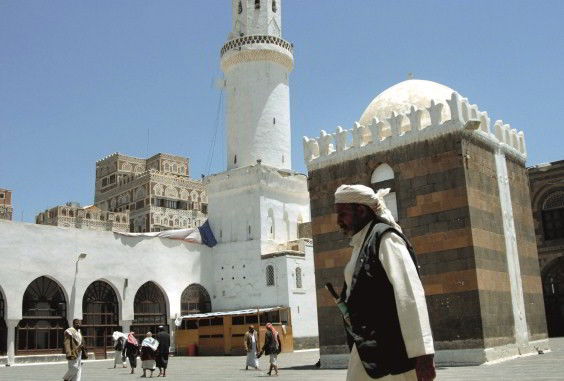 From the outside Yemen’s House of Manuscripts looks more like a jail than a library. Built in the early 1980s to house Yemen’s vast collection of medieval Islamic writing, the boxy structure stands surrounded by barbed wire and is incongruously devoid of charm amid the cobbled warrens and ancient tower houses of Sana’a, one of the world’s oldest continually inhabited cities. The Grand Mosque next door is thought to contain architectural traces of the mosque erected on this site by order of the Prophet Muhammad himself. The drab appearance of the House of Manuscripts belies the significance of what lies within.
It is here that the Sana’a Manuscripts are kept, a trove of crumbling paper and parchment that includes some of the oldest, if not the oldest of all Koranic texts. Discovered hidden in the ceiling of the Grand Mosque in 1972, many of them have yet to be restored – small wonder considering the uproar ten years ago when a German scholar claimed they contained textual variations from the accepted Koran that called into question the Muslim belief that it is the unchanging, uncreated word of God.
It is not that the Yemeni authorities don’t want people to see the manuscripts for fear of what they may contain, as is often claimed. Despite the earlier controversy, officials at the House of Manuscripts say they want to make the restored texts available to scholars worldwide, Muslim and non-Muslim alike. In 2008 its new supervisor, Sheikh Sam Yahya Hussain al-Amhar, launched a project to restore the remaining documents, including a second stash found in the Grand Mosque a year earlier.
Contention seems to follow the manuscripts at every turn, most recently over a contract to photograph the entire contents of the House of Manuscripts, including the 1972 find. Yemeni officials blocked the deal, saying it would be tantamount to giving away the country’s national treasure; but the agreement set in motion bureaucratic changes that could lead to the complete Sana’a Manuscripts seeing the light of day.
The exact age of the texts is unknown. On a recent visit Amhar showed me several of the pages restored during the 1980s, including a sheet of verses from Sura Yusuf, the 12th chapter of the Koran, written in the rightward slanting Hejazi script of the first and early second centuries of the Islamic era – probably not later than about ad 770. Pressed to show the oldest text he can find, he produces a scrap of parchment inscribed with the Islamic year 56 (ad 676), just 44 years after the death of the Prophet Muhammad. Considering the first definitive written text of the Koran was compiled around ad 650, these are certainly among the earliest existing fragments. They are stored not in climate-controlled vaults but in wooden boxes, with thousands of pages still not restored and kept in plastic bags inside tin trunks, ready to disintegrate if not handled properly.
Gerd-Rüdiger Puin began an unfinished restoration project in 1981 and according to him some might prefer it if the Sana’a manuscripts disappeared. It was Puin, a retired professor of Islamic antiquities at Germany’s Saarland University, who told the US magazine Atlantic Monthly in 1999 that the Sana’a fragments will help prove his theory that ‘the Koran has a history’ and that the holy book is in fact ‘a cocktail of texts that were not all understood even at the time of Muhammad’. Unsurprisingly many Yemenis were not pleased. A letter appeared in the Yemen Times arguing that aberrant Koranic texts, if found, should be destroyed, just as they were at the time of Caliph Uthman (c. 579-656), the man credited with compiling the written Koran based on the memory of the Prophet Muhammad’s surviving companions.

Precious bundle
Puin’s work on the origins of Islam has been met with both dismissal and ire, but even detractors give him credit for his work from 1981 to 1985 in restoring parts of the manuscripts. Speaking by telephone from his home in Germany, he relates the story of the 1972 discovery. When workmen pulled down an oblique western wall of the Grand Mosque for repairs they revealed a long-forgotten room, a dead space at most a metre and a half high between the ceiling and the outer roof containing, along with the tattered manuscripts, some old Turkish newspapers. ‘This would indicate that there was a bundle of worn-out Korans brought into what we call a “paper grave” during Ottoman times,’ he says. ‘That means about 1900 or 1910 or so.’
At first nobody knew what to do with the discovery. The manuscripts lay in the open air, some of the leaves blowing into the streets. ‘Nobody was even entitled to be in charge of these and the situation remained like that for some time’, says Puin, who was not in Yemen at the time but bases his account on friends and colleagues who were. Eventually, Qadi Isma’il al-Akwa, the head of Yemen’s Antiquities Authority, realised the importance of the discovery and put the texts in a relatively safe place – a minaret stairway – stuffed into about 20 potato sacks.
That’s where Puin’s friend, Albrecht Noth (1937-99), a professor of Islamic history in Hamburg, found them on a visit in the late 1970s. The Yemenis had been seeking European help to restore the texts and were pleased when Noth secured German government funding to do so. Puin arrived in Sana’a to lead the project in March 1981, devising a system for sorting through the manuscripts. Emptying the potato sacks onto a giant table he and his team first separated the paper from the parchment – the collection was roughly half and half – and focused their efforts on the latter since parchment Korans were likely the oldest and most fragile.
They divided the jumbled mass of leaves according to the number of lines on each page, a way of determining which pages might belong to the same manuscript. ‘It reminded me of an imperial British post office in India’, Puin says. ‘I had bought and organised 100 or more cardboard boxes for mineral water and I glued them together and made a whole wall out of them. On every box, like a postbox, the number of lines was written, so we could, in a very short time – I think it was six weeks – distribute the whole mess into this system.’ In the end they had sorted through fragments of nearly 1,000 different Korans.
Each page had to be cleaned and flattened with light pressure in a moisture chamber to prevent cracking. By the end of his four years in Sana’a, Puin had only finished restoring about half the 20,000 parchment sheets. His successor, Hans-Caspar Graf von Bothmer of Saarland University, worked for an additional two years, completing about 20 per cent more, some 12,000 sheets in total, before money ran out. Further funding allowed Bothmer to return in the early 1990s to photograph the restored sheets, but Puin says the Yemenis created too many obstacles to allow for high-quality photography and, while the resulting 44 rolls of microfilm are good enough to read for research purposes, they fall short of publication quality. Puin says the master films are now in the possession of the House of Manuscripts, with three additional copies in Yemen and a fourth in Bothmer’s personal possession. The paper portion of the 1972 manuscripts remains untouched to this day.
Koranic history?
There is nothing controversial about Puin’s work up to this point. But after he returned to Germany he began taking a good look for the first time at the text itself, using Bothmer’s microfilm copies. In his more recent scholarly work, Puin has used the Sana’a manuscripts to support his theory that the Koran evolved over time. The Sana’a fragments are only about one quarter of the texts he takes into consideration, with others including early Korans found in libraries and museums in London, Paris and Istanbul. ‘I can’t really hide my scientific opinion that the Koran is a text with textual history and, if I say that, it is an offence against the beliefs of Muslims because they say clearly that the Koran has no history’, he says.
Many Muslim academics say Puin is just another in a long line of western Orientalists using academic discourse to disparage Islam. The Saudi Arabian scholar Muhammad Mustafa al-Azami, professor emeritus at King Saud University in Riyadh, argues in The History of the Quranic Text (2003) that Puin cannot be regarded as an expert on the Koran any more than ‘a bookbinder who completes a magnificent binding of a complex mathematical text’ should therefore be considered a mathematician.
Those hoping for an Islamic Da Vinci Code are likely to be disappointed. On Puin’s own analysis the restored fragments contain no major aberrations and certainly no indelible human fingerprints that prove the Koran has profane origins. Nor is it true, as has been reported, that Puin has been barred from returning to Yemen.
Puin, however, calls the Sana’a manuscripts ‘eye openers’. Aside from orthographic variations common in older written Korans, Puin points to at least one early Koran in the collection that had been used as a palimpsest, meaning the pages were washed clean and rewritten within about 50 years. His theory is that there must have been major changes in the content for that to have happened, since scribes would have simply inserted any minor corrections into the text. More controversially he claims to have found alternative ordering of suras. ‘This is quite a discovery,’ he says. ‘I have been writing a short article on this, but I have not disclosed the manuscript or the number of manuscripts where this can be found, because there is good reason to expect that these sheets would immediately be destroyed.’ Although reordering the suras would hardly change the message of the Koran, as each sura functions as a self-contained unit, Puin says this challenges the traditional view that the sequence was dictated by the Prophet Muhammad with divine guidance.
Not so, says Azami, the Saudi scholar. He points out that he often photocopies portions of books rather than carry entire volumes when he travels. Likewise it is logical that an individual seeking to study only certain suras would selectively copy just those, especially as some manuscripts in the Yemeni collection use such large calligraphy that an entire Koran would exceed a metre in thickness. ‘Library shelves throughout the world are filled with partially written Korans’, he writes, providing a list of over 30 such examples found in a single library in Hyderabad. Puin counters that these are merely albums of Koranic leaves, while the Sana’a Manuscripts contain the only known instances on a single page where one sura ends and another begins out of sequence.

Cave of manuscripts
It will be difficult for scholars to make up their own minds without further access to the manuscripts. Back in Sana’a I met up with Abdulmalik al-Maqhafi, the general manager of the House of Manuscripts, in a private flat he uses to browse medieval Islamic tomes and chew qat, the leafy stimulant endemic to Yemeni life. Stacks of handwritten volumes, some up to 800 years old, are strewn about a divan as he picks through a bundle of qat leaves. ‘Yemen can be considered a cave that is filled with manuscripts’, Maqhafi says. ‘But unfortunately there is not much awareness of their importance and value among Yemenis.’
Like others I speak to in Yemen, Maqhafi dismisses the entire Puin controversy as a mere misreading of old Arabic scripts. The fragments in the House of Manuscripts contain the text of the Koran, he says – nothing more, nothing less. But, like others, he is unable or unwilling to explain why the manuscripts have taken so long to be restored, even though he has worked at the House of Manuscripts since 1985. Puin claims the Yemenis could have restored the remaining pages without foreign help, given the transfer of equipment and knowledge that took place during his project, yet the remaining pages have sat untouched for 21 years. ‘There were many efforts in the past, either by individuals or official bodies, and from foreigners’, says Maqhafi. ‘But what was needed was a plan or general strategy to follow.’
The story resumes in September 2008, when the government handed control of the House of Manuscripts to the ministry of culture under a new division headed by Amhar. A relative of the late tribal leader and former parliamentary speaker Sheikh Abdullah bin Hussain al-Ahmar (1933-2007), Amhar is a soft-spoken man who came to the antiquities sector with little
experience, having previously managed the ministry’s tourism division.
Today he claims to have plans for an enlarged House of Manuscripts. ‘If we have money, we’re going to build a new building’, he says, adding that a plot has already been allocated next to Sana’a’s new Saleh Mosque. Asked to describe his vision, Amhar replies: ‘You know the Alexandria Library? Like the Alexandria Library,’ referring to Egypt’s $230 million Bibliotheca Alexandrina, which opened in 2002. He says it with a smile, a tacit acknowledgement that the ambition is far-fetched, given the scale of Yemen’s poverty and the precarious financial situation of a government that has trouble keeping the electricity on in the capital. Amhar’s current annual budget is a paltry $1 million and during our talk in August 2010 the House of Manuscripts boasted just six computers. ‘My dream is big, but my hands are small’, he says. Still, under Amhar’s leadership, the more modest goal of completing the restoration is visibly proceeding, aided by about 50 trainee students from Sana’a University. Speaking in 2009 he estimated that the project will take two to four years to complete.
Outside influence
Just as it did decades earlier, the trigger for this change came from outside Yemen. Before Amhar’s arrival the House of Manuscripts had been under the authority of Yemen’s General Organisation of Antiquities and Museums, headed by Abdullah Bawazir. The ministry of culture removed manuscripts from Bawazir’s jurisdiction because of a deal he had signed with the Juma al-Majid Centre for Culture and Heritage. Founded as a charity in 1991 by Juma al-Majid, chairman of the Dubai Economic Council, the centre sets up book and manuscript restoration ‘factories’ throughout the Muslim world, with digitised copies of restored Islamic manuscripts made available to scholars free of charge. The agreement would have given the centre the right to photograph every item in the House of Manuscripts in exchange for training and equipment. The contract concerns not just the 1972 fragments but the entire inventory, close to 10,000 volumes, most of them not Koranic texts but medieval Islamic writings on history, astronomy, mathematics and jurisprudence. There is no evidence that the Juma al-Majid Centre is interested specifically in the controversial Koranic fragments.
The deal sparked another round of outrage in Yemen and Amhar says he has no intention of allowing it to go through: ‘It’s not fair for us’, he says. ‘I’m going to give him [Juma al-Majid] photos of all the manuscripts in here, for what? These manuscripts do not belong to me, or to Abdullah Bawazir or anybody. They belong to my country.’ Later he adds: ‘You have to ask him [Bawazir] why he signed this.’
Bawazir is initially reluctant to discuss the topic: ‘I don’t want to talk about the manuscripts’, he says. ‘It’s finished. For me it’s finished. It’s not my responsibility now. It’s their responsibility.’ The conversation soon turns to the relative lack of interest shown by Arab countries in preserving Yemen’s ancient heritage. Compared with Europeans, richer Arab neighbours have shown little desire to contribute financially to excavations and preservation projects, he says: the Juma al-Majid deal was a rare exception. ‘When Juma al-Majid came, I told myself I’d like to work with them more than with the Germans or the French or the Dutch. They are close, from the area, they know the Arabic language.’ The group also offered more equipment, training and expertise than European donors, he adds.
Yet Amhar says the equipment the Juma al-Majid Centre delivered in February 2008 would damage delicate manuscripts. It sits, unused, in a storeroom in the House of Manuscripts. A brief report by two book conservators involved in the German project during the 1980s, Ursula Dreibholz and Abdulwahid al-Shami, supports this claim. According to the report, the equipment ‘presents in no way a complete conservation workshop or an equivalent in value to the demands the Juma al-Majid Centre is asking in exchange for this “donation”.’ The deal’s opponents, including Amhar, also suggest the Juma al-Majid Centre is a commercial operation, not a philanthropic one, and that it would sell images of the manuscripts for profit.
Worse still, Anne Regourd of the Department of Islamic Arts at the Louvre in Paris, who is heading a project to preserve privately held manuscripts in Zabid, a medieval academic centre in western Yemen, says she has heard accounts of the Juma al-Majid Centre giving cash payments to library owners in Zabid to photograph entire collections in a manner and at a speed that would undoubtedly damage the artefacts. At Amhar’s request she filed a report repeating what she had heard, though she adds she has never witnessed this first-hand.
One ministry spokesman told me that the contract is unfair as written and the questions raised about the equipment give the ministry an opening to back out. ‘We are lucky they didn’t comply with the conditions’, he says. The contract itself, meanwhile, is nowhere to be found. Asked at the House of Manuscripts to provide a copy, Amhar agrees, saying he will get it from his office at the ministry of culture. Later, at the ministry, an assistant says they will have to search for it at the House of Manuscripts. Finally his office tells me the contract has been lost.
Local difficulties
In Dubai officials at the Juma al-Majid Centre paint a different picture, describing Yemen as uniquely difficult among the 14 countries with which they work. The deal they offered was no different from similar arrangements the organisation has elsewhere, they say. ‘We hope to clear up this misunderstanding and to assure the people in Yemen that our factory is professional, our job is professional, and everything we do is professional’, says Mohammed Yaser Amro, its general manager.
The centre currently has 300,000 manuscripts available, including 9,000 originals dating back to the 11th century. They claim to have given Yemen equipment even more advanced than that sent to other countries, with one official adding he sent Amhar a point-by-point rebuttal of the Dreibholz-Shami report. Moreover, they say the organisation has never worked in Zabid and makes no money from the sale of manuscripts or images.
The Juma al-Majid Centre invited me to its restoration shop in the city of Deira, where equipment seemingly similar to that in the storage room in Yemen is used to restore fragile manuscripts. Nidal Kawaf, the head of the centre’s restoration section, demonstrates an air-flow cleaner in which books or manuscripts are placed under a transparent cover and cleaned using air pressure. The Yemenis claim it would damage brittle parchment since the air flow cannot be adjusted. Kawaf counters that one can easily modify it for use on manuscripts provided one lays the manuscripts flat on a rack and adjusts the air flow from the back of the machine. If that is the case, it seems the matter could have been resolved by including an operational manual.
Again seeking a copy of the disputed contract, I ask Anwar ad-Dahar, the Juma al-Majid Centre’s media spokesman, to provide one. He says he cannot share it due to confidentiality, suggesting I ask the House of Manuscripts. Told that Yemeni officials claim to have lost the contract, Dahar, who happens to be Yemeni, laughs: ‘I don’t think they lost it’, he says. ‘They don’t want you to see it.’ At this point the entire story, from the hiding place in the roof to the missing contract, starts to resemble an onion. Peeling away the final layer reveals not the long-sought truth, but merely another layer.
Spoken word ascendant
In Yemen, a land of gossips, storytellers and the occasional sage, the spoken word takes precedence over the written one. The contract, now seemingly consigned to its own paper grave, hardly matters, for the stories told in Yemen about the Juma al-Majid Centre, whether true or false, have damaged its reputation to the point where any written document is worthless, a reality the organisation will have to confront if it ever wishes to incorporate the contentious manuscripts into its digital library.
Indeed, for the Sana’a manuscripts, the primacy of the spoken word lies at the root of all intrigue. The word Koran itself, after all, means ‘recitation’ or ‘reading’. Puin faced the issue decades ago, though the subject at hand was a weightier one (infinitely so, for believers) than a lost contract.
Members of his restoration team sometimes complained that the fragments contained mistakes, Puin says: ‘When they were determining the contents of the sheet in front of them, they had to use the concordances and compare it with the printed Koran. Sometimes they discovered that there was a parchment containing a difference or a variant or another text than the printed version has. For the Yemenis this was a very embarrassing experience, but I just consoled them and said: “You know why the Koran is called the Koran. Because it is something to be read aloud. If the Koran were only there in written form, its name would have been Kutban.” They were happy with that explanation.’
He also tells of a visit from a high-ranking religious official in the House of Manuscripts’ early days. The visitor, wearing the vestments and turban of ‘a wonderful figure from the opera’, could not read the calligraphy on the page Puin showed him, but when the German scholar pointed to a word and began reading the text slowly ‘immediately he would continue, because he knew the Koran by heart’. And then the visitor said something that took Puin aback. ‘He looked at me and said: “Do you only restore the Koran?” I looked at him and didn’t know what he meant. And then he added: “Why don’t you restore useful books?” Those were his words, kutub nafiaa. “Why don’t you restore useful books, like mathematics or geography?”.’
It might seem a shocking statement for a religious man to make, until one considers that, according to Muslim belief, everything that needs to be known about the Koran is already immanent in the text recited aloud for centuries. The fragments found in the Ottomans’ secret chamber are useless scraps by comparison. Presuming that somebody finally navigates the Yemeni bureaucratic thicket and restores, studies and publicises the complete Sana’a Manuscripts before they crumble to dust, will it tell us anything new about the Koran? The ancient streets surrounding the Grand Mosque are lined with bookstalls where you can buy a copy for a few riyals – and that, for vast numbers of the faithful, is the last word on the matter.
Scott MacMillan is a freelance investigative journalist, travel writer and the editor of WanderingSavage.com