Millennialism: ‘The End is Nigh’
Penelope J. Corfield considers how catastrophic visions of the end of the world have recurred throughout history, in all societies and religions.
Scientists who research the future of the cosmos debate the possibility of a cataclysmic Big Crunch that will end everything – the inverse of the Big Bang that is the generally favoured model of cosmic origins. However, it is hard to get personally worried about such a final prospect, which is scheduled for billions of years hence. Much more immediately alarming are the dangers of drastic climate changes. Such alterations will not affect the entire cosmos but they do threaten to make Planet Earth a hostile place for human existence.
Hence the current debates about how much countervailing action is needed, and how soon. Breaking the common assumption that the framework of existence will unfold smoothly from one day to the next entails an entirely new attitude to both today and tomorrow. It jolts people awake. Indeed, it can be like a moment of spiritual conversion. That feeling is often part of the intense excitement generated by the end-of-the-world visions that recur within many religions. It is true that mainstream church leaders habitually discourage attempts to second-guess the divine plan. In momentous times of turmoil, however, caution may be discarded. Among the prophetic religions, Islam generally shuns attempts at foretelling the Last Judgement, as the Koran (7:187) specifies that the moment will come as a surprise, quite unexpectedly. In the early history of the faith, some devout Muslims expected that the world would end exactly 500 years after the first revelations to Muhammad, as the Arab philosopher Ibn Khaldun reported in the fourteenth century. However, their disappointment reinforced the view that fallible humans should not jump to conclusions. Different communities within Islam now sustain special expectations. For example, the ‘Twelver’ Shi’ites, with their very large majority in present-day Iran and with sizeable groups elsewhere, follow the teachings of the long-departed Twelfth Imam, who is now, in theological terms, deep in ‘occultation’ (concealment). His return will signal the end. However, it is not the task of believers to calculate the date. Instead, they wait, living worthily and handing on the message to future generations.
One potential sign within Islamic theology may, nonetheless, be vouchsafed by the appearance of the Mahdi, literally the ‘divinely-guided one’, who appears as the ‘messenger of the latter days’. Hence, in troubled times, various Muslim leaders (both Sunni and Shi’a) have been saluted with that title. Egypt and Sudan have seen several such holy men, associated with resistance against oppressors. In the later seventeenth century, the Mahdi Wad al-Turabi strove to protect the poor against the harsh tax-collectors of the Funj Sultanate on the Upper Nile. Another appeared in Egypt in 1799 to oppose Napoleon and the invading French army. The best-known Mahdi of all was Muhammad Ahmad ibn Abdullah, who challenged foreign occupiers in Sudan in the 1880s. He besieged and took Khartoum in 1885, killing the British commander General Gordon in the process. The Mahdist uprising was defeated militarily, but the Mahdist tradition continued within the region, where both the Mahdi’s youngest son and grandson played a significant role in twentieth-century Sudanese politics. In all these cases, the fusing of cataclysmic religious beliefs with clear political aims fortifies activists in the here and now, as is happening again today.
Abrupt finales are similarly envisaged within Jewish and Christian thought. In the Old Testament, the prophetic books of Isaiah and Daniel are central, as is the Revelation of St John the Divine – known in Greek as the ‘Apocalypse’ or the unveiling of secrets – in the New Testament. The texts are evocative yet cryptic. No precise dates, either for the start or the end of the world, are specified. This restraint, however, did not hold scholars back from trying to decipher the mystery. Among them was Sir Isaac Newton, who, like many in the later seventeenth century, believed that the world was shortly due to end. However, his painstaking studies in this field did not match the originality of his physics. So Newton eventually endorsed the Biblical warning that the date of doomsday remains ‘closed up and sealed till the time of the end’.
Whenever that occurs, however, Jewish and Christian teaching expects the advent of the Messiah or ‘Shiloh’, the redeemer who will inaugurate God’s heavenly kingdom of Zion. In Judaism, this event has yet to occur; and attempts at guessing it are discouraged. ‘Do not calculate the date of redemption, wait patiently,’ the poet-philosopher, Rabbi Jehudah Halevi, advised in the twelfth century. Nonetheless, there was a semi-secret tradition of Jewish cabbalistic writings on the theme; and from time to time, imminent claims were made. In eighth-century Persia, a tailor named Abu-Isa ben Ishak identified himself as the Messiah’s messenger and led an unsuccessful revolt against Muslim rule. He himself died in battle and most of his followers became disillusioned. But a handful of Isavites adjusted the prophecy to a longer timescale. They left Persia for Damascus, where a small sect survived for two hundred years, handing on the faith among families and close associates. Thus one outcome of a failed end-of-the-world crisis is a shift to an alternative option of prolonged waiting.
The same result occurred in the mid-seventeenth century, when international Judaism experienced a notorious schism. In 1665 a mystic named Sabbatai Zevi, from Izmir (Smyrna) in Turkey, was acknowledged as Messiah. Followers arrived from all over Europe. Even the shock conversion of Sabbatai to Islam, after his capture by the Ottoman Turks in 1666, did not deter a minority of the faithful. His actions were given an occult interpretation, as part of a secret mission. During the centuries that followed, different groups of believers handed on Sabbatai’s teachings to their descendants – one of these groups being the Sabbatianist/Muslim Dönme, who still survive in Turkey.
Mindful of the controversial nature of dramatic end-of-the-world prognostications such as these, the Jewish leaders of secular Zionism in the twentieth century were careful not to link the creation of an independent state of Israel with any explicit intimation of the ‘last days’. However, not all agreed. In 1940–42 the militant Abraham Stern and his confederates broke with secular Zionism to launch a violent campaign against the British mandate in Palestine, hoping to ‘force the end’ as soldiers for ‘king Messiah’. In this case, the response remained a minority one. The Gang’s uprising was quashed and its leaders condemned to death.
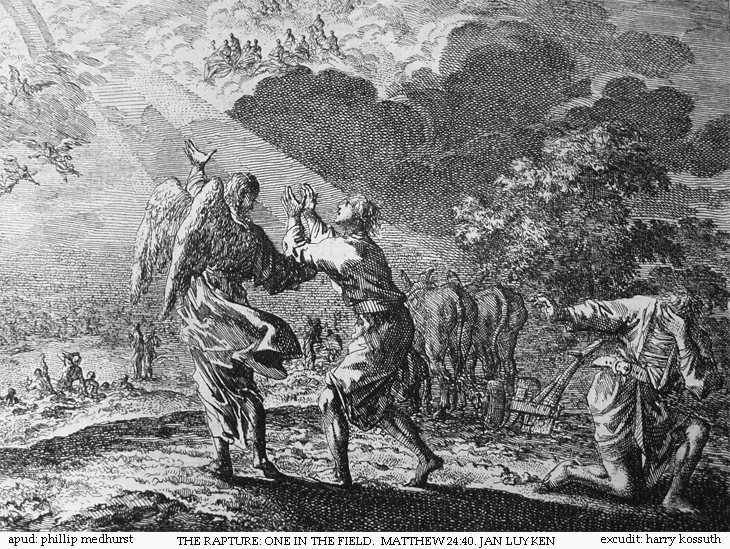
Nevertheless, the potential role of a restored Israel, as prophetic of imminent doomsday, remains today a central teaching within some fundamentalist strands of religious thought. Christian theology, meanwhile, teaches that Christ the Messiah has already appeared once, so giving the authority of experience to expectations of his second coming. For that reason Christianity is a particularly prone to recurrences of end-of-the-world prophesying. According to the book of Revelation, the four horsemen of the Apocalypse – pestilence, warfare, famine, and death – will signpost its coming. There will also be a great battle of Armageddon against Antichrist (‘the Beast’) and all sinners who bear ‘the mark of the Beast’. Another foe to be defeated is the ‘scarlet woman’, the ‘great whore’ named Babylon. Christ will then triumph and rule with his saints for one thousand years – the long-awaited millennium, before the eventual Last Judgement. From the start, the Christian churches strove to prevent undue speculation about this stirring but complex end-saga. However, over the centuries millenarian groups have gathered to greet the imminent arrival of Christ’s kingdom. To take one example, in Samoa in the 1830s the followers of the Siovili cargo cult believed that Jesus would come ‘walking over the sea’, bringing coveted consumer goods. He did not, but a minority continued to wait by the shore, vainly, for some years.
Hopes for a dramatic change in life’s circumstances have a special appeal to people who feel socially marginal or otherwise wronged. The American Sioux in 1890 dreamed not only of meeting their returned Christian saviour in their ecstatic Ghost Dances, but also of resuscitating their departed ancestors and of restoring the exterminated buffalo. But they were disappointed in all their hopes. Whilst awaiting the end, an alternative tactic is to establish a settlement of believers with a separate lifestyle. Such schemes rely upon the charismatic ‘pull’ of the leader – and also upon the willingness of followers to accept privations in the cause. The members of the Church of the Last Testament in Russia live in rudimentary comfort in remote Siberia, gathered around ‘Vissarion Christ’, formerly named Sergei Torop. At a time of personal and political turmoil in 1989, he announced himself as the reincarnated son of God and organized his followers in a reclusive commune. As often happens in intense and secretive cults, there have been subsequent splits within the movement. Both men and women are attracted to such Messiah claimants. And, although the allotted female role within millenarian groups tends to be subordinate, the millenarian challenge to convention offers scope for female initiative too. In 1810, Lady Hester Stanhope, an aristocratic Englishwoman, dramatically quit her home and country to settle in the Lebanon, where she hoped to witness Christ’s second coming. Donning eastern dress, she waited there, at first in eccentric splendour and later in dire poverty, until her death twenty-nine years later. Stanhope developed her own mystic philosophy, a hybrid package of occult beliefs; and, in a zany touch, she kept in a special paddock two ‘sacred’ Arabian mares, ready to be ridden by herself and the expected Messiah.
A variant role invoked female leadership via a special millenarian wedlock and/or millenarian maternalism. In 1774, Ann Lee, the founder of the Shaker end-of-the-world community in America, called herself both the ‘bride of Christ’ and the ‘first Mother, or spiritual parent’ of her flock. In 1814, Joanna Southcott, an Englishwoman of modest social status who had already written numerous prophetic tracts, announced, at the age of sixty-four, that she was pregnant with the new Messiah. Her supporters funded a beautiful ‘celestial bed’, ready for the holy child. Southcott herself issued handwritten seals guaranteeing heavenly salvation to those she deemed worthy. But she died, childless. Most of her following disappeared. Again, however, a small and semi-clandestine movement has continued, awaiting the moment when Joanna’s message can be revealed to the world.
Cataclysmic events may also suggest a sign of the impending end. Natural disasters such as volcanic eruptions and earthquakes are particularly ominous. ‘Wo unto thee Britain; wo unto thee Ireland; wo unto thee London; wo unto thee Liverpool,’ began a preacher uncompromisingly to his Liverpool flock in 1756. Unless they repented speedily, he warned, they would face divine wrath on an even greater scale than the earthquake that had just obliterated the great city of Lisbon.
Major warfare is particularly likely to be taken as portending the coming battle of Armageddon. Apocalyptic imagery, furthermore, can be used not only by those seeking change but also by those opposing it. When Napoleon marched upon Moscow in 1812, the Russian Orthodox Church identified him as the ‘Beast’ or Antichrist, so resistance to the invaders became a Christian responsibility as well as a patriotic duty. And the Russian peasantry responded with the drastic ‘scorched earth’ policy, denying all food and supplies to the foreign ‘devils’.
Another variant possibility, however, implies that the end will arrive without fanfare, since Christ remarks that his return will be stealthy: ‘Behold, I come as a thief’ (Revelation 16:15). An alternative method of predicting the end therefore relies not upon looking at world affairs for a signal but upon decoding hints within the Biblical texts. In early Christianity, two much canvassed end-dates were the years 1000 and 1033, the millennial anniversaries of Christ’s birth and crucifixion. A flurry of millenarian excitement also attended the year 2000. The quest to calculate the end-game timetable recurs particularly in the Protestant tradition, with its stress on close readings of the Bible. But a failed prophecy may raise the need for recalculation. When William Miller, a Vermont farmer, declared October 22nd, 1844 to be the date of doomsday an estimated 100,000 Protestants in the USA and Britain stopped work and made ready. There followed the ‘Great Disappointment’. ‘Still in the cold world! No deliverance – the Lord not come!’ sighed one disillusioned believer on October 23rd. Nevertheless, the keenest Millerites were not deterred. They argued that the 1844 debacle was but a stage in a greater scenario and refounded the church as the Seventh-Day Adventists. On that basis, they resumed preaching the prophetic message to generate what has become, over the generations, a major Christian denomination with an international following.
Intense millenarian excitement is heady. For that reason, on more than one occasion apocalyptic fervour has curdled into destructive ‘catastrophism’, when people take aggressive action to hasten the grand finale. That happened in 1978 in the isolated settlement at Jonestown, Guyana, when 913 followers of James Warren Jones, the man they trusted as a Christian prophet, died in a collective ceremony of self-killings and child-murders. The violence is sometimes turned against outsiders too. The Aum Shinrikyo sect in late twentieth-century Japan fused an apocalyptic Buddhism with Egyptian occultism, Christian millennialism, and the prophecies of Nostradamus, the sixteenth-century French astrologer. The leader Shoko Asahara declared himself to be the ‘last Messiah of the last century’. A few of his critics within the sect were poisoned, as were a number of innocent travellers on the Tokyo subway in 1995. Now some of Asahara’s former followers express amazement as well as remorse at the collective frenzy generated within the secretive cult.
Not all respond to talk of crisis in the same way. If the end is really nigh, another option is insouciance: ‘eat drink and be merry’. And there are always doubters. Or perhaps whatever will happen is an outcome far into the future. Prophets of imminent doom have not always met the response they expect. John Mason, a Protestant divine, announced that Christ was due to reappear in April 1694 at Water Stratford, a small village near Buckingham, where he would judge the world. However, a sceptical friend decided that Mason was unhinged through smoking too much tobacco. He advised Mason to ‘let blood speedily’.
So the future remains at once supremely important, yet hard to call. It is easy to pronounce that time is running out - or perhaps that it is not. Because no one knows for certain, it remains a matter for sober calculation as well as prophetic zeal. Certainly, end-time views need to be taken very seriously, at a time when, among the combatants in present-day Iraq, there is a Shi'ite Mahdi militia, the Jaish al Mahdi, confronting an American/coalition army directed from Washington, where Christian end-time believers organized as the Apostolic Congress are strongly lobbying the Bush presidency. The dangers of millenarian enthusiasm overtaking political prudence are all too real. Meanwhile, we all exist in history; and our views about its shape - past, present and future frame the way we live our lives today.