Jacquard Patents His First Loom
On 23 December 1800 Joseph Marie Jacquard set out to revolutionise weaving – and took his first step towards greatness.
When the computer pioneer Charles Babbage received guests, he liked to show them a framed portrait of the French weaver Joseph Marie Jacquard seated beside a model of his loom. ‘Oh, that engraving?’ the duke of Wellington asked when his attention was drawn to it.
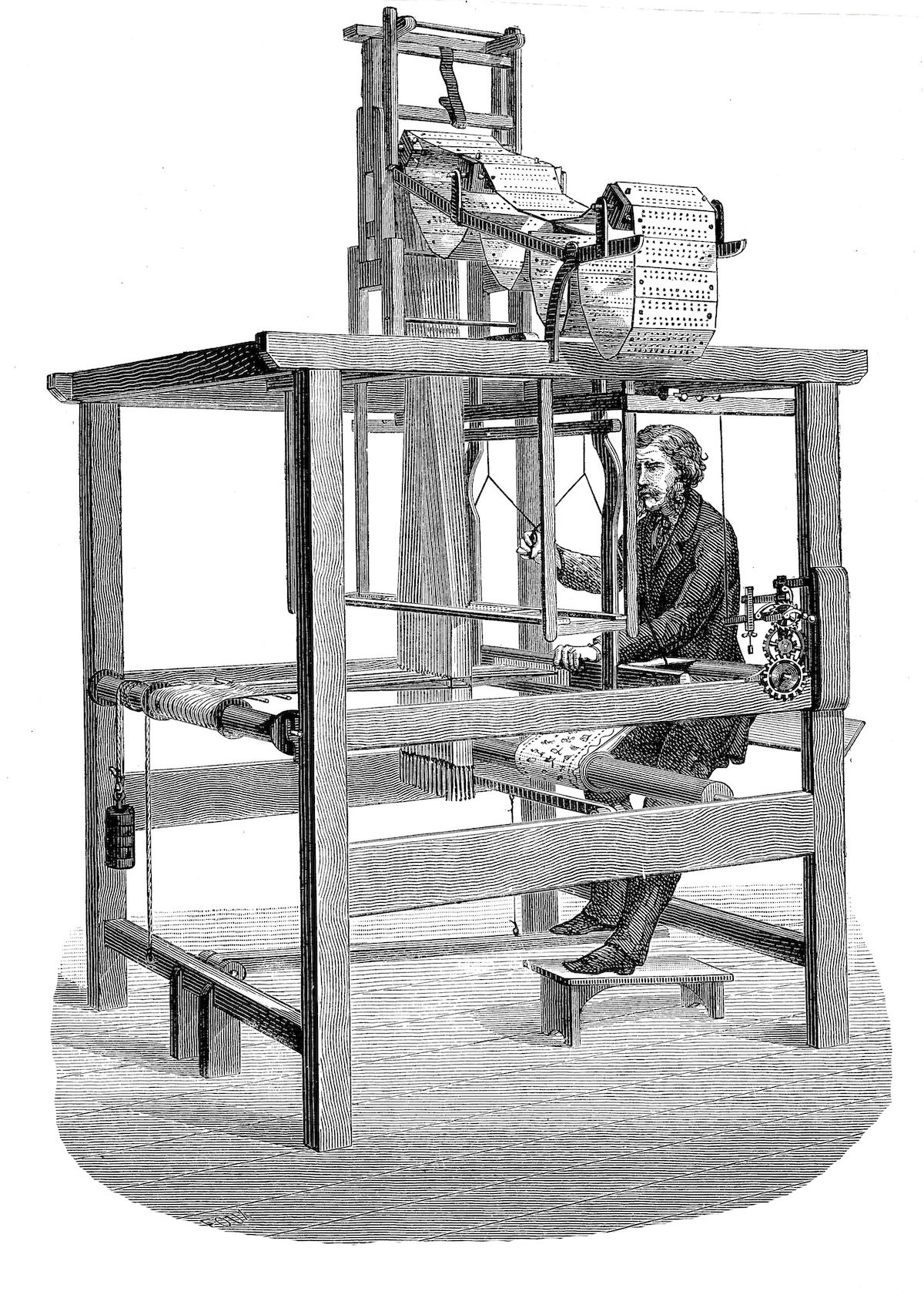
But it wasn’t an engraving. It was a sheet of finely woven silk – a thousand threads to the inch – so subtle and detailed that it deceived many who saw it. It also held the secret to Babbage’s analytical engine: Jacquard’s right hand rests on a stack of punch cards, which controlled the loom’s operation.
Jacquard was born in Lyon in 1752 into a family of silk weavers. It was the city’s principal trade, involving some 40 per cent of the workforce. He patented his first loom on 23 December 1800. Punch cards were a later innovation, elaborated from the work of an earlier weaver, Jean Baptiste Falcon. Jacquard’s card-driven loom was operational by April 1805 when Napoleon made it public property. Thereafter, all of the emperor’s ceremonial clothes were woven using Jacquard’s process.