The Woman Behind the Kindertransport
Female volunteers such as Marie Schmolka played a decisive role in the collaborative project to rescue beleaguered Jewish children.
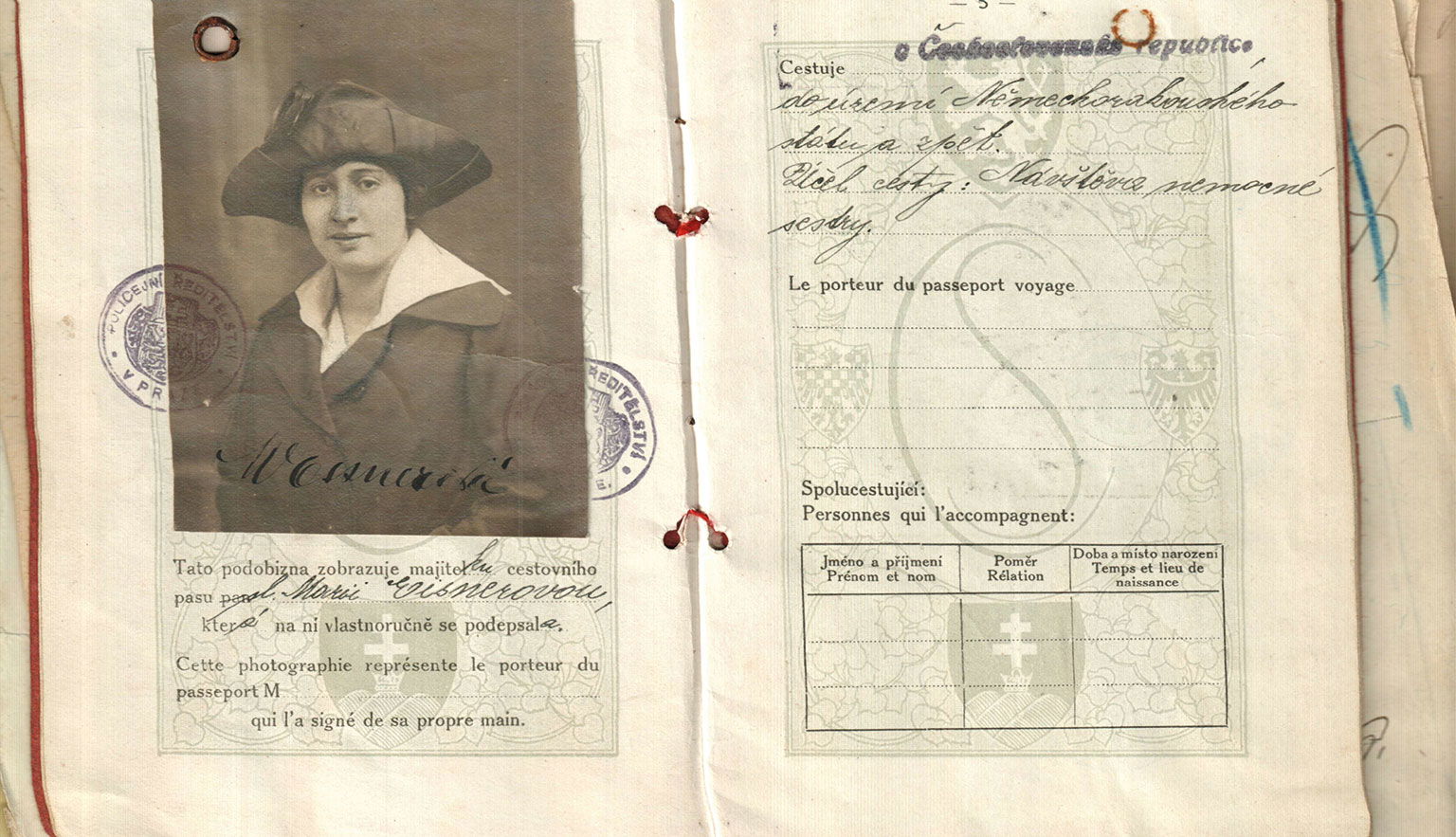
There are few more encouraging stories for the British than that of the Kindertransports, the scheme to rescue Jewish children from Central Europe in the days leading up to the Second World War. It positions Britain on the side of justice in opposition to the Holocaust and affirms a positive national identity. It is a powerful story: the rescued were children, the innocents of impending war. The figure of a lonely male hero, the British stockbroker Nicholas Winton, remembered as the organiser of the Kindertransports, has been sacralised. This popular perception, however, has meant that Winton’s activities among volunteer refugee helpers has been taken out of context. A more accurate account would show that he, with others, organised the Kindertransports because, amid the xenophobic atmosphere of 1930s’ Britain, adult refugees were regarded as dangerous.
What is more often neglected is Winton’s repeated assertions that he was part of a much larger network, which included older female social workers who played key roles in directing the operation. Reducing rescue work to a single great man not only erases women from history, it makes their work seem distant and impossible to emulate and repeat. The real history of the rescue volunteers reveals a transnational network between Germany, Austria, Czechoslovakia and Britain. The rescue effort is also a reminder of a forgotten history of a time when Zionist activists organised the escape of German communists. A key figure in this transnational effort was a Prague Jew, Marie Schmolka. Though now largely forgotten, in 1938 she was the hub of a rescue effort that spanned Europe in the final months before war.
Habsburg Prague
Schmolka was born in Prague when it was still part of the Habsburg Empire. The youngest child of Hynek and Julie Eisner, who ran a wholesale textile store, she grew up with three older sisters in the heart of the city’s Old Town, in a small, crooked house in a tucked away street behind the Old Town square. Her sisters married and left home, while Marie remained living with her mother. She studied at a higher girls’ high school on Vodičkova Street, where one of the teachers was the writer Gabriela Preissová. Marie would have liked to study, but she did not, perhaps for lack of funds, although in 1916 she attended classes at the Charles University. The Eisners were apparently assimilationists and spoke Czech at home, while also being fluent in German: among close friends were German-speaking intellectuals such as Felix Weltsch, from Kafka’s circle, who was a lifelong friend. Marie also spoke good English and French. Religiously, the family was rather lukewarm. As a single woman, Schmolka became quite successful: she worked for a bank and eventually became its deputy manager. Her conduct was never very feminine: ‘I can still hear my mother who used to say: the youngest Eisner child is as active as a man. And the characteristic “like a man” remained with her all her life’, wrote Weltsch.
After her mother’s death, and now aged 30, Marie married the much older Leopold Schmolka, a noted Prague lawyer; he was widowed and had three grown-up children. It was a happy marriage, albeit a brief one. The Schmolka children loved Marie and their children remember her to this day as a beloved grandmother. After less than five years of marriage, though, Leopold died.
Middle East
This proved a watershed moment in Schmolka’s life. She decided to visit the Middle East: Egypt, Syria and, fatefully, Palestine. The trip was organised by Preissová, her old teacher, who asked her friend Irma Polak, a key member of the Czechoslovak Women’s International Zionist Organization (WIZO), to help Schmolka set up her travel itinerary. Polak wrote letters of introduction to Palestine and when Schmolka returned a convinced Zionist the two became friends. Through Polak, she was also introduced to Berta Goldstein-Thieberger, whose husband Friedrich used to teach Hebrew to Kafka. Schmolka joined the WIZO and became active in social work for refugees. She first addressed the effort for the impoverished Carpatho-Russian Jews, many of whom left to emigrate to Palestine via Prague. WIZO oversaw their housing and training prior to emigration. Schmolka soon became a member of WIZO’s executive and contributed not only managerial skills, but also created links to the Czech feminist movement, which in interwar Czechoslovakia was split into three distinct ethnic groups: Czech, German and Jewish. In 1931, when the WIZO congress was held in Prague, Schmolka met its founder Rebecca Sieff, who was to eulogise her nine years later: ‘She refused to be intimidated, either by the threats of hostile governments, or by the barriers of pomp and circumstance which surround even friendly governments and their chancelleries.’
In 1933, following the Nazi takeover in Germany, the refugee relief effort changed. German communists and social democrats sought refuge in neighbouring Czechoslovakia; one such was Herbert Wehner, a later inhabitant of the Hotel Lux in Moscow, who, after 1945, would become the deputy chairman of West Germany’s SPD. The Czechoslovak Communist party was, after Germany’s, proportionally one of the largest in Europe and, while the social and political reality towards refugees in Czechoslovakia, hit hard by the economic crisis, was not as rosy as some histories would like us to believe, Czechoslovakia did offer asylum to many thousands of political refugees. As the historians Kim Wünschmann, Rose Holmes and Laura Brade remind us, the history of the 1930s’ political emigration from Germany is a forgotten transnational story. Schmolka was at its centre. She got to know hundreds of individuals, organised visas, negotiated with police for the right of domicile, set up housing and financial support and negotiated with employers to supply refugees with jobs.

Schmolka’s experience in the WIZO relief efforts led her to become the president of the National Coordinating Committee for Refugees in Czechoslovakia, where her colleagues included Milena Jesenská, the journalist noted for her correspondence with Kafka and Max Brod, Kafka’s literary executor. Schmolka’s work was aided by her lifelong engagement as a social democrat and the networks and connections she had built up, which opened doors to top-level politics and police stations alike; her quietness, warmth and organisational talent no doubt helped. Schmolka later became the representative of the transnational Jewish aid organisations, the Joint Distribution Committee and HICEM (the Hebrew Immigrant Aid Society, or HIAS, the target of a recent attack in Pittsburgh, was a part of HICEM). Schmolka was also the sole Czechoslovak representative on the League of Nations Commission for Refugees, representing the country during the Évian conference in July 1938.
A turn for the worse
By then, her area of influence extended well beyond her homeland. When, in April 1938, the Burgenland Jews were expelled following the Austrian Anschluss, a group of around 70 people became stranded in no-man’s-land between Czechoslovakia, Hungary and German-annexed Austria. Schmolka travelled to the site, where the refugees were kept on a boat on the Danube. She spent a couple of days there, drafting a plan for how to get them refuge. Similarly, when Nazis forcibly deported 17,000 Jews with Polish citizenship from Germany in October 1938 over the border to Zbaszyn and Bytom, Schmolka was part of the Jewish aid organisations’ effort to help. Milena Jesenská wrote about her at the time:
At the first glance you may not say that she is pretty. Women who work all day and late into night, who have since years been looking at the suffering of people, are perhaps not pretty. But if she is not pretty, she is beautiful. It is something from the inside that makes this face so distinctive, definite, and chiseled. This woman knows personally every person, who in the past five years have passed [our] borders. She knows their fates, she knows the dangers they are in. In the avalanche of these fates it is almost as if she did not have her own. She constantly moves between illness, life, and death, between offices in London, Paris, and Prague, she passed through no man’s land, refugee camps, a boat stranded for two months on Danube in front of Bratislava. She sees so much hopelessness and after terrific struggle she can enforce only little hope: and yet she is remarkably calm, as only believers can be.
At this point, the situation in Czechoslovakia took a dramatic turn for the worse. In September 1938, the Munich Agreement, signed by Britain and France with Germany, forced Czechoslovakia, the supposed ally of Britain and France, to surrender its borderlands, the Sudetenland, where many Germans had settled. The relief organisations were unable to cope with the influx of over 100,000 refugees, both political opponents of Nazism and Czech Jews. Schmolka visited the areas where refugees were concentrated, collected evidence to mobilise public opinion and wrote appeals to foreign ambassadors in Prague and to Jewish agencies abroad.
No free country, however, was willing to help the Jewish refugees: Great Britain would take children, as long as they came unaccompanied. As the historians Laura Brade and Rose Holmes have shown, Schmolka’s endeavours were aided by humanitarian volunteers from Britain. Foremost among them was Doreen Warriner, a lecturer in economics at University College London, who was well known for her left-wing sympathies and who, between 1938 and 1952, was monitored by MI5. Warriner was the representative of the British Committee for Refugees from Czechoslovakia, a voluntary aid organisation set up in the wake of the Munich Agreement to support those refugees in immediate danger due to their political allegiance. Overwhelmed with the work of helping hundreds of families of political refugees, Warriner and Schmolka asked Martin Blake and his friend, a young British stockbroker named Nicholas Winton, to help with a scheme Warriner had developed: the Kindertransports.
The idea was that unaccompanied children would be seen as less objectionable than adults. Schmolka and her team provided the majority of the lists of endangered children, including the offspring of the German and Austrian refugees, children stranded in no-man’s-land. In a race against time – Schmolka was in no doubt that Germany would occupy Czechoslovakia next – the women rescue workers tried to get as many people out of the country as possible. Winton remained in Prague for a month and, once back in Britain, continued working for the cause. As it became clear that the occupation was drawing nearer, the focus of the Kindertransports shifted from children of political opponents to those of Czechoslovak Jews.
On 15 March 1939 Germany occupied the western part of Czechoslovakia and annexed it as the ‘Protectorate of Bohemia and Moravia’. Marie Schmolka and her co-workers from the Committee for Refugees were among the first arrested. Schmolka was kept for two months in the Pankrác prison, while the Gestapo subjected her, a diabetic, to interrogations of up to eight hours in length. Schmolka was released in May 1939, thanks to ongoing protests of Protectorate ministers and her old friend from the Czech women’s movement, the politician Františka Plamínková, who was later executed by the Nazis. In August, Adolf Eichmann, the head of the Nazis’ Central Office for Jewish Emigration, sent Schmolka, together with Emil Kafka from the Jewish Community, to Paris to push for speedier Jewish emigration. Overtaken by the outbreak of the Second World War, they then moved on to London. Kafka’s family was split. While his children had already left for Britain, he was forced by the Gestapo to leave his wife behind in Prague as a hostage while he carried on negotiating the Jewish emigration.
Schmolka’s time in London was hard. ‘We live here like funambulists’, she wrote to her nephew in San Francisco. Some of the people whom she had helped to emigrate to Britain now feared losing their new status and jobs and did not want to give her a place there, unwilling to share their space in the refugee organisation. Schmolka eventually continued her work; her little office in the ‘Bloomsbury House’ became the meeting place for the Czechoslovak diaspora, as well as Zionist and Quaker social workers. In the last six months of her life, Schmolka moved in with her old acquaintance, the suffragist and pacifist Mary Sheepshanks, in Parliament Hill Mansions in Gospel Oak, where their neighbours would write racist messages on the door, protesting Sheepshanks’ help for the refugees. It was in this house, on 27 March 1940, that Marie Schmolka drew her last breath: she had worked herself to death, from a heart attack, at just 46 and had not sought medical attention. The attendees at her funeral at Golders Green were a Who’s Who of Czechoslovak emigration and Zionist organisations. Jan Masaryk, the Czechoslovak foreign minister, spoke. The Czechoslovak exile WIZO group, headed by Nelly Engel, changed its name to ‘The Marie Schmolka Society’ and, in 1944, published a memorial booklet. This slim volume is all that remains of Schmolka, who does not even have a grave: the records state that her ashes were ‘taken away by the funeral director’.
Schmolka’s position as a childless widow was a necessary condition for her work, while her financial independence guaranteed her relative material freedom. A similar position applied to many other female Jewish social workers who played key roles in refugee help: Gertrud van Tijn in the Netherlands, or Berta Schnabl in Brno, were both widowed. Their married colleagues, such as Nelly Engel or Irma Pollak, were sometimes portrayed as failing in their family duties, which never happens to men. Schmolka’s colleague Emil Kafka, forced to emigrate without his wife, who only through a stroke of luck survived the Lodz ghetto and Ravensbrück, was not blamed for abandonment.
Forgotten
Married or widowed, these women have one thing in common: they are all largely forgotten. Schmolka and her fellow women organisers disappeared from public memory; today, they are known only to a few specialist historians. There are monographs on Felix Weltsch and Max Brod, but Schmolka, their fellow Zionist and friend, who saved thousands of lives, has only a brief entry in Encyclopedia Judaica, which gets the year of her birth wrong. The YIVO Encyclopedia of Jews in Eastern Europe touches on Schmolka’s rescue work, but she does not have her own entry, nor do other female colleagues. Meanwhile, even Friedrich Thieberger, husband and brother of two of Schmolka’s colleagues, has his own, for having taught Kafka Hebrew. Similarly, Schmolka is forgotten by the Zionist historiography: her help of Communist refugees makes her unsuitable. As Zionism has drifted to the right, its politically left humanitarian roots, which Schmolka embodied, have become radical and uncomfortable.
A question remains: who is remembered by history? The female rescue workers removed from history demonstrate two lessons. First, that rescue is a team effort and, therefore, something that can, and should, be emulated. Second, it is a reminder of the injustice of who is remembered in popular memory.
Anna Hájková is Associate Professor of Modern European History at the University of Warwick. Together with Martin Šmok, she founded the Marie Schmolka Society: http://marieschmolka.org