Empire’s Other Whites
In the popular imagination, the archetypal British imperialist is the kind of daring young adventurer portrayed in the stories of Rider Haggard and Rudyard Kipling. But, reveals Will Jackson, those who settled the Empire were far more diverse than stereotypes allow.
‘On 11 August 1923 I started walking.’ So began a letter sent by a Mrs Winifred Caldwell to the Earl of Athlone, Governor General of South Africa, in July 1925. We do not know where Caldwell was born or when she migrated to South Africa, only that she was British. With her husband struggling to find work, 10 children to support and no means of making a living, Caldwell decided to leave her home in the village of MacLear, on the banks of the River Mooi in South Africa’s Eastern Cape, and walk.
For two years Caldwell and her children walked across South Africa, giving ‘an entertainment’ to the locals at every town they reached in order to earn food and shelter. ‘We walked’, wrote Caldwell, ‘for 3,014 miles. We suffered hunger and misery. My feet were often soaked in blood.’ It was heartbreaking, she said, to see her little children living such a bitter life. Caldwell begged the government not to take her children from her. Instead she asked for land. If she only had a small plot, a cottage and perhaps some poultry with which to make a start, she was sure she could make good. ‘My husband is a sober, honest and hardworking man’, she wrote. ‘I too am willing to work hard.’
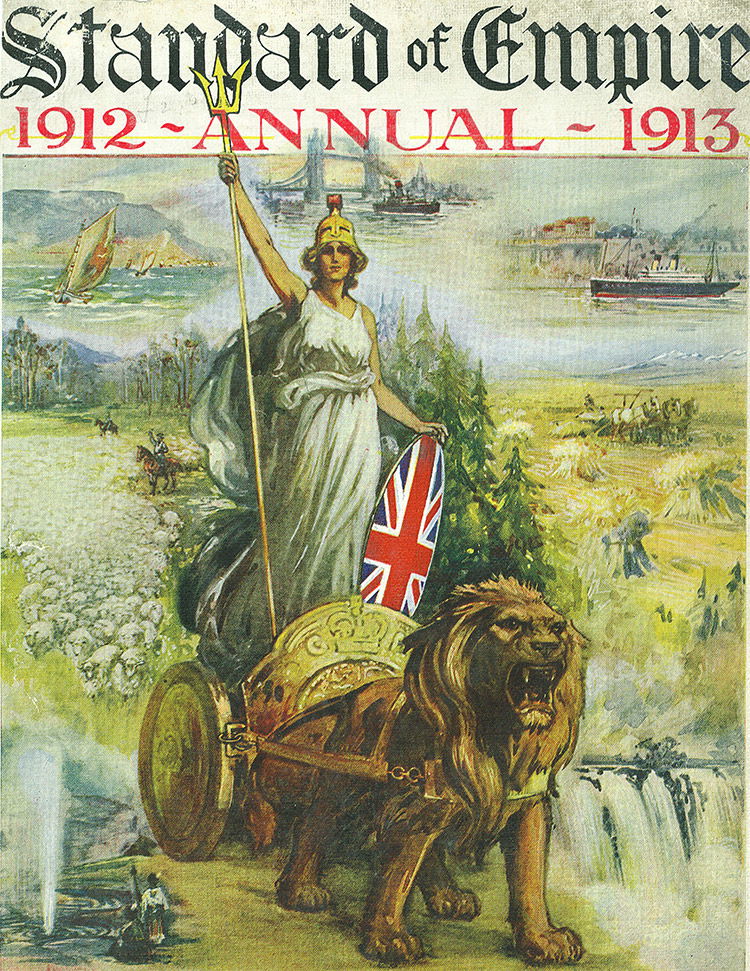
In appealing for land and by stressing her industrious character and that of her husband, Caldwell called to mind the ideal British settler at the high tide of Empire. As waves of emigrants from the British Isles fanned out across the globe during the later 19th century – 25 million in just 55 years – they brought about what the historian James Belich has termed a ‘settler revolution’, transforming environments, populating new settlements and largely destroying indigenous peoples and cultures. In North America, Australasia and southern Africa, a new Anglo settler world was forged, based on technological prowess and gentlemanly capitalism but no less dependent upon a shared and fiercely felt wellspring of cultural conviction. This was ‘the British world’, as a number of recent historians have termed it, a place in the mind and a historical moment by which the spirit of the British people appeared to bring a frozen picture to life: when hubris and history animated the backward peoples and places of the earth.
So much rested, ideologically speaking, on the idea of the white man or woman as engine of historical change or, to mix metaphors, one of the millions of particle units diffused as if by natural law to spread the spirit of imperial Britain abroad. But as steamships and railways carried forth British civilisation, they also carried the Empire’s ‘other whites’: those who did not assume an imperial mantle or emulate the much lionised figure of the British imperialist overseas. These were not just misfits or bad apples: they were everyone that the imperial ideal was not. Imperial failure was not about a minority: it was about the mainstream. It was the default.
***
Caldwell’s claim to have walked 3,014 miles might seem incredible. Petitioners seeking help from the British government usually wrote in ways to make them appear deserving. But are we really to imagine a single woman shepherding 10 young children on foot thousands of miles across the southern African veldt?
One document on her file suggests that we might. At every town the family visited, Caldwell made sure she obtained the local magistrate’s stamp. On a creased and dog-eared page of paper, Caldwell collected the stamps, a record of her journey on foot and proof for anyone who needed it that she really was ‘a genuine case’.
From that page we can begin to reconstruct the Caldwell family’s walk. Many of the magistrates’ stamps are too worn to be legible but we can still see the progress of Caldwell and her children across the Boer republics and the British colonies that had joined just ten years previously to become the Union of South Africa. In the summer of 1925, with temperatures above 30°C, the family walked the breadth of the Transvaal, from the old gold-mining town of Leydenburg in the north to the maize fields of the Orange Free State in the south. Caldwell’s home at MacLear was then 400 miles away.
We tend to think of the great travellers of Empire as men: the heroic explorers, the pioneers. Here by contrast is a woman and her children; only the man is missing. Stories of itinerant households with a female at the head travelling through South Africa may at first appear unusual, but stories like these allow us to challenge expectations as to who Britain’s imperial forebears were and the kinds of experiences they enjoyed.
Certainly the Caldwells were not the only British people wandering around southern Africa at the British Empire’s height. Search the colonial archives and you find their records, lodged in local magistrates’ reports, in police transcripts and in the case files of charities, welfare organisations and benevolent societies. In each and every case, investigations were undertaken into the character and circumstances of individuals variously described as vagabonds, vagrants, paupers and tramps. As colonial administrations developed new techniques for patrolling their territorial and maritime borders, they generated new kinds of records, documenting the lives of thousands of repatriates, deportees and prohibited immigrants – or ‘undesirables’ as they were often known. As they worked to police their internal borders – the social boundary lines separating white from black,
colonisers from colonised – they examined with new vigour and attention to detail the domestic arrangements and family lives of those they categorised as white.
***
To contemporaries, these ‘other whites’ were a problem. They tarnished white prestige, they cohabited with Africans, they ‘went native’. Contemporary writing is replete with disdainful references to ‘poor whites’ and ‘degenerates’, ‘bad characters’ and ‘loose women’. It is precisely because these people were problematic, however, that we can reconstruct their lives. In attempting to control social and racial boundaries, the authorities could not help but describe the people who transgressed them.
Until the later 19th century, the principal means for doing so was conferred by the Distressed British Seaman Acts. Dating back to the Napoleonic Wars, these laws enabled British consuls to repatriate stranded mariners washed up in foreign ports. Through the 19th century, as the British Empire expanded and the numbers of British emigrants increased, Distressed British Seamen morphed into Distressed British Subjects. Getting these people home, it was argued, was necessary not just for humanitarian reasons but to uphold British honour overseas. ‘Putting the question of humanity aside’, as one official noted, ‘there is the expediency of avoiding a public scandal.’ ‘It would be discreditable to the English name’, wrote another, ‘that such persons should be allowed to wander about in a denuded and half-starved condition.’
By the turn of the 20th century the numbers of impoverished Britons discovered across southern and central Africa had risen considerably. In January 1909, G.B. Beak, the British Vice Consul in Katanga, southern Congo, reported that the appearance of indigent whites was becoming an event of increasing frequency. Beak was writing from Kambove, a ramshackle settlement amid the copper and tin mines then attracting itinerant whites from around the world. Kambove was 350 miles, or 15 days by foot, from both railway and telegraph. Distance made distress much harder to relieve. And yet, as Beak went on, ‘a White man cannot be allowed in the wilds to beg of the natives … It is for the sake of White prestige that his destitution should be concealed and that he should be returned to civilisation without delay’.
Where the imperial presence was weak, where colonial power was attenuated, the problem of white distress proved especially dangerous. Those who knew Central Africa well, Beak concluded, understand ‘how essential it is in the midst of the black peril to give the impression, even if it be unreal, of the solidarity of race’.
***
The solidarity of race was even more important in the British settler colonies, where British subjects did not intend merely to prospect, mine or travel through. Britons in Kenya, Rhodesia, Natal and the Cape were settling for good. They could hardly be stranded in a place to which they attempted to belong. As more and more British people came to identify the colonies as their home, it could no longer be assumed that Distressed British Subjects should be sent back to Britain. Poverty, distress and failure became colonial problems in ways they had never been before.
What developed was a remarkable human traffic. Across and between cities, colonies, continents and seas, the failures of Empire were moved. Just as people sleeping rough today get moved on, so Empire’s great vagrant class were perpetually sent away, put on ships and trains to rid the colony in which they were apprehended of the financial and ideological burden that their presence entailed. But repatriation meant only a postponement of the problem: sending failures away did not work when immigration restrictions offered the surest means of fixing the problem at source.
A far better solution was to investigate each case on its merits. Passage back to Britain (or to Cape Town in the case of British subjects born in South Africa) should only be provided if the applicant could show that he had family at home willing to support him or a good chance of a job. Deportation worked best in the case of undesirables and frauds. The deserving poor should rightly be rehabilitated in country, transforming paupers into upstanding British settlers, converting failure to success.
In the wake of the First World War that project had spawned a complex web of systems and structures designed to discipline the recalcitrant and rehabilitate the deserving. In South Africa laws were implemented as sanction against interracial sex and ‘mixed marriage’. Vagrancy legislation enabled the imprisonment of destitute settlers. ‘Those judged ‘of unsound mind’ were confined to one of a string of psychiatric institutions. Across the settler colonies reformatories, industrial schools and labour camps worked to discipline the degenerate and the workshy. Homes for fallen women and friendless girls controlled female sexuality. Nursing homes, sanatoriums and Salvation Army hostels provided down-and-outs with temporary shelter.
This all entailed a far more elaborate operation than did shipping home the destitute and the undesirable. The basic imperative to siphon the genuine from the fraudulent cases endured but the grounds on which fraudulence and authenticity were detected grew infinitely more complex. At base was the endeavour to know the person: to discern their character and judge the significance of their family background for shaping their future life as a member of the ‘British race’.
Case work gives us the means to reconstruct this history. In 1926, for example, the case of 10-year-old Arthur House and his six-year-old sister, Mabel, was taken up by the Cape Town police. The children’s father, who had migrated to South Africa from his home town in Kent, said that he had no control over his son; detectives found the boy ‘hanging around’ with ‘low class coloured companions’. Mabel, it was reported, was staying with her older sister, who was married to a Greek shopkeeper: hardly a healthy environment for a British girl. In July 1923, a CID detective was sent to the parents’ home. ‘Mrs House was up and dressed’, he reported, ‘but I will swear she had never washed her face.’ He continued:
She appeared to me to be in a dirty condition in general. All the Bed Clothing was in a dirty filthy condition. The room appeared to me as if it had not been swept for a week. … The whole of the family as I saw them struck me as being a dirty lazy lot, in fact too lazy to assist themselves.
In the colonies, unlike in Britain itself, the making of the deserving and undeserving poor was racialised. In lower-class parts of town, from the copper-belts of Central Africa to the slum yards of Cape Town, British people were found living in close proximity to black and ‘coloured’ people. ‘My daughter is European’, said Alfred Fisher, ‘my first wife is European, my second wife is Coloured.’ Why he felt the need to make this explanation is not immediately clear, though neighbours reported Fisher himself to be a ‘slightly coloured man’. Marrying and having children ‘across the colour line’ not only degraded a settler’s social standing but raised doubts over his very whiteness. The charge of being ‘slightly coloured’ was effective in this regard because it was so open to suggestion. There was no objective way of measuring colour. Whites who failed to behave as whites should quickly discover their racial status to be not a given but a claim.
Widows and women deserted by their husbands occupied an especially difficult position. Responsible for keeping a respectable home and for the raising of children, women carried a disproportionate burden in the work of maintaining white prestige. But empire also served as – to use John Tosh’s words – a ‘flight from domesticity’. Service in the colonial administration or indeed emigration itself allowed British men the chance to escape the obligations and constraints of their families back at home. Colonial governments circulated enquiries from women from across the Empire seeking the whereabouts of their missing men-folk. Whereas family networks, for some historians, served as the ‘sinews of empire’, in another light Empire appears as the enemy of family life. Women were both revered and demonised for their reproductive potential – a necessary asset but a ‘danger’, too, in settler colonies where blacks outnumbered whites by 50-1.
***
We see this most clearly in the case records of child welfare societies. In 1908 South Africa’s first child welfare organisation was formed, Cape Town’s Society for the Protection of Child Life. Over the ensuing 30 years the society compiled many thousands of records, documenting in great detail the family lives of impoverished British migrants. While the society was concerned only with the upholding of a certain social and moral order in the impoverished quarters of Cape Town, its case histories yield a kaleidoscope of imperial history ‘from below’, routed through the complex, often haphazard journeys of those would-be settlers who pitched up in southern Africa in some degree of social, financial or emotional distress.
Dozens of stories of poor white women emerge from these files. Women such as London-born Louisa Marshall, who sailed to South Africa in the wake of the South African War, or Boer War, with her husband but was deserted by him after the birth of their two children. After her husband was later discovered living in Canada, both Louisa’s children were taken into care. Or Dublin-born Ursula Rolfe, who travelled out to Cape Town with her husband in 1912 but found herself struggling to survive after he caught a ship back to England. Police reports disclosed that Ursula was ‘said to drink and have frequent visitors’. Her children were also taken into care.
In the absence of men-folk, female character began to degrade. Poor white women were always more problematic than poor white men, precisely because they lacked the opportunities to disappear unencumbered. When their men-folk failed them, most often through their absence, women built relationships of friendship and support that paid little heed to dictates of race or respectability. The family, the ideal social unit for replicating British imperial culture overseas, was confounded by the necessity of Britons to forge intimate connections with people outside their biological kin: neighbours, colleagues, lovers and friends.
Increasingly, therefore, attempts to rectify colonial failure focused on women and children and the relations that shaped the modern settler home. As imperial cities expanded, the image of the disorientated white man lost in the African ‘wilds’ became out of date. Yet colonial authorities increasingly encountered another kind of colonial failure, perhaps the most difficult to resolve of all. These were the old men of Empire: the hunters, soldiers, prospectors and pioneers of the high imperial, late Victorian years, who in their youth had typified the heroism of that moment and, with it, the assertive self-confidence of an ascendant British world, but who, by the 1910s and 1920s, had become anachronistic: human relics of a bygone age.
Men like Herbert Goodridge, ‘an old British soldier down to the bone’ in the words of one official, who had gone to South Africa to fight in the Zulu Wars of the 1870s and had subsequently fought through eight campaigns against the Zulu, the Basutu, the Matabele and the Boers. Or John Winter, who served 13 years on India’s North-West Frontier before travelling to fight in the South African War of 1899-1902. By 1919 he was socially isolated, his health failing, lacking any family connections in South Africa. ‘My home is wrecked and I am dependent on others for food’, he wrote. ‘I think sometimes that perhaps I have earned a little more than this from my country.’
***
Most troubling about southern Africa’s old white men was not the practical problem of how they were to be supported but the ideological one of what they seemed to represent. Like women deserted by their husbands, or children neglected by their parents, old white men were vulnerable. But the form that vulnerability took seemed to parody the hero myths of the imperial frontier. John Bowyer, admitted to the Valkenberg asylum in Cape Town in 1915, told staff that since 1877 there was not a campaign in South Africa in which he had not taken part. ‘He evidently has had a chequered and adventurous existence’, noted one doctor. ‘I suspect a certain amount of fabrication’, recorded another. Harold Ward, 57 years old and a self-described traveller, told stories to anyone who would listen of shooting lions up country. John Lee, 85, who scraped a living by hawking copies of his typed out autobiography, remembered days hunting elephants in Matabeleland. ‘Once all powerful with the Matabele nation’, his pamphlet read, ‘Lee holds the world record for having shot 13 elephants in a single day.’ Stephen Hall, a shipwright from Dundee, claimed his house was ‘full of diamonds’. So did another Scot, 50-year-old Roger Merriman. ‘He expresses fantastic grandiose ideas’, Merriman’s doctor recorded, ‘that his house is full of diamonds … that he built the Beira-Bulawayo railway … that he has vast sums invested in the Rhodesia mines.’ Belief in their fantastic wealth marked these men out as disturbed but echoed the iconography of Rider Haggard, Cecil Rhodes and the mineral revolution then transforming the subcontinent.
At the colonial asylums, doctors struggled to ascertain how long an individual had been in southern Africa. Charles Lorimer remembered a previous life as a fruit farmer in Australia but did not know why or when he had left for the Cape. Nor did he know whether he was married or if he had any children; only that he had to get back to Rhodesia, where he had been prospecting for gold. Of Frank Harris, brought to the Wynberg jail outside Cape Town in 1893, almost nothing at all was known. Staff guessed him to be English and ‘about sixty years old’; Harris himself insisted only that he had to ‘get out to fight the rebels’. Within weeks, he was transferred to the Robben Island asylum. We do not know what happened to him after that, though other mental patients spent 10, 20 or 30 years in southern African asylums, their families’ absence meaning they were all but forgotten. On other occasions, family members back in Britain wrote letters for many years enquiring after their relatives’ health. It was rare for patients without family in the colony ever to be released.
The records touched on here were found largely in South African archives and tell stories with South Africa at their heart. Perhaps the most pervasive imperial failure of all was the failure to be so neatly bounded. From the small towns of the Eastern Cape to the gold fields of California, from Durban to Dundee, British settlers were seldom settled. We discover them in moments when their movement was arrested: when they crossed borders, broke laws or contravened social norms. Yet failure might not be the most fitting way to describe these people’s lives after all. The story of Winifred Caldwell and her children is a sad one but it is no less striking for the resilience and the ingenuity it reveals. Caldwell’s ‘failure’ was only really an inability to conform to contemporary understandings of what colonial life should entail and to our own historical pre-conceptions of what might be encompassed by an imagined British world.
Will Jackson is Associate Professor in imperial history at the University of Leeds and author of Madness and Marginality: The Lives of Kenya's White Insane (Manchester University Press, 2013).