Thomas Cranmer's Close Shave
Derek Wilson explores the Prebendaries Plot against Henry VIII’s reforming archbishop.
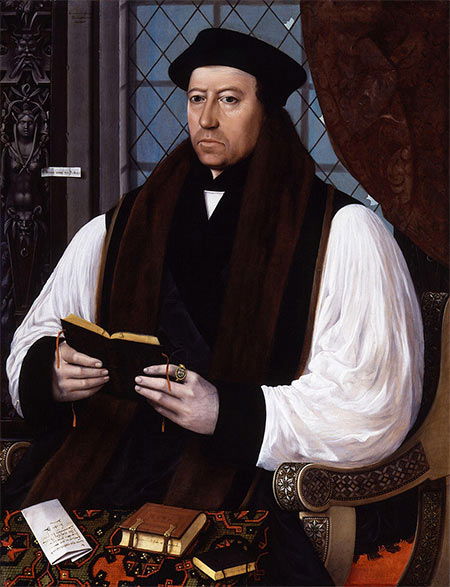
There are some events which, because they lack high drama or obvious significance, tend to receive scant attention in history books but, on closer examination, prove to have been of great consequence. The failure of Archbishop Cranmer’s enemies to ensure his destruction in the autumn of 1543 is one such. The story ends in anticlimax. The conspiracy against him had been well-planned, involved several agents and seemed to be on the verge of success. Then, at the 11th hour, Henry VIII intervened and it was all over. What has been called the ‘Prebendaries Plot’ was a flop and, therefore, has been accorded just a wry footnote in some accounts of the king’s final years. It is only if we pause to ask ourselves ‘What if’ that we truly grasp the monumental significance of Cranmer’s escape. The failure of the conspiracy bought Cranmer another dozen years of life, years that saw the archbishop set up the theology and liturgy of the reformed English church.
If the forces of Catholic reaction had triumphed in 1543 the politics of Henry’s last years and the brief reign of the young Edward VI would have been very different. It is unlikely that England would have become a Protestant state. Mary Tudor, coming to the throne in 1553, would have had little difficulty in returning her realm to papal obedience. And Elizabeth I? Lacking the zeal of her half-brother and his evangelical councillors, it is unlikely that she would have rekindled the fires of religious revolution. So, there is ample reason to take a closer look at the Prebendaries Plot.
Unstoppable team
In the 1530s the reform movement had been led by Thomas Cromwell and Thomas Cranmer: the former giving the forces of change legislative teeth, the latter providing the theological meat for them to chew on. They had seemed unstoppable. Then the fiasco of Henry’s marriage to Anne of Cleves gave the Catholic clique the opportunity for a counter-attack. Cromwell’s fall in July 1540 was sudden and complete. One charge against him was that he was an extremist religious radical and a supporter of known heretics. Over the ensuing months the Catholic group on the council, led by Stephen Gardiner, Bishop of Winchester and Thomas Howard, Duke of Norfolk, made the most of their advantage. They took every opportunity to block moves by Cranmer and his supporters to press on with the work of reform. There are various schools of thought about how appropriate it is to think of the sick and aged king as being manipulated by ‘court factions’, but there is no doubt that two activist groups were now emerging with radically different visions for the future of the realm.
For his support Cranmer could look to members of Henry’s intimate inner circle, such as the Earl of Hertford, Prince Edward’s grandfather, the royal physician, Sir William Butts, and the head of the privy chamber, Sir Anthony Denny, as well as lesser members of the household carefully placed in position by Cromwell before his fall. To counter this the conservatives tightened their grip on the Privy Council. In order to prevent an ‘over-mighty subject’ ever again holding supreme power, this body re-invented itself. By adopting a new constitution it became a committee whose collective decisions carried ultimate authority under the Crown. Cranmer was a member of this body but was in no position to dominate its proceedings. For 16 months there was a period of calm at the political centre. Gardiner was away most of the time on a diplomatic mission. The court was much taken up with the celebrations of Henry’s fifth marriage, to the vivacious Catherine Howard (Norfolk’s niece), and with preparations for a royal tour of the North (from June to November 1541). This does not mean that the politico-religious conflict was over. As Diarmaid McCulloch explains, the conservatives began ‘nibbling again at the edges of the Cranmer circle’ in December 1540. Pulpit wars continued in various locales and Bishop Bonner began a purge of people suspected of being in breach of the Act of Six Articles, which demanded obedience to major Catholic doctrine.
But vigilant friends of reform were equally active. These were days when anyone expressing strong religious views of any kind ran the risk of being informed against and arrested: as a suspected heretic if tending towards the New Learning or a covert papist traitor if defending the old. This perilous game was fought with increasing fervour, with the monarch playing the role of reluctant referee, halting play or allowing it to continue according to his interpretation of the rules. In the summer of 1541 the conservative group had the run of the ball.
Howard own goal
Then, when the king was touring the northern counties showing off his attractive young bride, the Howard clan scored a spectacular own goal. Evidence was produced that the queen had been foolishly cuckolding her husband. Cranmer played a leading role in unmasking her adulteries and for this Norfolk never forgave him. The hatred between the rival camps grew more intense. Gardiner was denounced from several pulpits as a supporter of the pope and the bishop, for his part, was rumoured to have said that he would give £6,000 to pluck down the Archbishop of Canterbury. Yet, with the storm raging all round him, Cranmer appears to have continued almost serenely with his task of purifying ecclesia anglicana. Shrines and altars were purged of ‘papist’ ornament. The calendar of saints’ days was heavily pruned in order to cut out any non-biblical recipients of devotion. When Gardiner struck back by pressing for a new version of the vernacular scriptures, which would reinstate some medieval doctrinal emphases and ditch the Great Bible (which smacked too much of Tyndale), Cranmer graciously agreed and placed the project in the hands of the two universities, knowing that it would flounder in an academic quagmire.

The campaign against Cranmer was pursued on several levels. Throughout the country and particularly in his Kent diocese preachers acting with Cranmer’s licence were watched carefully and any suspected of unorthodox views were hauled before the magistrates. At the royal court friends and supporters of Cranmer were under close observation. The members of the Privy Council were slowly taking sides. Cranmer could normally count on the support of Hertford and the Lord Chancellor, Thomas Audley. William Paget, secretary to the council and, from 1543, a full member, was a protégé of Gardiner’s but turned out to be a broken reed, veering more and more towards a reformist position. The appointment of John Dudley, Lord Lisle, as Lord Admiral early in 1543 was a boost to Cranmer, for the office carried ex-officio membership of the Privy Council and Dudley was definitely pro-reform. Reading between the lines of personnel changes at the centre suggests an atmosphere in which participants were manoeuvring for advantage and cautiously taking up ideological positions.
The spearhead of the campaign against Cranmer was in Canterbury. The cathedral prebendaries (senior clergy) were bitterly divided into pro- and anti-Cranmer camps. An incident in late May indicates the depth of feeling stirred by religious controversy. Prebendary Richard Champion, one of Cranmer’s supporters, died and was buried in the cathedral. At the end of the ceremony another official jumped down into the grave and emptied hot coals from a censer onto the coffin, a symbolic burning of the heretic. One of the prebendaries was Germain Gardiner, Stephen Gardiner’s nephew. He acted as messenger and information-gatherer for his uncle and, in the spring and summer of 1543, was compiling a list of the archbishop’s ‘heresies’ with the names of his evangelical protégés. At Easter he preached an incendiary sermon in the cathedral, in which ‘he did inveigh against preachers … and … made such exclamations, crying out “Heretics! Faggots! Fire!”’. Around the end of April Germain Gardiner’s ‘little black book’ was given to the king and Cranmer’s enemies noted with satisfaction that Henry was distancing himself from his archbishop.
Emboldened by their progress, the conservative faction was ready to focus its attention on members of the king’s entourage. They carried out a purge of evangelicals in the town of Windsor and the staff of the royal castle. Five men were arrested and taken to the Marshalsea prison, close to Gardiner’s Southwark palace. There they were interrogated and every effort was made to make them implicate their superiors in the king’s household. Three of the prisoners were burned at the end of July.
Noose tightening
Linking targeted individuals to convicted heretics was a standard tactic employed by conservative witchhunters. One man who suffered from the attentions of inquisitors was Richard Turner. He was a member of the Chapel Royal at Windsor, rector of Chartham, Kent, where he attracted crowds to his evangelical sermons, and a favourite of Cranmer. When repeated attempts to convict him had failed, he was finally taken to London for an interrogation carried out, in person, by Stephen Gardiner in autumn 1543. The noose around Cranmer was tightening and he was in no position to save himself by a personal appeal to the king. Henry, troubled by the web of rumour being spun around his archbishop, was keeping Cranmer at a distance. It was Cranmer’s secretary, Ralph Morice, who rescued his master by imploring Dr Butts and Sir Anthony Denny to approach the king on Turner’s behalf. Having described the various perjuries and stratagems employed to have the rector of Chartham condemned, Morice protested:
If his majesty will thus permit learned honest men thus daily to be overcrowed and trodden under-foot with a sort of tyrannous, or rather traitorous papists (who cannot abide to hear his majesty’s supremacy advanced, nor the sincere word of God preached), it were better for men to dwell amongst the infidels and miscreants than in England.
Thanks to his friends at court Turner was exonerated.
Henry's resolve
Henry, in his gilded isolation, received such reports and appeals and heard the complaints and rumours from various sources, keeping his cards close to his chest. He must have been weighing up in his mind whether or not to sacrifice his archbishop. He will have remembered how he had been persuaded to throw Cromwell to the hounds, only to regret later losing ‘the best servant I ever had’. He resolved not to make the same mistake again. The exact chronology of events in the autumn of 1543 is not clear but John Foxe in his Acts and Monuments of the Christian Religion recorded two incidents reported to him by Morice. The first took place aboard the royal barge moored off Lambeth. Henry, out for a trip on the river, summoned Cranmer to join him. He produced the evidence gathered against the archbishop. ‘Now I know who is the biggest heretic in Kent’, he said. It must have been a heart-stopping moment for his passenger. But Henry went on to point out that, if erroneous doctrines were being preached in Cranmer’s diocese, then a full investigation must be carried out. And who better to head that investigation than the archbishop himself. By this one act (the kind of dramatic gesture Henry loved) the judicial initiative changed hands. The prisoner became the judge. Now all suspect preaching could be brought under review, papist as well as evangelical. One result was the examination of the anti-Cranmer conspiracy. Prebendary Gardiner’s lodgings were ransacked and incriminating evidence discovered. His uncle hastened to disassociate himself from his relative’s actions and, the following March, Germain Gardiner suffered a traitor’s death at Tyburn on dubious charges of denying the king’s supremacy over the English church.
Desperate situations call for desperate measures and the conservative leaders made one more determined attempt to destroy Cranmer. It was intended to be a re-run of the events which had brought Cromwell down. They obtained the king’s permission to confront the archbishop at the council board and detain him for examination. Henry allowed them to go ahead but, once again, intervened by having a private audience with Cranmer. The archbishop responded that he was prepared to have his opinions placed under scrutiny. At this, Henry upbraided his naivety. Once his enemies had him in confinement, the king pointed out, they would produce false witnesses to ensure his conviction (an indictment of the Tudor justice system from the horse’s mouth). He gave Cranmer his ring, with instructions to produce it when his enemies tried to proceed with his arrest. That is precisely what happened at the next day’s council meeting. Gardiner, Norfolk and their allies were completely outmanoeuvred and hurried to the royal apartments to beg forgiveness of Henry and his archbishop: ‘Nevermore after, no man durst spurn [Cranmer] during the King Henry’s life.’
Derek Wilson is the author of several books on Tudor England. He has recently published a novel, The Traitor’s Mark, set against the background of the Prebendaries Plot.