Dreadnoughts Without Wheels: The Schleswig-Holstein Question
Stephen Cooper and Ashley Cooper find parallels between the Schleswig-Holstein question and more recent European interventions.
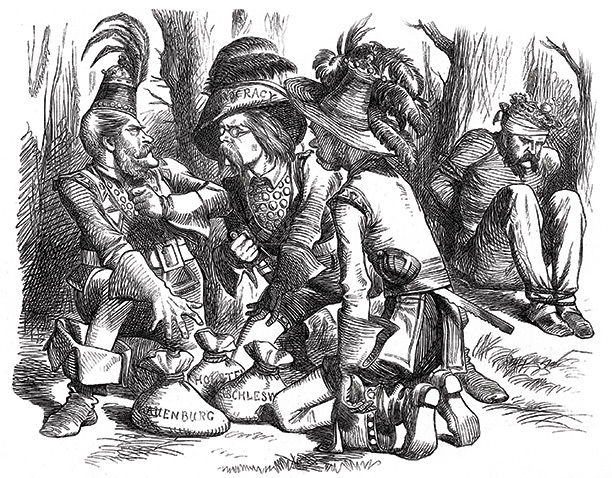 The British prime minister Lord Palmerston is said to have remarked in the early 1860s that only three men in Europe had ever understood the ‘Schleswig-Holstein Question’: one (Prince Albert) was dead, the second (a Danish statesman) was in an asylum and the third (himself) had forgotten it. The Question concerned the governance of Schleswig and Holstein, two duchies occupying the southern half of the Jutland peninsula between Denmark and Prussia, which were ruled by the King of Denmark in a ‘personal union’. Whereas the northern part of Schleswig was Danish-speaking, the people in the southern part, and in almost the whole of Holstein, spoke German. Holstein was also a member of the German Confederation, the polity established in 1815 after the defeat of Napoleon. Prussia was the de facto military agent of the Confederation.
There was nothing particularly complicated about this form of government. The medieval Holy Roman Empire had been a patchwork of competing jurisdictions and loyalties and Hanover had been ruled by the kings of England in a personal union between 1714 and 1837; but, during the 19th century, a number of factors cast doubt on the survival of the ancient constitution of Schleswig and Holstein. The first was the increasing likelihood that at some future date the person who succeeded to the kingdom of Denmark would not also succeed as duke in the duchies. The second was the increasing desire among many in Holstein and some in Schleswig to shake off Danish rule and seek closer union with the German Confederation. This coincided with a general impulse throughout Europe towards the creation and consolidation of nation states. However, it was difficult to know how the other Great Powers who had settled the affairs of Europe in 1815 would react to any expansion of Germany. Similar anxieties were expressed in relation to German reunification in 1990.
During the rule of the Danish king Christian VIII (1839-48) it became increasingly clear that, although he had an heir, the future Frederick VII, the latter was unlikely to produce one himself. Furthermore, although there were more distant claimants to the throne, these would be ineligible to succeed to the duchies, where Salic law applied. Shortly after Frederick VII came to the throne in 1848 there was an uprising in the duchies against the Danish king, which was supported by the German Confederation. Prussia led an invasion in response, while the other Great Powers – Britain, France, Russia and even German-speaking Austria – took the side of Denmark and made warlike threats. Under pressure, Prussia withdrew and the Treaty of London of 1852 (in which Palmerston played a leading role) saw the duchies restored to Danish rule, subject to the proviso that they should continue to be governed separately from the Danish kingdom.
The death of Frederick VII in 1863 precipitated a second and deeper crisis. The different inheritance laws prevailing in Denmark and Schleswig-Holstein meant that only a male from the Oldenburg dynasty could succeed in Denmark, but that any new ruler of the duchies had to come from the Schauenberg family. So, whereas Christian IX (1863-1906) succeeded without objection as king of Denmark, it was Duke Frederick of Augustenborg who was entitled to succeed as Duke of Schleswig-Holstein; and Duke Frederick did indeed claim this right, though his father had once waived it. Moreover, he was known to favour closer links with the German Confederation.
Christian IX confirmed a new constitution, incorporating Schleswig into his kingdom. This contravened the provisions of the Treaty of London and Prussia was now joined by Austria in lending military support to the duchies.War followed in 1864. Prussia and Austria quickly occupied the duchies, at one stage overrunning the whole of Jutland, to the great concern of other European powers. There was a brief pause and a further period of fighting; but then Bismarck, the minister-president of Prussia, dictated peace. At the Treaty of Vienna on August 1st, 1864 Denmark agreed to cede Schleswig and Holstein to Prussia and Austria. The age-old Question had been resolved.
Drawing the line
The crisis in Schleswig-Holstein has some resonance with recent events in Syria, when the US and the UK both made vain threats to intervene. In 1863, Lord Palmerston made a speech in Parliament in which he drew a ‘red line’ under Schleswig-Holstein, declaring that, if Prussia and Austria were to try to take those provinces by force, it would not be Denmark alone with which they would have to contend.
The Danes took him seriously. On February 11th, 1864 they appealed for help, relying both on this speech and an old treaty of 1720, but Palmerston sat on his hands. In June 1864 he made a further statement to the Commons, focusing this time on Denmark itself, rather than the duchies, saying that Britain would not go to war with the German powers unless the existence of Denmark as an independent power was at stake or its capital was threatened. Yet, when the Prussians and Austrians did invade Jutland and a majority of the British Cabinet voted to send the Royal Navy to defend Copenhagen, Palmerston still sent no assistance. Later he argued that he had never meant to imply that British assistance would be provided to the Danes, but rather that Denmark might not find itself alone, because the French and the Russians might help it. But this attempt to ‘spin’ his own words convinced no one. Disraeli remarked that no one in Denmark was blaming France or Russia for betraying them: on the contrary, they all blamed Palmerston.
In any event, Palmerston’s threats were not even issued with the backing of his own governing party, let alone the country, where sympathies were keenly divided. At the top, Queen Victoria was strongly opposed to intervention: after all, her late husband Prince Albert had been German and her daughter Victoria had married into the Prussian royal family in 1859, though the Prince of Wales had married into the Danish in 1863.
Why did Palmerston, already internationally famous for ‘gun-boat diplomacy’, send not a single frigate to help the Danes? Essentially, because there was nothing the British could do militarily to alter the situation. Britain was a world power but it was no superpower: it had the largest navy by far, but lacked the capacity to ‘put boots on the ground’ in sufficient numbers to assist the Danes; and the Prussians in particular were fully aware of this. Their strategist, General von Moltke, said that England was as powerless on the Continent as it was presumptuous. On another occasion Bismarck remarked that ‘Dreadnoughts have no wheels’. There are parallels here, too, with August 1914, when Germany discounted British military intervention, but with much more catastrophic results for all concerned.