The Glorious First of June
In 1794, at the start of the French Revolutionary Wars, 'the nation wanted a victory'. It was provided by Admiral Howe.
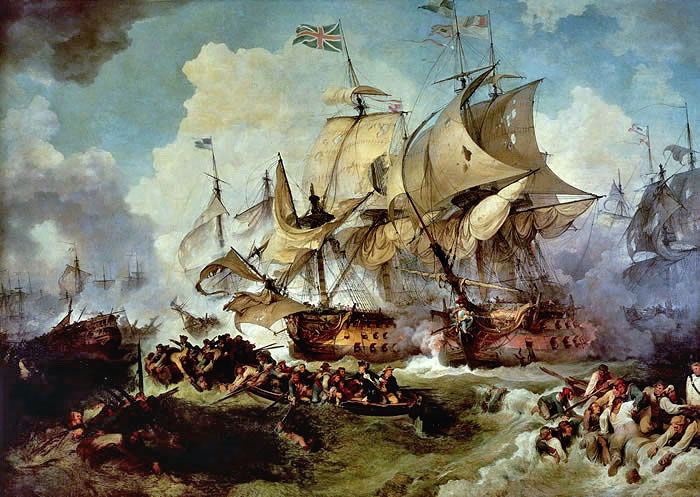 One day, in the spring of the year 1793, soon after the declaration of war with Revolutionary France, a young man of 23 received a flattering invitation. Sir William Howe, whom he had known for a long time, suggested that he should go with him to Grafton Street. The pair would breakfast with Sir William's brother, Admiral Lord Howe. It was a notion likely to arouse both hope and apprehension. Lord Howe could make an officer's career at sea, and the young man was a sailor, but – was he not difficult, formidable, taciturn? Sir William, a debonair soldier, laughed away doubts. All would be well.
The young man's name was Codrington, and that particular meeting was a turning point in his life. After the dishes had been cleared away, Sir William left his brother to talk with the tall midshipman, who already had ten years' creditable experience behind him. He perceived that the two liked one another, as he knew they would.
Lord Howe, in a most unexpected way, proceeded to unburden himself. He spoke warmly of his brother, of his agreeable manners, his knowledge of the world. But with himself it was otherwise; he found it hard to get on with other people, to gain their confidence. He had, as Horace Walpole noted many years before, a 'constitutional intrepidity,' allied to profound reserve. But his nickname in the fleet, 'Black Dick,' was not bestowed opprobriously. It was due to his dark complexion. When he smiled, so the men said, they knew they were in for a fight.
The admiral had invited Codrington to call, he explained, because he thought he might like to serve in the Queen Charlotte, the flagship in the Channel. Was that so? It was indeed.
And how about his promotion to lieutenant: when was that due? Promotion, answered Codrington, had been promised by Lord Chatham, who was then presiding at the Admiralty.
Howe shook his head doubtfully. Personally, he was 'inimical' to Chatham. He owed his present command to the King, not to the First Lord. There seemed a slight impasse, but it was eased by Codrington saying that he wanted nothing better than to serve with Lord Howe in any capacity, and – in reply to another question – that if he should be promoted while in the Queen Charlotte he would certainly not object to continuing as lieutenant in a ship where he had formerly been a subordinate. Howe approved this frame of mind. In fact, he would arrange for Codrington to join as soon as possible. He should be his aide, and learn something about signals. Signals were the clue to much of Howe's fame as a tactician. With a fleet the size of that which he now commanded, organized into Van, Centre and Rear Squadrons in the fashion of the old Dutch Wars, good communication would be more than ever essential.
At the time of the breakfast encounter, Howe was 67. He had another six years to live, and his career, already packed with action and high responsibility, would end in a blaze of glory. Nelson, who wrote to him later that the victory of the Nile was largely due to his signal system, called him, in the same letter, 'the first and greatest sea officer.'
Howe's life spanned the last three-quarters of the 18th century (1726-1799). He had sailed with Anson on his famous circumnavigation, though his ship, the Severn, was forced to turn back from Cape Horn by gales and sickness. As a young commodore in the Seven Years War, serving the elder Pitt, he had won distinction in combined operations. He had led Hawke's line at Quiberon Bay. He had been in supreme command – jointly with his brother Sir William – against the revolted Americans, and had outwitted D'Estaing when he brought a French fleet to help them. He had relieved Gibraltar in 1782 in the face of enormous odds – in his own view, this was his best achievement. He had twice held office as First Lord. He and Kempenfelt, who perished in the Royal George, had between them transformed naval opinion on signals and tactics. As he was still willing to serve at sea, there had been no competitor, in the view of George III, for the post of principal commander-in-chief in the struggle which had just opened, and which was to prove so long. Lord Hood was given the Mediterranean, Howe the Channel.
War was declared in February 1793, and in August Hood took Toulon, though he could not hold it. It was likely that stress would shift north, into Howe's sphere. France, then in the throes of the Terror, was starving, owing to harvest failures and neglect of the fields. She would need to import grain from America. To do this in the face of superior force would require planning, secrecy and skill. It might lead to a full-scale engagement in the Atlantic. Howe's task was to train his fleet so that, in any encounter, it could be sure of that 'combat supremacy' which Mahan rightly held to be one of the basic principles of mastery at sea. Powerful as it was on paper, Howe was uneasy as to the quality of his material. Hood, he thought, had most of the best ships; and he did not think much of some of the Channel captains. By the winter of the opening year of the war Howe had given them so little chance to show their mettle that, when he went to Bath to recruit his health, he was insulted by the mob. The nation wanted a victory.
By the early months of 1794, the situation in the Atlantic was as follows. Over a hundred vessels, filled with grain for the relief of France, were assembling in the Chesapeake. They were to sail in April. Their immediate escort was to consist of four ships of the line under van Stabel. Cover would be provided by the main fleet under Villaret-Joyeuse, who had been a mere lieutenant three years before, and who had, to help him in his flagship, an official whom later generations would learn to call a Revolutionary Commissar. This man's name was Jean Bon St. Andre, and, unlike many of his kind, he was a person of great practical ability.
The French admiral's life, as well as his professional future, depended upon the grain reaching his countrymen. He had orders to sail his fleet from Brest and to meet the convoy about four hundred miles from land. On April 10th he sent an advanced detachment to sea, and prepared to follow in person.
Howe made a cruise in April, but met nothing. On May 2nd he again sailed from Spithead. He had 34 ships of the line, but as he, too, had orders to protect an outward convoy, he was forced to detach eight, ordering six to rejoin him with all speed after seeing the merchantmen to the latitude of Cape Finisterre.
By May 5th, Howe was off Ushant. There he learnt that his opponent had still not sailed. Not wishing to prevent him from so doing (for he was as eager to fight the French fleet as to capture the convoy), he made no attempt to watch Brest, but advanced westerly, along the 47th parallel, so putting himself between the convoy from America and the main French fleet, and in a fair position to capture the grain first and defeat Villaret-Joyeuse later.
A week passed, and Howe met no one. He returned to Ushant, off which he arrived on May 19th. He found Brest empty, for the French had sailed three days before, with 25 of the line. Villaret had been joined at sea by one additional ship, and had actually passed close to the British, unseen in the foggy weather. The moment Howe had firm news of Villaret's course, he pursued, without waiting for the six ships which were due to join him.
On the 25th, two French corvettes out of Brest were seen steering after the British fleet, thinking it their own. Both were captured and burnt, Howe remarking to his staff: 'It must be very unpleasant to you gentlemen to see your promotion burnt: but I shall shortly be able to make you amends for it.' Early on May 28th, with a rough sea running, Codrington, at the mast-head of the Queen Charlotte, saw Villaret's ships to windward, some ten miles off. The British were then farther from Brest than their opponents, a fact which seems to have puzzled Villaret, and one which speaks well for the pursuit. The French began an orderly retreat, intending to draw Howe away from the precious convoy.
Howe, who had formed his fastest ships into a flying squadron, signalled the general chase. Four ships got into action with the French rear, whose number included the three-decker Revolutionnaire. After a stiff fight she was rendered unfit for further action, at the expense of one disabled British vessel, the smaller Audacious.
Next day, the 29th, Howe was still to leeward of the enemy, and his immediate object was to gain the windward position – the 'wind-gauge' so valuable in days of sail, which enabled an admiral to attack when he chose. Howe determined if possible to break the French line from his leeward station. Although his Van failed in this object, he himself, with two other ships, broke through the French towards the rear of their line, and cut off three of their number.
Villaret, in order to save these three, was forced to run to leeward; even so, he was too late to prevent them from being made unfit for further fighting. Through the action, Howe had not only secured his weather-gauge but had reduced Villaret's effective strength to 22, while he himself still had 25 ships fit for action.
May 30th was foggy, and Howe was content to maintain contact, while Villaret continued to edge away to leeward, being so fortunate as to meet with and be reinforced by four ships of a detached squadron. On the 31st, at midday, the fog lifted, but Howe, with that moral strength which was one of his characteristics, decided to postpone his final attack until June 1st. That day he was seen to smile, and the news spread like lightning through the Queen Charlotte.
His plan, which he intended to execute on the last day of the encounters, was designed to overcome the French withdrawing tactics. When operating from leeward, they would fire at the masts and sails of an advancing enemy, withdrawing as soon as the latter approached close range, and repeating the manoeuvre until their opponents were rendered immobile.
Howe, instead of engaging the French on the same tack while still to windward, which would have been the conventional tactics of the time, proposed to break through their line at all points, and to engage from leeward, thus preventing retreat. It was a counsel of perfection, if not every ship could be expected to break through. Each one that did so would, however, if properly supported, be reasonably sure of defeating her opponent.
The attack produced a melee during the course of which a number of British ships, including the Queen Charlotte, did in fact break through. When the smoke cleared, after an hour of grim fighting, it was seen that six Frenchmen had struck, while a seventh, the Vengeur, was sinking. None of Howe's ships was lost, though as the French defended stubbornly, the damage and casualties were heavy. It was not an annihilating victory such as Nelson would seek, but it was a resounding one. The prizes, the Juste and Sans Pareil of eighty guns, the America, Achille, Northumberland and Impetueux of 74, looked well at Spithead, and rejoicing was appropriate to the occasion. The King arrived in state, to present Howe with a diamond-encrusted sword worth three thousand guineas, and he offered him a marquisate, which was declined. Honours fell thick among the flag-officers and captains, though there were some omissions which caused grief. The Glorious First of June was among the most notable sea battles since Quiberon Bay, where Howe had won the praise of Hawke. Britain had re-established combat supremacy and won a tactical triumph, though the strategic honours were with France, for her grain was safe. Villaret, who was not pursued, kept both his head and his command.
Howe was so weary after his days and nights of vigilance and responsibility that, when the battle was over, a slight roll from the Queen Charlotte nearly sent him toppling into the waist of the ship. 'Why,' he said good-humouredly, as he felt Lieutenant Codrington's arm securing him, 'you hold me as if I were a child.'
Logs and despatches confirm for posterity the factual structure of a campaign or battle, but they do not enable later generations to see things in terms of personal experience, except in a generalized sense. There are, fortunately, a number of private records of the First of June, among them Codrington's.
Codrington, who as a post-captain fought with distinction at Trafalgar, and lived to command-in-chief at the last fleet action wholly under sail – that at Navarino in 1827 – so little forgot his earlier experiences with Howe that in later life he was provoked into putting them on record.
It happened that one evening, in the 1830s, he was dining with William IV at the Brighton Pavilion. The talk turned upon Howe. Codrington said that it was a great pity nobody had written his Life. The King agreed. Shortly afterwards he set the Second Secretary of the Admiralty, Sir John Barrow, to gather material. The result was disappointing. The admiral's own papers had by that time largely been destroyed in a fire in Ireland, and Barrow depended on scattered memories and fragments. When the book came out, a reviewer spoke of Howe's 'shyness' in action in later life. That was altogether too much for Codrington. He included in his own Memoirs an account of his time in the Queen Charlotte which was designed to show Howe in a truer light. It is one of the best portraits extant.
To add to Codrington's recollections, there has been published within the last few months a Journal, kept by Edward Dillon, who was a boy of fourteen at the time of the battle, and who, like Codrington, later achieved his flag. Dillon was in the Defence. The captain was Gambier. They called him 'Preaching Jimmy,' but he fought his ship magnificently, as Howe himself was heard to say.
There were heroes at the First of June, such as the men of the Brunswick who battered the Vengeur to pieces with their gunfire, although – despite the legend once supported by Carlyle – a large number of her people were rescued and taken prisoner. There were the men of the Queen, the Bellerophon, Leviathan, Marlborough and other ships with long lists of dead and wounded. There was a baby, born to the wife of one Mackenzie, a seaman of the Tremendous, a day or two before the action; the infant lived to receive the Naval General Service Medal, instituted 54 years later, with a clasp for the battle. There was at least one villain, Captain Molloy of the Caesar.
Molloy had a fast ship, and he led the line. He was an officer of experience who had done well under Rodney years before, but he did not please Howe. Again and again he was in trouble for not answering signals. He came close to spoiling the whole plan both on May 29th and June 1st. Ten months later he was court-martialled – at his own request – and dismissed his ship. Dillon tells us that on the way home to Spithead the Caesar had for a time the job of towing the damaged Defence, and that Molloy 'came on board anxious to argue the point with Captain Gambier, but our chief would not listen to one word.' There were those who said that others were nearly as bad, and indeed, as he had long feared, Howe's captains proved far from Nelson's 'band of brothers.' When the old Earl wrote to congratulate Nelson on his first success in independent command, he could not help remarking on what was to him the astonishing fact that every captain appeared to have done his duty.
In the crises Howe, as always, was the calmest man in the fleet. For four days, says Codrington, what rest he had was taken in his great-coat, sitting in an armchair behind a canvas screen, for his cabin had been cleared for action. He never slept, but he was never worried or in doubt. He knew exactly what he was doing.
Howe carried in his coat pocket a little signal book. After breakfast on June 1st, just before the firing opened, he said to Sir Roger Curtis, the Captain of the Fleet: 'And now, Sir, prepare the signal for close action.' 'My lord,' said Curtis, 'there is no signal for close action.' 'No sir,' replied Howe, 'but there is a signal for closer action, and I only want that to be made in case of captains not doing their duty.' It was, in fact, soon flying for the Caesar. 'And now,' he said at last, turning to the staff by whom he was surrounded, 'no more book, gentlemen, no more signals. I look to you to do the duty of the Queen Charlotte in engaging the French Admiral. I do not wish the ships to be bilge to bilge, but if you lock the yard-arms so much the better, the battle will be the sooner decided.' The words and the episode deserve to be remembered in the history of the sailing navy.
Sir Roger Curtis, who acted as Chief of Staff, was a bit of an old woman. Although personally brave, he was always fussing about something, and he was so anxious over the safety of the fleet, once the fighting was over, that he persuaded Howe not to follow the beaten foe with such ships as were capable of doing so. But both the captain of the Queen Charlotte, Sir Andrew Douglas, and the Master of the Fleet, James Bowen, were of very different mettle. Douglas had been knighted on the occasion of George Ill's first going to sea, in a frigate which he then commanded. He was greatly loved, though Dillon, who once served under him, records seeing him break a speaking-trumpet over the head of a seaman who did not jump fast enough to do what he was told. He was painfully wounded in the scalp during the battle, never fully recovered, and died young.
As for Bowen, he was very much Howe's man, and one of the great characters of the navy of his time. He had given up a lucrative shore job in the transport line to be with the admiral, and when Codrington first joined he was there on the dock-side, shouting directions beneath a pink umbrella. Bowen was much aware of rank. In the thick of the fighting Howe was heard to say to him: 'Bowen, pray, my good fellow, do give over that eternal 'my lord,' 'my lord.' Don't you know I am called Black Dick in the Fleet?' And when the Queen Charlotte was closing with the French Montagne, Howe, who was himself conning the flagship, called out to Bowen to starboard the helm, to which Bowen remarked that if they did so they would be on board the next French ship, the Jacobin. 'What is that to you, Sir?' said Howe tartly. Bowen, a little nettled, said in an undertone: 'Damn my eyes if I care if you don't! I'll go near enough to singe some of our whiskers.' Howe heard him. 'That's a fine fellow,' he said to Curtis.
It is good to know that Bowen attained his great ambition, post-captain's rank, not long after the battle, and that he died Rear-Admiral of the Blue, with his portrait at Greenwich.
The First of June was won by a Hanoverian aristocrat fighting zealous revolutionaries. The fact was symbolized in at least two odd details. When the ships returned to Spithead, one of the captains told Howe's favourite daughter, Lady Mary, that the cartridges used on board the French ships were mostly made of fine painted church music formerly in the cathedrals, and of preuves de noblesse, some of them many hundreds of years old, illuminated with the devices of heraldry. Dillon records a still more curious fact. The Leviathan actually fired silver dollars at the America, one of the prizes. He saw some still sticking in her plank. What had happened was that when the Leviathan had been with Hood's force at Toulon she had acquired some fine brass howitzers, together with some red tin canisters supposedly full of shot. They were actually stuffed with five-franc pieces which had been sent by a nobleman to the dockyard, and hidden in what he thought would be a place of safety.
From Dillon comes a report of one of the few jokes ever to fall from Howe's lips. In the junketings which followed the visit of the Royal Family to Portsmouth to greet the victorious sailors, Howe included a splendid party for his principal officers. Among the few people absent was Payne, captain of the Russell, a genial man commanding a ship which had done well. 'Is he not here?' said Howe. 'I am sorry for that. There is no pleasure without Payne.'
Dillon, like Codrington, makes clear how proud the great fleet was of their 'renowned' admiral. Even the private ships felt a share in him. Howe had always been known as the sailor's friend, and when Bowen asked him to receive a deputation of seamen, while the Queen Charlotte was on her way home, they cheered their leader to the echo. The admiral said to them from the break of the poop, his voice trembling: 'No, no: it is you, my brave lads, it is you, not I that have conquered.' He gave his own large share of the prize bounty to the wounded.
Two infantry regiments show the 1st of June among their battle honours – the Queens, the old 2nd Foot, and the Worcestershire Regiment, the 29th Foot, which had companies serving with the ships. An officer of the Queens was killed in action on the quarter-deck of the Queen Charlotte, and the incident is shown dramatically in Mather Brown's reconstruction of a scene in the battle. In this same picture Howe stands sombrely, with his sword drawn. It was with the flat of this weapon that Codrington saw him strike the captain of a gun whom he believed, erroneously, to be firing at his own side.
The Glorious First of June was Howe's last and greatest fight. He lived to settle a serious mutiny at Spithead in 1797, the prelude to a graver crisis at the Nore. He gloried in the succession of victories of younger admirals with which the 18th century closed; and he was the first man to receive the Garter for achievements in the navy. He prized the blue ribbon, but not for himself, for he was without vanity. It was the highest distinction his Sovereign could confer in recognition of service in a profession to which he was devoted.