Smoking in the First World War
Chris Wrigley explores the hugely beneficial impact of the First World War on the British tobacco industry and looks at how smoking became an approved symbol of comradeship and patriotism.
 The trade journal Tobacco, in an editorial of October 1914, claimed that ‘it might almost be said that a man in the firing line first thinks of his cartridges and the very next thing he seems to worry about is ammunition for his pipe. The pipe itself is only less precious than the rifle’. While frontline troops were probably more concerned with lack of regular food or effective footwear to cope with the often waterlogged trenches, nevertheless tobacco and cigarettes were highly valued comforts.
British soldiers and sailors smoked 1,000 tons of cigarettes and 700 tons of pipe tobacco in 1915. The tobacco trade journals quoted from an article in the Lancet:
We may surely brush aside much prejudice against the use of tobacco when we consider what a source of comfort it is to the soldier and sailor engaged in a nerve-wracking campaign … There can indeed be little doubt that tobacco fills an important place in the psycho-physiological affairs of the human race.
For those wishing the troops well cigarettes were gifts of appreciation and, from family, of love. A newspaper report from Southampton dated August 24th, 1914 commented:
Local ladies provided free refreshments and cigarettes from two marquees erected on the Common, while in the Avenue, close by, a hall was opened, where soldiers could write their letters – stationery and stamps being provided free – and inspect the latest newspapers and periodicals, while the fair sex handed cigarettes round the happy ‘Tommies’, who, before their departure, did not forget to express their gratitude …
‘The Nation had gone mad on tobacco’, was the view expressed in late 1915 by a member of the British Anti-Tobacco and Anti-Narcotics League. Wartime images of soldiers smoking have become part of later generations’ images of the Western Front, featuring in later dramas and films such as Oh, What A Lovely War! (1963) and King and Country (1964). Cigarettes also feature in discussions of the Home Front, as in Arthur Marwick’s study The Deluge (1963), in which there are memorable accounts of young female munitions workers spending their money in restaurants and smoking publicly, a practice almost unimaginable before the war.
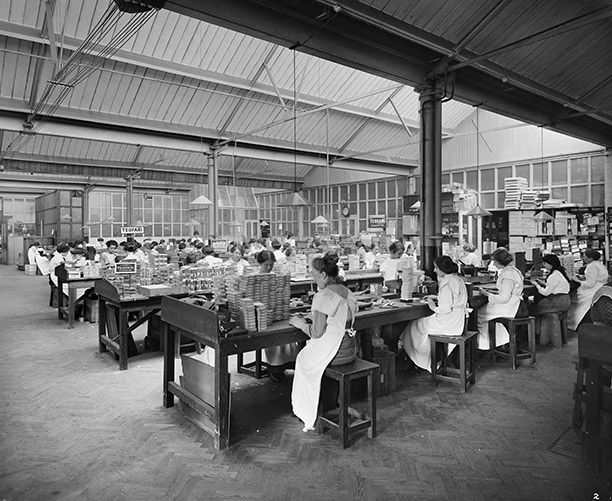
According to the 1911 census tobacco manufacturing directly employed over 20,000 people in England, Wales and Scotland. Over half the work force were women (58.5 per cent). The industry also created a number of jobs for people beyond those preparing tobacco, a point often made by the manufacturers, including the production of ancillary goods such as pipes and snuff boxes. In 1911 in England and Wales some 2,300 people were employed in such work. The figures for the retail sector were higher, with a total of 23,000 people working as tobacconists in England, Wales and Scotland, 44 per cent of whom were female (in Scotland 63 per cent were women). All cities and most towns had at least one tobacconist. In England and Wales between 1901 and 1915 the numbers of people working in tobacconists increased by over a quarter.
The First World War was at first seen as a potential threat to the tobacco industry, as it caused major dislocation to shipping. Imports were increasingly controlled by the government in order to conserve both shipping space and Britain’s dwindling supply of dollars. Tobacco was deemed important for morale among the armed forces and so continued to be imported. In spite of the concerns of the tobacco retailers, the quantity of pipe tobacco consumed during the war remained fairly stable, dipping below the 1914 level (55.7 million lbs) only in 1916 (54.7 million lbs), while cigarette consumption rose steadily (from 49.2 to 56.8 million lbs) throughout. Cigarettes and tobacco were regarded as luxuries but were deemed not only important in maintaining the morale of men in the armed forces but also of those working long hours in war production. Even so, tobacco was constrained later in the war, first by shipping shortages caused by devastating German U-boat attacks and then from 1917 by a shortage of space due to the need to bring US troops across the Atlantic.
In the opening months of the war many tobacco retailers made dire predictions as to what it might do to their trade, but the tobacco industry did well out of the conflict. Trade grew along with the desire of families and friends to send cigarettes, tobacco and related items to servicemen. In many areas it was also boosted by nearby military camps and by large numbers of workers in munitions and other factories earni
g good money through long hours and, sometimes, bonus systems.There were notable variations in the performance of tobacco companies. The Nottingham-based firm John Player’s saw their tobacco and cigarette sales increase much faster than the national average, especially between 1914 and 1916 before supply problems restricted sales. From November 1st, 1914 to October 31st, 1918 its sales of tobacco (by weight) rose by 42 per cent while sales of its cigarettes (by number) increased by 54 per cent. This compared with average national rises of 3 per cent and 7 per cent respectively.
With the advent of rapid output cigarette machines in the 1880s, more mechanised and better packaging and more subtle curing of Virginia tobacco leaves, cigarettes had steadily taken a greater share of the market from the 1890s. In 1900, in terms of value, cigarettes accounted for 20 per cent of tobacco sales, by 1914 this proportion had risen to 56 per cent and reached 58 per cent in 1918. Pipe tobacco remained popular, but increasing numbers of servicemen turned to cigarettes. This trend away from the ‘manly’ tobacco was something commented on just before the outbreak of war, when, after a royal review of the Navy at Spithead, battleships went to Weymouth and Portland. Then it was noted:
The ‘Navy plug’ is not so popular with the younger generation of Jack Tars as it used to be with the ‘old salts’ and there is a great demand among the sailors for cigarettes and packet tobacco.
During the war it seems likely that servicemen were smoking more, as Tobacco asserted in December 1914.
There are some million-and-a-half men in uniform. Kitchener’s Army, the Territorials at home and the Expeditionary Force in France are all smoking. Man for man they are smoking more than in times of peace.
The demand for tobacco and cigarettes on the Western Front is apparent from contemporary sources. The desire for cigarettes is a frequent feature of letters home. In the 1916 documentary film, The Battle of the Somme, made just before the battle and during its early stages, cigarettes feature in several of the film’s short sections, sometimes as a commodity of compassion. In one scene, which is quite contrary to the usual depiction of ‘bestial Huns’, injured German prisoners are shown as fellow human beings to be pitied and in another scene some are given cigarettes by a British guard. In one of the most moving passages in the film, as a group of soldiers in a sunken lane in no-man’s land are resting before advancing, the caption informs us they were soon to be machine gunned. A man looks to the camera with the despairing stare of one convinced his death is imminent, a few others smoke.
From early in the war the state provided soldiers at the front with tobacco. By September 1914 each soldier in France and Belgium was allocated two ounces a week, initially of Wills’ Capstan tobacco. The French had been swift to supply tobacco to their soldiers with apparently ‘about 50 tons a day for the frontier regiments alone’. France’s national tobacco factories were reported to be operating night and day, with some of their output initially going to British troops. As the British soldiers preferred sweet Virginia tobacco (rather than the Turkish or Egyptian blends favoured on the Continent), tons of Virginia leaf was shipped to them from England. Tobacco was not unique in being provided to boost troop morale. The War Office also provided increasing volumes of cocoa and chocolate, rising in weight from 65,000 cwt in 1914 to 372,000 in 1918.
The tobacco companies had long emphasised their patriotic role in supplying the Armed Forces. John Player’s Navy Cuts brand, with its sailor trademark, was obviously linked to the senior service. The sailor’s head had been registered for copyright in 1883 and it developed in stages, with the lifebuoy frame in 1888 and the two ships, HMS Hero and Britannia, added in 1899. An examination of the Player’s advertising archives suggests that the sailor’s face was also modified, making it appear stronger. In 1900 Player’s despatched to the British troops in the Boer War £1,500 worth of Navy Cut cigarettes as a Christmas gift.
During the First World War state censorship extended to cigarette cards. The Player’s company had previously issued several series of cigarette cards of Boer War themes, which proved popular with the British public and aroused no official concern, and there were more series of Great War themes issued during 1914-18 by Players and other companies. However, from September 14th, 1916 all cigarette cards with naval and military subjects had to be cleared by the Press Bureau’s censors. As well as outright propaganda, tobacco firms also put useful information for troops in cigarette packets. For instance, in packets of its Black Cat brand the London-based cigarette firm Carreras put in 24-page English-French dictionaries, phrase books and French grammars designed to be of use to the troops in France. In 1916 the same company also issued 140 cartoons, many featuring anti-German propaganda, drawn by Louis Raemaekers.
In the First World War there were gifts for soldiers and sailors from several British tobacco companies. For example, early in the war the Godfrey Phillips company sent 2.5 million of its cigarettes to the British Expeditionary Force, 1,600 packets of tobacco to Belgium (and further tobacco to Belgian refugees in Britain) and 50,000 cigarettes to the ambulance train at Southampton. Also, in the opening months of the war, Rhodesia donated 400,000 packets of cigarettes and 10,000 tons of tobacco to British troops and 10,000 tons to the Royal Navy, while three Egyptian firms gave 90,000 cigarettes.
Tobacco retailers were eager to encourage the public to buy their goods for relatives and friends serving in the armed forces. There was widespread use of posters and careful development of window displays. One early poster read:
GIFTS FOR THE MEN
Soldiers and Sailors are mostly Smokers
Perhaps YOU have a friend who has been called up.
Send him something to smoke.
Come in NOW! We will despatch what you buy to his address
In the early part of the war there was considerable disruption of domestic markets. Resorts such as Blackpool, Whitley Bay, Jersey and Guernsey were hard hit by thousands of people cancelling their holidays. In Guernsey the boats serving tourists went on their winter schedule in August rather than October 1914 due to lack of trade. In Jersey not only did 8,000 holidaymakers leave or cancel, but some 2,000 French reservists, mostly agricultural labourers, were called up. For a few months in the autumn of 1914 tobacconists in the industrial Rhondda area of South Wales were hard hit due to the large number of miners volunteering, with some traders taking other employment, including going down the coal mines. In contrast in Woolwich, south London, the Royal Arsenal was working at maximum pace, workers enjoyed good take-home pay and the local tobacconists prospered. Similarly, many tobacconists did well in towns with barracks full of recruits or with huge temporary camps nearby, such as Colchester and Plymouth, where thousands of army and navy Reservists created a huge demand for tobacco, ‘necessitating frequent wires to manufacturers for fresh stocks’.
Nottingham was one of the cities whose tobacco retail trade was affected early on. In late August 1914 trade was said to have declined by over a third. Six thousand men in the reserves and territorials, ‘who are all practically smokers’, had left the city at a time of already reduced demand, as lace warehouses had cut wages by 25 per cent and there was growing unemployment. A month later there were reports of short time being worked in the city’s cigarette and cigar factories. However, by late September 1914 the campaign for ‘smokes for soldiers’ was creating additional demand. Retailers were doing brisk business a month later; sending troops cigarettes was ‘the fashion of the hour’. In addition, there were 300 Belgian refugees and many wounded soldiers in the city. Some city tobacconists put out collecting boxes with red crosses on the outside for pipes, tobacco and cigarettes supplied at cost price to the wounded and the refugees. John Player’s, like other tobacco manufacturers, published advertisements listing its brands and making the point that soldiers and sailors in military hospitals could be sent tobacco and cigarettes duty free. The city tobacco retailers also did well from soldiers on leave. In late October 1914 around 600 soldiers on 48 hours weekend leave ‘took back with them such stocks as they could afford’.
At the outset of the war the tobacco industry had large reserves in bonded warehouses: 232,500,000 lbs of leaf and strips plus nearly 1,000,000 lbs of cigars. In October 1914 nearly 10,000,000 lbs of leaf was shipped from the US (over 80 per cent of the total leaf imports) while 2,377,500 lbs came from Sumatra and other non-European areas. UK tobacco merchants hoped to take over the trade based in the Baltic port of Bremen, especially Germany’s export markets (including 2,000,000 lbs of leaf and ten tons of cigarettes per annum into Britain). The UK trade expected to take ‘advantage … of the mother country sentiment in the colonies (the finest and best market for Britain’s goods)’. The British tobacco industry steadily increased its exports until 1916. In March that year the value of tobacco exports was £364,000 (around £35 million today), only £7,000 less than in March 1914.
Thereafter shipping restrictions led to a temporary decline in the domestic trade, with sustained shortages in some areas. In March 1916 imports of both new and manufactured tobacco were banned briefly, unless given special licences. The government aimed to reduce imports for domestic consumption by two thirds. However, as the business historian Howard Cox has commented, the issuing of licences to importers rather than to manufacturers was controversial, as was permitting importers to bring in all the tobacco they needed for their export business on top of the third that was generally permitted. For the rest of the war, in spite of a little over two years’ stock in bond and some imports by licence, there was a squeeze on the industry. In the last two years of the war the unmanufactured stock of tobacco dropped by nearly half.
In the latter part of the war the Tobacco and Matches Control Board acted on behalf of the government to protect consumers, as well as trying to ensure a level playing field for manufacturers, wholesalers and retailers, drawing on powers under the Tobacco Restriction Orders, part of the Defence of the Realm Act of 1914. By late 1916 tobacco retailers were again complaining of falling tobacco consumption. There were suggestions that the inflation of food prices left less money for tobacco. The retailers were also agitated over the Early Closing Order, an Order in Council, issued in October 1916 under the Defence of the Realm Act, 1914, which ordered tobacco sales to cease at 8pm. There was also the introduction of a half-day closing in the week where two thirds of tobacco retailers wished for it. A Half-Holiday Order was introduced as early as the summer of 1915 in Exeter. However, such moves became more widespread when retailers faced a shortage of supplies in 1917 and 1918. Tobacconists in Leeds and Glasgow were among those who opted in 1918 for half-day closing. The prospect of abolishing Sunday trading was also raised.
By 1918 there were tobacco shortages in most cities and towns. In mid- June there were queues outside tobacconist shops on the Clyde. In one munitions area it was reported that ‘men refused to go on with their employment unless tobacco was found’. Shopkeepers closed for several days during the Glasgow Fair holidays. In Norwich retailers rationed their customers. In Pontypridd the cheaper brands of cigarettes – Woodbines, Cinderella and Tabs – were unobtainable, so working people were buying the more expensive brands, to the delight of the tobacconists who predicted that, once supplies were restored to normal, ‘the call for the better class of cigarettes will be heavier than before’. Similarly, when the 1918 Budget increased the price of cigarettes, a Norwich retailer observed: ‘For myself I do not think that we shall sell a single ounce less … I shall sell all I can get.’
With a shortage of cigarettes some males became even more critical than usual of women smoking. A report from Hull in a trade journal claimed that the ‘increased prevalence of feminine smoking’ was causing ‘a great deal of public comment and controversy, especially the habit of women filling railway smoking compartments’.
By the end of the war, as Christopher Snowdon has put it, the cigarette had become not just a popular item but almost a patriotic one. The returning soldiers and sailors continued to smoke. So did many of the new wartime female smokers (though initially not often in public). With the wartime restrictions on tobacco supply lifted, sales jumped. Expenditure on all tobacco products rose from £65 million (the last full year of war) to £115 million in 1919. The tobacco industry had a good war.
Chris Wrigley is Professor of History at Nottingham University.