Brazil in the First World War
Roderick Barman examines the circumstances surrounding Brazil’s entry into the Great War and appraises the conflict’s legacy on the developing nation.
 The year 1917 was a crucial one in the course of the First World War. Two revolutions removed Russia from the conflict and the entry of the United States, with its human and material resources, was to prove decisive in achieving the defeat of the Central Powers. By comparison, the declaration of war by Brazil on the side of the Entente powers on October 27th, 1917 has passed almost unnoticed in history. Brazil had no great reason to involve itself and its contribution to the war effort was slight. On the other hand, the conflict’s impact on Brazil, while not immediately obvious, can be seen over the long term as profound.
The immediate cause of Brazil’s entry into the war was the sinking of its merchant ships by German U-boats as part of the unrestricted submarine warfare initiated in January 1917. However the wider causes were complex and investigating them offers a good understanding both of the nature of Brazil and of the war’s influence on the country.
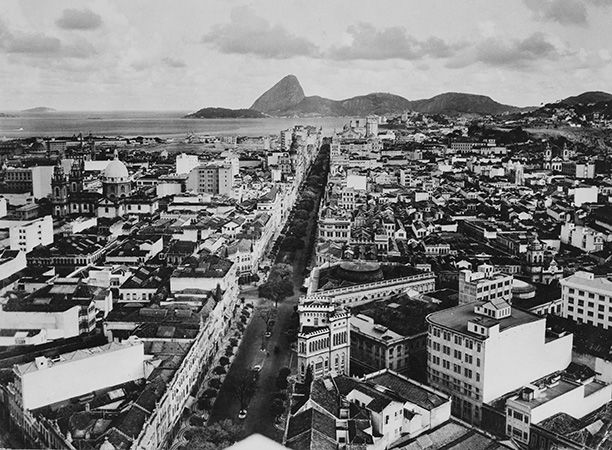
At the start of the 20th century Brazil was the second largest country in the New World with a population of 24 million, about two thirds the population of the UK at the same time. The country produced about three quarters of the world’s coffee and two thirds of its rubber (surpassed after 1910 by the new plantations in Malaya). It was also a major producer of cocoa and tobacco. A manufacturing base, mainly in textiles and other secondary industry, had by the second decade of the century emerged in the south-east, mainly around the city of São Paulo. Brazil was a favoured site for foreign (above all British) investment, in government loans, railways, banks and commerce. Since 1889 it had been a republic with a constitution mirroring that of the United States. The ruling class identified with and considered their country to be, in terms of culture and race, an extension of Europe, above all of France. Early in the century Rio de Janeiro was refashioned to resemble Paris. In 1906, determined to assert its strength in world affairs, the government ordered the construction in Great Britain of two dreadnoughts, plus a string of lesser warships, all of which were in service by early 1910.
Such were the appearances. On the other side were harsh realities. The bulk of the population was rural and illiterate, either in occasional employment or engaged in subsistence agriculture and wholly or partly of African or indigenous descent. By force and fraud they were denied any role in public affairs. Urban settlements were dotted along the coast, with the interior being largely unoccupied save for indigenous peoples. No national transport system existed. Communication within Brazil was mostly by water. Export agriculture used mainly immigrant labour, much of it Italian. Heavy industry did not exist and the weak manufacturing base, centred on textile production, depended on the exploitation of female and child labour, most of it immigrant. The armed forces were small, poorly armed and ineffective, with the rank and file, mostly of African descent, compelled to enlist. In November 1910 the crews of the two recently arrived dreadnoughts mutinied against ill-treatment. The crisis was resolved by the passage of an amnesty law, which the national government failed to honour.
Brazil’s prosperity depended upon its role in what may be termed the ‘gold standard’ international economy. The country produced raw materials, which it exchanged for industrial goods from Europe and North America. Trade was financed mainly through the City of London, which also provided the capital and the technology for trade. Brazil’s currency, the milréis, while not directly convertible, was linked to gold and so the vagaries of the world economy had an immediate impact. Due to the downturn caused by the Balkan Wars of 1913 the Brazilian economy was in depression when wider war broke out. The impact of the conflict on Brazil was severe, since it involved the halting of all financing of trade (no discounting of bills, no acceptances and no bank loans), a hiatus to almost all shipping and an immediate decline in exports, in part due to the blockade instituted by the Royal Navy. Coffee sales fell by over a third from 1914 to 1915, a consequence of the Royal Navy’s interdiction of neutrals’ trade with Central Europe, and because coffee was not a product essential to the war effort. Imports, including consumer goods and foodstuffs, fell sharply.
This crisis had serious consequences at all levels of society. Falling imports drastically reduced the customs duties on which government revenues depended. Reduced exports made it impossible to secure the funds needed to pay the interest on the external debt, forcing the government in October 1914 to arrange a £14 million loan organised by the Rothschild bank in London. The government met the internal shortfall in revenue by raising indirect taxes and by issuing more and more inconvertible currency. The burden of the war fell directly on the mass of Brazilians. In its first year real wages for industrial workers dropped by one quarter and in Rio, which was then the capital, the price of food rose by almost one half, driven up by reduced imports. The national government did nothing to control either the price or the supply of foodstuffs and other essential goods.
By 1916 both international trade and the Brazilian economy had adjusted to war conditions. Despite the British blockade and its increasingly effective blacklist of German-owned firms in neutral countries, exports from Brazil were on the upsurge and the balance of external trade in surplus. By 1916 coffee exports were equal in size to those of 1913 and, while international prices were only two thirds of what they had been in 1913, the decline in the value of the milréis largely compensated for that. Even rubber exports had stabilised, while sugar and meat exports grew thanks to the demands of war. What had not improved were the conditions faced by the country’s industrial workers. Real wages and work conditions continued to decline, intensifying resentment and driving workers to desperation.
At the start of 1917 the whole dynamic of the war changed with the German decision to resume unrestricted submarine warfare, having ceased it at the end of 1915. The German government, aware that the resumption was likely to bring the United States into the war, believed that Britain would be forced to sue for peace before any US soldiers could join the fighting. Unrestricted submarine warfare meant the indiscriminate sinking of all shipping, regardless of national registry. On February 3rd, 1917, two days after unrestricted warfare had been resumed, the United States broke off diplomatic relations with Germany and then, following the sinking of US merchant ships and the provocation of the Zimmerman telegram (offering US territory to Mexico), declared war on the Central Powers on April 7th. Two days previously a German U-boat torpedoed the Brazilian merchant ship Paraná. Brazil broke off diplomatic relations with Germany on April 11th, 1917.
In terms of military preparation, financial and economic resources and national advantage, the Brazilian government had no great cause to enter the war. In the case of Brazil’s neighbour and rival Argentina, some of its merchant ships were sunk but the country’s president, Hipólito Yrigoyen, managed to secure sufficient assurances from Germany to keep Argentina out of the war. Why therefore did Brazil enter the conflict? The sinking of the Paraná did provoke anti-German riots in Rio and other towns and forced the resignation of the Brazilian foreign minister, Lauro Muller, the son of German immigrants. A considerable section of the ruling class, perceiving the war as a crusade for ‘civilisation’, had since August 1914 campaigned relentlessly for Brazil’s entry into the conflict. However another, if much smaller section, was sympathetic to German culture and achievements. Its support for neutrality was backed by popular opinion, which feared the further deprivations, including the compulsory recruitment for service in Europe, that war would bring. The public had some knowledge of the horrors of life in the trenches via Brazil’s large Portuguese and Italian immigrant communities.
The reasons for entering the war were predominantly external. By 1917 the course of the war, in particular the collapse of Russia and the conquest of Romania, made the Entente powers grasp at anything that might increase their strength and boost popular morale. The British actively encouraged Brazil to declare war. Of equal influence was the entry into the conflict of the United States in April 1917. Brazil’s links with the United States had become close after 1900, based on exchange of Brazilian coffee for US manufactures and on mutual support of each other’s interests in Latin America. These links tightened after 1914 so that continuing neutrality by Brazil would put a strain on the relationship. By entering the war Brazil would strengthen its position with both the United States and Britain. It could legitimately request the assignment of more shipping for its exports, gain preferred access to trade goods and secure greater amounts of capital. It could also seek to purchase modern armaments for its forces. Finally, entry into the war served the long held desire for Brazil to become a player in world affairs.
Although declaring war on the Central Powers was likely to increase dissent within Brazil, the offsetting benefit for the national government was that it acquired war powers, which enabled it to suppress social radicalism. These powers were the more necessary since the passivity that had originally characterised the workers in the face of rising prices, scarcity of food and goods and high unemployment was no longer apparent in July 1917. The killing of a young worker, José Martinez, a Spanish immigrant, by the police at the gates of a São Paulo factory sparked a series of demonstrations and strikes that disrupted the city for days. From then until 1920 the industrial sector was rife with protest rallies, strikes and trade union formation, made the more threatening by the success of the October Revolution in Russia. The challenge caused deep alarm among the ruling class. In November 1918 a leading Brazilian politician, according to the British envoy, ‘attributed the discontent to the spread and sustenance of those doctrines which are associated with the name of Bolshevism, which were being fomented and stimulated by foreign anarchists’.
Having declared war on October 27th, 1917, the Brazilian government moved to assist as best it could the Entente powers. Given the continuing threat of the German U-boat campaign, the Brazilian navy offered the best and swiftest means of aid. However it soon became clear that the ships the navy could mobilise were limited. The two dreadnoughts were already outdated, lacking any fire control system for their guns. Since neither the dreadnoughts nor the other warships constructed in Britain had been refitted since their purchase, extensive renovations, particularly the replacement of boilers, were required. As a result, the naval squadron formed for service in January 1918, consisting of two light cruisers, four of the country’s ten destroyers and three support vessels, did not leave until August 1918 for its appointed patrol grounds off Dakar in West Africa. There its effectiveness was diminished by the Spanish flu that swept through the vessels’ crews. Reassigned to other duties, the squadron did not reach Gibraltar until the day before the Armistice.
Of even less significance was the army’s participation. Expanded in size to 54,000 men following the declaration of war, the army had to commit all its resources to training, arming and housing the new recruits. The best that the army could do was to dispatch in the middle of 1918 a group of 20 officers to serve with various units of the Entente armies on the Western Front and to organise a medical mission, about a hundred strong, to staff a hospital in France. The officers won plaudits for their involvement in active combat and one was seriously wounded, but the medical mission did not arrive in France until late September 1918. Its personnel was mainly employed in dealing with the Spanish flu outbreak, although the intended hospital was established in Paris by the end of the year.
Brazil’s participation in the First World War was therefore tardy and its contribution peripheral. Paradoxically, the war acted as a catalyst, which produced profound long-term change in three aspects of Brazil as a nation state.
The first was the realisation that its armed forces were unable to fight in a modern war. The army was too small in size, untrained and lacked sufficient weaponry. Brazil had no significant armaments industry and produced no petroleum, vital for airplanes and tanks. It did not even possess a steel mill. Among the junior army officers a core group, including those who had served in France in 1918, were determined to remedy the situation. Their goals were not easily or swiftly achieved. Oil production did not begin until the 1930s. The first steel mill was opened in 1946. The army itself did not become fully professional until the 1930s. During the Second World War an expeditionary force was organised and served well on the Italian front, giving the army close ties to the US forces. The army went on to dominate Brazil from the 1950s to the 1980s.
The second aspect was industrialisation. A manufacturing base had been established in Brazil prior to 1914 but it was the drastic reduction in the import of foreign goods throughout the war that enabled local industries to produce to the limit of their capacities and to sell at maximum prices. The consequent profits funded the continued expansion of the manufacturing base in the postwar period, enabling Brazilian manufacturing to compete with the renewed imports provided mainly by the United States. When the Great Depression hit in 1929 Brazilian industry was able to take full advantage of the virtual standstill in international trade. The Second World War completed the emergence of Brazil as an industrial power.
Finally, the war saw the emergence of a working class that actively sought participation in the political system. By 1920 the wave of unionist militancy had been subdued but the regime’s success was pyrrhic. It never regained the sense of security and legitimacy it had enjoyed before 1914. Discontent with the status quo was evident at all levels of society. A revolution in 1930 finally overthrew the ‘Old Republic’, as it was called. The new regime led by Getúlio Vargas introduced social welfare schemes linked to trade unions that were authorised and controlled by the state. Finally, in 1945 with the founding of the Partido Trabalhista Brasileiro (Brazilian Labour Party), industrial workers gained a permanent place and voice in politics and public affairs. Although the connection is distant, the Partido do Trabalhadores (Workers Party), which since 2002 has controlled the government of Brazil, ultimately owes its existence to Brazil’s participation in the First World War.