Bismarck and Gladstone Beyond Caricature
Though they are often seen as polar opposites,the architect of modern Germany and the great British Liberal statesman shared more in common than one might think. Roland Quinault draws comparisons.
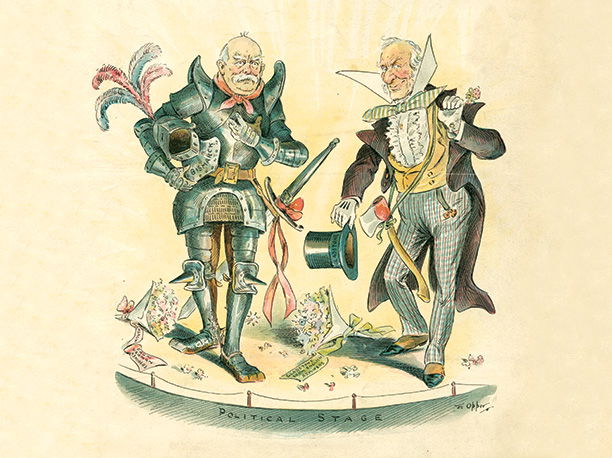 Gladstone and Bismarck were the two most important, enduring and influential European political leaders of the later 19th century. They were also near-contemporaries: Gladstone, born in 1809, was six years older than Bismarck but they both died within ten weeks of one another in 1898. They never met, however, and their tenure of office was quite different. Bismarck was continuously in power for 28 years. He was minister president of Prussia from 1862 to 1890, chancellor of the North German Confederation from 1867 to 1871 and then chancellor of the German Empire until 1890. Gladstone, by contrast, became prime minister on four different occasions but never held that office for more than five years at a stretch.
Contemporaries of the two men emphasised the differences between them. Gladstone’s secretary, Edward Hamilton, observed in 1890: ‘There were certainly never two men – the two most conspicuous men alive – who had so little in common.’ John Morley (1838-1923), the political lieutenant and biographer of Gladstone, thought that he represented the pacific and Bismarck the military tendencies of the era. Morley established the orthodox view of Gladstone as a liberal moralist, who was committed to peace, retrenchment and reform, as well as justice for the Irish and freedom for other oppressed peoples. Bismarck, by contrast, was considered, both in his own time and subsequently, as a conservative autocrat who unified Germany by ‘blood and iron’ at the expense of the liberals, social democrats, Roman Catholics and Poles.
In the 20th century the differences between the two men’s outlook, policies and legacy were regarded as partly responsible for the First World War. In 1936 the historian R.C.K. Ensor wrote of Gladstone: ‘In the harsh Bismarckian age he stood for the humaner liberalism of the mid-19th century; and the value of that attitude can be appreciated today, when we see to what Bismarckianism led.’ The view that Bismarck sowed the seeds of the First World War is now largely discounted, but modern historians still claim that the two men had a mutual antipathy to each other. For example, Fritz Stern claimed that Bismarck’s intense dislike of Gladstone almost dictated his policy and Paul Kennedy wrote of Bismarck’s ‘ideological war against Gladstonism’. Yet both men’s biographers have paid little attention to their mutual relations. While Bismarck and Gladstone were critical of each other at times, their relations were by no means wholly negative. Moreover, there were some significant similarities in their attitudes, policies and modus operandi.
They shared a privileged upbringing and early links with the political establishment. Bismarck’s father was a member of an old Junker landowning family, whereas Gladstone’s father was a nouveau riche Liverpool merchant. But Gladstone’s aristocratic education at Eton and Christ Church College, Oxford more than matched that of Bismarck at the universities of Göttingen and Berlin. The young Gladstone, moreover, was a staunch Church and State Conservative, whereas the young Bismarck briefly considered himself a pantheist with republican leanings.
In his early adult life Bismarck displayed an Anglophilia, which has been underplayed by historians. While at Göttingen – when it was part of the Kingdom of Hanover belonging to the British monarch William IV – he acquired a command of English, which enabled him to court eligible young Englishwomen who were visiting Germany. In 1842 he visited England and was impressed by the friendliness of the people. He even contemplated a military career in British India. Although he married a Prussian – Johanna von Puttkamer – his courting letters to her contained many quotes from English literature. He shared Gladstone’s enthusiasm for Byron, Shakespeare and particularly Scott, while both men read the novels of Disraeli. In later life Bismarck admitted that he had lost the habit of speaking English for want of practice but he spoke English to Disraeli at the Congress of Berlin in 1878. Charles Dilke, who met the chancellor in 1889, observed: ‘Bismarck speaks admirable English, with hardly any trace of accent, but spoken very slowly.’ When he resigned, in 1890, his last words addressed to the kaiser were in English.
The young Bismarck shared Gladstone’s admiration for Peel, whom he regarded as a model statesman under a free constitution. But he did not think that the English system of government would work in Prussia and his conviction on that point was confirmed by the 1848 Revolution in Berlin. That led Crown Prince Wilhelm – Bismarck’s future master – to seek temporary refuge in London. Britain, however, was also affected by the revolutionary mood, which led Gladstone to serve as a special constable on the day that the Chartists held a great rally at Kennington Common on April 10th, 1848.
Both men believed in the union of a protestant church and a protestant state. Gladstone’s 1838 book, The State in its Relations with the Church, was well received by Prussian Lutherans. They both initially opposed Jewish emancipation but changed their stance in the mid-19th century. Bismarck also shared Gladstone’s evangelical belief in the need to atone for sin and he kept the Day of Atonement religiously. They also believed that God had chosen them to carry out ‘His purposes’ – a conviction strengthened by their long tenure of office.
There were also similarities in their domestic lives. They both liked shooting and riding in their youth and they both married in their early thirties, enjoying long honeymoons in Italy. Their marriages were close and enduring and their wives gave them unquestioned loyalty. Yet both were strongly attracted to a younger woman: Bismarck to Katharina Orlov and Gladstone to Laura Thistlethwayte.
As younger sons they both needed to make their own way in the world. Bismarck began in local government and then became a diplomat before entering politics. Gladstone, by contrast, went straight into Parliament, thanks to his Oxford connections and financial support from his father. But both men spent time in their early middle years looking after their families’ estates and industrial concerns. In later life they spent much time on their estates, usually in the second half of the year, when the legislature was not in session. Gladstone believed that the preservation of large estates was essential for the maintenance of true conservatism. Bismarck defended the rights of landed property owners because he regarded the decline of agriculture as one of the greatest dangers to the permanence of the state.
They both served monarchs with close ties to each other. In 1858 Queen Victoria’s eldest child, the Princess Royal, married Crown Prince Friedrich, the son and heir of Wilhelm I. Bismarck’s ascendancy depended on royal approval – Wilhelm I made him premier of Prussia in 1861 and Wilhelm II, Queen Victoria’s grandson, effectively dismissed him from his post as reich chancellor in 1890. Gladstone, by contrast, owed his four premierships to the decision of the electorate and his return to power was against the wishes of the queen. Neither minister was a courtier by temperament. In 1874, after the resignation of the Liberal government, Queen Victoria observed: ‘Mr Gladstone would have liked to govern HER as Bismarck governs the Emperor.’ However, they spent much time and effort briefing their respective monarchs. Bismarck sometimes wrote five or six letters a day to Wilhelm I and his nocturnal meetings with the kaiser during the 1866 war with Austria left him exhausted. Gladstone was likewise worn out by Queen Victoria’s criticisms and demands and told Rosebery: ‘The Queen alone is enough to kill any man.’
Bismarck was not directly responsible to the legislature in the way that Gladstone was to the House of Commons. Yet in 1874 Bismarck resigned the chancellorship after an adverse vote in the Reichstag but then won a vote of confidence and returned to office. Throughout his career, moreover, he devoted much time and attention to various parliaments. It was his membership of the united Prussian Diet, in 1847, that first brought him out of rural obscurity and he was a Prussian representative at the Frankfurt Diet in 1851. As first minister of Prussia he had to deal with three legislatures: the Landtag, the Zollparlament, which briefly dealt with customs matters, and the parliament of the North German Confederation, which became the Reichstag. Bismarck was not a natural orator, but he was capable of electrifying his audience. His collected parliamentary speeches filled 14 volumes and thus matched in quantity those of Gladstone. He also hosted beer parties for members of the Reichstag that he wanted to cultivate – the equivalent of Gladstone’s breakfast parties.
Bismarck, moreover, introduced a more democratic franchise than that advocated by Gladstone. In 1866 universal (male) suffrage was adopted for elections to the parliament of the German Confederation, which later became the Reichstag. By contrast, Gladstone’s 1866 Reform Bill proposed a much more limited extension of the franchise. It was not until the early 1890s that Gladstone fully endorsed the principle of universal male suffrage. Likewise the system of sickness, accident, old age and invalidity insurance, which Bismarck introduced in the 1880s, was not imitated in Britain until the early 20th century. Yet Bismarck, like Gladstone, was reluctant for the state to determine the hours or conditions of labour.
In the 1860s both men established tenuous links with workers’ organisations, though neither of them showed any interest in socialist theory. Bismarck claimed ignorance of Karl Marx, while Gladstone described a biography of the theorist as ‘incredibly dull’. In the late 1870s and 1880s Bismarck’s repressive anti-socialist laws and antipathy to the Social Democratic Party contrasted with Gladstone’s good relations with the trade unions and his readiness to welcome Labour MPs into the Liberal alliance. Yet Gladstone also disliked what he called the ‘leaning’ of both political parties to socialism.
The popularity of Gladstone with the working classes reflected their appreciation of the effect that his free trade policies had on their living standards. Bismarck initially followed Gladstone’s example by securing a commercial treaty with France. In 1880 the deteriorating economic situation led Gladstone to combine the premiership with the Exchequer and a few months later Bismarck combined the chancellorship with the Prussian ministry of trade. But his response to the economic depression was to adopt protectionist rather than free trade measures.
Later in life Bismarck, unlike Gladstone, was often depicted in military uniform. Neither man, however, had personal experience of combat or any enthusiasm for it. In 1850 Bismarck warned politicians not to whip up war frenzy needlessly and then leave their soldiers to pay the price. The suffering that he
witnessed during Prussia’s conflict with Austria in 1866 reinforced his distaste for war. In 1876 he declared that the Eastern Question – the struggle occasioned by the decay of the Ottoman Empire in the Balkans – was not worth ‘the healthy bones of a single Pomeranian musketeer’. Gladstone likewise condemned going to war without adequate justification.
Both men used unparliamentary methods to enact army reform. Bismarck came to power as a result of a conflict between Wilhelm I and the Prussian Landtag over army expenditure and reorganisation. He resolved the problem by proroguing parliament and raising the money without its consent. A decade later, Gladstone adopted similar tactics to implement army reform in Britain. He curtailed debate on the issue in the House of Commons and bypassed opposition in the House of Lords by using the royal prerogative to abolish the purchase of army commissions. That led a Tory MP, George Bentinck, to claim that Gladstone was taking ‘a leaf out of Count Bismarck’s book’.
Gladstone was not initially critical of Bismarck’s foreign policy. He did not condemn Prussia for going to war with Denmark in 1864 or with Austria in 1866. Indeed he was pleased that Prussia’s victory in 1866 enabled Italy to recover Venetia and Hungary to gain greater autonomy. In 1870 Gladstone blamed Napoleon III for instigating the Franco-Prussian War, praised the organisation of the Prussian army and did not oppose German unification. The premier contrasted Bismarck’s immediate undertaking to respect Belgian neutrality with the laggard response of the French. He praised Bismarck’s ‘resolute will and clear eye’ and observed that his policy, if unscrupulous, had not been hypocritical. Nevertheless Gladstone criticised the German decision to annex Alsace-Lorraine against the wishes of its people. Later, however, when he learnt that Bismarck would have been satisfied with the acquisition of just Strasbourg, he praised the chancellor for trying to limit German gains.
Both men strongly opposed the declaration of papal infallibility in 1870 as an interference with the allegiance of citizens to their national governments. In 1874 they feared that, if the French government fell into the hands of the clerical faction, it would lead to a war to re-establish the temporal power of the papacy. In his pamphlet, The Vatican Decrees in Their Bearing on Civil Allegiance, published that year, Gladstone blamed Rome for provoking the German government’s anti-Catholic measures, known as the Kulturkampf. Although he privately observed that ‘Bismarck’s ideas and methods are not ours’, he confessed that ‘my sympathies … are more with him than against him’. Bismarck admired Gladstone’s pamphlet and distributed a translation in Germany. Consequently Gladstone sent the chancellor a copy of his follow-up pamphlet, which prompted a response from Bismarck, written in English:
It affords me a deep and hopeful gratification to see the two nations, which in Europe are champions of liberty of conscience, encountering the same foe, stand henceforth shoulder on shoulder in defending the highest interests of the human race.
Gladstone replied that he had ‘a deep interest in the ideal of freedom’. His love of freedom, however, led him to differ from Bismarck’s approach to the Eastern Question, which was to preserve the Austrian empire, rather than create new national states in the Balkans. Yet in his 1879 Midlothian speeches Gladstone did not extend his denunciation of Disraeli’s foreign policy to that of the German chancellor. Bismarck, on his part, opposed the formation in Germany of what he termed ‘a Gladstone Cabinet’. By that he meant a combination of Liberals and Catholics, such as had characterised Gladstone’s first ministry, and that threatened to force the chancellor from office.
Gladstone’s return to power in 1880 greatly alarmed Bismarck, who privately scorned him as ‘Professor Gladstone’, an impractical idealist who was destabilising the world. In 1884 he told Prince Wilhelm: ‘The silly chap can do nothing but make speeches and hew wood.’ Bismarck particularly feared that the Liberal ministry would encourage the republican movement: an
erroneous view but one that mirrored court and Conservative hostility to Gladstone in Britain. In 1883 he told the kaiser that Gladstone’s premiership might lead to the abolition of the monarchy as well as the House of Lords. Ironically, however, Bismarck’s dislike of Gladstone was heightened by his own antipathy to Victoria, the German crown princess, Queen Victoria’s eldest daughter and the wife of the heir to the throne. She strongly mistrusted Bismarck, who described her as ‘a follower of Gladstone’. Yet the crown princess admired Gladstone’s ability to act as a break on democracy.
At the start of his second ministry, in 1880, Gladstone seemed to offer Europeans a liberal alternative to Bismarckian realpolitik. Odo Russell, the British ambassador in Berlin, wrote: ‘It is curious to think of Gladstone, the non-interventionist, who has always been so ridiculed on the Continent, acquiring an influence of which even Bismarck himself is afraid.’ Yet Gladstone was more prepared than Bismarck to use force, or the threat of force, as a diplomatic weapon. In 1880 he forced the Turks to cede Thessaly and Epirus to Greece by threatening to seize the port of Smyrna. Then in 1882 he sanctioned British military intervention in Egypt, which Bismarck criticised but subsequently tolerated in return for favours elsewhere.
In the mid-1880s Bismarck embarked on a policy of colonial expansion, which aroused some misgivings in Britain. Gladstone did not want to give in to bullying by Bismarck or to alienate opinion in the British settler colonies. But he attached great importance to Anglo-German friendship and he welcomed Germany as a colonising partner ‘in the execution of a great purpose of Providence for the benefit of mankind’. Yet neither man was keen on acquiring new colonies in Africa. Bismarck declared ‘my map of Africa lies in Europe’ and Gladstone showed no interest in a map of East Africa that the explorer Henry Morton Stanley showed to him.
Bismarck was hostile to the Polish minority in Prussia and opposed any recognition of Polish identity, in marked contrast to Gladstone’s acknowledgment of Irish national feeling. Yet Gladstone’s parliamentary dependence on the Irish Home Rule party, from 1886, was paralleled, to some extent, by Bismarck’s reliance, from 1878, on the votes of the German Catholic Centre Party in the Reichstag. Both men, moreover, favoured state-backed land purchase as a way of mitigating ethnic problems. In 1886 Bismarck sponsored a Prussian law that established a fund to buy up Polish properties as part of a process of Germanisation. In the same year, Gladstone introduced an ambitious but abortive Irish Land Purchase Bill to partner his Home Rule Bill.
The eldest sons of both men entered their respective parliaments but it was their two younger sons, both named Herbert and near-contemporaries, who became prominent politicians. They started by acting as political aides to their fathers. In the early 1880s Herbert Bismarck was a councillor at the German embassy in London and his father was gratified by the attention shown to his son. Herbert acted as a conduit between Gladstone and his father after he had returned to Berlin. He became the German foreign secretary in 1886 but resigned along with his father in 1890 and never held office again. Herbert Gladstone, by contrast, held only junior office during his father’s lifetime but later became home secretary and governor-general of South Africa.
Gladstone received no material reward for his public services other than his ministerial salary and he declined a peerage on his resignation from the premiership. Bismarck, by contrast, was well rewarded with both titles and lands. He was made a count in 1865, a prince in 1871 and a duke in 1890. In 1866 he was voted a large donation by the Prussian Landtag, with which he purchased an estate at Varzin in Pomerania. In 1871 Wilhelm I gave him the very large Sachsenwald estate near Hamburg, in which he established his principal home at Friedrichsruh. In 1885 donations collected to mark his 70th birthday enabled him to re-purchase his family’s ancestral Schönhausen estate. He thus became one of the largest landowners in Germany, particularly in timber. In a message to Gladstone, he said: ‘Tell him that, while he is chopping trees down, I am busy planting them.’
In 1895, following Gladstone’s final retirement, Sir Donald Currie took him on a cruise across the North Sea to Hamburg, where he was well received. A proposal that Gladstone should visit Bismarck came to nothing but some of his party journeyed to Bismarck’s home at Friedrichsruh, where they left a card from ‘W.E.G.’. They brought back with them a small fir tree, a present to Gladstone from the head forester.
In the last decade of their lifetimes the two men privately expressed mixed views about each other. In 1888 Gladstone described Bismarck as ‘a queer sort of fish in many ways’ and on hearing of his resignation confessed that he had never admired the chancellor, whose greatest failing was ‘his utter want of sympathy with liberty’. Gladstone had, however, made exactly the same criticism of Wellington and Disraeli a decade earlier. He later described Bismarck as ‘a very big man, but very unscrupulous’. He thought that Bismarck did not admire him, ‘having a great contempt for oratory and no appreciation of governing a country through parliamentary machinery and of the qualities required for such a task’. However he added that Bismarck had told a Chinese visitor that he greatly admired Gladstone.
Bismarck spoke to Lord Randolph Churchill of his admiration for Gladstone’s eloquence but compared him to an ungovernable horse and said that he should be very alarmed if such a man governed Germany. He admitted, however, that Gladstone would be useful in putting right the disorders in German finance. Bismarck also concluded, despite Gladstone’s assumption to the contrary, that the parliamentary system was an aid rather than a hindrance to good government.
In their last years both men became increasingly incapacitated. In February 1898 Gladstone’s daughter, Mary, feared that the family might have to deal with years of invalidism, ‘like Bismarck’. They were spared that, however, and Gladstone’s funeral later that year was marked by expressions of respect from all sides of the House of Commons. By contrast, in 1895 the Reichstag had refused to vote an address to Bismarck on his 80th birthday because of the opposition of the Catholic Centre Party and the socialists.
Both men were posthumously commemorated with numerous public memorials, although those to Bismarck were larger in both number and size. The biggest monument, unveiled in Hamburg in 1906, was a colossal statue of him as a martial warrior holding a sword. The memorial in Berlin depicted Bismarck holding a sword and surrounded by four statues: Atlas, Siegfried forging the imperial sword, Germania suppressing discord and rebellion and Sibyl reading the book of history. The London memorial to Gladstone, in the Strand, unveiled in 1905, also showed him circled by four allegorical figures: Brotherhood, Aspiration, Education and Courage. Thus Gladstone was commemorated as a peaceful and inspirational figure, Bismarck as a leader who built a nation by blood and iron.
The contrasting iconography of the two men helped to perpetuate the belief that they had nothing in common. There were real differences between some of their views and policies and the institutions in which they operated. But historians have exaggerated their mutual antagonism. Gladstone showed no personal animus against Bismarck, although he echoed the conventional view of the chancellor as an unscrupulous schemer. Bismarck’s bad-mouthing of Gladstone was largely confined to the early 1880s and was paralleled, at other times, by his criticisms of Disraeli, Salisbury and other British statesmen whom he suspected of opposing his stratagems.
As members of the same generation, prominently involved in national and international politics from the early 1860s to the early 1890s, the two men often faced common issues and they sometimes reacted to them in similar ways. In the 1860s and 1870s their policies on army reform, franchise extension, trade and religious allegiance had something in common. Even their attitudes to foreign policy and conflict were far from being polar opposites. As the historian Katherine Lerman has observed, Bismarck was never the arch-conservative reactionary his liberal opponents made him out to be. Likewise Gladstone was not the dangerous radical that his conservative opponents, both in Britain and Germany, claimed. While they both sometimes endorsed the conventional view of the other they also showed a sneaking admiration for their respective qualities. Each recognised that the other was, in Gladstone’s words, a ‘big man’.