Edward III: The Flower of Kings Past
Edward III’s 700th anniversary is a suitable moment to celebrate one of England’s greatest monarchs, says Ian Mortimer.
 There is a sporadic but ongoing debate about who might be England’s greatest king. Some favour Alfred the Great, even though he was not king of England but only of Wessex; some opt for William the Conqueror. The other candidates regularly cited are Henry VIII and his daughter Elizabeth I. As any serious commentator is aware, the process is something of a parlour game – a harmless bit of fun that may prove of some value if it provokes some interest in an aspect of the past. But, like lists of ‘the best album of all time’, repeated critical attention means the same few candidates are cited again and again; and tested against the lowest common denominator of general historical knowledge with the result that the tediously repetitive shortlist has more to say about Victorian ideals and current historical assumptions than the actual impact of the individuals. People tend to opt for their favourite royal stories, not the actual achievements of these monarchs.
One thing is generally agreed: that to be eligible, the monarch has to have ruled before the Restoration (after which most of the initiative for matters of state passed to Parliament) but few people manage to shrug off post-1660 ideological shifts in considering the achievements of kings and queens before this date. Had you asked this question in the 17th century, you would probably have heard only two names put forward for the title of England’s greatest monarch: Edward III and Henry V; and the reason for the inclusion of the latter was largely due to his determined attempt to emulate the former.
Edward III was born on Monday November 13th, 1312 at Windsor Castle. At the time of his birth the kingdom was teetering on the edge of civil war, due to the murder of Piers Gaveston, the favourite of Edward’s father, Edward II. The dire circumstances of Edward III’s birth only grew more worrying as, later, civil war broke out and young Edward found himself pulled into the power struggle between his father and his favourite, Hugh Despenser, on the one hand and his mother Queen Isabella and her wily lover, Sir Roger Mortimer, on the other. The difficult situation did not end even with the enforced abdication of Edward II and young Edward’s coronation in January 1327. For most of the next four years he was king in name only, as Mortimer dominated the government of the realm in conjunction with the queen. By 1330 Edward was living in fear of his over-mighty ‘subject’.
Nothing was easy for him. He might have been born to greatness but greatness was withheld from him. He set about reversing this in admirable style, helping in a plot hatched by his friend Sir William Montagu to take Mortimer prisoner in October 1330. But even after the monster had been overcome, Edward faced opposition from Scotland and France. It was the making of Edward’s greatness that he was able to turn the diplomatic crises to his advantage.
There is no doubt that he was enormously lucky. He had the necessary leadership qualities just at the point when the English nobility needed them most. His vision of kingship was very much of the old school, based on Arthurian romances and great men achieving great deeds with their swords, their courage and complete faith in God. But what transformed his fortunes and those of his kingdom was almost the exact opposite of this elitist chivalric vision: the power of the people. In August 1332 at Dupplin Moor in Scotland a small force of English knights and their archers prepared to fight a much larger army of Scotsmen. The archers were placed on the flanks, ready to cut down the advancing vanguard; and in that strategic measure lay the heart of an innovation that was to inspire England’s young king a week later, when he was told what had happened. The archers stopped the front ranks dead in their tracks and the charging army behind were impeded by their falling comrades. Basically the small English force had corralled the Scottish army in such a way that they could not escape the force of the English longbows.
The importance of that battle cannot be overestimated. It was only a minor victory (fought, incidentally, without the king’s official blessing), but it demonstrated that projectile war could be used to huge advantage by relatively few archers against a much larger army of men-at-arms. Modes of fighting that had stood the test of time were threatened; so too were social norms. Before this moment a small army would never normally march against a larger one unless the latter was unarmed, demoralised or trapped. Now a small army of archers could massacre a much larger force of knights.
This is where Edward’s next immense piece of luck came into play. The social tensions and upheaval of the previous two reigns meant that communities in northern and midlands England had learned to value the power of the bowman. They respected the real Robin Hoods in their parishes. For this reason, when Edward decided to try out his military experiment on a massive scale against the Scots in July 1333, he could simply summon archers by the thousand from the northern counties. The massed arrow-power of these men proved decisive at Halidon Hill near Berwick. The Scots did not have a culture of archery, nor did they have sufficient numbers of archers to defeat the English. The French were even less prepared to defend themselves against longbowmen, having a negative view of the role of the foot soldier armed with such a humble weapon and thus very few adequately trained men. Edward realised he had been given a blueprint for victory that his enemies were incapable of matching.
Edward’s diplomatic adversities now became opportunities. He could impose his military ambitions on his neighbours while at the same still champion the chivalric culture that he had inherited from his grandfather. Battle after battle was won by the English. At sea Edward was victorious at Sluys (1340) and Winchelsea (1350). The king of Scotland, David II, fell prisoner to the English at Neville’s Cross in 1346. In the same year Edward crushed the military might of France at Crécy. The following year he took the important port of Calais after an 11-month siege and in 1356 the king of France himself was taken prisoner under the command of Edward’s son, at Poitiers.
All of this lived up to the expectations of a great king; but Edward would not have been so lauded had his vision only extended to the battlefield. Military success was just one part of what was required of a great medieval king. In addition he was expected to judge his people fairly and to keep powerful magnates at peace with one another – not an easy task when they were easily disturbed by acts of favouritism that did not go the way they hoped. With a few exceptions Edward succeeded in both of these tricky areas for all 50 years of his reign. With regard to the former he worked with Parliament to offer safeguards against royal highhandedness, for example, in defining what constituted treason (an Act still on the statute books to this day) and put forward a legislative programme to rival that of his grandfather, Edward I. By keeping England at war continuously with France and Scotland he channelled the kingdom’s energies into fighting abroad and thus preserving peace at home, with the commensurate expansion of building and trade. It is ironic but, by starting the Hundred Years’ War – for which the Victorians so castigated him – Edward ushered in one of the longest periods of domestic peace in medieval England.
The final requirements of great kingship are the hardest to achieve: to deliver the people what they cannot expect; to supply rewards that they could not have dreamed of at the start of the reign. Again Edward was lucky. His wars were expensive; companies of archers still required considerable levels of funding and naval forces similarly required large sums. But in the consequent need to tax his people to pay for the wars, Edward’s easiness of manner came into play. He was affable and able to understand the politics of compromise. As Parliament found itself burdened by new taxation demands, so it made reciprocal demands. Edward and Parliament forged a new way of king and people working together for the greater good of the kingdom. And for those who were not wealthy enough to be represented in Parliament there was empowerment of another sort. Edward’s use of archers acted as a sort of patronage so that the humble yeoman or husbandman who could draw a bow was given more respect. Once it had been only the knightly class who were described as ‘those who fought’; Edward’s defence of the realm and his legislation promoting archery effectively raised all able-bodied Englishmen to this status. The king’s spreading of the longbow and his support of the use of cannon levelled the social classes in respect of their military power.
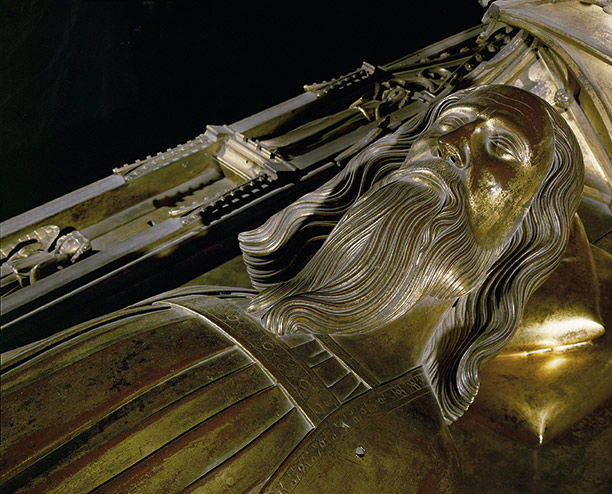
Edward secured domestic peace and glory abroad; he was seen as a fair judge and a brave commander: a lion to his adversaries and a lamb to his people. He facilitated a profound social change and responded to the challenges of that change. To satisfy the English desire for autonomy from the controlling interests of the Roman Church, he began a series of breaks with the papacy, then at Avignon. Contemporary Englishmen said of this situation: ‘Now that the pope has become French and Jesus English, we’ll see who is greater.’ Whether he had a comprehensive programme of nationalism in mind is debatable, though the level to which he championed Englishness is quite startling for a man brought up speaking French as his first language. He also championed the English saints, gave the English their own gold coinage; on his 50th birthday he recognised English as the tongue of the nation and even used it in some of his own mottoes. His legacy goes right to the heart of what it is to be English today. He founded the Order of the Garter, he adopted St George as the kingdom’s principal patron saint, he paid Geoffrey Chaucer’s ransom when he was captured in France, he rebuilt most of the English royal fortresses – his transformation of Windsor Castle into a palace fit for a king cost more than £50,000, the most expensive secular construction of the entire Middle Ages. Even Big Ben has its origins in the bell tower he built at Westminster, which carried a great bell called Edward. In image and reality he delivered more than his compatriots could have expected of their monarch. Shortly after he died, this motto was inscribed on his monument in Westminster Abbey:
Here lies the glory of the English, the flower of kings past, the pattern for kings to come, a merciful king, the bringer of peace to his people, Edward III, who attained his jubilee. The undefeated warrior, a second Maccabeus, who prospered while he lived, revived sound rule, and reigned valiantly; now may he attain his heavenly crown.
Today he is largely forgotten. As a warrior king he fell foul of the wave of Victorian historians who were either reforming bishops or middle-class tea drinkers: he was too secular for the former and too violent for the latter. His ‘policies’ were unacceptable to a generation that did not yet have the intellectual reach to judge him by the standards of his own time. The neo-chivalric fashion of the 19th century did little to reverse this, striking a somewhat absurd tone in an increasingly industrial age. As the spectre of war in Europe loomed at the start of the 20th century, Edward’s star waned.
If truth be told, comparisons of monarchs are anachronistic and meaningless; they miss what is actually important – that most monarchs contributed to a single development and built on each other’s achievements: they were not in competition with one another. Edward had his place – his sort are not welcome in government today. But one should note that he was heralded by the scholar Joshua Barnes as late as 1688 as perhaps the greatest monarch the world had ever known: greater even than Julius Caesar, Augustus, Justinian and Charlemagne. It is unlikely that any historian would seriously suggest that any other English monarch might deserve that exalted position.