Persia and Persepolis, Part I
George Woodcock describes how, towards the end of the seventh century BC, the Persians first began to establish themselves as a rising power in the Middle East.
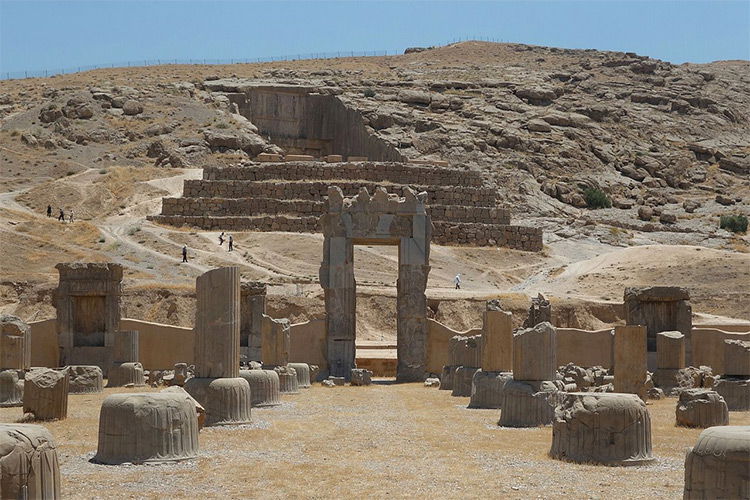 Even in antiquity the name of Persia was already applied to the whole of that great desert plateau edged by steep mountain ranges which now, like its people, we call Iran. We still describe as Persian medieval and modern artefacts made by people who may well have been Iranian, but who were only rarely Persian in a true sense.
The long accepted error is a tribute to the fascination that the achievements of the small group of tribes who were true Persians have exercised over the western world for more than two thousand years.
In recording the splendour of Persian victories and the suddenness of Persian decline, the Greeks not only created the art of history as we know it, but at the same time immortalized their own image of this vigorous people and their Achaemenid kings.
Modern research has shown that image to be inexact in some of its details, but the general outlines have stood the test of time and of historical criticism surprisingly well.
Yet, in one respect, the knowledge shown by the Greek historians of the Achaemenians was surprisingly lacking. They knew a great deal of the Persians as imperialists, as invaders and satraps, but of the Persians at home in their own small ancestral realm of Parsa or Persia they had surprisingly little to say.
The great complex of palaces and tombs that Darius and his successors constructed at Persepolis may have been known to a few Ionian travellers and ambassadors, but it was not described in any surviving Greek account until it had been captured and destroyed by Alexander's army, almost two hundred years after the thousands of labourers from subject countries began to terrace the hill looking out over the valley of the Araxes which modern Persians call the Mountain of Mercy.
This real and remote Persia of the Achaemenids lies far to the south of the present Iranian capital of Teheran. Until recently the journey was long and difficult, by caravan routes around the rim of the central desert and then, after four hundred miles, through narrow defiles in the dry ranges that guard the modern province of Fars, whose very name echoes the Parsa of antiquity.
Today one flies there in a few hours, over the great empty land of Iran – the unpeopled tawny wastes, broken by snowy saw-edged ridges of arid mountains, dotted by the green splashes of far-spaced oases, and traversed by the faint lines of camel trails and the black ribbon of the new desert highway.
A few minutes before the blue domes and dark cypress gardens of Shiraz, the present capital of Fars, come into view, the plane crosses the penultimate line of hills, and almost immediately below one the massive rectangle of the platform of Persepolis juts out towards the ploughed lands of the valley.
Long slanting shadows define the few remaining columns that still stand erect in the great Apadana, the central hall of the complex, but the thick walls of mud-brick that formed the greater part of the structures erected by Darius and Xerxes have long disintegrated, and from the plane's height the impression is one of total desertion and desolation.
Even when one approaches by road from Shiraz the desolation is still there, made theatrical by the towering proportions of what remains, and accentuated by the fact that, apart from the official guardians, the only living beings in sight are often the little red-breasted desert hawks, and the pigeons who perch in peace beside them on the animal-headed capitals of the great columns.
It is only when one has climbed the long entrance stairs, with their treads made shallow for the processions of horsemen, that the richness of what remains at Persepolis becomes evident in the carved friezes depicting the breadth and character of the realm over which the Achaemenids ruled.
Persepolis was built mainly by Darius I and his immediate successor Xerxes, both of whom were peculiarly attached to this most withdrawn of their royal centres. Apart from Artaxerxes III, the later Achaemenids added little to it, but until the very end of the dynasty, when its power was usurped by Alexander the Great, Persepolis retained a special place in the minds of the Persians.
The other capitals of the empire had been taken over from older and defeated powers, Susa from the Elamites, Ecbatana from the Medes, Babylon from the Babylonians, but Persepolis was a foundation of the Achaemenians themselves, the royal citadel within their own land, the home near which from Darius onwards they chose to be buried.
With its dramatic scale, its elaborate documentary friezes and its great treasury where the gold of tribute accumulated for generations, Persepolis was in fact the symbolic apogee of Achaemenian achievement, a monument recording the rise to power of the Persian tribes under the protection of Ahuramazda, the creator god of the Zoroasterian creed.
Insignificant among the Iranian tribes until the appearance of Cyrus the Great, the Persians moved into history late in the ninth century BC as a half-nomadic people slowly making their way south-eastwards out of Central Asia along the line of the Zagros mountains which form the western marches of Iran.
Though related to the more numerous Medes, they were already a separate group of tribes united under a single ruler. In 836 BC the Assyrian King Shalmaneser received tribute from a king of Parsua whose realm lay to the west of Lake Urumia in the north-western corner of Iran; the Medes were at this time living on the opposite side of the lake.
The Persians continued to move southward for almost two centuries before they found a permanent home to which they could give their name. In 820 BC Shalmaneser's successor, Shamshi-Adad, encountered their vanguard in the neighbourhood of Kermanshah, two hundred miles south of Lake Urumia, and the process of nomadic migration continued, encouraged by pressure from the northerly kingdom of Urartu and by the need to find regions less vulnerable to the periodic military raids of the Assyrians.
Pushed onward by more powerful forces, the Persians in their turn displaced or conquered the aboriginal peoples and the earlier Aryan tribes who had found fertile land and temporary security in the valleys on the edge of the great Iranian desert.
By the beginning of the seventh century they had already abandoned the region of Kermanshah for the Bakhtiari mountains, a further two hundred miles southwards, where they became established in the shadow of the declining kingdom of Elam, and, under the founder of their great dynasty, Achae-menes, created the kingdom of Parsumash. Either as vassals, or perhaps even as temporary raiders, they held as their capital the formerly Elamite city of Anshan, and Teispes, the son of Achaemenes, assumed the title of 'great king of Anshan'.
It was under Teispes, towards the end of the seventh century, that the Persians moved into Parsa, the modern Fars; they retained their earlier kingdom of Parsumash; together the two provinces formed a desert and mountain realm almost three hundred miles long to the north and northeast of the Persian Gulf.
Here, at last, the Persians began to transform themselves into an independent and stable element in the quickly shifting power structure of the seventh-century Middle East. During the two centuries in which they had moved slowly southward from Lake Urumia they had survived largely by making the right alliances and breaking them where expedient.
Until the kingdom of Urartu was destroyed by the Assyrians, they were its vassals and doubtless its mercenaries, and later they appear to have been linked with the tottering realm of Elam. When, round about 670 BC, their Iranian congeners, the Medes, became united under Ksha-trita (whom the Greeks called Phraotes) and set up their federal capital at Ecbatana ('the place of assembly'), the Persians were forced to accept Median suzerainty as an alternative to invasion and absorption into the numerically stronger group of related tribes.
Thus the Achaemenids gathered strength slowly and cautiously, while the Median kings sought precipitate victory, and Kshatrita attempted to overthrow Assyria, only to be attacked and overwhelmed by a new nomad people from the north, the Scythians. Kshatrita himself was killed in 653, and for a quarter of a century his son Cyaxares had to accept Scythian suzerainty until, in 628, he finally defeated the nomad chieftains and brought about the resurgence of Media.
The Scythian tide did not reach the little Achaemenian realms of Parsumash and Parsa, and Teispes and his successors used the quarter of a century of Median weakness to assert their own independence, so that when Teispes died about the middle of the seventh century, and divided his two realms between his sons, Ariarmenes, to whom fell the southerly state of Parsa, became not merely the 'great king of Parsa' but also the 'king of kings', a mark of sovereignty, while his brother Cyrus I became merely 'great king of Parsumash', accepting his brother's suzerainty.
The seniority of the line of Ariarmenes suggests that already, to the Persians, the present province of Fars had become not only their ultimate destination, but also their most intimate stronghold, protected by ringing mountain ranges which the cumbersome armies of Assyria or Elam could only breach through the difficult defiles of the Persian Gates.
Their feeling towards Parsa was expressed in the oldest of all Persian inscriptions, written in cuneiform script on a gold tablet of King Ariarmenes. 'This land of the Persians, inhabited by fine horses and brave men, has been given me by the great god Ahuramazda,' says Ariarmenes in the restrained tones that distinguish the Achaemenians among the ancient monarchs of Asia; 'I am its king.'
Though Parsa lay near the Persian Gulf, it was an elevated plateau, protected by the neighbouring mountains from the unhealthy climate of the coast; as modern travellers know, there is no air in the world fresher and more invigorating than that of Shiraz, and undoubtedly this fact combined with the hardness of life in ancient Parsa to sustain the vigour of the Persian people.
Except in the rare oases the land was naturally arid, but on their way through the western marches of Iran the Persians had acquired many of the arts of agrarian civilization; while some of them, like the Mardian sub-tribe which took over the area where Persepolis was later to rise, continued the austere life of wandering herdsmen, others built the elaborate covered stone channels (ghanats) which carried water from the hills for many miles into the plains without risk of evaporation by the intense sunlight of that almost cloudless land.
As a result, many districts which had been desert and have since returned to that condition were fertile in the days of the Achaemenids, and the easily defended land of Parsa was rich in crops and provided grazing for great herds of horses.
The first place from which the Achaemenians ruled appears to have been Anshan in Parsumash, but this was an already existing city which they had occupied, and the earliest capital founded by the Persians themselves lay in Parsa, about twenty-five miles away from the site where Persepolis was later to rise. This was Parsagada, variously interpreted as meaning 'city of the Parsagadae' (the leading Persian sub-tribe to which the Achaemenids belonged) or 'camp of the Persians'.
Either would be correct, since Parsagada was not only the Achaemenian capital, but it was also an unwalled city, and in this sense resembled a traditional Aryan camp, though into its construction there entered sophisticated features, including the use of stone columns and the construction of platforms resembling that of Persepolis, whose form suggests that the original tent-carrying Persians learnt the fundamentals of their architecture from the people of Urartu who were their neighbours in the northern ranges of the Zagros.
Parsagada, which is now even more ruined and desolate than Persepolis, was first used by the Achaemenids towards the end of the seventh century, but it became associated peculiarly with the sixth-century founder of Persian imperialism, Cyrus the Great, grandson of the Cyrus I who had received the northern kingdom of Parsumash on the death of Teispes.
By now the relationship between the two branches of the Achaemenian royal house had changed, largely because of the political reshaping of the world outside the Persian lands. In 623 BC the Medes threw off the Scythian yoke, and under Cyaxares finally achieved their ambition of destroying'Assyria and dividing its territories with a resurgent Babylon.
Vulnerably placed on the southern frontier of a powerful Media, Cambyses I of Parsumash not only became a tributary to Cyaxares, but also married the daughter of his son and successor Astyages. It was evidently this alliance that enabled Cambyses to dispossess Arsames, the reigning king of Parsa, of both his seniority and his kingdom. From this time onwards the two Persian kingdoms of Parsumash and Parsa were reunited into the single realm over which Teispes had ruled.
The early Achaemenids combined their Zoroasterian religion with a humanity that prevented them from anticipating the actions of their late successor, Artaxerxes III, who celebrated his coronation by slaughtering all his likely heirs; Arsames lost only his crown, for an inscription of Xerxes at Persepolis shows that he was still living, in extreme old age, when Darius came to the Persian throne in 522, while his son Hystaspes held high office under Cyrus the Great, first as governor of Parsa, his father's former realm, and later as satrap of Parthia. As time quickly showed, however, the successors of Ariarmenes, in giving service to their cousins in the line of Cyrus I, did not abandon the thought of a return to power.
The story of Cyrus the Great and the victorious campaigns that ended with his ill-fated expedition against the Scythians is well known, and concerns us only indirectly, since our subject is the Persia that remained the centre of his realm. His conquests and those of his son, Cambyses II, resulted in the creation of the first of the great empires which aimed at being, in the words of Cyrus himself, 'the kingdom of the whole world.'
It was remarkable in ancient Asia for the humanity with which it was governed; the conquest of Media, after the defeat of Astyages' expedition into the Persian kingdom, was a model of statesmanlike restraint, devoid of atrocities and generous to the conquered, who became almost equal partners of the Persians in administering the Achaemenian empire.
Both Cyrus and Darius after him were celebrated even by the Ionian Greeks as law-givers; they recognized a conqueror's obligation to provide justice and order wherever his rule extended. But order as they conceived it did not mean uniformity. Unlike the Romans, but like the British, whose system of rule in India derived in part from traditions established by Cyrus and his successors in Punjab and Sind, they preferred, while receiving tribute, to allow every country within their empire to develop according to its own traditions and its own customs.
If there was any movement of influence, in a cultural as distinct from a political sense, it was from the peripheries of the empire, from Egypt and Nineveh, from Ionia and Babylon, towards the central nucleus of Parsumash and Parsa, where the Persian nobility learnt willingly from the civilizations they had conquered, so that Persepolis eventually became, not merely a sculptured record of the people who comprised the Persian empire, but also an anthology in stone of the artistic styles of the empire.
At the same time, though Parsa was the heart of the empire towards which flowed the ideas, the talents and the tribute of all the East between the Indus and the Libyan desert, the Persians themselves remained a distinctive, privileged and racially pure elect; while malcontents from subject countries were regularly settled in other parts of the empire, such as Elam, Bactria and even the Hindu Kush, they were never sent to Parsa itself to share the lands or dilute the blood of the Persians.
The Persians were the only subjects of the great king who paid no tax or tribute. They were mostly land-owning peasants, as free and self-sufficient as it was possible for men to be in any ancient empire. Their nobles were men of trusted loyalty who served as satraps and military commanders in the outlying provinces. For their privileges the Persians paid by forming the elite corps of the Achaemenian armies.
They provided most of the royal guard, the famous Ten Thousand Immortals, tall, splendidly-bearded men, armed with silver-butted spears and clad in gold-embroidered gowns; next in importance were the trousered Persian infantry with their longbows and their iron-scaled armour. These were the reliable soldiers, the core of the army, around whom the vast contingents from the satrapies were deployed as auxiliaries.